

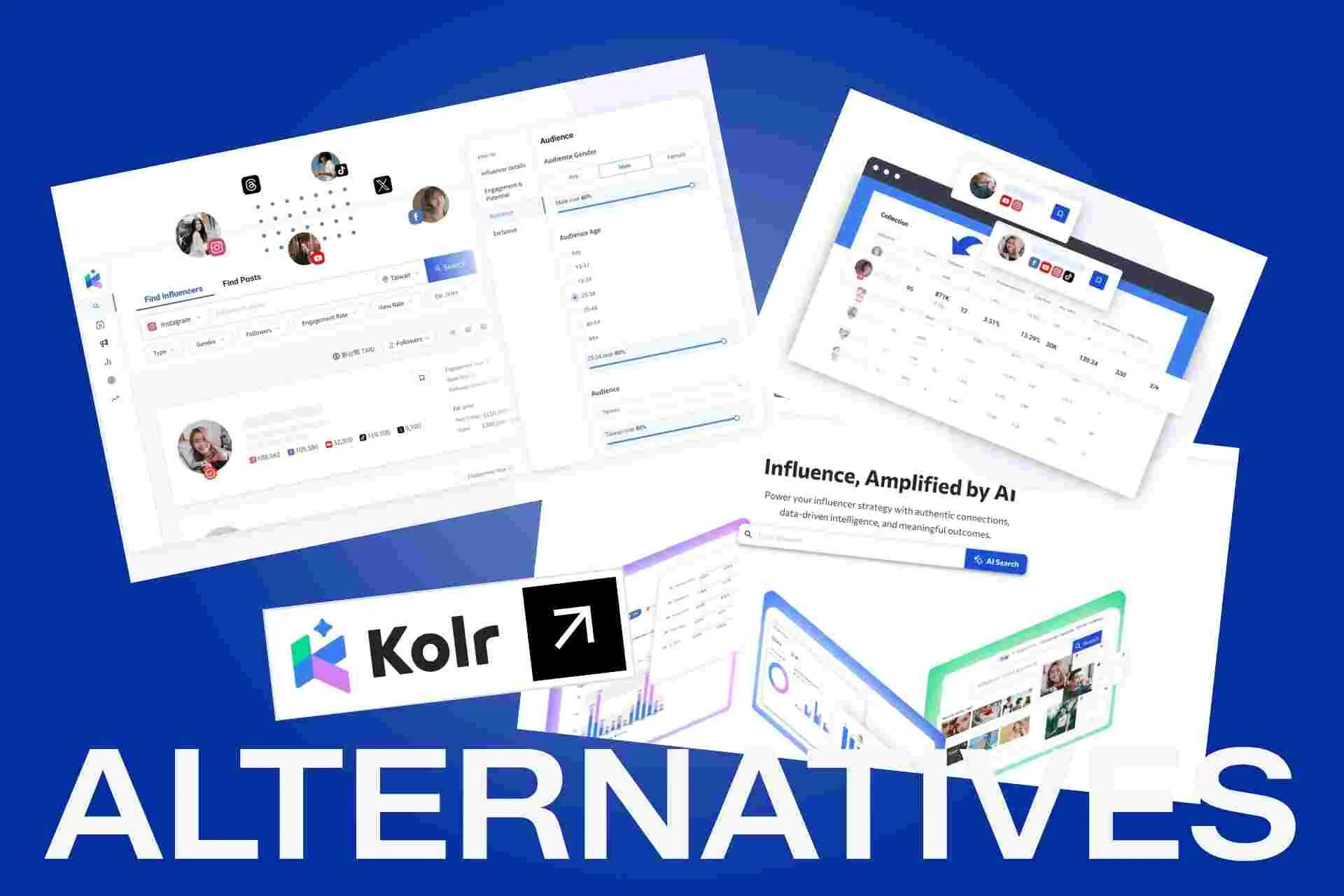
10 Best Kolr Alternatives for Influencer Marketing
Influencer marketing software has become essential for D2C brands looking to scale creator partnerships efficiently—helping teams handle everything from influencer discovery and outreach to campaign management and ROI tracking in one place. Kolr is one such platform, known for its AI-driven discovery, competitor analysis, and cross-border data capabilities, but it comes with trade-offs. Many teams find the free plan too limited to properly evaluate, while usage caps on profile unlocks, reports, and seats can slow down scaling efforts. The lack of monthly pricing flexibility, relatively lighter social listening features, and limited public user feedback also push brands to explore other options. This is why many D2C teams actively search for Kolr alternatives that better align with their workflow, budget, and growth stage.
In this guide, we compare 10 of the best Kolr alternatives—Upfluence, SARAL, GRIN, Influencer Hero, IZEA, Later, Ainfluencer, indaHash, Influencity, and Modash—to help you find the right influencer marketing software for your needs.
Key Criteria for Evaluating Influencer Marketing Platforms
Core Features
Evaluation of essential influencer marketing capabilities, including influencer discovery, outreach, CRM, campaign management, reporting, and content workflows.
Pricing & Flexibility
Comparison of pricing models, subscription plans, and contract terms to match different budgets and growth stages.
Customer Reviews & Satisfaction
Analysis of user feedback from trusted review platforms, focusing on usability, reliability, customer support, and overall performance.
Pros & Cons
Review of each platform’s strengths and limitations to highlight where it performs well and where it may fall short based on different use cases.
Integrations
Review of the most important integrations (e.g., Shopify and other tech tools), highlighting what each integration enables in one sentence.
Kolr Overview
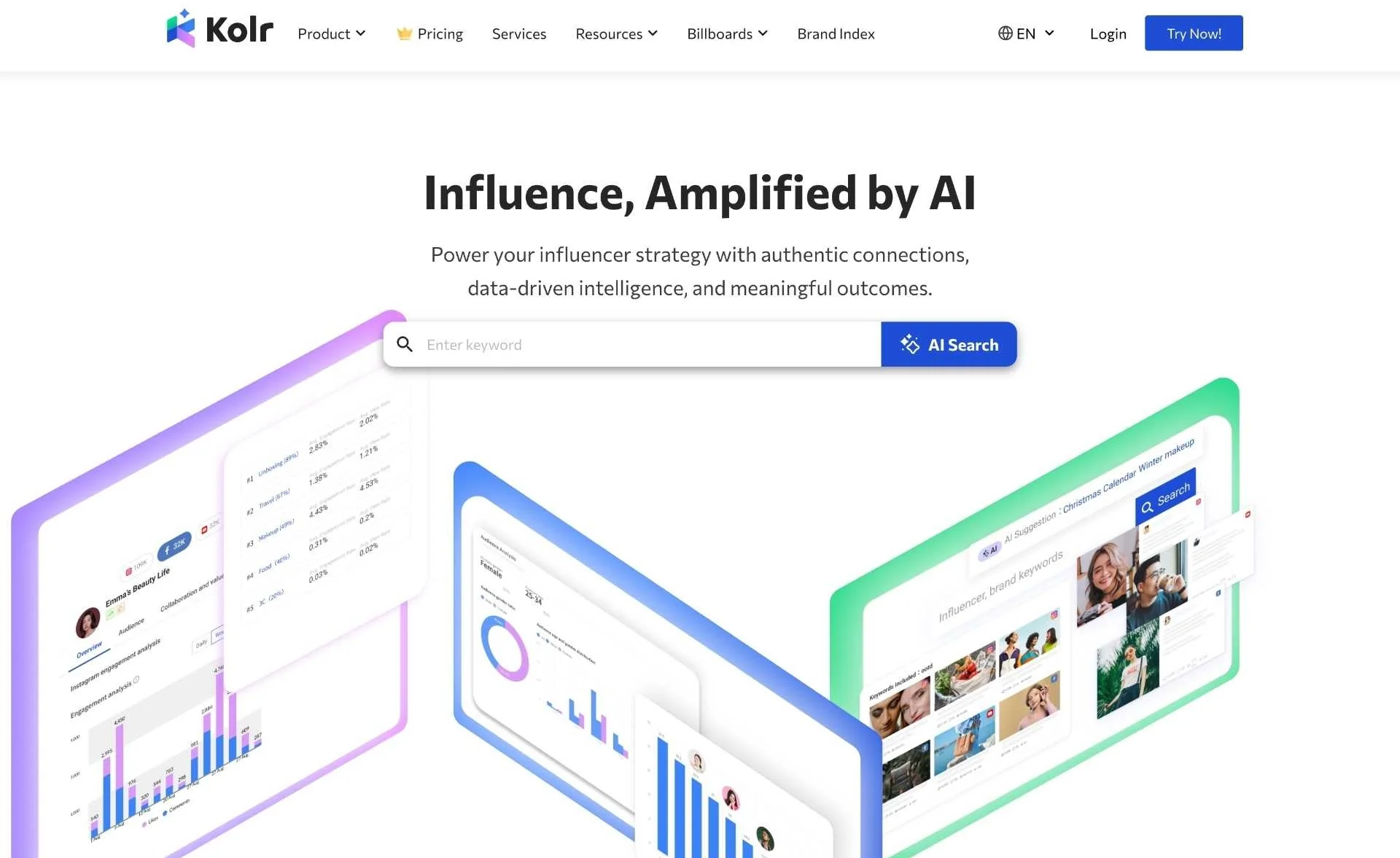
Kolr is an AI-powered influencer marketing platform developed by iKala, designed to help brands discover creators, analyze performance, manage relationships, and measure campaign impact in one place. Positioned as both a software platform and a managed service provider, Kolr supports global influencer campaigns with data-driven insights and strategic services—making it particularly relevant for brands scaling across multiple markets.
Key Features
• Global influencer database: Access to 300M+ creator profiles and billions of social data points across 190+ countries, enabling large-scale and cross-border influencer discovery.
• AI-powered influencer & content search: Search both creators and posts using advanced keyword logic (including intersections and combinations), making it easier to find niche or highly relevant influencers.
• Advanced filtering capabilities: Use 100+ filters such as engagement rate, follower growth, demographics, and posting behavior to build precise creator shortlists.
• Real-time analytics dashboard: Track engagement, audience insights, hashtag performance, and content trends with frequently updated data for better decision-making.
• Influencer collections & comparison tools: Save creators into lists, compare their performance side-by-side, and export reports for internal collaboration and approvals.
• Influencer Relationship Management (IRM): Manage influencer contacts, pricing, collaboration history, and notes in a centralized CRM-like system.
• AI-generated campaign reports: Automatically generate performance reports with insights on engagement, conversions, and campaign effectiveness.
• Competitor analysis tools: Monitor competitor campaigns, analyze their influencer partnerships, and benchmark your performance against them.
• Chrome extension: Analyze influencer profiles directly while browsing social platforms, streamlining the discovery workflow.
• API access: Pull influencer data into internal systems for custom workflows, reporting, or integrations.
Pricing
Kolr follows a semi-annual and annual pricing model, with limited self-serve flexibility:
• Free Plan: Includes basic search (4 results), 1 collection, and limited profile access.
• Premium Plan: $2,699 (6 months) or $4,799/year
• Advanced Plan: $5,399 (6 months) or $9,599/year
• Startup & Enterprise Plans: Custom pricing based on usage and requirements
• Managed Services: Custom pricing for end-to-end influencer campaign execution (strategy, outreach, ads, reporting)
Reviews
Not available
Integrations
• Instagram: Discover and analyze creators, engagement, and audience insights for campaign planning.
• TikTok: Evaluate short-form content performance and identify trending creators.
• YouTube: Analyze long-form content creators and video performance metrics.
• Facebook: Access broader audience data and creator activity across Meta’s ecosystem.
• X (Twitter): Monitor creator activity and brand mentions for competitive insights.
Pros
• Advanced competitive intelligence capabilities: Kolr goes beyond basic influencer discovery by offering built-in competitor analysis, helping brands understand who competitors work with and how their campaigns perform.
• Strong AI-driven reporting and insights: Features like Insight Reports and Brand Aura Index provide higher-level strategic insights, not just campaign metrics—useful for long-term influencer strategy.
• Expanding platform coverage (including Threads): Kolr recently expanded its data coverage to include newer platforms like Threads, giving brands early access to emerging creator ecosystems.
Common Drawbacks of Kolr
Highly limited free plan
The free tier is too restrictive for meaningful evaluation, making it difficult to test the platform before committing.
Usage caps on key features
Profile unlocks, reports, collections, and seats are all capped—even on paid plans—creating friction for scaling teams.
No monthly pricing flexibility
Plans are only available on semi-annual or annual contracts, which may not suit brands looking for short-term or flexible commitments.
Relatively light social listening capabilities
Compared to some competitors, Kolr’s social listening and broader market monitoring features are less robust.
Limited public user feedback
There are very few publicly available reviews, making it harder for buyers to assess real-world performance and support quality.
Best Kolr Alternatives
| TOOL | REVIEWS | BEST FOR | TRIAL INFO | PRICING | ||
|---|---|---|---|---|---|---|
1 |
|
⭐ | Influencer discovery | Book Demo | Pricing | Website |
2 |

|
⭐ | UGC creator collaborations | Book Demo | Pricing | Website |
3 |

|
⭐ | DTC creator management | Book Demo | Pricing | Website |
4 |

|
⭐ | Influencer CRM & automation | Book Demo | Pricing | Website |
5 |
|
⭐ | Influencer marketplace | Book Demo | Pricing | Website |
6 |

|
⭐ | Social media & influencer campaigns | Book Demo | Pricing | Website |
7 |
|
⭐ | Influencer discovery & outreach | Book Demo | Pricing | Website |
8 |
|
⭐ | Enterprise creator campaigns | Book Demo | Pricing | Website |
9 |

|
⭐ | Campaign management | Book Demo | Pricing | Website |
10 |

|
⭐ | Influencer discovery | Book Demo | Pricing | Website |
Upfluence

Upfluence is an end-to-end influencer and affiliate marketing platform built primarily for eCommerce brands that want creator discovery, outreach, gifting, affiliate tracking, and revenue attribution in one system. It is especially strong for brands selling through Shopify and Amazon, and it positions itself as a performance-focused platform rather than a light creator CRM.
Key Features
• Creator discovery across major channels: Upfluence offers a large influencer database with filters for niche, location, audience demographics, engagement, and creator interests, helping teams build shortlists faster.
• Jaice AI campaign automation: Its AI assistant helps brands automate creator outreach, follow-ups, and campaign setup, reducing manual email work for larger programs.
• Affiliate and sales tracking: Upfluence ties influencer activity to clicks, conversions, revenue, ROI, AOV, and commissions, making it more performance-oriented than tools focused mainly on discovery.
• Shopify and Amazon workflows: The platform supports gifting, promo code generation, affiliate tracking, and Amazon Attribution, which is a major differentiator for DTC brands operating across both channels.
• Built-in payments: Creator payouts can be handled inside the platform through Stripe-powered Upfluence Pay, including multi-country payment support.
• CRM and creator relationship management: Teams can manage outreach, collaboration history, affiliate status, and campaign communication in one workspace.
• Social listening and customer-to-creator identification: Upfluence can identify influential customers from commerce or subscriber lists, helping brands recruit warm creators rather than relying only on cold outreach.
Pricing
• Pricing model: Upfluence uses custom pricing rather than a public fixed plan table.
• All plans are custom made. There’s a minimum full year of service you have to commit to with monthly payments. On average plans start around $1,276 - $2,000/month ($24,000 yearly)
Reviews
4.3/5.0 (Capterra)
Pros
• Best-in-class Amazon plus Shopify positioning: Upfluence is still one of the few influencer platforms with native Amazon Attribution support alongside deep Shopify gifting, code generation, and affiliate tracking.
• Jaice AI adds real workflow automation: Rather than stopping at discovery, Upfluence’s newer AI layer helps automate campaign setup, product shipment coordination, approvals, and payments.
• Strong customer-as-creator activation: The ability to identify influencers inside customer and subscriber lists is a standout for eCommerce brands trying to recruit authentic advocates instead of starting from scratch.
Cons
• Pricing is not very transparent: Public pricing is limited, and most brands still need to talk to sales to understand the real package cost.
• There is a learning curve for new teams: User feedback repeatedly points to a more complex setup experience than lighter-weight tools.
• Workflow flexibility can feel rigid: Some users report that campaign editing, sequencing, and general workflow customization are not as flexible as they expected.
Integrations
• Shopify: Connect your store to find creators in your customer base, send gifts, generate codes, and track influencer-driven sales.
• Amazon Attribution: Measure influencer traffic and sales tied to Amazon listings from inside Upfluence.
• Klaviyo: Enrich subscriber data with creator insights and launch creator-specific email flows from existing lists.
• Gmail / Outlook: Sync outreach with your mailbox so creator emails and replies stay centralized inside the platform.
• Stripe: Use Upfluence Pay to automate creator payouts and track transactions securely across markets.
Kolr vs. Upfluence
Kolr is more discovery-and-intelligence-led, with a much heavier emphasis on AI-powered creator search, competitor analysis, and automated campaign reporting across a huge cross-border dataset. Upfluence is more commerce-native: it is built to connect creators directly to gifting, affiliate infrastructure, Amazon Attribution, and revenue tracking.
In practice, Kolr is the better fit for brands that prioritize market intelligence, competitor monitoring, and cross-border creator analysis, while Upfluence is the better fit for brands that want influencer marketing tied tightly to Shopify and Amazon sales outcomes. Kolr also publishes semiannual and annual SaaS plans, while Upfluence still keeps most package details custom or modular.
SARAL
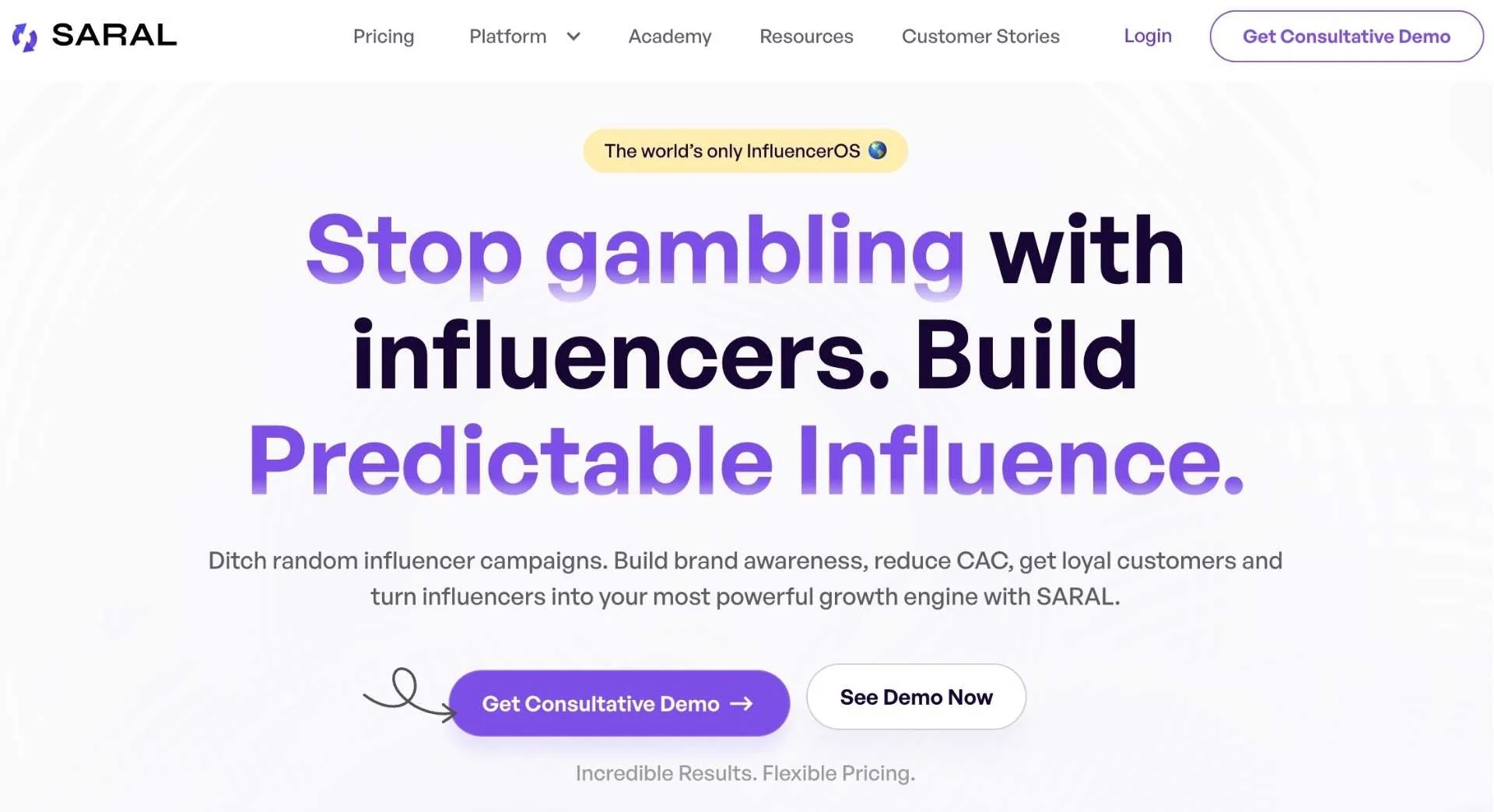
SARAL is an influencer marketing platform built for eCommerce brands that want a simpler, more operationally focused workflow for finding creators, scaling outreach, managing relationships, shipping products, and tracking ROI. Its positioning is notably SMB- and DTC-friendly, with transparent pricing and a strong emphasis on ease of use over enterprise complexity.
Key Features
• Influencer discovery with AI recommendations: SARAL lets brands search by keywords, hashtags, themes, and audience fit, while LookalikesAI recommends similar creators based on saved profiles.
• Outreach and follow-up automation: The platform is designed to automate personalized outreach at scale so teams can run more creator conversations without spreadsheets and inbox chaos.
• Creator relationship management: SARAL’s relationship view gives teams a clear pipeline for campaign stages, tags, briefs, and creator status tracking.
• SIA AI assistant: SARAL’s AI assistant helps with discovery, reply drafting, follow-ups, negotiation support, and faster workflow execution inside the inbox.
• Performance and ROI reporting: By connecting Shopify, brands can track sales, new customers, and ROI in clearer dashboards rather than relying on manual exports.
• Ambassador and application workflows: SARAL supports ambassador-style programs with application forms, acceptance flows, product shipping, and campaign tracking.
• Payments in one system: SARAL also includes creator payment workflows, helping lean teams avoid patching together separate tools.
Pricing
SARAL offers tiered pricing primarily billed annually or quarterly:
• Starter Plan – $12,000/year or $3,600/quarter Includes 100 active partnerships, 300 new influencers/month, limited post tracking, and 1 user seat.
• Business Plan – $15,000/year or $4,500/quarter Includes 500 active partnerships, 800 new influencers/month, unlimited tracking, and 3 seats.
• Professional Plan – $25,000/year or $7,500/quarter Includes 1,000 active partnerships, 2,000 new influencers/month, full social listening, and 10 seats.
Reviews
4.7/5.0 (G2)
Pros
• Transparent pricing is a real differentiator: Unlike many influencer platforms, SARAL clearly publishes plan pricing, seat counts, and capacity limits.
• SIA is built around actual operator workflows: Its AI assistant is focused on discovery, inbox management, follow-ups, and shipping support rather than just generic content generation.
• Built for lean DTC teams: SARAL’s biggest strength is its operational simplicity: it is designed to replace spreadsheets and multiple point tools without requiring enterprise onboarding.
Cons
• Less enterprise-oriented than larger platforms: SARAL is intentionally built for leaner eCommerce teams, so brands needing very deep enterprise customization may outgrow it.
• Public review depth is still lighter than older incumbents: While ratings are strong, the overall review footprint is smaller than more established enterprise platforms.
• Feature breadth is more practical than expansive: SARAL is strong on workflow and ROI, but it is not trying to match every enterprise listening, benchmarking, or managed-service feature in the category.
Integrations
• Shopify: Connect store data to track sales, new customers, product gifting, and campaign ROI.
• WooCommerce: Run gifting and affiliate tracking for WooCommerce stores through SARAL’s connected workflow.
• Klaviyo: Sync newsletter and subscriber workflows for influencer and ambassador nurturing.
• Slack: Push team updates and workflow notifications into Slack so campaigns are easier to monitor.
• PayPal: Handle creator payments inside the wider SARAL workflow instead of managing payouts manually.
Kolr vs. SARAL
Kolr and SARAL solve different problems. Kolr leans heavily into AI discovery, large-scale cross-border data, competitor analysis, and reporting intelligence, while SARAL is much more workflow-first and built for lean eCommerce teams that want a practical system for outreach, seeding, ambassador programs, and ROI tracking.
The biggest difference is complexity and buying motion. Kolr feels closer to a data-rich influencer intelligence platform, while SARAL feels like an operator-friendly influencer OS with transparent pricing and a faster path to execution. If Kolr is stronger for market analysis and cross-border creator research, SARAL is stronger for teams that want simplicity, speed, and predictable DTC workflows.
GRIN

GRIN is a creator management platform built around eCommerce workflows, helping brands discover creators, manage long-term relationships, automate gifting and payments, and measure influencer-driven revenue. It has historically been positioned at larger DTC teams, but its newer messaging also emphasizes self-serve access and AI-native workflow automation through Gia.
Key Features
• Creator CRM and relationship management: GRIN is built to manage creators across the full lifecycle, from recruitment and onboarding to briefing, approvals, and retention.
• Gia AI assistant: Gia is GRIN’s agentic AI layer for creator discovery, outreach, onboarding, rate suggestions, and performance management.
• Content management and UGC library: Teams can store, tag, search, and repurpose creator content across marketing channels from one central library.
• Product seeding and gifting workflows: GRIN’s Shopify-connected gifting lets brands place creator orders, track delivery, and keep gifting tied directly to campaigns.
• Affiliate and payment automation: The platform supports affiliate revenue tracking, commission management, and creator payments, including 1099 handling in the U.S.
• Application pages and inbound recruitment: Brands can create landing pages and creator intake flows to build warm creator pipelines.
• Commerce-heavy integrations: GRIN integrates with eCommerce, communication, and storage systems so teams can run programs without constantly jumping between apps.
Pricing
• Official pricing model: GRIN’s current pricing page promotes a 30-day free trial and more flexible packaging than before, including self-serve access.
• Public starting price benchmark: Recent software directories list GRIN from $999/month, though enterprise pricing still appears to scale materially based on features and program size.
• Enterprise benchmark pricing: Recent sales benchmarks and product overviews still place GRIN commonly starts at $25,000/year (approx. $2,050/month), with no discounts for upfront payment. Contracts require a full-year commitment with monthly billing.
Reviews
4.5/5.0 (G2)
Pros
• Gia is one of the category’s stronger AI launches: GRIN’s AI assistant is positioned as an agentic layer that can actually execute workflow steps, not just recommend actions.
• Very strong eCommerce and gifting infrastructure: GRIN remains one of the better fits for brands that need product seeding, affiliate tracking, creator payments, and revenue visibility in one place.
• New self-serve access improves flexibility: GRIN has recently expanded beyond pure enterprise sales motion by promoting instant self-serve access and more flexible entry options.
Cons
• The platform can still feel complex: Review feedback frequently mentions a learning curve, duplicate handling issues, and interface complexity for smaller teams.
• Performance complaints still show up in reviews: Bugs, slow load times, and inconsistent reporting remain recurring criticisms.
• Pricing can rise quickly for advanced use cases: Even with a lower listed entry point, GRIN is often still evaluated as a premium platform once teams scale up features and usage.
Integrations
• Shopify: Sync product catalogs, inventory, orders, and gifting workflows directly into creator campaigns.
• PayPal: Manage creator payments and commission payouts from the platform.
• Klaviyo: Centralize creator email communication and campaign messaging alongside your broader marketing stack.
• Gmail / Outlook: Run creator communications with tracked opens, clicks, and replies from inside GRIN.
• WooCommerce: Connect WooCommerce for gifting, attribution, and order management in creator campaigns.
Kolr vs. GRIN
Kolr is stronger on influencer intelligence, competitor analysis, and cross-border creator discovery, while GRIN is stronger on relationship management, eCommerce workflows, gifting, and creator program operations. If a team’s priority is finding and analyzing creators across markets, Kolr has the sharper data-and-insights angle. If the priority is running a creator program end to end inside a commerce stack, GRIN is usually the more operational platform.
GRIN is also moving faster on AI-native workflow automation through Gia and has recently introduced a more flexible self-serve motion. Kolr, by contrast, still feels more like a premium data platform plus service model, especially for brands focused on regional expansion and competitor benchmarking.
Influencer Hero
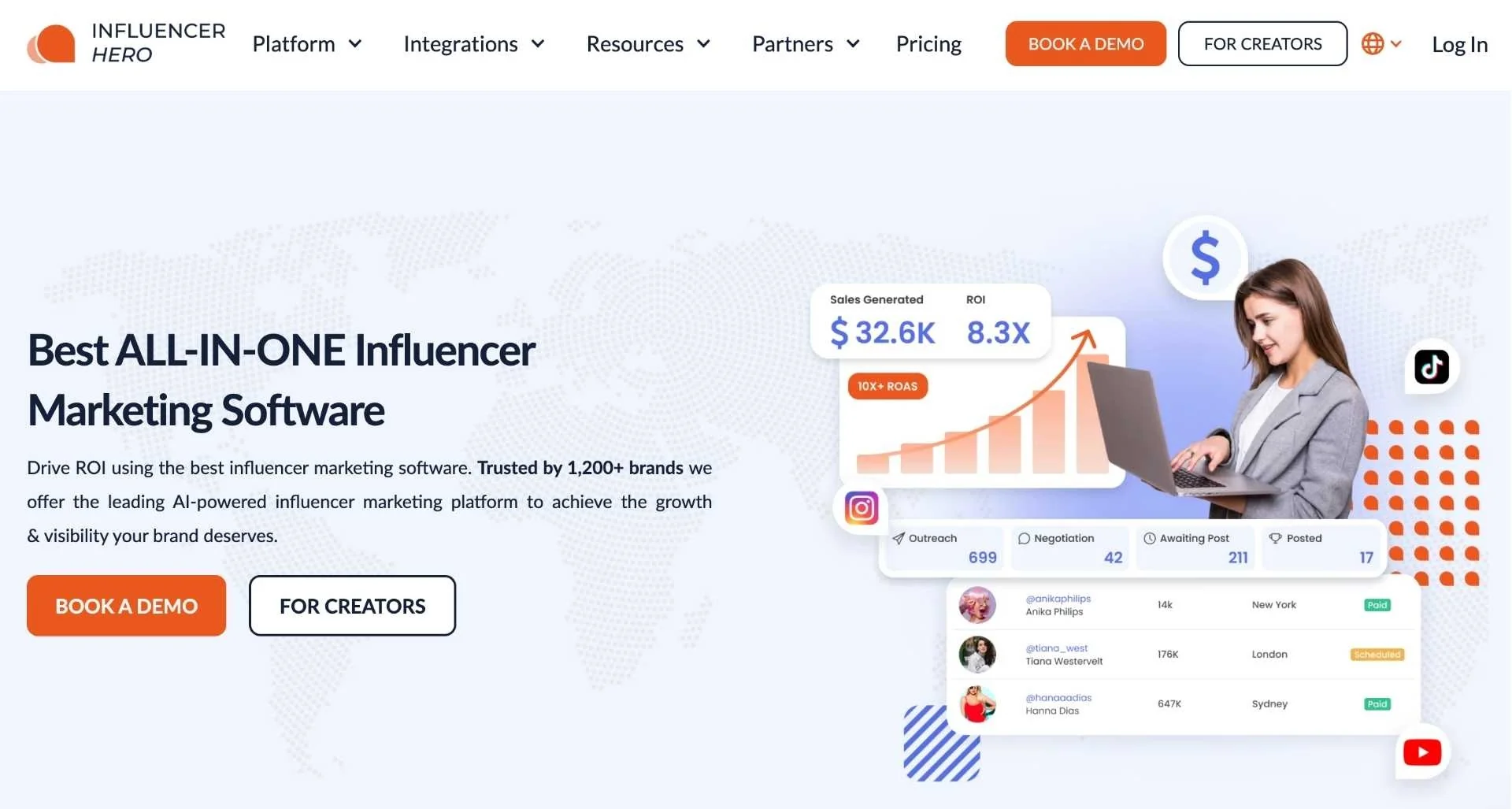
Influencer Hero is an all-in-one influencer marketing platform aimed at DTC brands and agencies that want discovery, CRM, bulk outreach, gifting, affiliate tracking, UGC management, and payouts in one workflow. Its positioning is notably modern and flexible, with strong automation, transparent plan pricing, and an expanding integration ecosystem.
Key Features
• Influencer discovery and filtering: Influencer Hero helps teams search creators by demographics, niche, engagement, audience quality, and lookalike criteria.
• Bulk outreach with AI personalization: The platform supports sequences, reply tracking, and AI-enhanced personalization for high-volume outreach.
• Campaign-centric CRM: Structured boards, bulk actions, tags, and automated workflows are central to the product and are one of its clearest strengths.
• Gifting, affiliate, and payout workflows: Brands can manage codes, links, commissions, payouts, and content collection inside the same workflow.
• UGC library and content tracking: Influencer Hero automatically gathers influencer posts and stores them for reuse and reporting.
• Chrome extension and API access: Teams can pull live creator stats while browsing, and developers can access creator data and campaign insights through the API.
• Application pages and storefront-style workflows: The platform supports branded signup pages so brands can recruit creators inbound rather than relying only on outbound discovery.
Pricing
Influencer Hero offers flexible pricing based on outreach volume and you can have unlimited creators in your CRM:
• Standard — $649/month (up to 1,000 outreaches per month)
• Pro — $1,049/month (up to 5,000 outreaches per month)
• Business — $2,490/month (up to 10,000 outreaches per month)
• Custom / Agency — Tailored pricing
Custom pricing is available for agencies and larger teams
Reviews
4.9/5.0 (Capterra)
Pros
• Strong balance of automation and usability: Influencer Hero’s CRM and sequence automation are sophisticated, but the product is still positioned as easier to adopt than many enterprise alternatives.
• AI-powered workflows built for scale: Influencer Hero streamlines the full campaign lifecycle—from discovery to outreach—with automation, predictive scoring, and smart campaign suggestions, helping teams reduce manual work without losing control.
• Highly personalized outreach at volume: AI-enhanced email flows and automated follow-ups generate messages that feel tailored and relevant, improving reply rates, conversions, and long-term creator relationships.
Cons
• Can feel feature-heavy at first: First-time users may need stronger onboarding to fully use all modules.
• No free trial: Makes it harder for teams to evaluate the platform before committing
Integrations
• Shopify: Track influencer sales, automate gifting, create links and discount codes, and connect campaign reporting to store revenue.
• WooCommerce: Sync clicks and sales back into the CRM for performance tracking and commission workflows.
• API: Pull creator discovery, audience insights, and campaign data into custom internal systems.
• Slack: Support internal team collaboration by sending campaign updates, creator activity, and workflow notifications directly into Slack channels.
• Zapier: Connect Influencer Hero with thousands of third-party tools, enabling no-code automation across outreach, reporting, CRM updates, and more.
Kolr vs. Influencer Hero
Kolr is more analytics-led, with stronger competitor analysis and broader cross-border creator intelligence, while Influencer Hero is more workflow-led, with stronger CRM automation, flexible pricing, and a heavier focus on eCommerce execution. For teams that want data-rich discovery and regional market insight, Kolr has the edge. For teams that want a modern all-in-one campaign operating system with transparent pricing, Influencer Hero is usually the more practical fit.
The biggest separation is buying stage and operating style. Kolr fits brands that value intelligence and benchmarking before execution, while Influencer Hero fits brands that want to execute high-volume outreach, gifting, affiliate tracking, and UGC workflows with less friction and more pricing clarity.
IZEA
IZEA is one of the older names in the creator economy software market, combining managed services with product offerings such as IZEA Flex, Creator Marketplace, and FormAI. IZEA Flex is aimed at brands and agencies that want creator discovery, campaign management, contracts, content collection, tracking links, and analytics inside a broader creator marketing stack.
Key Features
• Creator marketplace and casting calls: IZEA gives brands access to creator listings and casting-call workflows so creators can pitch for campaigns directly.
• Flex campaign management: IZEA Flex supports campaign planning, creator communication, offer management, tracking links, and performance reporting in one platform.
• Google Analytics and Shopify-linked measurement: Brands can tie influencer campaigns to sales, time-on-site, conversions, and revenue through commerce and analytics integrations.
• Contracts and e-signatures: The Contracts module helps teams manage agreements without relying entirely on third-party signature tools.
• AI layer through IZZY and FormAI: IZEA has invested heavily in AI, adding IZZY to Flex and continuing to expand FormAI capabilities for creative and campaign work.
• UGC-focused enhancements: Recent product work has added stronger UGC management inside Flex for brands using creator content beyond sponsored posts.
• Flex Portal for stakeholder visibility: IZEA also offers a portal layer that gives stakeholders controlled visibility into campaign progress.
Pricing
• Starter Plan: starts at $130/month.
• Power Plan: starts at $500/month.
• Free trial: 10 days.
• Managed Services: custom proposal-based pricing for fully managed campaigns.
Reviews
3.9/ 5.0 (G2)
Pros
• Deep creator-economy ecosystem: IZEA combines Flex, Marketplace, Casting Calls, FormAI, and managed services, which gives buyers more paths than a single-point influencer SaaS tool.
• Recent AI momentum is meaningful: The additions of IZZY in Flex and newer FormAI capabilities show IZEA is actively investing in AI-assisted campaign execution and content workflows.
• Strong contract and UGC support: Built-in contract workflows and the July 2024 UGC enhancements make Flex more useful for brands that need legal and content operations in the same system.
Cons
• User feedback on communication friction is mixed: Reviews mention cumbersome back-and-forth with creators and slower response flows in practice.
• Mobile workflow limitations have been noted: At least some reviewers flagged missing mobile submission options for creators.
• Review sentiment is more mixed than the other tools in this group: IZEA Flex’s public review rating is materially lower than platforms like Upfluence, SARAL, GRIN, and Influencer Hero.
Integrations
• Shopify: Track campaign impact down to orders and revenue and connect creator activity to store performance.
• Google Analytics: Measure site behavior, conversion metrics, and campaign performance in a more attribution-focused way.
• Gmail: Use verified Gmail integration to improve creator communication directly from Flex.
• DirectPay / creator payments: Manage creator compensation with built-in payment tooling rather than entirely manual payout processes.
• Flex Portal: Give stakeholders access to campaign visibility and reporting in a controlled environment.
Kolr vs. IZEA
Kolr and IZEA come at influencer marketing from very different directions. Kolr is primarily an AI data platform for creator discovery, competitor analysis, and campaign reporting, while IZEA is more of a creator-economy suite with marketplace access, casting calls, AI content tooling, contracts, and managed services.
Kolr is the better fit for teams that want sharper influencer intelligence and cross-border market analysis. IZEA is the better fit for teams that want a broader creator procurement and campaign operations ecosystem, especially when UGC, casting workflows, and managed support matter as much as influencer analytics.


Later
Later is a social media management platform that has expanded into influencer marketing through its creator marketplace and brand collaboration tools. Originally known for scheduling and content planning, Later now offers influencer discovery, campaign management, and creator partnerships—making it a strong option for brands that want to combine organic social and influencer workflows in one place.
Key Features
• Creator marketplace and discovery: Later provides access to a curated database of influencers, allowing brands to search creators by niche, audience demographics, engagement, and performance.
• Campaign management workflows: Brands can manage influencer campaigns end-to-end, including outreach, content approvals, and performance tracking.
• Social media scheduling integration: Unlike most influencer tools, Later combines influencer marketing with content scheduling across Instagram, TikTok, Pinterest, and more.
• Linkin.bio tracking: Track traffic and conversions driven by influencer content through Later’s native link-in-bio analytics tool.
• Content calendar and collaboration tools: Plan both brand and influencer content in a unified calendar, improving alignment between organic and paid strategies.
• Analytics and reporting: Measure engagement, reach, clicks, and campaign performance across both influencer and owned content.
Pricing
Later’s influencer marketing platform (Later Influence) uses custom pricing, and brands need to request a demo for exact costs.
Based on our research, there are different plans:
• Essentials Plan: Starts at $28,500/year. Best for brands starting in influencer marketing.
• Pro Plan: Starts at $42,000/year. Best for data and automation to make your campaigns run faster and achieve better ROI.
• Premier Plan: Starts at $60,000/year. Everything you need for a scaled influencer program.
• All plans come with an additional one-time onboarding fee of $5,000 for all new customers.
Reviews
4.4 / 5.0 (Capterra)
Pros
• Unique combination of social + influencer marketing: Later stands out by combining content scheduling and influencer campaigns in one platform.
• Strong Instagram and TikTok workflow integration: Native tools like Linkin.bio and scheduling make it easy to connect influencer content to owned channels.
• Accessible pricing for smaller teams: Compared to enterprise influencer platforms, Later is significantly more affordable and easier to adopt.
Cons
• Limited advanced influencer analytics: Compared to dedicated influencer platforms, discovery and analytics are less sophisticated.
• Smaller creator database: Later’s marketplace is more curated, which can limit scale for large campaigns.
• Not built for complex global campaigns: Lacks deeper features like competitor analysis or enterprise-level reporting.
Integrations
• Instagram: Schedule posts, track engagement, and manage influencer collaborations directly.
• TikTok: Plan and publish content while tracking influencer-driven performance.
• Pinterest: Manage visual campaigns and influencer content distribution.
• Shopify: Track sales driven by influencer links and social content.
• Linkin.bio: Measure traffic and conversions from influencer campaigns via tracked links.
Kolr vs. Later
Kolr is a data-heavy influencer intelligence platform with strong AI discovery, competitor analysis, and cross-border capabilities, while Later is primarily a social media tool with added influencer features. Kolr is better suited for large-scale influencer discovery and analytics, whereas Later is ideal for brands that want to combine influencer campaigns with everyday social media management.
Ainfluencer
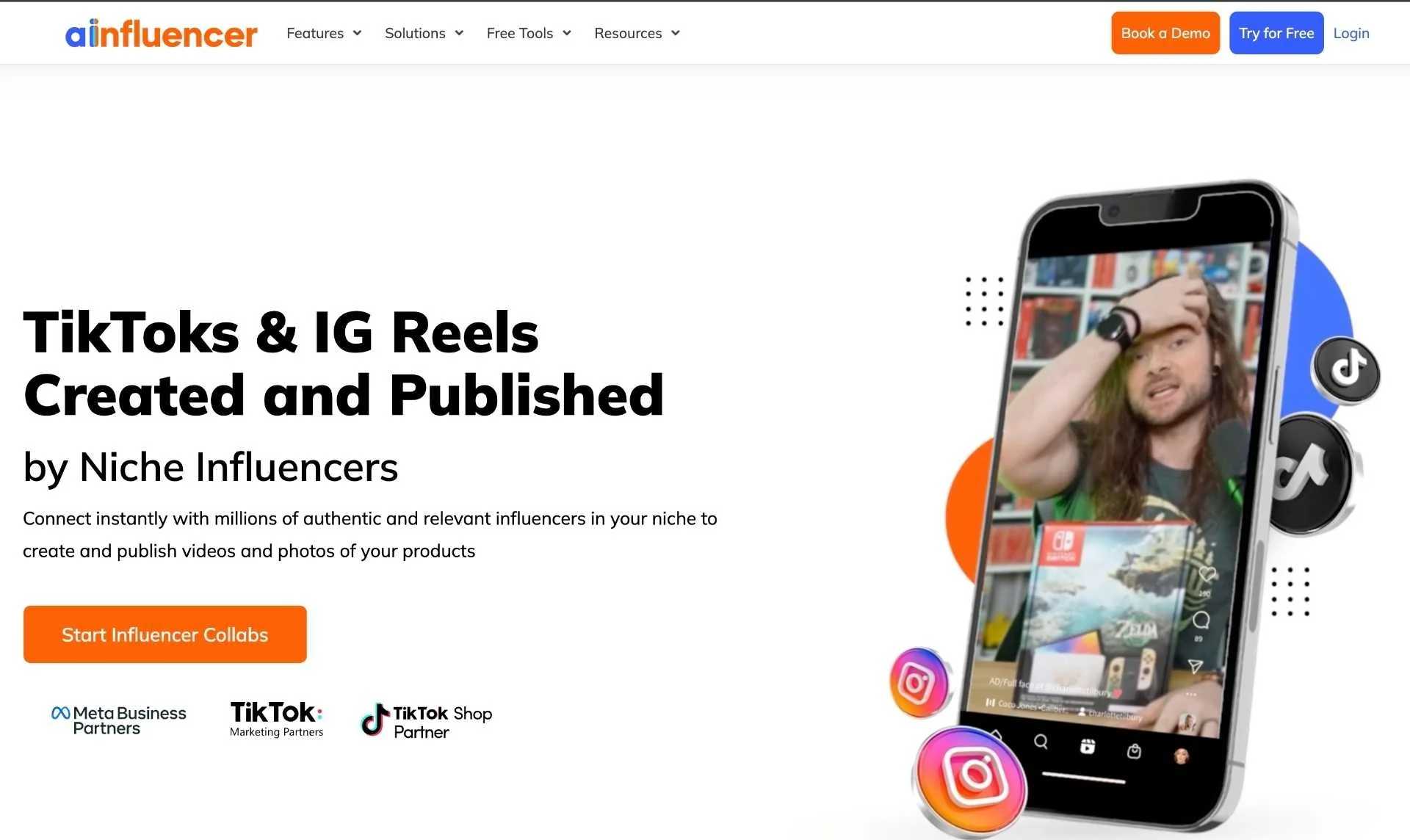
Ainfluencer is a free-to-use influencer marketing marketplace that connects brands with influencers on Instagram and TikTok. It focuses on simplifying collaboration through a two-sided platform where brands can create campaigns and influencers can apply directly, making it especially attractive for small to mid-sized teams.
Key Features
• Marketplace-style discovery: Brands can search and invite influencers or create campaigns where influencers apply directly.
• Campaign creation and management: Define campaign goals, deliverables, and compensation structures within the platform.
• Built-in messaging and negotiation: Communicate directly with influencers using templates and custom messages.
• Escrow-based payments: Payments are held securely and only released once deliverables are completed and approved.
• Content library and ownership: All submitted content is stored and owned by the brand, with approval workflows built in.
• AI-powered campaign messaging: Generate campaign messages and outreach content using AI tools.
• Chrome extension: Invite influencers directly from social platforms into campaigns.
Pricing
• Free Plan (Core Offering): $0/month
• Commission-Based Model: ~20% service fee deducted from influencer payouts
• Managed Campaign Packages (Optional)
• Viral: $7,999 (1 month)
• Scale: $9,999 (2 months)
• Super Scale: $15,000 (3 months)
• Turbo Viral: $29,999 (4 months)
• Custom pricing available depending on campaign scope
Reviews
4.8 / 5.0 (G2)
Pros
• Completely free self-serve model: One of the few platforms with no software subscription cost.
• Secure escrow payment system: Protects brands from non-delivery and ensures accountability.
• Marketplace-driven inbound applications: Reduces the need for manual outreach by allowing influencers to apply directly.
Cons
• Limited analytics and reporting: Only basic performance metrics like views and engagement are available.
• Smaller platform ecosystem: Lacks deep integrations and advanced campaign features.
• Quality control can vary: Marketplace model can lead to inconsistent influencer quality and responsiveness.
Integrations
• Instagram: Discover and collaborate with influencers directly on the platform.
• TikTok: Run campaigns and track performance across short-form content creators.
• Chrome Extension: Invite influencers directly from their social profiles into campaigns.
• (Upcoming) Shopify: Planned integration for product gifting and fulfillment workflows.
• In-app messaging system: Manage all communication without external tools.
Kolr vs. Ainfluencer
Kolr is a premium AI-driven influencer intelligence platform, while Ainfluencer is a free marketplace focused on accessibility. Kolr offers deeper analytics, discovery filters, and campaign insights, whereas Ainfluencer prioritizes ease of use and low-cost entry. For brands focused on scale and data, Kolr is stronger; for budget-conscious teams, Ainfluencer offers a simple starting point.
indaHash
indaHash is a global influencer marketing platform and agency hybrid that connects brands with influencers across multiple markets. It focuses heavily on managed campaigns and international reach, making it suitable for brands running large-scale, multi-country influencer programs.
Key Features
• Global influencer network: indaHash provides access to a large pool of influencers across multiple regions and industries.
• Managed campaign execution: Offers full-service campaign management including strategy, influencer selection, and execution.
• Performance tracking: Tracks engagement, reach, impressions, and campaign performance metrics.
• Content moderation and approval: Ensures brand safety and consistency through content review workflows.
• Multi-market campaign support: Built to handle campaigns across different countries and languages.
• Mobile app for influencers: Influencers manage tasks, submit content, and track campaigns through a dedicated app.
Pricing
indaHash does not publicly disclose full pricing on its website, and most plans are offered on a custom or quote-based model. However, publicly listed pricing tiers include:
• Creator Discovery – $499/year
• Discovery & Campaign Management – $999/month
• White Label (Agencies) – $9,990/year
• Enterprise License – $4,999 (one-time)
• Free Trial: Available
Reviews
4.7 / 5.0 (G2)
Pros
• Strong global campaign capabilities: Designed for multi-market influencer campaigns at scale.
• Managed service expertise: Combines software with agency-level support for execution.
• Dedicated influencer app: Improves communication and campaign efficiency with creators.
Cons
• Limited self-serve functionality: More reliant on managed services than SaaS tools.
• Pricing transparency is low: Requires direct engagement with sales for quotes.
• Less flexibility for smaller teams: Better suited for enterprise or large campaigns.
Integrations
• Instagram: Run and track influencer campaigns across posts and stories.
• TikTok: Manage short-form content collaborations globally.
• YouTube: Track video-based influencer campaigns and performance.
• Mobile app: Central hub for influencer communication and content submission.
• Internal analytics system: Monitor campaign performance across markets.
Kolr vs. indaHash
Kolr is a self-serve AI platform focused on discovery and analytics, while indaHash leans more toward managed services and global campaign execution. Kolr gives brands more control and data insights, whereas indaHash provides hands-on campaign support for large-scale international activations.
Influencity
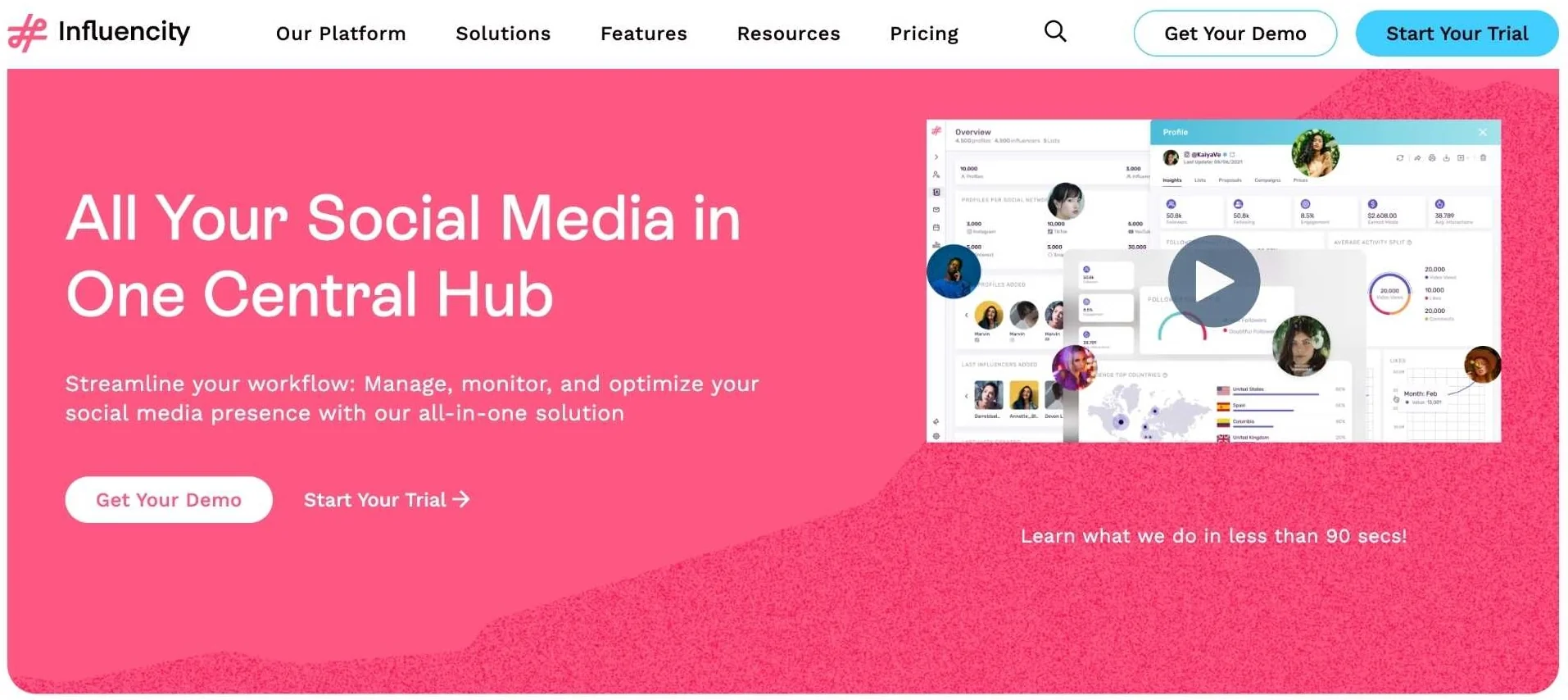
Influencity is a data-driven influencer marketing platform focused on discovery, relationship management, and performance tracking. It is widely used by agencies and brands looking for detailed analytics and scalable influencer workflows.
Key Features
• Large influencer database: Access millions of influencer profiles with detailed audience and engagement data.
• Advanced filtering and segmentation: Filter by demographics, audience quality, interests, and performance metrics.
• Campaign management tools: Manage influencer campaigns from outreach to reporting within one platform.
• Relationship management: Store influencer data, track collaborations, and manage communication.
• Performance analytics: Measure campaign ROI, engagement, and audience insights with customizable reports.
• Fraud detection: Identify fake followers and audience authenticity.
Pricing
Influencity offers three main pricing tiers, along with add-ons:
• Professional Plan: $318/month or $3,816/year
• Business Plan: $798/month or $9,576/year
• Enterprise Plan: Custom pricing
• Auto-Tracker Add-On: $660/year (for 50 influencers)
Reviews
4.3 / 5.0 (G2)
Pros
• Strong analytics and audience insights: One of the better platforms for deep influencer data analysis.
• Flexible pricing tiers: Offers accessible entry-level plans compared to enterprise competitors.
• Robust fraud detection tools: Helps ensure higher-quality influencer partnerships.
Cons
• Interface can feel complex: Advanced features may require onboarding time.
• Limited built-in outreach automation: Not as strong as CRM-heavy tools.
• Some data gaps in smaller markets: Coverage may vary depending on region.
Integrations
• Instagram: Analyze influencer performance and audience data.
• TikTok: Track engagement and discover short-form creators.
• YouTube: Evaluate long-form content performance.
• Google Analytics: Connect campaign data with website performance.
• Shopify: Track influencer-driven sales and conversions.
Kolr vs. Influencity
Kolr and Influencity are both data-focused platforms, but Kolr leans more into AI-driven insights and competitor analysis, while Influencity focuses on detailed analytics and fraud detection. Kolr is stronger for market intelligence, whereas Influencity is better for hands-on campaign analytics and flexible pricing.
Modash
Modash is an influencer marketing platform focused on discovery, analytics, and campaign tracking, with a strong emphasis on transparency and global coverage. It is particularly popular among eCommerce brands looking for scalable influencer discovery without managed services.
Key Features
• Global influencer database: Access over 250M+ influencer profiles across Instagram, TikTok, and YouTube.
• Advanced search and filtering: Filter by audience demographics, engagement, brand affinity, and more.
• Audience analysis: Deep insights into follower authenticity, demographics, and engagement quality.
• Campaign tracking: Monitor influencer posts, track mentions, and measure performance automatically.
• Email and outreach tools: Export contact details and manage outreach workflows externally or within the platform.
• Competitor tracking: Analyze competitor influencer strategies and partnerships.
Pricing
• Essentials: ~$199/month (paid annually)
• Performance: ~$499/month (paid annually)
• Enterprise: custom pricing
• Typically billed annually, with scaling based on usage and team size.
Reviews
4.9/5.0 (Capterra)
Pros
• Highly transparent data and analytics: Known for accurate and detailed audience insights.
• Large global database: Strong coverage across regions and platforms.
• Simple and fast UI: Easy to use compared to more complex enterprise tools.
Cons
• Limited built-in campaign management: Focuses more on discovery than execution.
• No native payment or affiliate tools: Requires external systems for payouts and tracking.
• Less suited for managed campaigns: Fully self-serve approach may not suit all teams.
Integrations
• Shopify: Track influencer-driven sales and campaign ROI.
• Google Analytics: Measure website performance tied to influencer campaigns.
• Instagram: Discover and analyze influencer profiles and engagement.
• TikTok: Track short-form content creators and performance.
• YouTube: Analyze video creators and audience insights.
Kolr vs. Modash
Kolr and Modash are both strong in influencer discovery and analytics, but Kolr emphasizes AI-driven insights and competitor intelligence, while Modash focuses on transparency and usability. Kolr is more feature-rich for campaign intelligence, while Modash is simpler, faster, and more accessible for self-serve teams.
Final Thoughts on Kolr Alternatives
Kolr stands out for its AI-driven discovery, competitor analysis, and cross-border data capabilities, but many alternatives offer stronger strengths in specific areas such as eCommerce integrations, workflow automation, or pricing flexibility. Platforms like Upfluence and GRIN lean heavily into revenue attribution and commerce workflows, while tools like SARAL and Influencer Hero prioritize usability and streamlined campaign execution. Meanwhile, solutions like Modash and Influencity focus on analytics and discovery, and others like Ainfluencer or indaHash cater to marketplace-driven or managed-service approaches. The right alternative ultimately depends on whether a brand prioritizes data intelligence, operational simplicity, or end-to-end campaign management.
.png)


.jpg)