


10 Best Keepface Alternatives for Influencer Marketing
Work out which Keepface you are actually buying before you compare it to anything else. The CRM is one product, campaign management is a second, the affiliate program a third, and customer and employee advocacy are two more, each carrying its own free tier and its own ceiling. Bought one at a time they look inexpensive, and a brand using a single module genuinely does get a bargain. Assembled at Growth across the three modules a working program needs, they come to $647 a month, and that figure is the whole comparison, because it lands within two dollars of all-in-one platforms that also cover gifting, creator payouts and store attribution.
Ten Keepface alternatives are covered below, in this order: Influencer Hero, CreatorIQ, Upfluence, Afluencer, Aspire, NeoReach, Klear, Traackr, Social Cat and Heepsy.
Key Criteria for Evaluating Influencer Marketing Platforms
Core Features
Evaluation of essential influencer marketing capabilities, including influencer discovery, outreach, CRM, campaign management, reporting, and content workflows.
Pricing & Flexibility
Comparison of pricing models, subscription plans, and contract terms to match different budgets and growth stages.
Customer Reviews & Satisfaction
Analysis of user feedback from trusted review platforms, focusing on usability, reliability, customer support, and overall performance.
Pros & Cons
Review of each platform’s strengths and limitations to highlight where it performs well and where it may fall short based on different use cases.
Integrations
Review of the most important integrations (e.g., Shopify and other tech tools), highlighting what each integration enables in one sentence.
Keepface Overview
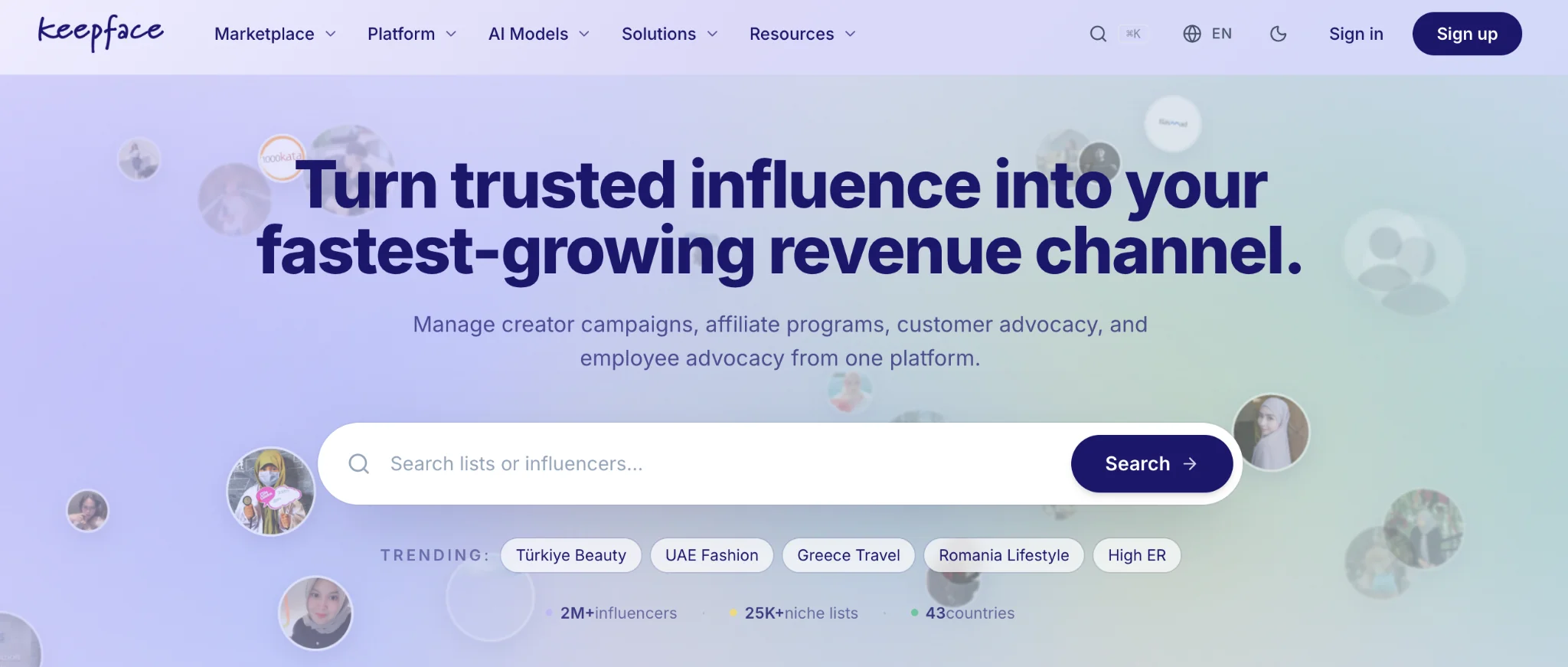
Keepface sells influencer marketing as five separate product lines: recruitment and CRM, campaign management, an affiliate program, and customer and employee advocacy. Behind them sits a network of more than two million influencers sorted into 25,000-plus niche lists across 43 countries, weighted toward Turkey, the Caucasus, Central Asia and the Gulf alongside the USA, with coverage of Instagram, TikTok, YouTube and Snapchat. The Snapchat support is worth noting, since it carries real weight in Gulf markets that most Western tools ignore completely. Set against single-product influencer CRM software, Keepface offers more ground but hands you the job of assembling it.
Key Features
- AI-curated recruitment pools: Hundreds of creator pools organised by niche, so a shortlist starts from a segment instead of an empty search box.
- Relationship CRM: Saved creator lists and outreach tracking, with seats and search quotas set by the tier you buy.
- Campaign management and reporting: Live campaign KPIs and marketing ROI, metered by how many campaigns and influencers the tier allows.
- Affiliate program: Auto-tracked links and a commission ledger, billed against monthly GMV rather than seats.
- Advocacy modules: Separate products for turning customers and staff into advocates, priced by how many people you enrol.
Pricing
- Influencer CRM: Free, $29/month Starter, $149/month Growth, Enterprise custom.
- Campaign Management & Reporting: Free, $149/month Starter, $349/month Growth, Enterprise custom.
- Affiliate Program: Free up to $500 monthly GMV, $49/month Starter up to $10,000 GMV, $149/month Growth up to $100,000 GMV, Enterprise custom.
- Advocacy modules: Customer and Employee Advocacy each free, then $78/month Starter and $480/month Growth.
- Bundles and add-ons: Marketing Pack $161/month, Sales Pack $205/month, Advocacy Pack $301/month at Starter level, plus White Label at $250/month and an Agency add-on at $168/month.
Annual billing saves 30%, and there are no setup fees, per-transaction charges or contracts. The figure that decides the buying question is the assembled one: CRM, campaign management and affiliate at Growth totals $647 a month.
Reviews
No verifiable rating. Keepface has no G2 or Capterra listing with a published review count that resolves, so there is no independent brand-side score to cite.
Integrations
- Instagram: Discovery, campaign delivery and performance reporting on the primary channel.
- TikTok: Short-form creator sourcing and campaign tracking.
- YouTube: Channel-level discovery and campaign measurement.
- Snapchat: Coverage of a network few competitors index at all, and a genuine advantage in Gulf markets.
- Affiliate link tracking: Auto-generated tracked links feeding the commission ledger inside the affiliate module.
Keepface publishes no broad integration directory, and no Shopify or WooCommerce connection is documented, so store-level attribution is not something you configure directly.
Pros
- Every module has a free tier: Rare in this category, and it means each piece can be tested properly before any money changes hands.
- Nothing is hidden behind a form: Every tier, bundle and add-on is listed, with no setup fees, no per-transaction cut and no contract.
- Regional and Snapchat reach: Depth across Turkey, the Caucasus, Central Asia and the Gulf, on a network most rivals do not index.
Common Drawbacks of Keepface
The assembled price is the real price
A working program usually needs CRM, campaigns and affiliate together, which reaches $647 a month at Growth. The $29 headline describes one module, not an influencer program, and the gap between those two numbers is where most buyers get caught.
Affiliate tiers capped by GMV
Starter stops at $10,000 monthly GMV and Growth at $100,000. A successful affiliate program therefore forces a tier change rather than simply costing more to run, which penalises exactly the outcome you are paying for.
Coverage is thinnest where most buyers sell
The market list leans to MENA, Turkey and Central Asia, so a US or Western European brand gets far less from the 43-country figure than it implies.
Nothing independent to check it against
With no resolving G2 or Capterra listing, there is no third-party evidence on data accuracy, support responsiveness or day-to-day delivery.
Best Keepface Alternatives
| TOOL | REVIEWS | BEST FOR | TRIAL INFO | PRICING | ||
|---|---|---|---|---|---|---|
1 |

|
⭐ | Influencer CRM & automation | Book Demo | Pricing | Website |
2 |

|
⭐ | Enterprise influencer marketing | Book Demo | Pricing | Website |
3 |

|
⭐ | Influencer discovery | Book Demo | Pricing | Website |
4 |

|
⭐ | Influencer marketplace campaigns | Book Demo | Pricing | Website |
5 |

|
⭐ | Influencer partnerships | Book Demo | Pricing | Website |
6 |

|
⭐ | Influencer campaigns & data analytics | Book Demo | Pricing | Website |
7 |

|
⭐ | Influencer analytics | Book Demo | Pricing | Website |
8 |

|
⭐ | Enterprise influencer analytics | Book Demo | Pricing | Website |
9 |

|
⭐ | Micro-Influencer Campaigns | Book Demo | Pricing | Website |
10 |

|
⭐ | Influencer discovery | Book Demo | Pricing | Website |
Influencer Hero
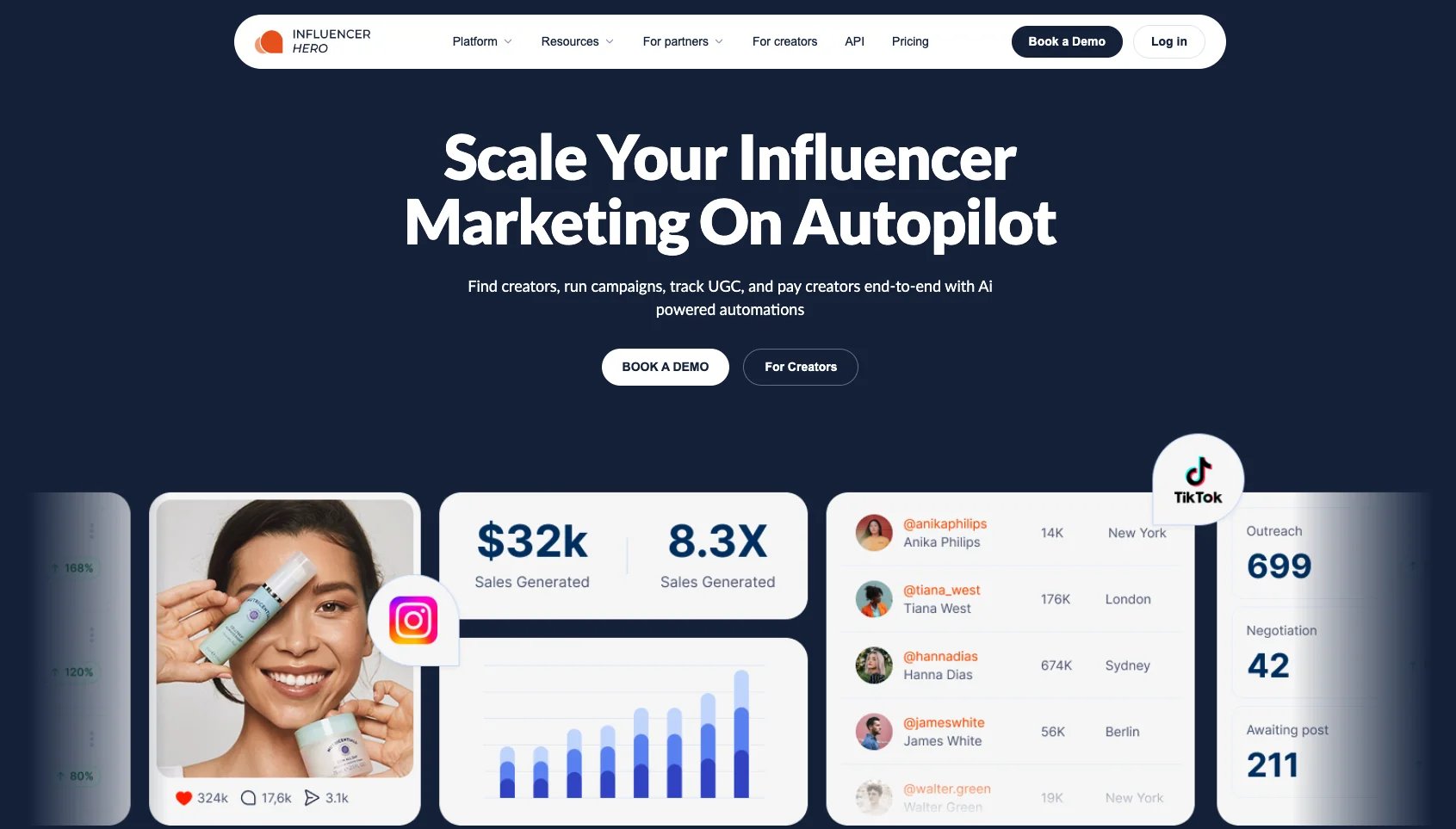
Influencer Hero puts influencer discovery, outreach, CRM, gifting, affiliate tracking and creator payouts behind a single subscription, aimed at D2C and eCommerce brands running continuous creator programs. It covers Instagram, TikTok and YouTube, with automation doing the heavy lifting so a small team can work at seeding volume. Where Keepface sells the pieces, this is the assembled version at a published price.
Key Features
- Affiliate management without volume caps: Codes and tracked links per creator, with attribution that keeps working however much revenue the program generates.
- Payout Manager: Bulk and scheduled creator payouts at 0.1% to 0.4% via bank debit, with invoice requests and approval tied to each payout.
- Product seeding: Gift fulfillment triggered through Shopify and WooCommerce, with shipping and delivery confirmed per creator.
- Influencer storefronts: Branded pages where creators feature your products and drive affiliate sales directly.
- Bulk actions across segments: Email, tasks and integration actions fired at an entire filtered group from one screen.
- Chrome extension: Live creator stats while browsing Instagram, TikTok or YouTube, with one-click import into a campaign.
- Audience-quality screening: Fake-follower detection and fraud checks before budget is committed to a creator.
- Multi-platform eCommerce support: Shopify and WooCommerce natively, plus custom stores through an embedded script.
Pricing
- Standard: $649/month, up to 1,000 reachouts per month
- Pro: $1,049/month, up to 5,000 reachouts per month
- Business: $2,490/month, up to 10,000 reachouts per month
- Custom & Agency: Custom pricing
Quarterly billing saves 20% and yearly billing saves 30%.
Reviews
5.0/5.0 (Capterra)
Pros
- Growth does not trigger a bill: No GMV ceiling on affiliate activity, so a program that works keeps running on the plan you bought.
- The store is wired in: Gifting, codes and payouts connect to Shopify, WooCommerce or a custom build, so results arrive as attributed revenue.
- One subscription, not five: Discovery, CRM, campaigns, affiliate and payments are included rather than assembled from separate purchases.
Cons
- No free tier to learn on: Evaluation runs through a demo, where Keepface lets you use each module at zero cost first.
- Expensive for smaller brands: $649 a month is hard to justify for a brand running two campaigns a year.
- Learning curve: The breadth that makes it capable also means a team is not using all of it in week one.
Integrations
- Shopify: Fires gifting orders, issues codes and attributes revenue per creator automatically.
- WooCommerce: The same seeding and affiliate loop on WordPress storefronts.
- Klaviyo: Moves creator contacts into email flows and segments.
- DocuSign: Sends and stores creator contracts inside the campaign.
- Zapier: Opens 8,000-plus further apps for anything not covered natively.
Keepface vs Influencer Hero
The prices land in the same place, which makes this an unusually clean comparison. Keepface at Growth across CRM, campaigns and affiliate is $647 a month. Influencer Hero Standard is $649. Two dollars apart, so the question is entirely what each buys.
Influencer Hero adds gifting, creator payouts at 0.1% to 0.4%, fake-follower screening, brand-follower detection and native Shopify, WooCommerce and custom-store connections, none of which Keepface documents. It also applies no GMV cap to affiliate activity, where Keepface pushes you to Enterprise once monthly affiliate revenue passes $100,000. Keepface answers with something Influencer Hero has no equivalent for: a free tier on every module, so a brand can run one piece for $29 a month or nothing at all. At the low end Keepface wins outright. At full use the two cost the same and one covers considerably more of the program.
CreatorIQ
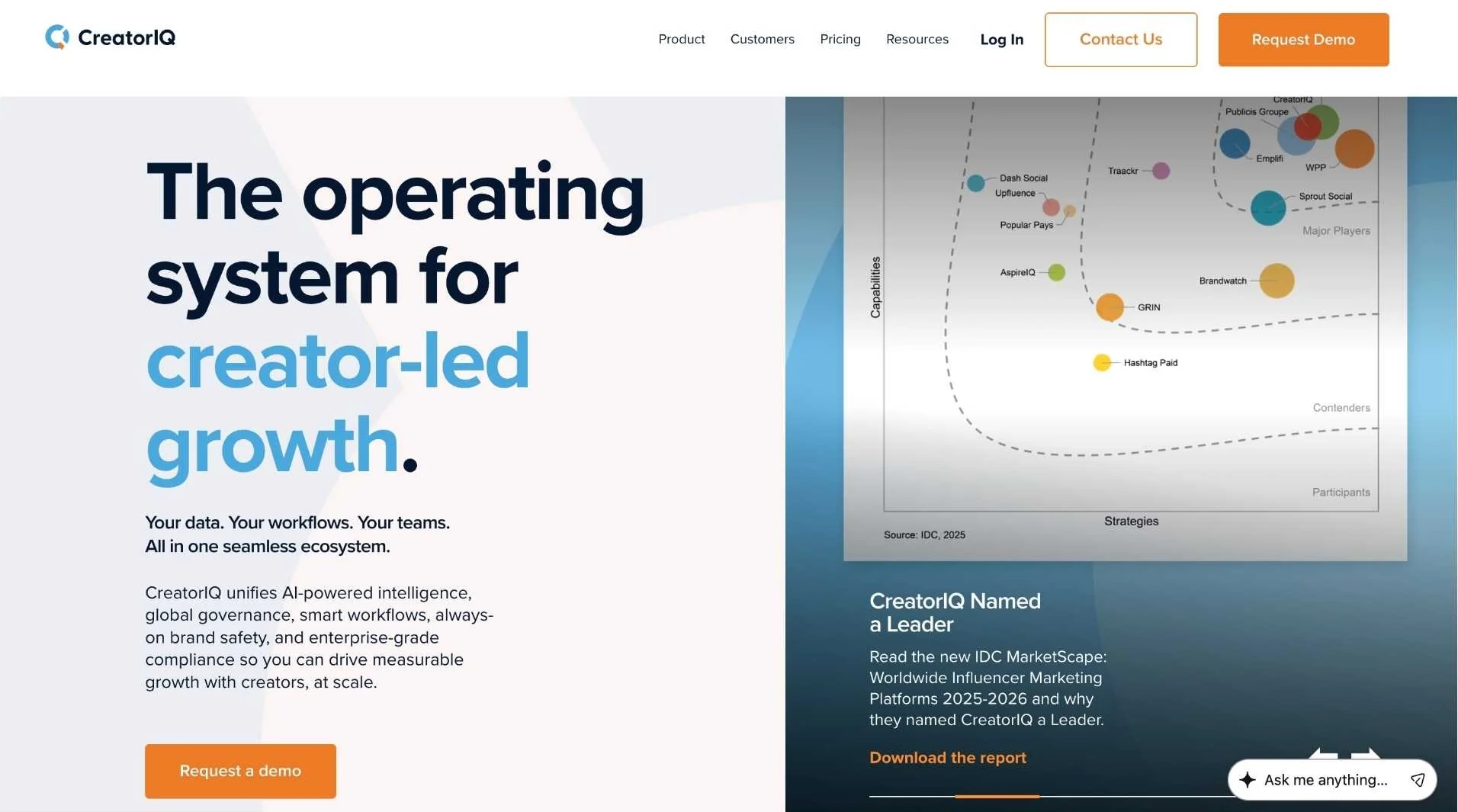
CreatorIQ serves global brands and large agencies whose influencer activity is permanent rather than campaign-shaped. Its value sits in first-party social API relationships, standardised measurement and reporting solid enough to survive a finance review. Ease of purchase is not part of the offer.
Key Features
- Measurement and attribution: Social performance combined with eCommerce and affiliate conversion data to produce program-level ROI.
- Creator discovery: A large indexed database filtered by audience quality, demographics and brand affinity.
- Campaign management: Briefs, contracts, approvals and deliverables tracked across many concurrent campaigns.
- Creator payments: Payout workflow handled in-platform instead of routed through finance.
- ExchangeIQ data layer: API access pushing creator data into data lakes, BI tools and marketing mix models.
Pricing
- All tiers: Not published. The pricing page is fully demo-gated with no plans or figures shown.
- Reported entry point: Third-party directories list a starting figure around $36,000 per year.
- Reported typical contract: Marketplace contract data puts the median annual commitment near $39,250, ranging roughly $30,000 to $59,500.
There is no monthly plan, no self-serve entry and no free trial.
Reviews
4.6/5.0 (G2, 581 reviews)
Pros
- Reporting built for scrutiny: The cross-channel analytics are what justify the premium over cheaper tools internally.
- Portable data: The API and data exchange move creator performance into your own BI stack rather than stranding it in a dashboard.
- Handles real scale: Thousands of creators across markets without the workflow breaking down.
Cons
- Five figures a year, annually committed: No trial and no monthly option, which rules it out for anything but always-on activity.
- Discovery complaints: Reviewers regularly report search missing relevant creators or returning irrelevant ones.
- Heavy interface: Frequently described as busy and slow, with some bulk actions still manual.
Integrations
- Shopify: Store data synced to attribute creator-driven orders and promo codes.
- Impact, CJ and Awin: Affiliate network conversion data ingested for creator-level revenue attribution.
- Google Analytics: Creator traffic connected to on-site conversion behaviour.
- Sprinklr: Creator, organic and paid social reporting unified through a formal partnership.
- DocuSign: Contracts and signatures handled inside the campaign workflow.
Keepface vs CreatorIQ
Opposite ends of the category on every axis that matters. Keepface publishes everything and starts free; CreatorIQ publishes nothing and reportedly starts near $36,000 a year on an annual contract.
What CreatorIQ buys is governance and evidence: first-party API data, attribution through Shopify and three affiliate networks, export into your own BI environment, and 581 G2 reviews behind it. Keepface buys breadth of modules at a knowable price with no commitment and no independent review base whatsoever. A brand that has to defend creator spend to a board will not get there on Keepface. A brand that wants to start this week without a procurement cycle cannot start with CreatorIQ.
Upfluence

Upfluence sells to eCommerce brands and agencies, and its distinguishing move is looking at your own customer and email data to find creators already buying from you. The product spans search, outreach, campaign management, affiliate tracking and global payments, sold as modules. It states plainly that it takes no percentage of creator-driven sales.
Key Features
- Customer-to-creator matching: Shopify and email data scanned to surface existing customers with creator followings.
- Affiliate and promo tracking: Codes and tracked links per creator with revenue attributed to each.
- Upfluence Pay: Creators paid globally in local currencies with compliance handled.
- Creator search: A large indexed database filtered by platform, audience, engagement and keyword.
- Outreach automation: Personalised sequences sent and tracked from a connected Gmail or Outlook inbox.
Pricing
- All packages: Quote-only. Three named tiers are shown but no figures are published.
- Structural terms the vendor does publish: Fixed platform fees with no percentage of sales taken, and no mandatory setup fee.
- Contract: Annual plans carry a 12-month minimum commitment.
A free trial is available only after an initial consultation call.
Reviews
4.6/5.0 (G2, 140 reviews)
Pros
- Commerce data done properly: Shopify, WooCommerce, BigCommerce and Amazon connections make revenue attribution usable rather than theoretical.
- No cut of your sales: Fixed fees only, with the vendor explicit that it takes no revenue share.
- Account management included: A dedicated manager on all plans, consistently well rated in reviews.
Cons
- Quote-only plus a year lock-in: Nothing can be budgeted without a call, and annual plans hold you twelve months.
- Learning curve: Reviewers describe the interface as heavy for teams without dedicated influencer staff.
- Organisation at volume: List and campaign management draws repeated criticism once creator counts grow.
Integrations
- Shopify: Gifting orders triggered, fulfilment tracked and sales attributed per creator.
- WooCommerce and BigCommerce: Coupon generation and conversion tracking on non-Shopify storefronts.
- Amazon Attribution: Creator activity linked to Amazon sales with affiliate campaigns automated.
- Klaviyo: Creators identified inside your email list and moved into dedicated nurture flows.
- Zapier: Thousands of further apps connected for custom automation.
Keepface vs Upfluence
Both sell modularly, so the structures rhyme, but only one of them will tell you what a module costs. Keepface lists every tier; Upfluence names three packages and quotes them privately.
Upfluence is far stronger on commerce, connecting to Shopify, WooCommerce, BigCommerce and Amazon so creator revenue lands in your own reporting, and its customer-matching turns an existing order history into a creator shortlist. Keepface documents no eCommerce integration at all and meters affiliate activity by GMV instead. Upfluence also locks annual plans for twelve months where Keepface has no contract of any kind. For a store that needs attribution, Upfluence does a job Keepface cannot. For a brand that wants to see a price before a sales call, the reverse holds.
Afluencer
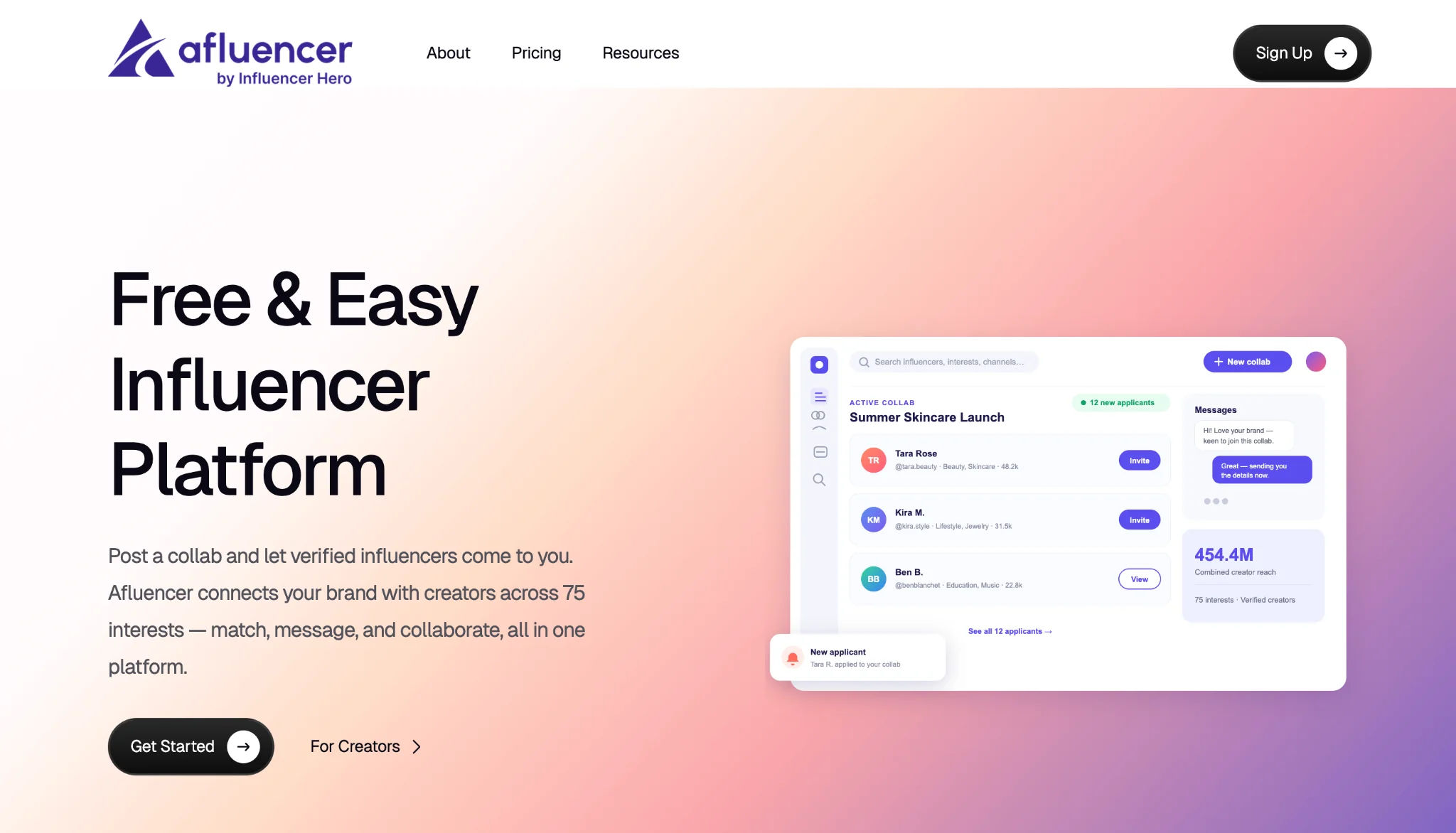
Afluencer runs on applications rather than search. Brands publish campaign listings called Collabs, verified creators apply, and the brand picks from the people who put their hand up. It suits SMB and D2C merchants whose bottleneck is creator supply rather than tooling.
Key Features
- Collab listings: Publish a campaign with channel, niche and follower criteria and let creators apply to it.
- Product send-outs: Gifting logistics and creator payments handled on paid plans.
- CreatorGPT matching: AI narrowing of applicants and creator suggestions by niche fit and audience quality.
- Creator directory: A browsable index across dozens of interest categories with filtering.
- In-platform messaging: Briefs, deliverables and gifting details coordinated directly with creators.
Pricing
- Free tier: Browse the directory and post listings with monthly invitation credits.
- Paid plans: From $49/month, adding outreach volume, product send-outs and creator payments.
- Higher tiers: More seats, larger reach-out allowances and dedicated support.
Reviews
4.6/5.0 (G2, 738 reviews). The review base leans toward creators using the marketplace rather than brands paying for the upper tiers.
Pros
- Creators come to you: Inbound applications remove the reply-rate problem that makes outbound discovery expensive.
- Gifting and payments handled: Product send-outs and creator payments run on paid plans, which Keepface’s modules do not cover.
- 738 reviews of evidence: One of the deepest independent review bases on this list, against none for Keepface.
Cons
- Supply, not infrastructure: It finds creators; it does not run a large program with attribution and payouts at scale.
- North America weighted: Reviewers elsewhere report a thinner pool of relevant creators.
- Roster quality control: Reviews cite occasional inaccurate creator classifications.
Integrations
- Shopify: Products gifted and discount codes issued straight from the store.
- Klaviyo: Creator and campaign contacts passed into email flows.
- Amazon: Amazon-focused collabs and product promotion supported.
- Slack: Collab and application notifications pushed into team channels.
- DocuSign: Creator agreements and signatures handled in the workflow.
Keepface vs Afluencer
Both are affordable and both publish their prices, so the comparison turns on which half of the problem you have. Keepface hands you tooling and expects you to find creators. Afluencer hands you creators and expects little tooling.
Afluencer’s inbound model removes the outreach cost entirely, and it covers gifting logistics and creator payments that no Keepface module touches. It also carries 738 G2 reviews where Keepface has no resolving listing. Keepface wins on reach outside North America, particularly across Turkey, the Gulf and Central Asia, and for micro-influencer collaborations Afluencer’s roster noticeably thins once you leave its home market.
Aspire

Aspire runs word-of-mouth commerce programs for mid-market and enterprise eCommerce brands, concentrated in beauty, apparel, food and home. Discovery, creator CRM, seeding, content licensing and affiliate attribution live in one workflow, with first-party Meta, TikTok and Pinterest partnerships supplying verified analytics. Brands usually arrive at it while consolidating three or four separate tools.
Key Features
- Influencer CRM: Creator records, tags, tiers and relationship history maintained at scale.
- Campaign workflow: Briefs, seeding, content approvals and deliverable tracking in one flow.
- Affiliate and conversion tracking: Links, codes and sales data consolidated from Shopify and affiliate networks.
- Content and UGC library: Creator content collected, licensed and repurposed for paid and owned channels.
- Creator discovery: Search plus a Chrome extension that captures creators and campaigns from the browser.
Pricing
- All tiers: Not published. There is no pricing page, only a demo request.
- Reported typical contract: Marketplace data puts the median annual commitment near $15,588, ranging roughly $11,139 to $36,599.
- Possible service fee: At least one buyer reports negotiating away a 2% service fee, so check whether a percentage sits in your quote.
There is no free trial and no freemium tier; access is gated behind a paid contract.
Reviews
4.6/5.0 (G2, 146 reviews)
Pros
- Replaces the assembled stack: Reviewers describe it absorbing several separate tools across recruiting, content and payment.
- Verified social data: Meta, TikTok and Pinterest partnerships supply first-party analytics rather than scraped estimates.
- Support quality: Responsive account teams are the most-cited strength across its review base.
Cons
- Contract-only with a possible percentage: No trial, no published price, and a service fee at least one buyer had to negotiate out.
- Performance issues: Slow loading and social-integration failures appear regularly in reviews.
- Onboarding burden: Implementation typically runs to around three months, with reviewers citing thin training.
Integrations
- Shopify: Seeding, promo codes and identification of influential existing customers.
- Meta and TikTok: Verified analytics and branded-content ads through direct partnerships.
- Impact, CJ and ShareASale: Affiliate link management and creator payouts centralised.
- Klaviyo: Influencer contacts synced into CRM and email nurture campaigns.
- PayPal: Creators paid directly from inside the platform.
Keepface vs Aspire
Aspire consolidates precisely where Keepface separates. One workflow covers discovery, CRM, seeding, content licensing and affiliate attribution, against four or five product lines you buy and stitch together yourself.
That consolidation costs a reported median near $15,600 a year, with no trial and roughly three months to implement, against Keepface’s free entry and no commitment at all. Aspire also brings verified first-party data from Meta, TikTok and Pinterest plus 146 G2 reviews, neither of which Keepface can match. Check any Aspire quote for the 2% service fee some buyers have removed. A brand seeding at volume in beauty or apparel belongs on Aspire; a brand still assembling a program on a small budget does not.


NeoReach
NeoReach is an agency with software attached rather than the reverse. It runs large, measurement-heavy campaigns for mid-market and Fortune 500 brands and has managed more than $350M in influencer spend since 2013, mostly at macro and celebrity tier. The team is what clients are buying.
Key Features
- Managed services: Senior-led teams handling strategy, sourcing, negotiation and execution end to end.
- Creator database: 250M-plus profiles searchable across 40-plus filters including keywords and audience demographics.
- Campaign management: Multi-creator campaigns planned, tracked and reported from one dashboard.
- Measurement and reporting: Real-time dashboards covering reach, engagement and campaign ROI.
- Enterprise API: Cross-channel social and brand insight data fed into a client’s own systems.
Pricing
- Managed services: Not published. Priced per campaign by scope, channels and creator tier after a consultation.
- Self-service platform: Software directories list roughly $399 per user per month, unconfirmed by the vendor.
- Media spend: Creator fees sit outside the retainer entirely.
Reviews
4.5/5.0 (G2, 11 reviews, low review volume)
Pros
- People are the deliverable: Senior campaign management is the actual product for brands with no internal influencer function.
- Track record at scale: More than $350M in managed spend across large brand accounts since 2013.
- Search and filtering: The 40-plus filter discovery and analytics rate highly with reviewers.
Cons
- Three unknowns stacked: No published price, a directory figure that excludes managed retainers, and creator fees on top of both.
- Thin review base: Eleven G2 reviews is very little evidence in either direction.
- Macro skew: The database leans heavily to large creators, which makes micro-seeding awkward.
Integrations
- Enterprise API: The one documented integration path, feeding creator and brand data into client systems.
- Instagram: Creator data and campaign performance sourced from the platform.
- TikTok: Creator sourcing and campaign tracking.
- YouTube: Creator discovery and performance measurement.
- Influencers.com: NeoReach’s own talent property, used for representation and sourcing.
NeoReach publishes no integration directory, so the verifiable surface is narrow.
Keepface vs NeoReach
Software against services, and the budgets barely touch. Keepface can be run for $29 a month at Starter, while NeoReach quotes managed campaigns per project with creator fees stacked on top.
NeoReach fits a brand with money and nobody to run the work. Keepface fits a brand with people and very little money, since every module has a free tier to learn on. NeoReach’s 250M-profile index dwarfs Keepface’s two million, though Keepface curates into niche pools rather than indexing everything. Independent evidence is thin on both sides, at eleven G2 reviews against none.
Klear

Klear is no longer sold on its own. It ships as the influencer marketing module inside Meltwater’s media, social and consumer intelligence suite, which suits enterprises already paying for listening and PR monitoring. Fraud detection and database breadth are what it contributes.
Key Features
- Fraud and audience quality detection: Bots identified and True Reach reported instead of raw follower counts.
- AI creator discovery: 30M-plus profiles from nano to mega tier, with recommendations that learn from past results.
- ROI and attribution: Engagement, estimated media value and conversion attribution tracked together.
- Campaign management: Vetting, communications, approvals and reporting handled end to end.
- Social listening tie-in: Creator data sitting beside Meltwater monitoring and consumer intelligence.
Pricing
- All tiers: Not published. Four plans are named but no figures are shown.
- Tier gating: Influencer marketing is included only in the Enterprise and Agency tiers.
- Contract terms: Typically 12-month agreements, with implementation fees possible and no self-serve free trial.
Reviews
4.3/5.0 (Capterra, 13 reviews, low review volume under the legacy Klear listing)
Pros
- Vetting that shows its working: Bot detection and True Reach explain why a creator is or is not worth activating.
- Marginal cost inside Meltwater: Creator work lands in a suite the organisation already pays for.
- Database breadth: 30M-plus profiles spanning nano through mega tiers.
Cons
- Upper tiers only, on an annual lock: Enterprise and Agency plans exclusively, with onboarding fees possible on top.
- Lost product identity: Klear as a standalone is effectively gone, which means less focused roadmap attention.
- Workflow gaps: Reviewers cite slow adoption of newer platforms and a complicated third-party payment setup.
Integrations
- Meltwater tracking pixel: Creator-driven conversions attributed on any eCommerce platform.
- Shopify: Direct sales attribution from creator campaigns to store revenue.
- WooCommerce: The same conversion attribution for WordPress storefronts.
- Tipalti: Global creator payments and tax compliance processed.
- Gigapay: An alternative payout rail with local-currency support.
Keepface vs Klear
Both are pieces of something larger, but the shapes differ. Keepface sells its modules separately and lets you choose; Klear is bundled inside Meltwater and only available on the upper tiers, so buying just the influencer piece is not an option.
Klear brings fraud screening, conversion attribution through its own pixel and two global payment rails, none of which Keepface offers. Keepface brings a free entry point, no contract and regional reach in markets Meltwater does not prioritise. The economics come down to one question: if Meltwater is already in the building, Klear costs little at the margin and does considerably more. If it is not, an enterprise suite is a heavy way to buy what Keepface assembles for $647.
Traackr
Traackr exists for teams running always-on programs across several markets, where the recurring question is not who to work with but whether the spend is efficient. Beauty, fashion and CPG teams make up much of its base. Benchmarking and governance are why it gets shortlisted.
Key Features
- Performance benchmarking: Your spend and results measured against competitors and category norms.
- Spend and budget tracking: Creator costs tracked against results, with a cost calculator built in.
- Creator payments: Automated global payouts in local currencies through a zero-fee creator wallet.
- Influencer relationship management: One record of every creator relationship and conversation across teams and markets.
- Discovery and vetting: Audience quality, demographic and brand-affinity filters backed by platform API data.
Pricing
- All tiers: Not published. The pricing page is demo-gated with no tiers, figures or contract terms.
- Cost band: Independent review data places it in the highest perceived cost tier in the category.
- Renewals: Reviewers report pricing that increases over time, so budget for escalation.
Reviews
4.3/5.0 (G2, 377 reviews)
Pros
- Answers the efficiency question: Benchmarking and cost-per-result tracking suit teams who must justify the budget, not just spend it.
- Zero-fee creator payments: The payment wallet takes no cut, which reviewers single out.
- Enterprise governance: SSO, data lake export and multi-market visibility for large distributed teams.
Cons
- Unquotable pricing that keeps climbing: Nothing published, top cost band, and reviewers explicitly flag rising renewals.
- Speed and stability: Slow loading and content failing to render are the most common complaints.
- Long-tail data accuracy: Weaker data on smaller creators and delayed content tracking.
Integrations
- Link and code tracking: Clicks, conversions and revenue per creator on any eCommerce site.
- Meta and TikTok APIs: Real-time first-party creator and content data through direct partnerships.
- Shopify: Gifting and fulfilment automated, with the resulting content performance captured.
- SSO and data lake connectors: Enterprise sign-on plus export into your own BI environment.
- Gmail and Outlook: Personalised outreach sent and logged for the whole team.
Keepface vs Traackr
Both are relationship-led and both carry a payment or affiliate layer, so the split is transparency against rigour. Keepface publishes every price and charges nothing per transaction; Traackr publishes nothing and sits in the highest cost band in the category.
The money at Traackr buys governance: spend benchmarked against competitors, cost tracked against results through detailed campaign reporting, and creators paid globally at zero fee. Keepface’s affiliate module instead caps you by GMV, so growth triggers an upgrade rather than better numbers. Traackr also carries 377 G2 reviews against none for Keepface. A multi-market team accountable for efficiency needs answers Keepface does not attempt to give.
Social Cat
Social Cat keeps its scope deliberately narrow: gifted and small-paid collaborations with vetted Instagram and TikTok micro-creators, for small D2C brands, apps and agencies. The output is licensed content and awareness rather than program infrastructure. Everything about the offer is published before signup.
Key Features
- Content usage rights: Licensing built into every collaboration so brands can reuse what creators produce.
- Vetted creator matching: 500K-plus manually reviewed Instagram and TikTok creators filtered by niche and engagement.
- Gifted and paid collaborations: Product-gifting and paid campaigns with unlimited content per collaboration.
- Campaign and contract management: Contracts, private notes, creator reviews and a content library in one dashboard.
- Invitation system: Monthly invitation quotas that scale with the plan tier.
Pricing
- Essentials: $99/month, up to 5 collaborations, 1,000 invitations, 1 campaign, 1 seat.
- Performance: $199/month, up to 15 collaborations, 2,500 invitations, up to 3 campaigns, up to 5 seats.
- Pro: $299/month, up to 30 collaborations, 5,000 invitations, unlimited campaigns, up to 10 seats.
Annual billing gives two months free and a 7-day free trial is offered. A separate managed service is custom-priced, with the vendor stating most brands invest between $3,000 and $15,000 per month in total.
Reviews
4.7/5.0 (Reviews.co.uk, 2,773 reviews). The volume is overwhelmingly creators rating collaborations rather than brands rating software, and there is no verifiable G2 or Capterra brand-side score.
Pros
- Priced and capped in public: $99 to $299 with the collaboration limits stated, a 7-day trial and no annual lock-in.
- Usage rights included: Licensing arrives with the collaboration instead of being negotiated creator by creator.
- Human vetting: Creators are reviewed by a person, which matters at the micro tier where inflated followings are common.
Cons
- Collaboration caps force a big step: Thirty a month is the ceiling, and passing it pushes you to a managed service starting near $3,000.
- Two platforms only: Instagram and TikTok, with no YouTube or Snapchat coverage.
- No independent software reviews: Without brand-side G2 or Capterra scores, evidence on the software itself is thin.
Integrations
- Shopify: The one named eCommerce integration, connecting a store to creator campaigns.
- Instagram: Native creator sourcing, campaign delivery and content collection.
- TikTok: Native creator sourcing and campaign delivery.
Social Cat publishes no integration directory and offers no CRM, email platform, affiliate network or payment-rail connections, so the surface is genuinely narrow.
Keepface vs Social Cat
Both publish their prices and both work on small budgets, which puts them in real competition at the entry level. What differs is what the money produces: Keepface gives you tools, Social Cat gives you finished content.
Social Cat handles vetting, contracts, delivery and usage rights, so the output is licensed assets rather than dashboards. Keepface spans more ground on paper across CRM, campaigns, affiliate and advocacy, but each of those still needs somebody to operate it. Social Cat covers only Instagram and TikTok in Western markets, where Keepface adds YouTube, Snapchat and reach across MENA and Central Asia. A brand that needs content should not be buying a CRM to get it.
Heepsy

Heepsy is search-first, built for small businesses, agencies and marketers working to a budget. It covers Instagram, TikTok, YouTube and LinkedIn with authenticity checks and a light campaign layer on top. The free tier is genuinely usable, which is why it appears on lists like this.
Key Features
- Fake follower detection: Audience authenticity analysis that screens out inflated accounts before outreach.
- Influencer search: Location, follower, engagement and demographic filters, with AI and lookalike modes.
- Influencer marketplace: Creators can apply to your listed campaigns rather than only being found.
- Outreach emails: Campaign outreach sent and tracked in-platform, quota-limited by plan.
- Campaign and media library: Projects organised, communications tracked and delivered content stored.
Pricing
- Free: $0/month, 500 search results, 10 advanced profiles, 1 project, no outreach emails.
- Starter: $69/month, 5,000 results, 100 advanced profiles, 300 outreach emails, 5 projects.
- Plus: $149/month, 25,000 results, 500 profiles, 1,200 emails, 15 projects.
- Advanced: $229/month, 50,000 results, 1,000 profiles, 6,000 emails, unlimited projects and seats.
Annual billing saves up to 25% and a 14-day free trial is available. Heepsy also charges a fee on top of every creator payment without publishing the percentage, and reviewers report a strict no-refunds policy.
Reviews
4.5/5.0 (G2, 41 reviews) and 4.5/5.0 (Capterra, 72 reviews)
Pros
- Cheapest credible way in: A working free tier and a $69 paid plan, against $647 for an assembled Keepface stack.
- Channel breadth for the price: Instagram, TikTok, YouTube and LinkedIn at this tier is unusual.
- Two review listings that agree: 4.5 on both G2 and Capterra, with ease of use scoring highest.
Cons
- Undisclosed payment fee plus no refunds: A confirmed but unpublished cut of every creator payment, and a policy that makes a wrong plan choice unrecoverable.
- Feature gating on Starter: The $69 tier withholds basic demographic filters such as age and gender.
- Discovery-tool ceiling: Search and outreach with a light campaign layer, not program management.
Integrations
- Shopify: Store catalogue linked to campaign offers, with influencer-driven traffic and sales tracked.
- Instagram: Creator search, audience analysis and authenticity scoring.
- TikTok: Creator discovery and performance data.
- YouTube: Channel search and analytics.
- LinkedIn: B2B creator discovery, unusual coverage among discovery tools.
Keepface vs Heepsy
This is the closest match on pricing philosophy, since both publish everything and both run a real free tier. The split is breadth against depth in one place.
Heepsy does discovery and outreach well for $69 to $229, adds LinkedIn and a Shopify connection, and carries 41 G2 and 72 Capterra reviews of independent evidence. Keepface spreads across CRM, campaigns, affiliate and advocacy, which is more capability but assembled from separate purchases and backed by no review base at all. Heepsy’s undisclosed cut of creator payments is a genuine mark against it, and Keepface explicitly charges nothing per transaction. For pure discovery, Heepsy is cheaper and better evidenced. For program breadth on a budget, Keepface covers more ground.
Final Thoughts on Keepface Alternatives
Do the arithmetic first, because it changes the shortlist entirely. A brand running one module on a free or Starter tier will not find better value anywhere on this list, and Keepface deserves credit for making that possible at all. Assembled at Growth across CRM, campaigns and affiliate it reaches $647 a month, at which point it is competing with platforms that include gifting, creator payouts and native store connections it does not document, and that comparison goes the other way. The second number to check early is the affiliate GMV ceiling, since $100,000 a month sounds generous right up until the program works and the tier stops fitting. For brands selling outside the Gulf, Turkey and Central Asia, the regional depth that distinguishes Keepface is largely wasted, and Heepsy, Afluencer or Social Cat cover the same budget with real independent evidence behind them and, in Influencer Hero’s case, creator discovery that screens audience quality before you spend.

.png)


.jpg)










