


10 Best IROIN Alternatives for Influencer Marketing
The advertised price of IROIN is €299 a month. The price of the version that runs campaigns is €899.
That gap is the whole story. The entry tier gives you 440 million creator profiles, AI search and audience analysis, and then stops. No CRM, no workflow, no budget tracking, no ROI reporting. Everything a marketing team does after picking a creator sits three times higher up the page, on a twelve-month contract.
Ten alternatives follow in this order: GRIN, Influencer Hero, Later, Heepsy, Afluencer, Social Cat, Ainfluencer, Insense, The Cirqle and Creator.co.
Key Criteria for Evaluating Influencer Marketing Platforms
Core Features
Evaluation of essential influencer marketing capabilities, including influencer discovery, outreach, CRM, campaign management, reporting, and content workflows.
Pricing & Flexibility
Comparison of pricing models, subscription plans, and contract terms to match different budgets and growth stages.
Customer Reviews & Satisfaction
Analysis of user feedback from trusted review platforms, focusing on usability, reliability, customer support, and overall performance.
Pros & Cons
Review of each platform’s strengths and limitations to highlight where it performs well and where it may fall short based on different use cases.
Integrations
Review of the most important integrations (e.g., Shopify and other tech tools), highlighting what each integration enables in one sentence.
IROIN Overview
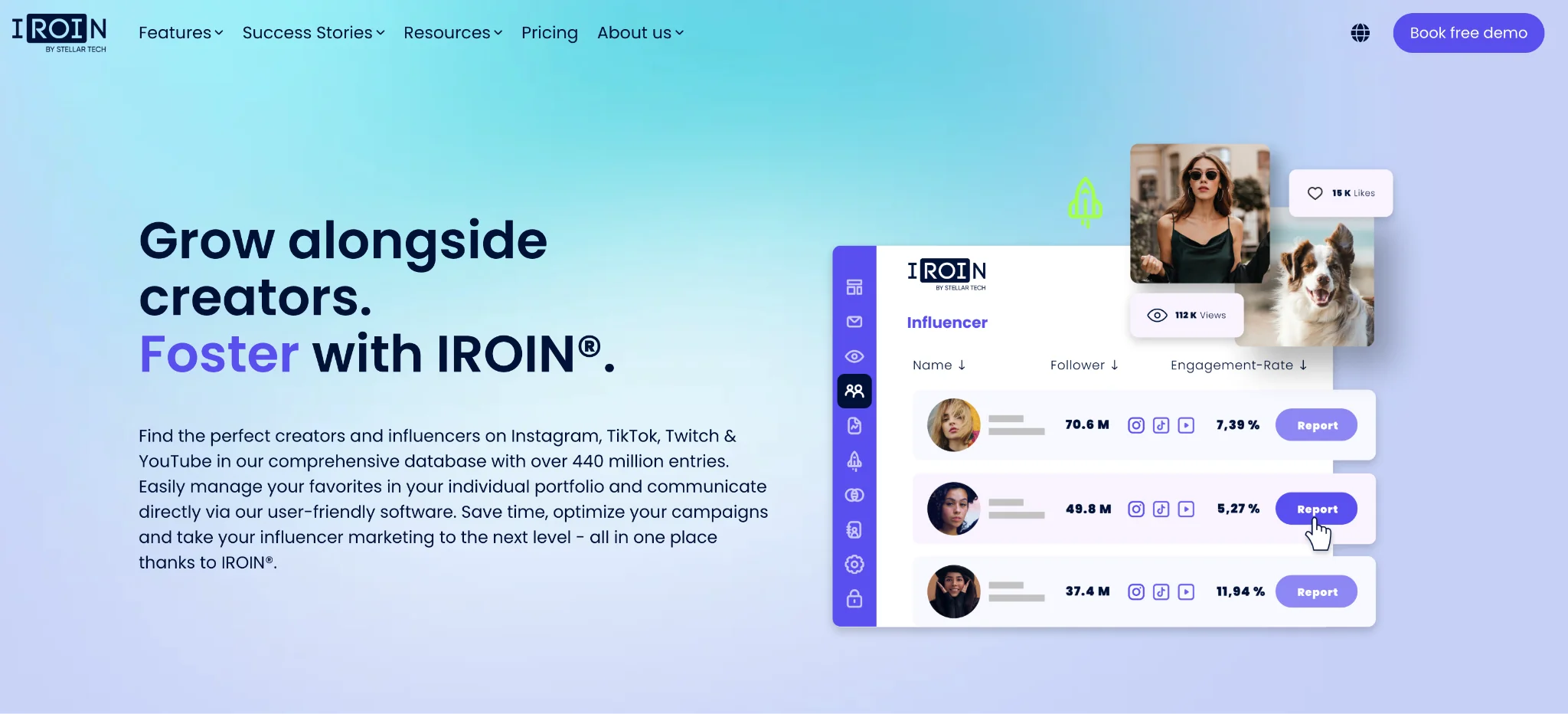
IROIN is a German influencer marketing platform built on more than 440 million creator profiles across Instagram, TikTok, YouTube and Twitch, searchable with over 45 filters and AI matching that works on visuals as well as text. Around that sit audience quality analysis, brand safety detection, competitor benchmarking and AI performance forecasting. Data is EU-hosted, the platform is GDPR-compliant and support runs in four languages, which removes a procurement conversation most US tools create for European buyers.
The catch is where the product divides. Discovery and analysis are the entry tier, and the operational half is a separate purchase: creator CRM, workflow automation, budget and deliverable tracking, live campaign monitoring and automated client reports. Teams buying it mainly for the last of those should test the ROI reporting against what they already produce, because some of it arrives as an Excel download.
Key Features
- Visual AI search: Find creators by what appears in their posts, not only by the words in their captions.
- 45-plus filters: Narrow 440 million profiles across four networks down to a workable shortlist.
- Brand affinity and safety checks: See who a creator has worked with and whether they carry risk before you make contact.
- AI performance forecasting: A predicted campaign outcome you can put in front of whoever signs off the budget.
- Promo code and link tracking: Unique codes and tracked links per creator, monitored through the campaign.
Pricing
Discovery Radar is €299 a month and Campaign Manager is €899, both on twelve-month subscriptions with three logins included. Enterprise+ is custom-priced and is the only tier with API access.
The €600 gap buys capability, not seats. Discovery Radar is a research subscription with outreach attached. Campaign Manager is the one with the CRM, the workflow automation, the budget tracking and the client reports, and it works out at €10,788 a year.
Reviews
- 4.7/5.0 (OMR Reviews, 183 reviews)
- Capterra: listed with no reviews yet
Integrations
- Instagram: The deepest platform connection, powering campaign tracking and profile insights.
- Bitly: Link tracking, which is what the promo code attribution runs on.
- Chrome plugin: Creator insights while you browse, rather than a data connection as such.
- API: Full access, but only on the Enterprise+ tier.
- eCommerce platforms: None published, so codes and store orders never reconcile automatically.
Pros
- 183 reviews at 4.7: Nothing below four stars in the distribution, which is rare in this category.
- European by build: EU servers, GDPR compliance and support in four languages.
- Three logins as standard: Included on both named tiers rather than charged per seat.
Common Drawbacks of IROIN
The entry tier cannot run a campaign
€299 buys search, analysis and outreach and nothing else. Any team managing creators is on Campaign Manager at €899, which is €10,788 a year.
Integrations are thin and users say so
Instagram and Bitly are the named connections. Reviewers ask for better TikTok, Twitch and LinkedIn support and report data accuracy problems on Meta.
No store connection at all
No Shopify, WooCommerce or equivalent is published. Codes and links are tracked inside the platform, so nothing ties a creator to an order in your checkout.
Twelve-month terms on a three-day trial
Every tier is an annual subscription and the reported trial runs three days. That is not long enough to test the campaign module you are paying the extra €600 for.
Best IROIN Alternatives
| TOOL | REVIEWS | BEST FOR | TRIAL INFO | PRICING | ||
|---|---|---|---|---|---|---|
1 |

|
⭐ | DTC creator management | Book Demo | Pricing | Website |
2 |

|
⭐ | Influencer CRM & automation | Book Demo | Pricing | Website |
3 |

|
⭐ | Social media & influencer campaigns | Book Demo | Pricing | Website |
4 |

|
⭐ | Influencer discovery | Book Demo | Pricing | Website |
5 |

|
⭐ | Influencer marketplace campaigns | Book Demo | Pricing | Website |
6 |

|
⭐ | Micro-Influencer Campaigns | Book Demo | Pricing | Website |
7 |
|
⭐ | Influencer discovery & outreach | Book Demo | Pricing | Website |
8 |

|
⭐ | UGC creators & paid social ads | Book Demo | Pricing | Website |
9 |

|
⭐ | Creator Performance Platform | Book Demo | Pricing | Website |
10 |

|
⭐ | Influencer campaigns & creator marketplace | Book Demo | Pricing | Website |
GRIN

GRIN is a creator management platform for eCommerce brands, built to hold a whole program in one place rather than to sell research access. It carries one of the largest review bases in the category after years as a default enterprise choice. Its plans are now self-serve, credit-based and month-to-month.
Key Features
- Creator discovery: Search and AI matching sit inside the same product as the campaign tooling, not on a separate plan.
- Campaign workflow: Briefs, approvals and deliverables tracked from first contact to published post.
- Content collection: Creator posts pulled in automatically and stored for reuse.
- Discount codes and links: Issued per creator and reconciled against real store orders.
- Unlimited CRM access: Included on every plan, with no cap on relationships stored.
Pricing
- Free: $0 a month, 200 credits, no card required
- Starter: $200 a month, 2,000 credits
- Growth: $500 a month, 7,500 credits, 100 active creators
- Scale: $1,000 a month, 20,000 credits, 250 active creators
- Complete: $1,500 a month, 30,000 credits, 500 active creators
Extra credits cost $0.10, and every plan runs month-to-month.
Reviews
4.5/5.0 (G2, 483 reviews).
Pros
- Campaign tools at every price: Even the free plan includes the CRM and code tracking.
- No contract: Month-to-month against a twelve-month commitment.
- Store attribution included: Revenue lands against the creator who drove it.
Cons
- Credits still meter usage: Busy months run over at $0.10 each.
- Roster caps by tier: 100 active creators on Growth, 500 on Complete.
- US-hosted: No EU data residency guarantee for European procurement.
Integrations
- Shopify: The eCommerce connection IROIN has no published equivalent of.
- WooCommerce: The same coverage for WordPress storefronts.
- Klaviyo: Creator segments dropped into lifecycle email.
- PayPal: Creator payments handled without an export.
- Zapier: The rest of your stack, connected without engineering time.
IROIN vs GRIN
Both sell a full program, but only one sells it in a single purchase. IROIN puts the CRM, workflow and reporting behind an €899 tier. GRIN includes the CRM on its free plan and adds discount codes, content collection and GMV tracking on top.
Terms decide the rest. IROIN wants twelve months at either tier. GRIN charges from $0 to $1,500 a month with no term at all. For a brand that has not proven the channel yet, being able to leave in thirty days is worth more than a bigger database.
Influencer Hero
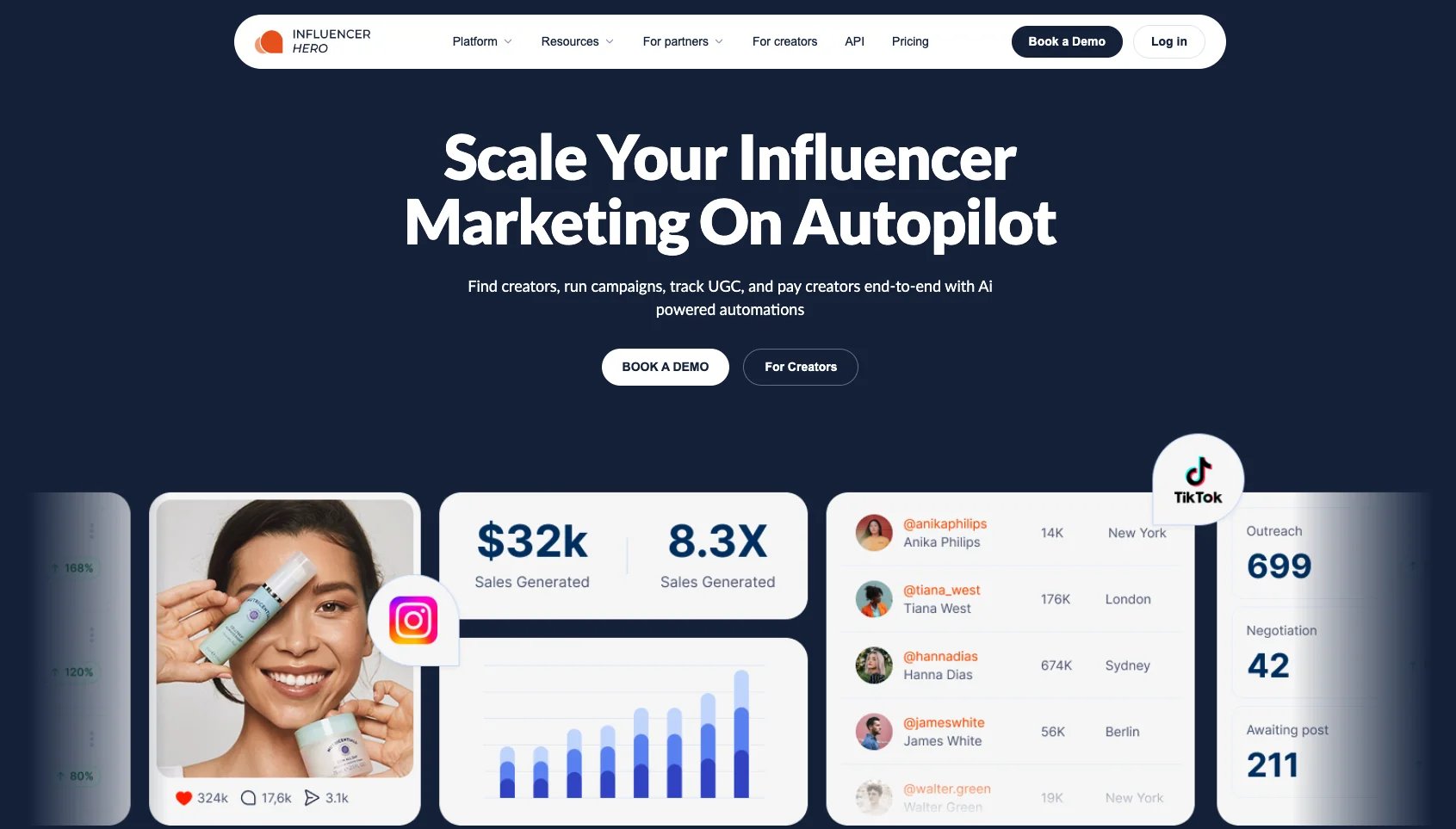
Influencer Hero is an all-in-one influencer marketing platform for D2C and eCommerce brands, spanning 8 social platforms with Instagram, YouTube and TikTok at the centre. Discovery, outreach, campaign boards, gifting, UGC, affiliate tracking and creator payouts sit in one product on one plan. Pricing is published and scales with outreach volume rather than with features.
Key Features
- Discovery with 20-plus filters: Eight networks and AI search, with fake-follower screening built into the results.
- Campaign boards: A drag-and-drop creator CRM with automations that fire when a creator moves stage.
- Custom fields and field-aware rules: Per-creator logic like tiered commission or gifting caps, without a developer.
- Gifting through your store: Product orders raised in Shopify or WooCommerce and tracked to delivery.
- Content review workflows: Request, approve or return content with a reason, tracked in one queue across campaigns.
- Affiliate codes and commission: Codes and links per creator, with commission worked out in the platform.
- Payouts and invoicing: Bulk and scheduled payments at 0.1% to 0.4%, with invoices requested automatically.
- Automated campaign reporting: ROI, sales by creator and product cost against return, compiled without an export.
Pricing
- Standard: $649 a month, up to 1,000 reachouts a month
- Pro: $1,049 a month, up to 5,000 reachouts a month
- Business: $2,490 a month, up to 10,000 reachouts a month
- Custom & Agency: custom pricing
Quarterly billing saves 20% and yearly saves 30%, with no minimum term.
Reviews
5.0/5.0 (Capterra)
Pros
- One tier, whole program: The CRM and reporting are not a separate purchase.
- Attribution reaches the order: Codes and links reconcile against Shopify and WooCommerce.
- No contract to sign: Published monthly pricing with no twelve-month lock.
Cons
- No free trial
- Expensive for smaller brands
- Steep learning curve
Integrations
- Shopify: Gifting orders raised and creator revenue booked automatically.
- WooCommerce: Equivalent coverage for WordPress, with scripts for Magento and custom builds.
- DocuSign: Creator agreements signed and filed on the deal record.
- Klaviyo: Creator and customer segments into lifecycle email.
- Zapier: Over 8,000 further apps for anything not native.
IROIN vs Influencer Hero
IROIN’s discovery is genuinely strong, and the visual AI search finds creators a keyword filter would miss. Influencer Hero puts the same class of discovery on eight networks with over 20 filters and fake-follower screening, then keeps going into the part IROIN charges extra for. Campaign boards with automations, gifting raised from Shopify or WooCommerce, a content library with approval workflows, affiliate codes with commission calculated in-platform, and creator payouts at 0.1% to 0.4%. Reporting compiles ROI and sales by creator on its own, rather than arriving as a spreadsheet to tidy up.
On cost the structures are not comparable in the way the headline suggests. IROIN’s campaign tier is €899 a month on a twelve-month term, or €10,788 committed before the first campaign. Influencer Hero publishes $649, $1,049 and $2,490 a month with 20% off quarterly and 30% off yearly, and no term at all. The entry plan is the cheaper of the two against Campaign Manager, includes 1,000 reachouts a month, and connects creator activity to actual store revenue, which IROIN has no published integration to do.
Later

Later grew from an Instagram planning tool into a social suite, and its influencer product sits alongside the scheduling one. In-house social teams are its natural users, publishing and managing creators from the same account. It also owns Mavely, an affiliate network creators join to earn commission on brand links.
Key Features
- Content calendar: Drag-and-drop planning across every connected network in one view.
- Approval workflows: Internal sign-off before anything publishes, from the Growth plan up.
- Later Influence: The separate creator product covering briefs, campaigns and deliverables.
- Competitive benchmarking: Your performance against rival accounts, on the top social tier.
- Mavely: Creator commission on brand links without a direct contract.
Pricing
- Starter: $25 a month, or $18.75 billed yearly
- Growth: $50 a month, or $37.50 billed yearly
- Scale: $110 a month, or $82.50 billed yearly
Those cover the social side, with a 14-day trial. Later Influence is quoted rather than published.
Reviews
4.5/5.0 (G2, 469 reviews) for Later Influence and 4.5/5.0 (G2, 384 reviews) for Later Social.
Pros
- A fortnight to test it: 14 days against a reported three-day window.
- Cheap on the social side: $18.75 a month yearly for publishing and analytics.
- Two review bases: 469 and 384 reviews across the two products.
Cons
- The creator product is quote-only: Later Influence publishes no price at all.
- No audience vetting: Nothing like authenticity scoring or brand safety analysis.
- Reviewers report glitches: Campaign delivery and dashboards come up repeatedly.
Integrations
- Instagram: Publishing, scheduling and creator content in one calendar.
- TikTok: Short-form planning and performance alongside everything else.
- Shopify: Shoppable posts pulled from your product catalogue.
- Canva: Design assets dropped into the planner without a download.
- Slack: Approvals and campaign alerts routed to the team.
IROIN vs Later
IROIN researches creators and reports on campaigns. Later publishes the content and schedules the posts around them. Very little overlaps, which makes this less of a swap than a question about which gap you have.
What Later does answer is the commitment problem. Fourteen days free and $18.75 a month yearly is a low-risk way in, against €299 a month locked for a year on a three-day look. The trade-off is that Later Influence, the part that actually competes here, has no published price either.
Heepsy

Heepsy is a discovery and outreach tool covering Instagram, TikTok, YouTube and LinkedIn, with a free plan and paid tiers that meter usage rather than seats. Small businesses make up 93% of its reviewer base. Its selling point is that search, email and payments live in the same low-priced product.
Key Features
- 30-plus filters: AI, lookalike and text search across four networks, usable on the free plan.
- LinkedIn creators: One of the networks IROIN reviewers ask for and do not get.
- Bulk email with sync: Send from the platform and take replies in your own inbox.
- Mailing sequences: AI-composed follow-ups from the Plus tier onward.
- Creator payments: Partners paid inside the tool rather than through finance.
Pricing
- Free: $0, 500 search results and 10 advanced profiles a month
- Starter: $69 a month billed annually, 300 outreach emails
- Plus: $149 a month billed annually, 1,200 outreach emails
- Advanced: $229 a month billed annually, 6,000 outreach emails
A 14-day trial runs on a work email with no card.
Reviews
4.5/5.0 (Capterra, 72 reviews).
Pros
- Discovery at a fifth of the price: $69 a month against €299 for the research tier.
- Free plan included: Real search access before you pay anything.
- Payments at the mid tier: Something IROIN does not offer at any tier.
Cons
- A much smaller index: Four networks and nothing near 440 million profiles.
- Metered on four axes: Results, profiles, emails and tracked creators all capped.
- 72 reviews: A thinner record than IROIN’s 183.
Integrations
- Shopify: A store link that connects campaigns to sales.
- Instagram: Profile data and content inside the search results.
- TikTok: Short-form coverage on the same filter set.
- YouTube: Channel analytics beside the short-form networks.
- LinkedIn: Professional creator search most rivals skip.
IROIN vs Heepsy
These compete directly on discovery, and IROIN wins on depth. A 440 million index with visual AI search and audience quality analysis is a different class of research tool from four networks and 30-odd filters, and 183 reviews back it up.
Heepsy wins on everything around it. It costs $69 a month rather than €299, has a free plan and a fortnight to test, adds LinkedIn coverage that IROIN users are asking for, and includes creator payments. For a small brand doing Instagram creator discovery on a modest budget, the cheaper tool covers more of the job.
Afluencer
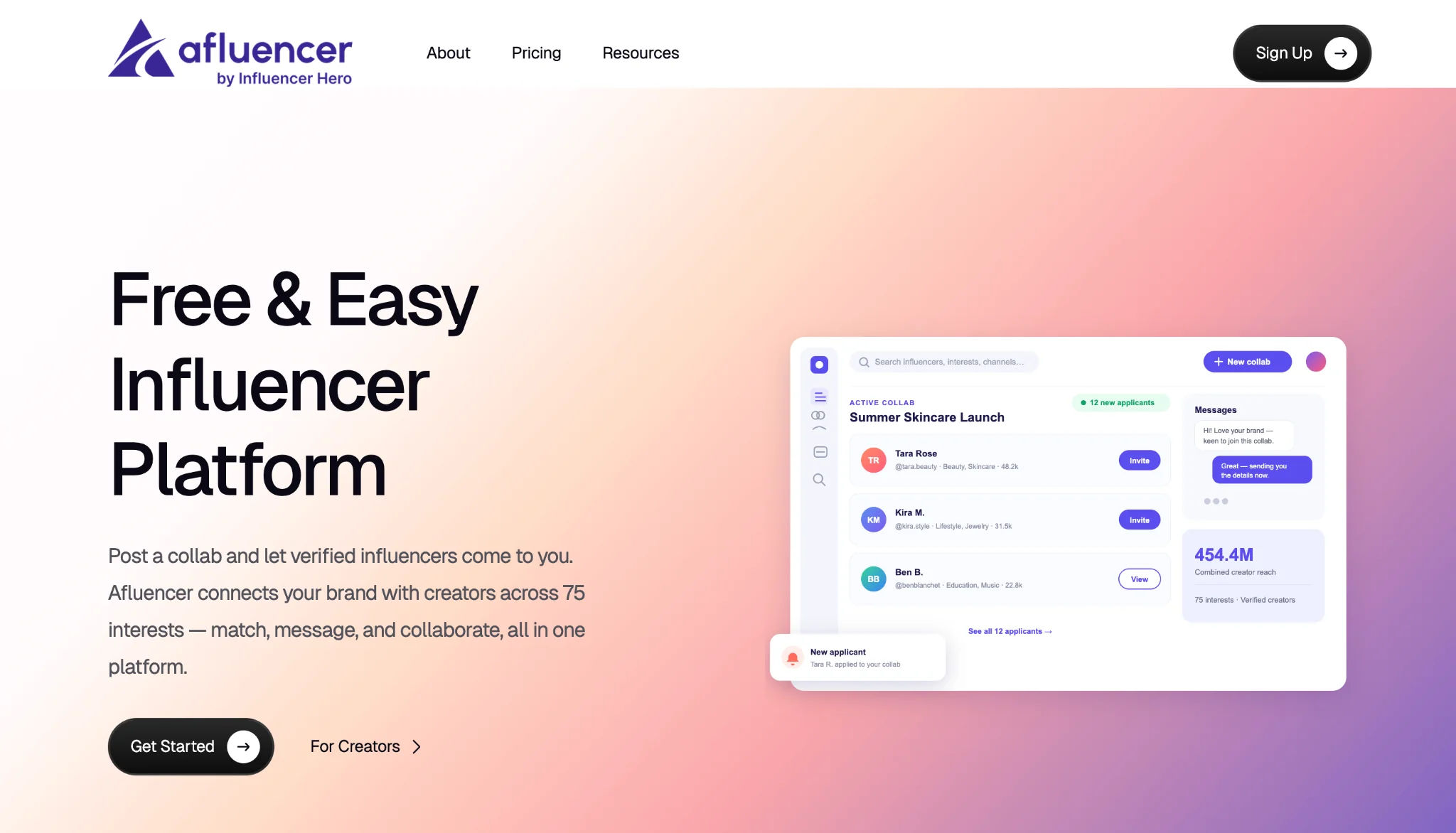
Afluencer works by application rather than search. Brands publish a collaboration listing, verified creators across Instagram, TikTok, YouTube, Facebook and X apply, and you choose from the queue. Its customers are mostly Shopify merchants and small D2C teams, on a published flat fee with no contract.
Key Features
- Collaboration listings: Post the brief and let creators come to you, with no search skill needed.
- Verified members: Accounts registered and checked before anyone can apply.
- CreatorGPT: AI ranks applicants against your brief before a person reviews them.
- Invite credits: Outbound approaches for the months when the queue is quiet.
- Store-connected codes: Discount codes and creator fees handled through the storefront link.
Pricing
- VIP: $49 a month
- Concierge: $99 a month
No minimum term, and creator-side plans are billed separately.
Reviews
4.6/5.0 (G2, 738 reviews) and 4.7/5.0 (Shopify App Store, 34 reviews). The G2 pool leans creator-side, so read it beside the Shopify score.
Pros
- $49 with nothing to sign: A sixth of the research tier, cancellable any month.
- No search expertise needed: A straightforward route to booking creators without learning a filter set.
- 738 reviews: The deepest evidence base of the ten.
Cons
- Inbound only, mostly: A weak listing produces weak applicants and you cannot force volume.
- Very little audience data: No authenticity scoring or brand safety reporting.
- North America weighted: European creator supply is thinner.
Integrations
- Shopify: Codes, referrals and creator orders tracked from the store.
- BigCommerce: The same connection for BigCommerce merchants.
- Klaviyo: Creator contacts pushed into email lists.
- DocuSign: Collaboration terms signed inside the flow.
- Slack: Application alerts sent to the team as they land.
IROIN vs Afluencer
IROIN is built for teams who have to defend a creator choice with data. Afluencer is built for teams who just need someone to say yes. Those are different problems, and most brands hit the second one long before the first.
The gap in commitment is severe. Afluencer is $49 a month, cancellable, and connects to your store. IROIN’s research tier is €299 a month for twelve months and connects to no store at all. For a European brand the GDPR position is real, but it is not worth €3,588 if the problem is an empty roster.


Social Cat
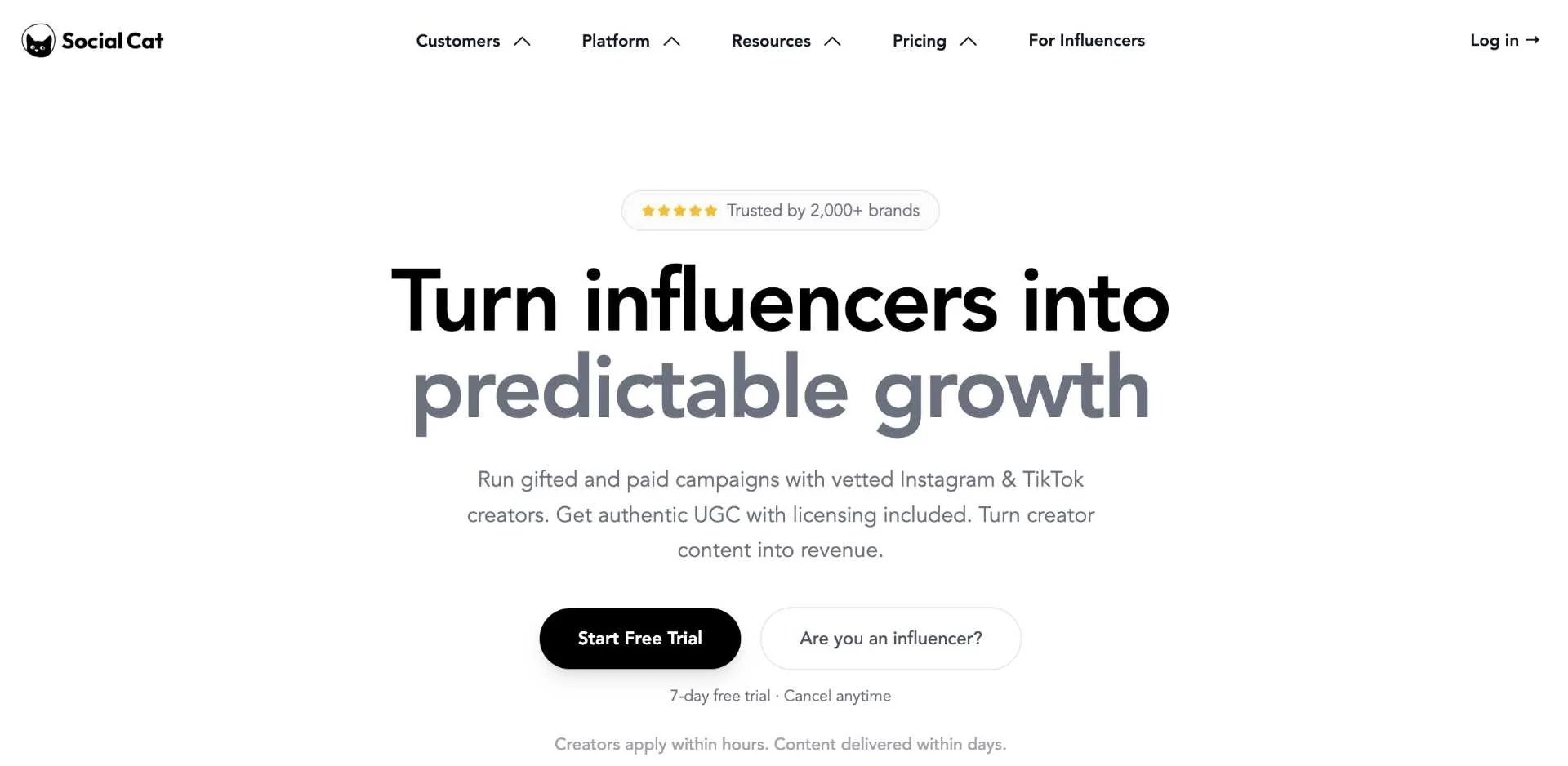
Social Cat matches smaller brands with micro-influencers for gifted and paid collaborations, and sells plans by how many collaborations you complete each month. Content comes back with usage rights attached. It is aimed at teams who want assets rather than analysis.
Key Features
- Completed-collaboration pricing: You buy outcomes per month rather than credits or seats.
- Bulk invitations: From 1,000 creator invites a month on the entry plan.
- Contracts in-platform: Terms agreed with each creator before product ships.
- Creator ratings: Past performance visible before you invite anyone.
- Content library: Delivered assets stored and reviewed in one place.
Pricing
- Essentials: $99 a month, up to 5 collaborations, 1 campaign
- Performance: $199 a month, up to 15 collaborations, 3 campaigns
- Pro: $299 a month, up to 30 collaborations, unlimited campaigns
Every tier includes a free trial.
Reviews
3.9/5.0 (Trustpilot, 364 reviews). Around 80% are five-star and 15% one-star, with slow support the repeated complaint.
Pros
- You end with content: Assets and rights rather than a shortlist and a forecast.
- Predictable ceiling: $99 to $299 a month, with the output known in advance.
- Trial on every plan: Testable without a year attached.
Cons
- Five collaborations on entry: A small program by design.
- Support is the weak point: One review in seven is a one-star about response times.
- The lowest rating here: 3.9 against IROIN’s 4.7.
Integrations
- Shopify: Gifted orders raised against the campaign rather than keyed in.
- Instagram: Creator profiles and delivered posts pulled in automatically.
- TikTok: The same route for short-form deliverables.
- Email: Creator conversations handled from the campaign record.
- Content export: Approved assets downloaded for paid social.
IROIN vs Social Cat
One is a research and reporting platform for teams with a process. The other is a content pipeline for teams with a product and a deadline. Social Cat will not tell you a creator’s audience quality, and IROIN will not put a single asset in your ad account.
Money separates them further than function does. Social Cat tops out at $299 a month with a trial and no term. IROIN’s campaign tier is €899 a month committed for a year, which is roughly thirty-six times the annual outlay for a brand that mainly needs posts.
Ainfluencer

Ainfluencer is a marketplace of more than 25 million creators across Instagram, TikTok and YouTube that costs brands nothing to use. Deals are negotiated in the platform and paid through escrow once content is delivered. Its revenue comes from a margin on creator payouts rather than a subscription.
Key Features
- Free for brands: Search, invite and negotiate with no plan and no card.
- Escrow releases: Funds held until the agreed content actually lands.
- AI filtering: Niche, location and engagement filters across the full pool.
- Mixed deal types: Gifted, paid and affiliate arrangements from one dashboard.
- Negotiation on the record: Offers and counter-offers logged instead of scattered across email.
Pricing
Free for brands, with no subscription at any level. The company takes a deduction from creator payouts, so your real cost is creator fees plus whatever margin sits inside them.
Reviews
4.7/5.0 (G2, low review volume at 24 reviews).
Pros
- Nothing to commit: No fee, no term and no seat count.
- Payment risk removed: Escrow protects the first collaboration on both sides.
- Unlimited outreach: No cap on creators contacted in a month.
Cons
- The cost is hidden in payouts: Free to you because it is priced into creator fees.
- 24 reviews: Thin for a platform that holds money.
- No analysis to speak of: Basic profile data, nothing like brand safety reporting.
Integrations
- Instagram: Creator profiles, engagement data and delivered posts.
- TikTok: Short-form coverage across every deal type.
- YouTube: Channel-level data for longer collaborations.
- Escrow payments: Money handled natively without an outside processor.
- Data export: Campaign and creator records out for your own reporting.
IROIN vs Ainfluencer
This is the extreme end of the price comparison. IROIN commits you to €3,588 a year at minimum and €10,788 for the campaign tier. Ainfluencer commits you to nothing and still lets you contact creators and pay them safely.
What you lose is the evidence. Ainfluencer gives you basic profile data and no brand safety reporting, so a team that needs to justify a creator choice internally cannot do it here. That is exactly the buyer IROIN is built for, and it is the one case where the annual contract earns its keep.
Insense
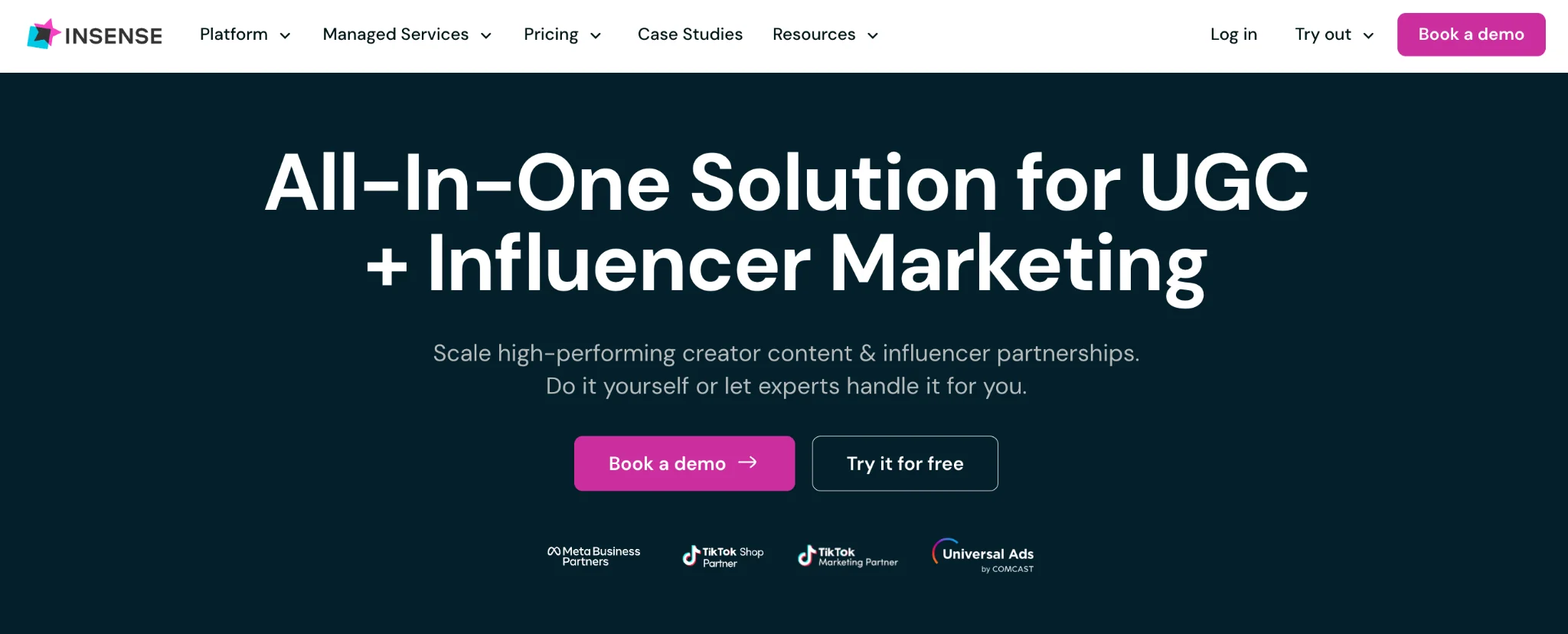
Insense supplies UGC video for paid social on a schedule. Vetted creators apply to a brief, deliver in roughly ten business days, and the content arrives with usage rights cleared. Performance marketers buying ad creative are its core customers.
Key Features
- Five-applicant guarantee: At least five matching creators apply, or the subscription is refunded.
- Three revision rounds: Structured feedback built into the brief rather than negotiated.
- Meta Partnership Ads: Creator handles connected so ads run from their profile.
- Seeding included: Product shipped to creators as part of the campaign.
- Rights-cleared assets: Paid usage licensed in the deal, not bolted on afterwards.
Pricing
- Trial: $650 for one month, 1 campaign and 10 creators, 20% marketplace fee
- Brand: $500 a month billed quarterly, or $400 a month annually, 10% fee
- Agency: $800 a month billed quarterly, or $640 a month annually, 7% fee
Campaigns and creators are unlimited on both paid plans.
Reviews
4.5/5.0 (G2, 374 reviews).
Pros
- A quarterly option: $500 a month billed quarterly instead of a year up front.
- Both costs published: Subscription and marketplace fee stated openly.
- 374 reviews: A large independent record for a marketplace.
Cons
- A fee on top: 7% to 20% of creator payments above the plan price.
- Creative, not reach: Built for ad assets rather than a creator’s own audience.
- No audience analysis: Creators are vetted, audiences are not.
Integrations
- Meta: Partnership Ads and whitelisted content run directly.
- TikTok: Assets routed into ad formats without re-uploading.
- Shopify: Seeding orders raised from your catalogue.
- Stripe: Creator payments processed in the workflow.
- Ad account export: Approved content pushed into live campaigns.
IROIN vs Insense
IROIN forecasts what a campaign might return. Insense delivers the video you would run it with. If your problem is that paid social keeps burning through creative, no amount of audience analysis fixes it.
Both charge more than the sticker, in different currencies of pain. Insense adds a marketplace fee of 7% to 20% on creator payments. IROIN adds a year-long term and a second tier to unlock the campaign tools. Insense at least lets you pay quarterly.
The Cirqle

The Cirqle runs influencer marketing as a performance channel, scoring creators on measured return from first-party data and automating everything around them. Briefs, negotiation, contracts, shipping, approvals and payouts move as one chain, and licensed content can be published as paid ads. Loop Earplugs, ABOUT YOU and Lookfantastic appear among its named customers.
Key Features
- ROAS-scored discovery: Creators ranked on measured returns rather than engagement rate.
- Turn-into-ads: Licensed content published on Meta, TikTok and YouTube from the platform.
- Automated campaign chain: Briefs through payouts handled without manual handoffs.
- Paid and organic in one view: Both tracked in the same attribution dashboard.
- Agentic access: Campaign data reachable from Claude, ChatGPT and other MCP clients.
Pricing
Nothing is published on the company’s own site, which routes you to a demo. Its Shopify App Store listing does show figures: Base at $999 a month or $9,998 a year, and Base Plus at $1,999 a month or $19,999 a year, with per-creator fees negotiated on top.
Reviews
4.8/5.0 (G2, 8 Reviews)
Pros
- Revenue is the ranking: Creators scored on what they actually returned.
- Store attribution built in: Shopify and Northbeam connections rather than none.
- Named European customers: Recognisable brands published openly.
Cons
- Two costs, one negotiated: Per-creator fees agreed case by case on top of the plan.
- No review record: Nothing independent to read anywhere.
- $999 is the floor: More expensive than IROIN’s campaign tier before fees.
Integrations
- Shopify: Orders matched to creators for revenue attribution.
- Meta: Creator content published and measured as paid media.
- TikTok: The same route for short-form creative.
- Northbeam: Results reconciled against your wider attribution stack.
- Impact.com: Affiliate and partnership data connected in.
IROIN vs The Cirqle
Two European platforms at the top of this list, arguing about what proof means. IROIN builds its case from audience data and forecasts. The Cirqle builds it from what a creator returned in revenue for other brands, then connects to Shopify and Northbeam so it can keep proving it.
Transparency is where IROIN wins outright. It publishes €299 and €899 and carries 183 reviews at 4.7. The Cirqle publishes nothing on its own site, starts at $999 on an app listing, adds negotiated per-creator fees, and has no reviews anywhere to check against.
Creator.co

Creator.co pairs a 400 million creator index with AI matching, drafted briefs and outreach, sold either self-serve or as a managed engagement. Nike, Oakley and Best Buy appear in its published customer list. Contact credits and insight reports are the metered units rather than seats.
Key Features
- 400 million index: Instagram, TikTok and YouTube at a scale close to IROIN’s own.
- AI campaign briefs: Briefs and personalised outreach drafted rather than written from scratch.
- Contact credits: 100 a month on self-serve, with more at $99 per hundred.
- Managed engagement: Their team runs recruitment, communication and optimisation on the higher tier.
- TikTok Shop attribution: Social commerce revenue tracked natively.
Pricing
- Self-Serve: $299 a month, or $199 a month annually, on a 3-month minimum
- Managed: $2,199 a month, or $1,499 a month annually, on a 6-month minimum
- Enterprise: custom pricing on an annual commitment
Self-Serve includes 100 contact credits and 50 insight reports.
Reviews
4.6/5.0 (G2, 124 reviews).
Pros
- A quarter of the commitment: Three months self-serve against twelve.
- Comparable index: 400 million profiles, in the same class of scale.
- Store attribution included: Shopify and TikTok Shop tracking as standard.
Cons
- Credits are the ceiling: 100 contacts a month before you buy more.
- Managed output is capped: Up to five collaborations a month at $2,199.
- Lighter risk analysis: Insight reports, but no sentiment or brand safety detection.
Integrations
- Shopify: Creator-driven orders and codes tracked from the store.
- TikTok Shop: Native attribution for social commerce.
- Google Analytics: Campaign traffic joined to on-site behaviour.
- Instagram: Creator profiles and post performance in the campaign view.
- Data exports: Creator and campaign records out for client reporting.
IROIN vs Creator.co
These are the closest match on this page. Both run large indexes with AI matching, both sell a research tier and a fuller one, and both are pitched at agencies as much as brands. Creator.co’s self-serve plan at $199 a month annually undercuts Discovery Radar by a wide margin while including campaign tools IROIN reserves for €899.
IROIN answers with depth and evidence: brand safety detection, competitor benchmarking, visual search and 183 reviews at 4.7 against 124 at 4.6. Where it loses is commitment and commerce. Three months against twelve, and Shopify and TikTok Shop attribution against no published store connection at all. Agencies weighing influencer marketing software on flexibility rather than database size will find that decisive.
Final Thoughts on IROIN Alternatives
IROIN earns its reviews. A 440 million index with visual search, audience quality analysis and brand safety detection, hosted in the EU with GDPR compliance and four-language support, is a serious research platform, and 183 reviews at 4.7 with nothing below four stars is unusual evidence in this category.
What it asks in return is a twelve-month commitment on a three-day trial, and a second tier at €899 before you can manage anything you find. Decide which half of the product you are really buying, then check whether the tools that bundle both cost less than the half you would be paying for here.

.png)


.jpg)










