


10 Best Influencers.club Alternatives for Influencer Marketing
Influencers.club is not really a place to run campaigns from. It is a creator database with pipes attached: 340 million profiles across 47 networks, verified emails and phone numbers, and an API that pushes all of it into whatever system you already use.
That is a strong product for a team with somewhere to put the data. It is the wrong purchase entirely if you wanted one subscription to find creators, brief them, ship product, track sales and pay them, because none of those things happen here at any price.
These ten cover more of that ground: CreatorIQ, Traackr, Influencer Hero, Klear, Afluencer, SARAL, Lefty, Humanz, Modash and Glewee.
Key Criteria for Evaluating Influencer Marketing Platforms
Core Features
Evaluation of essential influencer marketing capabilities, including influencer discovery, outreach, CRM, campaign management, reporting, and content workflows.
Pricing & Flexibility
Comparison of pricing models, subscription plans, and contract terms to match different budgets and growth stages.
Customer Reviews & Satisfaction
Analysis of user feedback from trusted review platforms, focusing on usability, reliability, customer support, and overall performance.
Pros & Cons
Review of each platform’s strengths and limitations to highlight where it performs well and where it may fall short based on different use cases.
Integrations
Review of the most important integrations (e.g., Shopify and other tech tools), highlighting what each integration enables in one sentence.
Influencers.club Overview
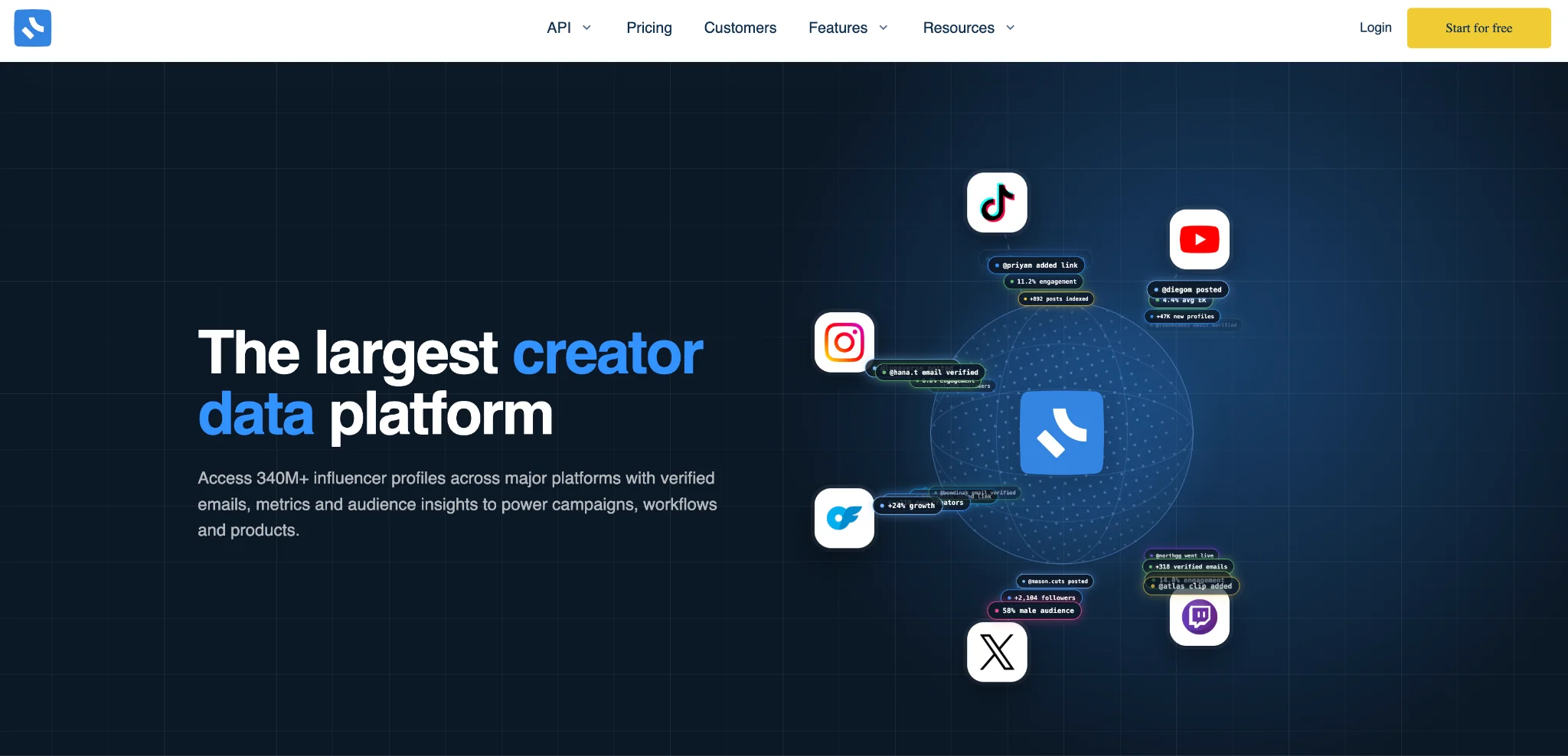
Influencers.club sells creator data as infrastructure. The database holds around 340 million profiles across 47 platforms, including Discord and other networks nobody else indexes, with roughly 200 data points per creator and verified contact details sold openly. Agencies, data teams and companies building creator features into their own products are the core buyers, and everything is metered in credits rather than bundled into a flat fee. Brands who only need one network will find the depth overkill next to a focused Instagram creator search.
Key Features
- 47-network coverage: Instagram, TikTok and YouTube plus 44 others, which is unmatched in this category.
- Verified emails and phone numbers: Real contact details rather than bio links or inferred addresses.
- AI search with 40-plus filters: Natural-language queries backed by structured filtering across 200 data points.
- The enrichment API: Endpoints for enrichment, discovery and monitoring, each metered at a different credit rate.
- Creator monitoring: Continuous tracking of performance, billed at 0.3 credits per creator per day.
Pricing
- Starter, dashboard only: from $140 a month, credits from $0.15, no API access
- Pro, API and dashboard: from $208 a month, credits from $0.23, with audience data and CRM enrichment
- Agency: custom pricing with volume discounts
Seats are unlimited and credits roll over. The subscription is only the entry point, since monitoring 100 creators for a month costs 900 credits before any discovery happens. New accounts get 10 free credits with Pro features.
Reviews
4.6/5.0 (G2, 27 reviews). Reviewers praise coverage, the API and support, and consistently criticise data accuracy and thin reporting.
Integrations
- HubSpot and Salesforce: Native enrichment writes creator records into the CRM your team already uses.
- Snowflake: Creator data lands in the warehouse next to commercial data.
- Clay: Feeds enrichment waterfalls, which signals exactly who the product is built for.
- Zapier and n8n: Trigger-based automation without a person in the loop.
- MCP: Direct access for AI agents, which almost nothing else in this category publishes.
What is missing is the commerce side entirely: no Shopify, no WooCommerce, no affiliate network and no payment provider.
Pros
- Coverage nothing else matches: 47 networks against the usual three.
- Contact data sold openly: The hardest thing to source for cold creator outreach.
- Fits systems you already run: CRM enrichment and a warehouse connector rather than another dashboard.
Common Drawbacks of Influencers.club
The credit meter is the real bill
$140 and $208 buy the smallest allowance. Monitoring a 100-creator roster costs 900 credits a month on its own, which adds $135 to $207 before a single new creator is found.
No campaign layer at all
There are no CRM boards, no gifting workflows, no discount codes, no affiliate tracking and no creator payouts. Everything after a creator says yes happens in a second tool.
Accuracy needs a human check
Reviewers who rate the product highly still report inconsistent prospect quality and creators filed under the wrong niche. On a database this size that is expected, but it keeps manual vetting in the loop.
Reporting is the weakest part
Analytics and dashboards come up repeatedly as thin, by the platform’s own users. You can monitor creators but struggle to show anyone what the monitoring concluded.
Best Influencers.club Alternatives
| TOOL | REVIEWS | BEST FOR | TRIAL INFO | PRICING | ||
|---|---|---|---|---|---|---|
1 |

|
⭐ | Enterprise influencer marketing | Book Demo | Pricing | Website |
2 |

|
⭐ | Enterprise influencer analytics | Book Demo | Pricing | Website |
3 |

|
⭐ | Influencer CRM & automation | Book Demo | Pricing | Website |
4 |

|
⭐ | Influencer analytics | Book Demo | Pricing | Website |
5 |

|
⭐ | Influencer marketplace campaigns | Book Demo | Pricing | Website |
6 |

|
⭐ | Influencer outreach | Book Demo | Pricing | Website |
7 |

|
⭐ | Influencer analytics & discovery | Book Demo | Pricing | Website |
8 |

|
⭐ | Data-led influencer platform | Book Demo | Pricing | Website |
9 |

|
⭐ | Influencer discovery | Book Demo | Pricing | Website |
10 |

|
⭐ | Small brands running influencer and UGC campaigns | Book Demo | Pricing | Website |
CreatorIQ

CreatorIQ is enterprise creator management software used by global brands and the agencies that support them. It combines a verified creator database with the workflow, approvals and reporting that large programs require, and it is bought when several teams need to operate in one system. Data portability matters as much as the interface for its customers.
Key Features
- Verified profile data: Creators connect their accounts, so the numbers behind a decision are first-party.
- End-to-end campaign workflow: Briefs, contracts, approvals and deliverables in one place rather than in a separate tool.
- Content rights management: Usage terms stored with every asset for later reuse.
- Affiliate and order attribution: Codes and links resolving revenue to named creators.
- Open API and warehouse exports: The same portability a data buyer expects, wrapped around a working platform.
Pricing
Not published. Procurement data puts entry near $30,000 a year, the median around $39,250 and larger contracts near $59,500, on annual terms.
Reviews
4.6/5.0 (G2, 581 reviews).
Pros
- Data and workflow together: Both halves in one contract instead of two.
- Payments included: Creator fees handled inside the platform.
- Large review base: 581 reviews against 27.
Cons
- A $30,000 floor: Many times the annual cost of a data subscription.
- Annual only: No monthly option and no self-serve entry.
- Heavier to run: More platform than a lean data team wants to operate.
Integrations
- Snowflake: Delivers creator and campaign data to the warehouse.
- Salesforce: Keeps creator records in step with the commercial system.
- Shopify: Connects orders so creator work is measured in revenue.
- PayPal: Settles creator fees inside the workflow.
- Slack: Routes approvals into the team channel.
Influencers.club vs CreatorIQ
Both sell portability, and both will land creator data in Snowflake. The difference is what surrounds it. CreatorIQ wraps that data in briefs, contracts, approvals, attribution and payouts, so the export is a feature rather than the entire product.
Cost decides who each suits. A data subscription runs a few thousand a year; CreatorIQ starts near $30,000. If you already have a campaign system and only need records to feed it, paying enterprise prices for a second workflow makes no sense. If you have no campaign system at all, the cheaper option leaves you building one.
Traackr

Traackr is designed for brands running creator programs as an ongoing, budgeted activity across multiple markets. Consistent measurement is its organising principle, with standard scoring so that programs in different countries can be compared directly. Beauty and personal care brands make up much of its client base.
Key Features
- Creator records with history: Every message, brief and payment retained against one profile over years.
- Audience quality analysis: Follower authenticity assessed during selection rather than afterwards.
- Budget tracking by market: Spend planned and paced per country and per team.
- Benchmarking against rivals: Category share of voice measured against named competitors.
- Reporting exports: Structured data out for teams that model performance themselves.
Pricing
Not published. Reported entry figures cluster around $25,000 a year with senior tiers past $55,000, and sources disagree enough that a quote settles it.
Reviews
4.3/5.0 (G2, 377 reviews).
Pros
- Relationship history included: Years of context per creator, not a point-in-time record.
- Spend management built in: Budget pacing rather than raw data.
- Consistent across markets: One methodology everywhere.
Cons
- No published price: Every evaluation starts with a call.
- Lowest rating here: 4.3, with interface complaints most common.
- Narrower network coverage: Nothing approaching 47 platforms.
Integrations
- Tableau: Sends spend and performance into existing dashboards.
- Shopify: Links creator activity to store orders.
- Gmail and Outlook: Keeps creator email attached to the record.
- Slack: Flags approvals and campaign changes.
- Google Drive: Holds briefs and creative assets per campaign.
Influencers.club vs Traackr
Both are bought by teams that take measurement seriously, but they measure different things. One measures creators as records to be enriched and monitored; the other measures a budget being spent across markets and asks whether it is pacing correctly.
Network breadth is the honest trade. Traackr will never index 47 platforms, and a data product will never track your spend or hold a two-year relationship history. Teams that need both usually end up buying both, which is worth pricing before assuming either is a replacement.
Influencer Hero

Influencer Hero is an all-in-one influencer marketing platform for D2C and eCommerce brands, spanning 8 social platforms with Instagram, YouTube and TikTok at the centre. It runs the whole program in one place, from finding creators through to paying them, with the commerce layer included rather than assumed. Pricing is published and set by outreach volume.
Key Features
- Discovery with authenticity screening: Over 20 filters plus fake-follower and fraud checks before any spend.
- Outreach automation: Bulk and one-to-one email with AI personalisation, drip sequences and reply tracking.
- Creator CRM boards: Campaign pipelines with automations, custom fields and a cross-campaign view of every creator.
- Gifting and seeding: Product orders raised automatically through Shopify or WooCommerce and tracked to delivery.
- Content library with approvals: Creator posts captured, searchable by quality and product visibility, routed through approve or request-edit.
- Affiliate codes and commission: Unique links and codes per creator with commission calculated in-platform.
- Payout manager and invoicing: Bulk and scheduled bank-debit payments at 0.1% to 0.4% with invoice approval built in.
- Influencer marketing API: Discovery and creator-data endpoints for teams that want to build on top.
Pricing
- Standard: $649 a month, up to 1,000 reachouts a month
- Pro: $1,049 a month, up to 5,000 reachouts a month
- Business: $2,490 a month, up to 10,000 reachouts a month
- Custom & Agency: custom pricing
Quarterly billing saves 20% and yearly saves 30%. Nothing is metered per profile or per lookup.
Reviews
5.0/5.0 (Capterra)
Pros
- One bill, not a meter: The tier is the cost, with no per-credit arithmetic to forecast.
- The program runs here: Boards, gifting, codes, commission and payouts all included.
- Store-connected: Shopify and WooCommerce natively, Magento and custom builds through a script.
Cons
- No free trial
- Expensive for smaller brands
- Steep learning curve
Integrations
- Shopify: Raises gifting orders and attributes creator revenue automatically.
- WooCommerce: The same for WordPress stores, with scripts for Magento and custom builds.
- Klaviyo: Moves creator segments into lifecycle email.
- DocuSign: Signs creator agreements onto the deal record.
- Zapier: Connects 8,000-plus further apps, including the automation tools data teams already run.
Influencers.club vs Influencer Hero
These solve adjacent halves of the same problem. Influencers.club is the better raw data source, with 47 networks against 8 and verified phone numbers nobody else sells. What it has none of is the program: no CRM boards, no gifting, no content approvals, no discount codes, no commission and no payouts. Influencer Hero covers all of those, adds fake-follower screening and lookalike search on the discovery side, and exposes its own API for teams that still want to build on top. For a D2C brand, the second list is the work that actually happens between finding a creator and seeing revenue.
The pricing models differ more than the headline numbers suggest. Influencers.club starts at $140 or $208 a month, but every lookup, enrichment and monitored creator draws down credits, so tracking 100 creators alone adds $135 to $207 a month before discovery. Influencer Hero publishes $649, $1,049 and $2,490 a month with nothing metered per profile, 20% off quarterly and 30% off yearly, which puts the entry tier at $5,452 a year prepaid. Once a data subscription is paired with a second platform to run campaigns in, the combined bill usually passes the single flat fee, and only one of the two arrangements has your store connected to it.
Klear
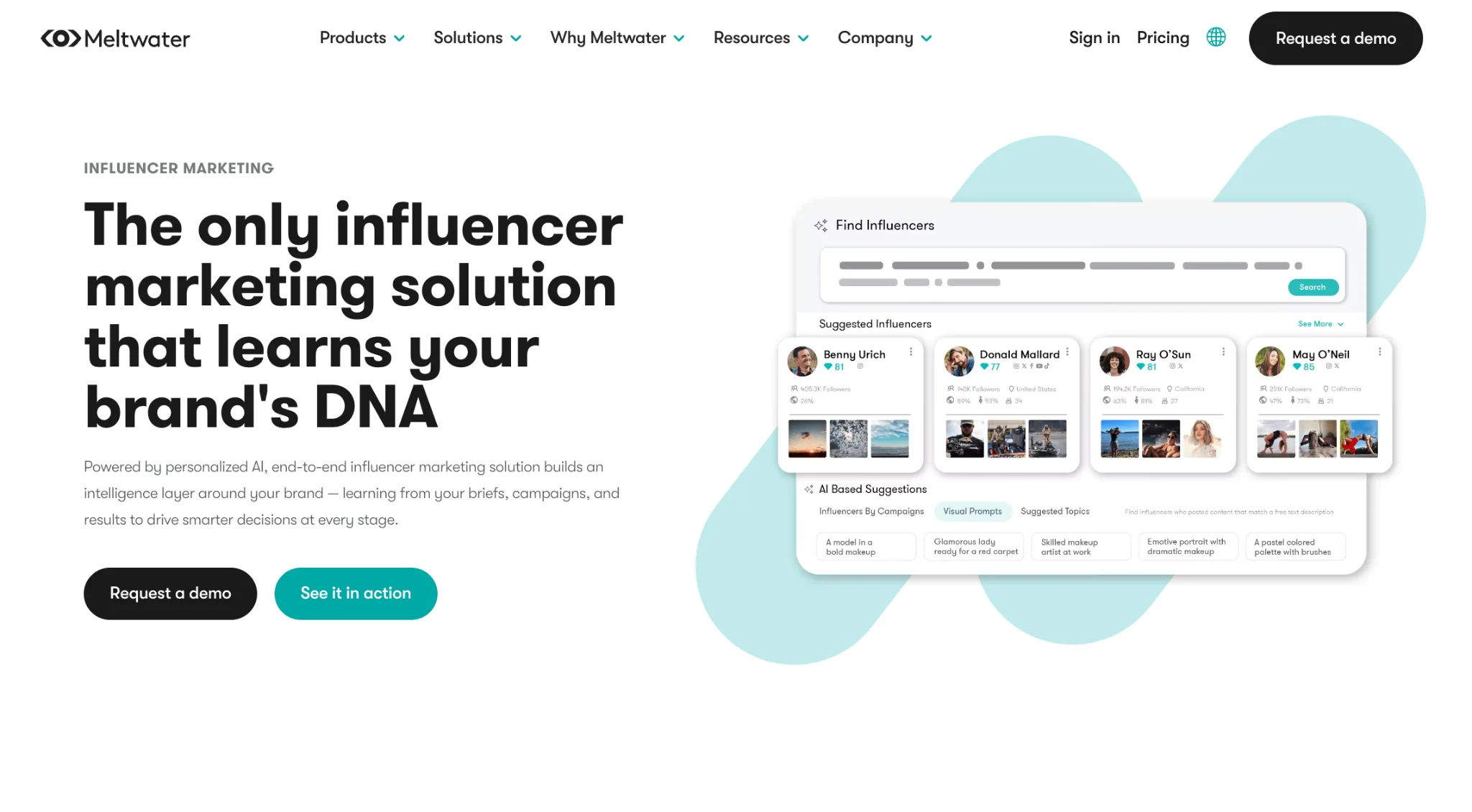
Klear is Meltwater’s influencer product, absorbed into the media intelligence suite after the 2021 acquisition. Audience intelligence is its centre of gravity, with demographic and interest profiling behind each creator. Communications and PR teams buy it most often, because creator results file alongside earned media in one report.
Key Features
- Audience profiling: Demographics, interests and location behind every creator record.
- Topic and skill scoring: Creators ranked on subject authority rather than follower totals.
- Historical collaboration data: Past brand work and how it performed.
- Campaign monitoring: Live tracking against the goals set at kickoff.
- Social listening: Category and brand conversation from the parent suite.
Pricing
Not published and rarely quoted alone, arriving inside an annual Meltwater package sized to the whole suite.
Reviews
No standalone listing remains on the major review sites. Meltwater scores 4.1/5.0 (G2, 2,640 reviews) for the full suite rather than the creator module.
Pros
- Interpretation, not just records: Scoring and analysis rather than raw fields.
- Listening included: Category conversation data most tools sell separately.
- Established data operation: A long track record behind the audience figures.
Cons
- Bundled pricing: Hard to buy or price the influencer piece alone.
- No API-first design: Built to be worked in rather than piped out.
- No module-level reviews: Only the suite score to judge it by.
Integrations
- Meltwater listening: Feeds conversation data into creator planning.
- Salesforce: Aligns contacts and coverage with the commercial record.
- Instagram and TikTok: Pulls verified performance into reports.
- Google Analytics: Links campaign traffic to site behaviour.
- Slack: Sends mentions and alerts to the team.
Influencers.club vs Klear
Both sell knowledge about creators, and they package it in opposite ways. Influencers.club hands you fields and lets you decide what they mean; Klear hands you scores, segments and a report someone else can read.
The choice follows your team. A data function will prefer raw records and an API over a dashboard it has to log into. A communications team with no engineers will get more from the interpretation, and will care that Klear’s price never appears on a page.
Afluencer
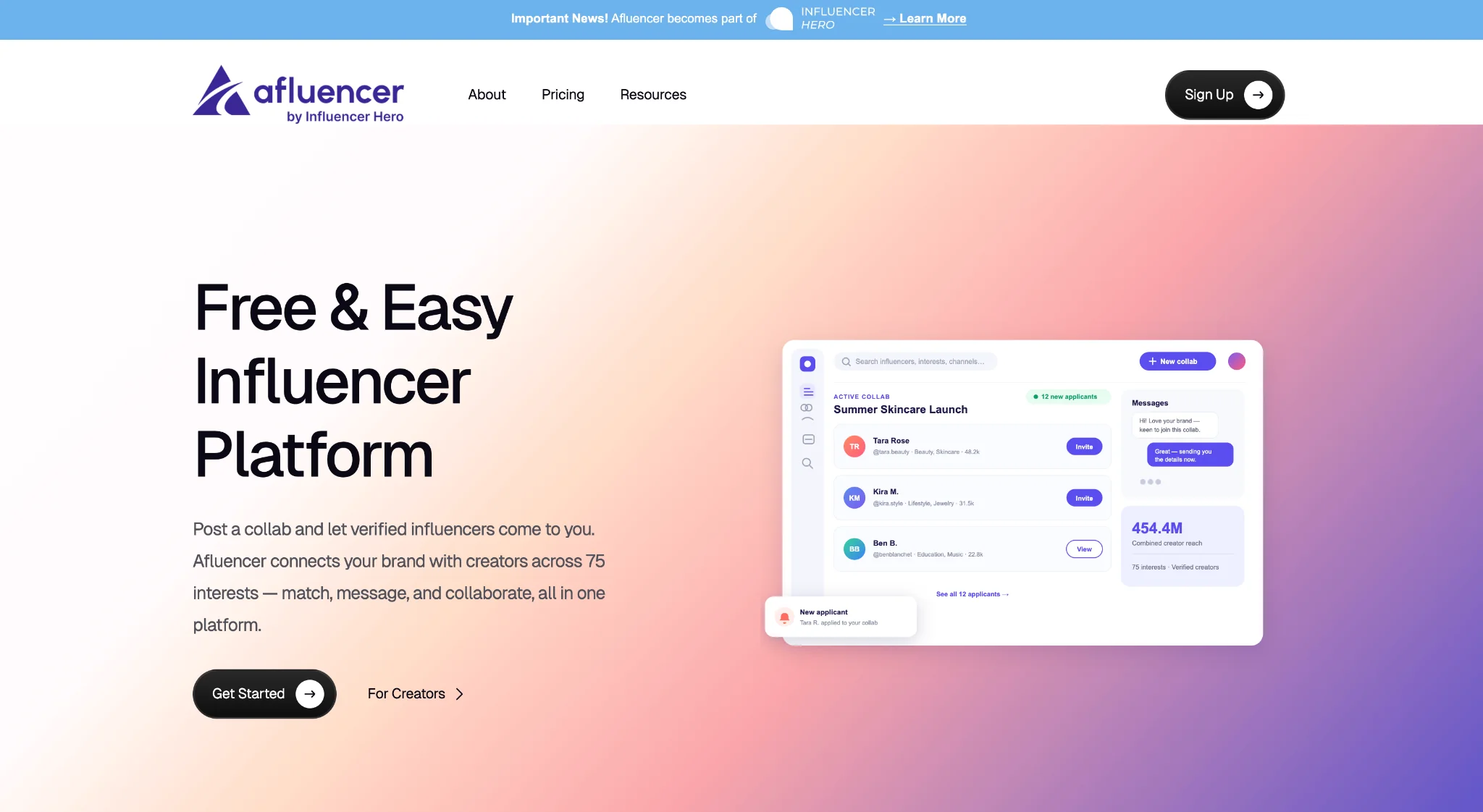
Afluencer removes the search step entirely. Brands post a collaboration listing, verified creators across Instagram, TikTok, YouTube, Facebook and X apply, and the brand chooses from who arrives. Shopify merchants and small D2C teams are the typical users, and the entry price is a flat monthly fee.
Key Features
- Inbound collaboration listings: Creators apply to you, so no database and no enrichment is needed.
- Verified opt-in members: Registered and checked rather than compiled from public data.
- CreatorGPT matching: AI ranks applicants against the brief before review, one of several AI influencer tools aimed at this step.
- Direct invitations: Credit-based outreach for creators who have not applied.
- Gifting, codes and payments: Send-outs, discount codes and creator fees handled in-platform.
Pricing
From $49 a month on the Marketplace plan, with higher tiers for more outbound volume. Creator-side plans are billed separately.
Reviews
4.6/5.0 (G2, 738 reviews) and 4.7/5.0 (Shopify App Store, 34 reviews). The G2 pool leans creator-side, so read it next to the Shopify score.
Pros
- Nothing is metered: $49 a month with no credits to forecast.
- Contact data is irrelevant: Creators arrive having chosen you, so no email hunting is required.
- Payments and codes included: The commerce step a data product does not attempt.
Cons
- Small applicant pool: A fraction of 340 million profiles, and only who applies.
- Five networks: No coverage of Discord or the long tail.
- No enrichment or API: Nothing to pipe into a CRM or warehouse.
Integrations
- Shopify: Connects the store for codes, referrals and creator orders.
- BigCommerce: The same for BigCommerce merchants.
- Klaviyo: Sends creator contacts into email campaigns.
- DocuSign: Signs collaboration terms in the flow.
- Slack: Alerts the team to new applications.
Influencers.club vs Afluencer
These sit at opposite ends of the same problem. One assumes you will find creators and contact them at scale, and sells the raw material to do it. The other assumes you would rather not, and brings creators to you for $49 a month.
Which is right depends on whether outbound is a capability you have. Verified phone numbers are worthless without someone to work the list, and for a small D2C team the applicant queue converts faster than an enrichment pipeline nobody has time to build.


SARAL

SARAL is an influencer operating system for eCommerce brands, built around ambassador programs rather than one-off posts. Influencer discovery, outreach, affiliate attribution and payment run in one flow, and every plan ships with onboarding and a named success manager. DTC founders and small influencer teams are its core customers.
Key Features
- Discovery with a Chrome extension: Add creators to a campaign while browsing their profile.
- Outreach sequences: Personalised email at volume with automated follow-ups.
- Unified creator inbox: Conversations, tasks and follow-ups against one record.
- Cookieless affiliate tracking: Orders attributed without third-party cookies.
- Commission and payouts: Rates per creator, calculated on real orders and paid out.
Pricing
$12,000 a year for Starter, $15,000 for Business and $25,000 for Professional, or $3,600, $4,500 and $7,500 quarterly. Tiers are set by active partnerships, and a trial comes first.
Reviews
No verifiable rating. SARAL does not hold a listing with enough reviews on the main software sites to quote a score fairly.
Pros
- The whole funnel in one place: Outreach through to revenue without a second system.
- Nothing metered: The tier covers usage rather than pricing each action.
- Support included: A success manager on every plan.
Cons
- $12,000 entry: Several times the annual cost of a data subscription.
- No independent reviews: Nothing public to check the claims against.
- Three networks: Instagram, TikTok and YouTube only.
Integrations
- Shopify: Runs attribution, codes and gifting orders end to end.
- Gmail and Outlook: Sends outreach from your own domain.
- Klaviyo: Feeds creator contacts into lifecycle flows.
- Slack: Notifies the team when content arrives.
- Zapier: Covers what the native list does not.
Influencers.club vs SARAL
SARAL is the campaign layer a data product deliberately omits. Sequences, shipments, commission and payouts are all present, and none of them can be assembled from an enrichment API without engineering time.
What you give up is reach. Three networks against 47, no verified phone numbers and no warehouse connector. A team that wants both usually pays for both, and at $12,000 plus a data subscription that is a real number worth putting on paper first.
Lefty
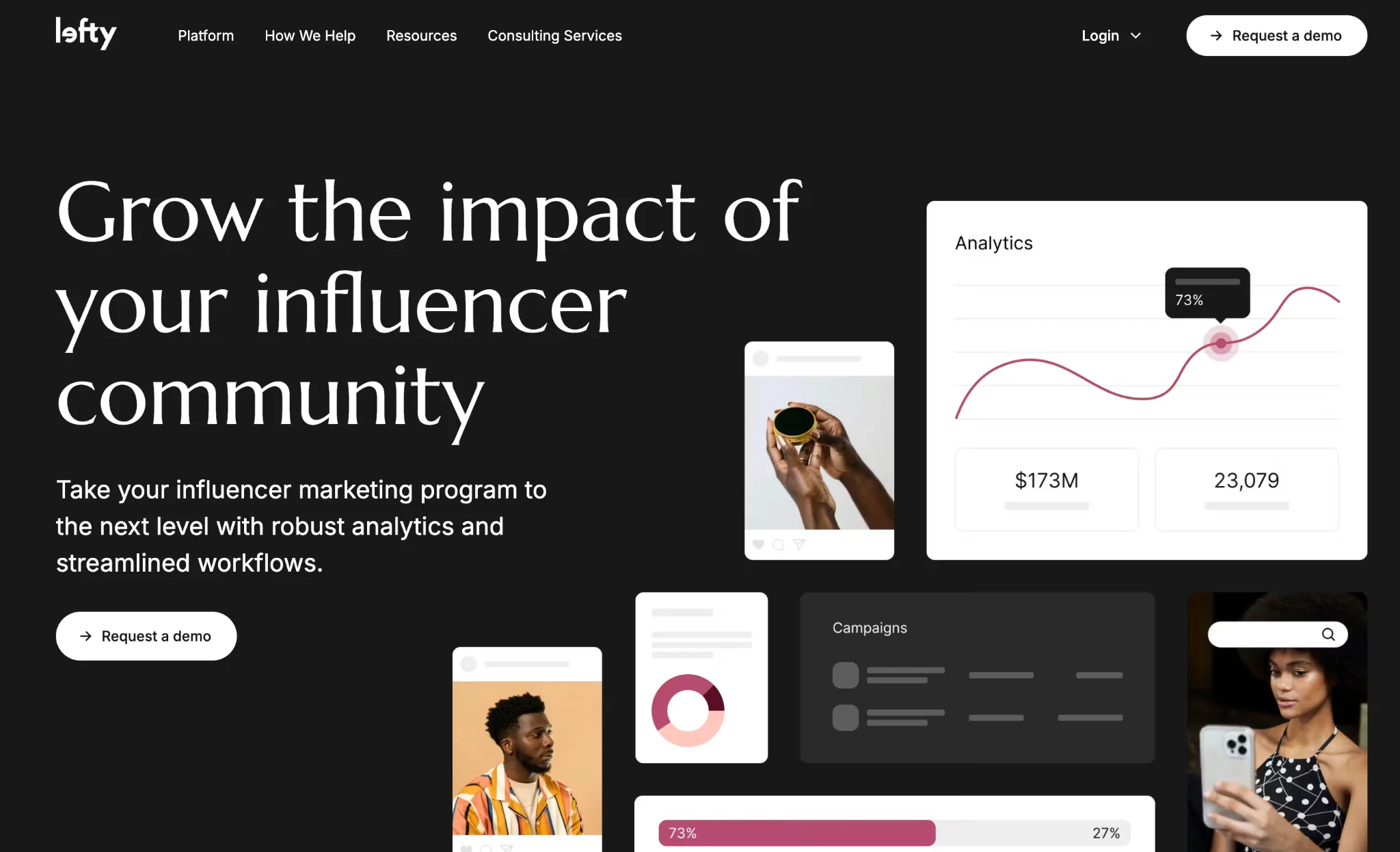
Lefty is the platform of choice for luxury, fashion and beauty houses, with Louis Vuitton, Clarins and Vans among its clients. It combines a creator index with CRM, campaign tracking, seeding and affiliate management, reports in earned media value, and covers Weibo, Douyin and RED alongside western networks. Creator teams inside large consumer brands are its buyers.
Key Features
- Creator index with affinity data: Filter on demographics and existing brand engagement.
- Partner records with health scores: Engagement quality tracked over time rather than sampled once.
- Automatic content capture: Campaign posts collected and valued without manual tracking.
- Seeding at volume: Hundreds of product send-outs planned together, in the way dedicated influencer gifting programs require.
- Stripe payouts: Commission and flat fees settled to creators in-platform.
Pricing
Not published. There is no pricing page, and a demo request is the only route in.
Reviews
4.7/5.0 (G2, 91 reviews).
Pros
- Chinese network coverage: Weibo, Douyin and RED tracked properly.
- Creators get paid here: Stripe settlement rather than an export to finance.
- Highest score in this list: 4.7 across 91 reviews.
Cons
- Expensive by reputation: Reviewers cite unused capability inflating the bill.
- Roster caps: Limits on tracked creators that larger programs hit.
- Quote-only: No published price and no self-serve route.
Integrations
- Shopify: Connects the store for affiliate attribution and seeding.
- Magento: Covers Adobe Commerce storefronts.
- Salesforce Commerce Cloud: Enterprise commerce for retail groups.
- Stripe: Settles commission and flat-fee payments.
- Gmail and Outlook: Keeps creator pitching in the CRM.
Influencers.club vs Lefty
Both go wide on networks, which is unusual, but they go wide for different reasons. Influencers.club indexes 47 platforms so you can find anyone; Lefty covers eight including the Chinese networks so you can run and value campaigns on them.
Lefty also closes the loop that a data product leaves open, settling commission and flat fees through Stripe. The trade is transparency: one publishes per-credit rates you can model, the other publishes nothing at all.
Humanz
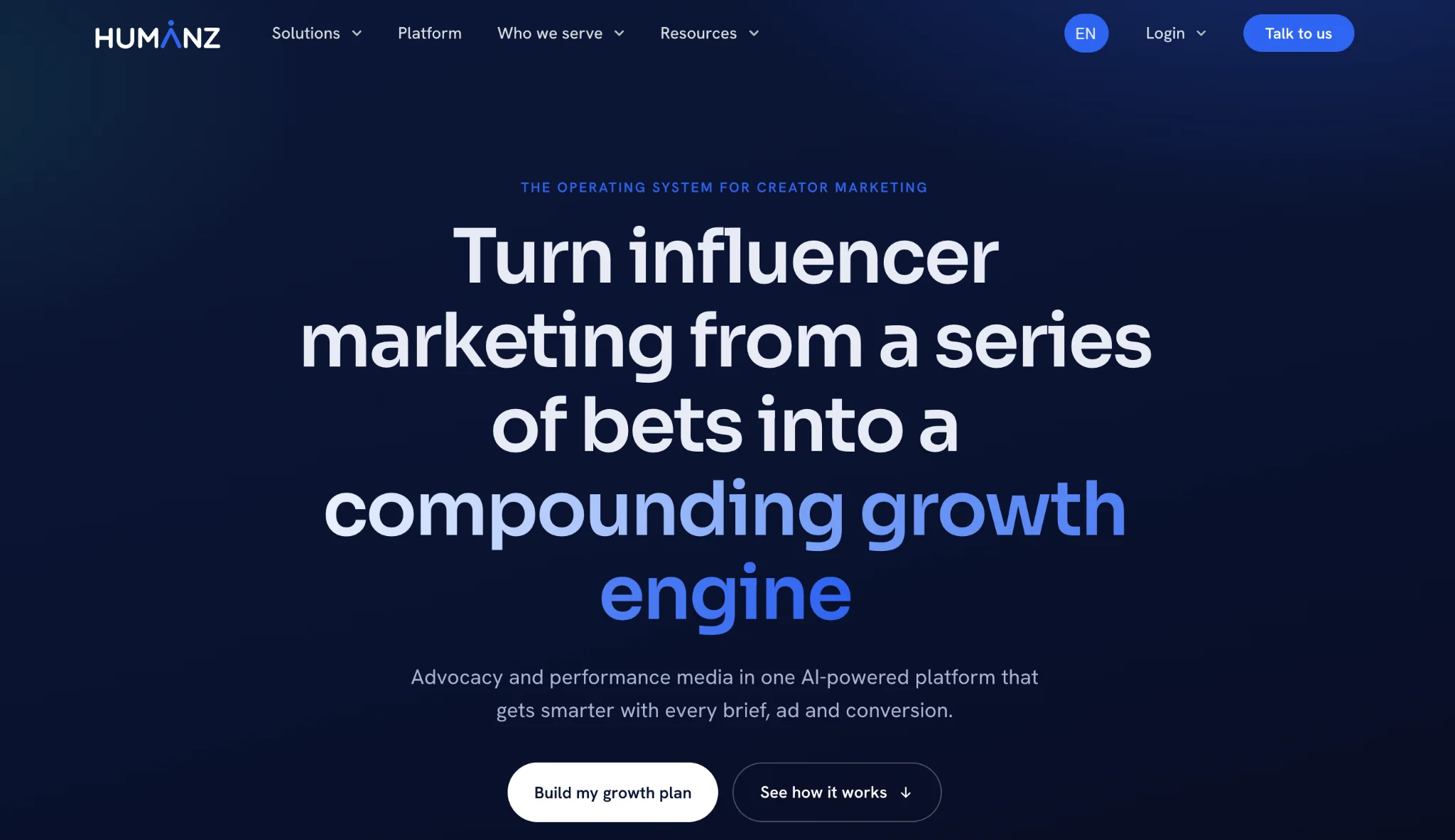
Humanz is a data-led influencer platform working with brands including McDonald’s, L’Oréal and Nestlé. Creator metrics come from official API connections rather than scraping, and briefs, contracts, performance bonuses and sales attribution run in a single flow. It suits brands that want campaigns judged on revenue.
Key Features
- API-permissioned data: Over 500,000 creators connected directly, so metrics are first-party.
- Briefs, contracts and bonuses: Agreements signed in-platform with performance bonuses attached.
- Shopify and Amazon attribution: Orders on both traced back to individual creators.
- Predictive modelling: Reach and return forecast before budget is committed.
- Talent manager portal: A separate workspace for agents running several creators.
Pricing
On request, charged per campaign as a share of media budget, with the percentage falling as spend rises. No subscription applies.
Reviews
4.8/5.0 (G2, 27 reviews), the same sample size as Influencers.club at a slightly higher score.
Pros
- First-party accuracy: Connected accounts rather than a categorisation algorithm.
- Revenue attribution: Amazon tracking that almost nothing else offers.
- Nothing owed between campaigns: No standing subscription at all.
Cons
- Small connected pool: 500,000 creators against 340 million profiles.
- Percentage pricing: The cost rises with the budget rather than staying fixed.
- 27 reviews: A thin evidence base for brands of this size.
Integrations
- Shopify: Attributes store orders to the creator behind them.
- Amazon: Tracks marketplace sales from creator campaigns.
- Meta Ads Manager: Boosts creator content as paid media.
- TikTok: Brings deliverable performance into the campaign view.
- Google Tag Manager: Deploys tracking without developer time.
Influencers.club vs Humanz
This is breadth against accuracy. Influencers.club indexes 340 million profiles it has never spoken to; Humanz works with roughly 500,000 who have connected their accounts, which is why its numbers are reliable and its pool is small.
The same split runs through the pricing. One meters lookups whether or not a campaign follows, and the other charges nothing until a campaign runs but takes a share of the budget when it does. Brands doing occasional large campaigns are better served by the second shape.
Modash
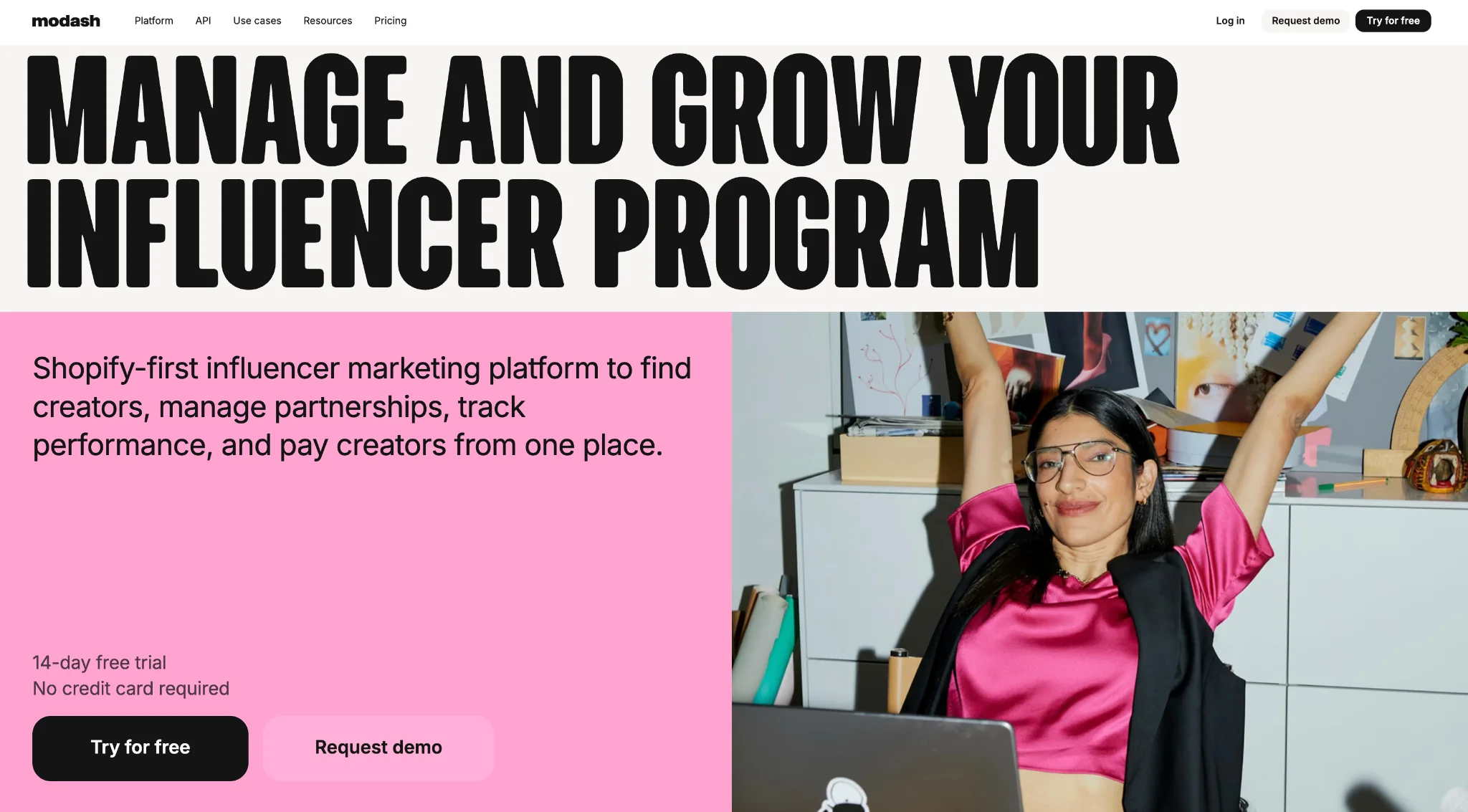
Modash indexes more than 380 million creator profiles across Instagram, TikTok and YouTube, with every account above 1,000 followers included. Around the search it adds tracking, creator lists, an email inbox and payments, all published at fixed prices with a free trial in front. Small and mid-market in-house teams are its typical users.
Key Features
- Full index on three networks: Comparable profile volume to a 47-network database, concentrated where most brands work.
- Audience credibility scoring: Fake-follower rates and demographics on every profile.
- Influential fans: Surface creators already following or buying from your brand.
- Content tracking: Posts and Stories captured automatically during a campaign.
- Creator payments: In-platform, free to $10,000 a year and 5% above.
Pricing
- Essentials: $199 a month, 300 profile opens and 100 tracked creators
- Performance: $499 a month, 800 profile opens and 250 tracked creators
- Enterprise: custom, from $14,700 a year
Both self-serve plans include a 14-day free trial with no card, and annual billing lowers the rate.
Reviews
4.9/5.0 (G2, low review volume at 19 reviews).
Pros
- Tracking is bundled: 100 creators tracked inside the plan rather than drawing down credits.
- Free to try: 14 days with no card, against 10 credits.
- Payments included: Creators paid from the same tool.
Cons
- Three networks: Nothing outside Instagram, TikTok and YouTube.
- No CRM enrichment: No HubSpot or Salesforce write-back.
- Caps per tier: Profile opens and email unlocks still run out.
Integrations
- Shopify: Connects store data for creator sales and gifting.
- Gmail and Outlook: Runs outreach from your own mailbox.
- Slack: Alerts the team when tracked content goes live.
- Zapier: Bridges to the rest of the stack.
- API: Pulls creator data into internal tools on higher tiers.
Influencers.club vs Modash
The profile counts are close, at 340 million against 380 million, so the real difference is shape rather than size. Influencers.club spreads across 47 networks and meters every action; Modash concentrates on three networks and bundles tracking, outreach and payments into a fixed monthly price.
Monitoring shows the gap plainly. Tracking 100 creators costs 900 credits a month at Influencers.club, roughly $135 to $207 on top of the subscription, and is included in the $199 Modash plan. Unless you need the long-tail networks or the CRM write-back, the bundled price is easier to defend.
Glewee
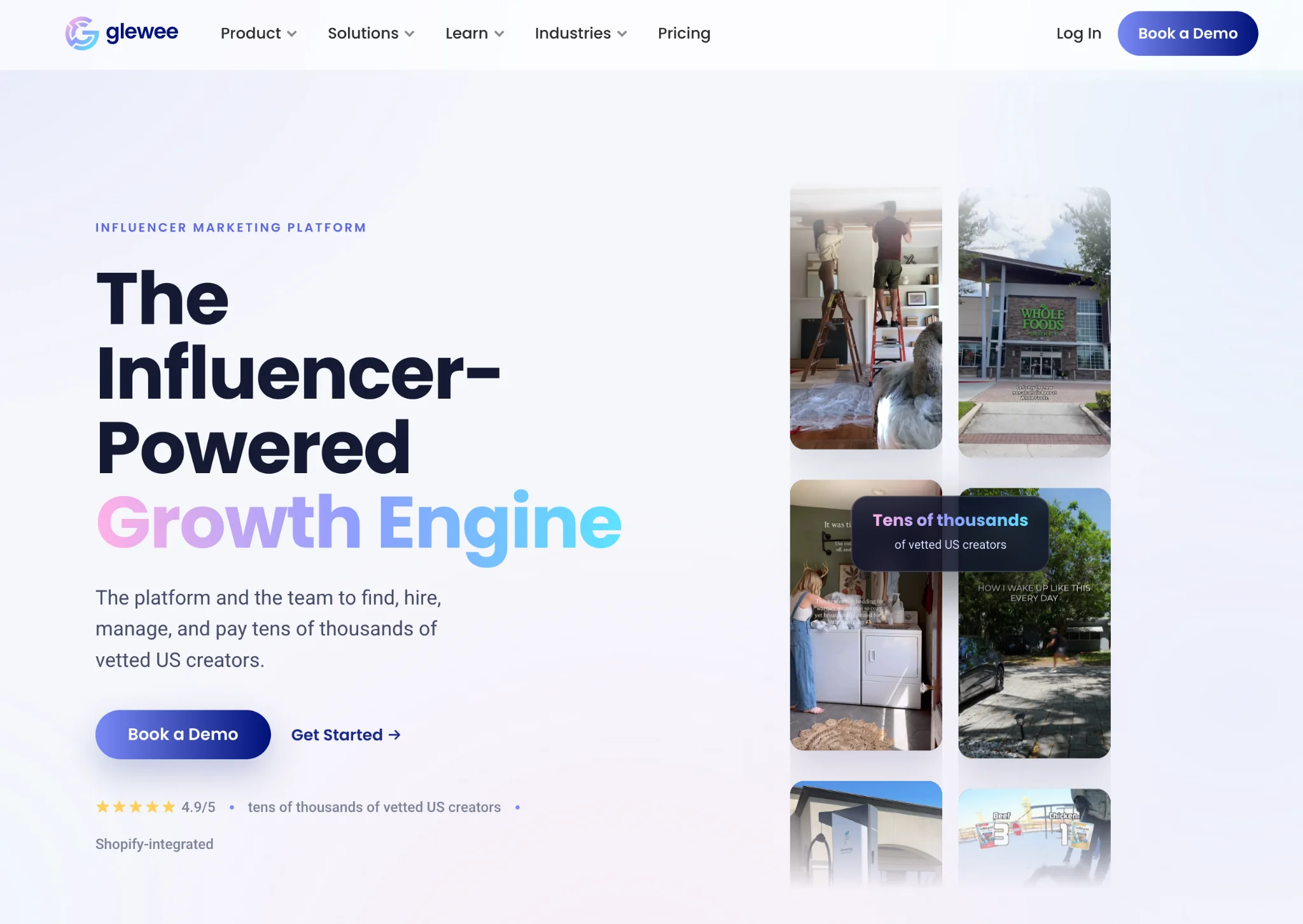
Glewee is a US marketplace with more than 50,000 pre-vetted creators in its network. Brands post a campaign, creators opt in, and briefing, contracts, content and payment all run in the app. It is priced for small and mid-market brands, and no cut is taken from creator fees.
Key Features
- Opt-in creator network: 50,000-plus US creators vetted before they reach a brief.
- Unlimited campaigns: As many briefs as you like on any paid tier.
- Chat and contracts in-app: Negotiation and agreement in one thread.
- Zero platform fee: Nothing taken from the creator fee on any hire.
- Lifetime organic rights: Campaign content reusable organically without a further licence.
Pricing
- Build: $199 a month, or $150 a month billed annually, with 3 seats and 10 gifting collaborations a month
- Scale: $499 a month, or $375 a month billed annually, with unlimited seats and gifting
- Full-Service: custom, managed by the Glewee team
Both self-serve plans run month to month with no contract, and annual payment saves 25%.
Reviews
4.8/5.0 (G2). Capterra carries the product with no reviews at all, so the sample is thin.
Pros
- No metering anywhere: Unlimited campaigns and no per-action charge.
- Creators are pre-screened: Vetting done before anyone reaches your brief.
- Contracts and payment included: The steps a data product leaves out.
Cons
- 50,000 against 340 million: A closed network rather than an index.
- US only: No use outside North America.
- No data export: Nothing to feed a CRM or warehouse.
Integrations
- Shopify: Connects the store for creator sales and gifting orders.
- Stripe: Processes brand payments and creator payouts.
- Instagram: Pulls post performance into reporting.
- TikTok: The same for short-form deliverables.
- Meta Business Suite: Routes creator content through for paid use.
Influencers.club vs Glewee
The contrast is as wide as this category gets. One sells access to 340 million profiles you must contact yourself; the other sells 50,000 creators who have already agreed to hear from brands, with contracts and payment attached.
Cost lands closer than expected. Glewee is $199 a month flat, while a data subscription plus monitoring plus a second tool to actually run campaigns adds up quickly. For a US brand that wants creators posting this month rather than a pipeline built this quarter, the marketplace is the shorter route.
Final Thoughts on Influencers.club Alternatives
Influencers.club is a genuinely good data product, and 4.6 across 27 reviews backs that up. Coverage across 47 networks, verified contact details and an API that writes into HubSpot, Salesforce or Snowflake is not something the rest of this category offers. The question is what you already have to receive it. With a CRM tool, a warehouse or an enrichment pipeline in place, this slots in cleanly and the credit meter is a reasonable trade for the breadth. Without one, you are buying raw material and no factory, and the second subscription you need to run campaigns will cost more than the data ever did. Price both together before deciding, and remember to include monitoring in the arithmetic — it is the line that catches people out.

.png)


.jpg)










