

10 Best Influencer Marketing Platforms for TikTok Campaigns
TikTok has quickly become one of the most powerful growth channels for D2C brands, driving product discovery, viral reach, and performance-driven content at scale. Its algorithm favors engaging, authentic content—making influencer collaborations a key lever for brands looking to acquire customers efficiently. However, managing TikTok creators manually can quickly become complex as brands scale campaigns. Influencer marketing platforms solve this by helping teams discover high-performing creators, streamline outreach, manage campaigns, and track performance from a single dashboard. For D2C founders and marketers, this translates into faster creator sourcing, scalable content production, and more measurable ROI from TikTok campaigns.
In this article, we’ll explore Later, Afluencer, Upfluence, Influencer Hero, GRIN, HypeAuditor, Skeepers, Klear, Influencity, and IZEA—some of the best influencer marketing platforms to help you scale TikTok campaigns effectively.
Best Influencer Marketing Platforms for TikTok Campaigns
| TOOL | REVIEWS | BEST FOR | TRIAL INFO | PRICING | ||
|---|---|---|---|---|---|---|
1 |

|
⭐ | Social media & influencer campaigns | Book Demo | Pricing | Website |
2 |

|
⭐ | Influencer marketplace campaigns | Book Demo | Pricing | Website |
3 |
|
⭐ | Influencer discovery | Book Demo | Pricing | Website |
4 |

|
⭐ | Influencer CRM & automation | Book Demo | Pricing | Website |
5 |

|
⭐ | DTC creator management | Book Demo | Pricing | Website |
6 |

|
⭐ | Influencer analytics | Book Demo | Pricing | Website |
7 |

|
⭐ | Influencer gifting & UGC campaigns with micro-influencers | Book Demo | Pricing | Website |
8 |
|
⭐ | Influencer analytics | Book Demo | Pricing | Website |
9 |

|
⭐ | Campaign management | Book Demo | Pricing | Website |
10 |
|
⭐ | Influencer marketplace | Book Demo | Pricing | Website |
1. Later
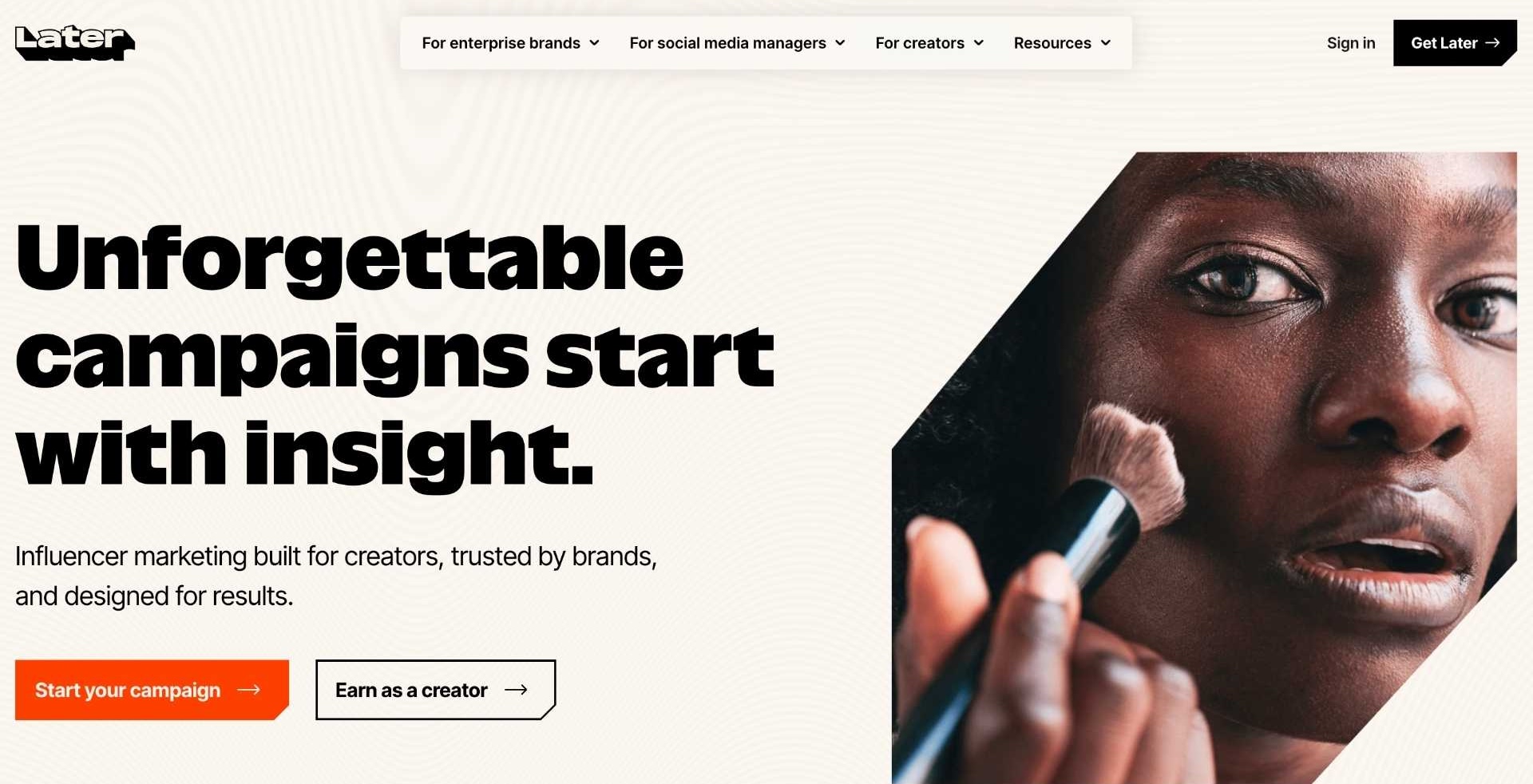
Later’s influencer marketing product, often referred to as Later Influence, is built for brands that want to discover creators, manage campaigns, and measure paid, organic, and sales performance in one place. It combines creator discovery, campaign workflow, incentive planning, reporting, and social commerce tools, with a strong emphasis on predictive intelligence through Later EdgeAI.
Key features:
- Creator discovery: Later uses brand signals to surface best-fit creators and flag potential risks early, which is useful when building TikTok creator shortlists faster.
- Incentive advisor: The platform shows what creators are actually paid across channels, helping brands set more realistic rates and avoid overpaying.
- Unified reporting: Brands can track paid, organic, and sales performance in one view, which is especially valuable for performance-led TikTok programs.
- Shopify gifting and codes: Later’s Shopify integration lets brands connect their store, send product codes, customize redemption windows, and support gifting without manual back-and-forth.
- Content syndication and reviews support: Later also supports content syndication and product review collection workflows, which can help D2C teams extend creator content beyond TikTok.
Pros:
- Strong fit for brands that want one system for discovery, campaign execution, reporting, and commerce measurement.
- Shopify workflows are especially useful for product seeding and code-based campaigns.
- Predictive data and benchmark-style intelligence can help performance-focused teams plan campaigns with more confidence.
Cons:
- Pricing is not publicly listed, so buyers have to go through a sales process to understand real cost.
- The platform appears better suited to structured in-house programs or enterprise teams than very small brands testing influencer marketing for the first time.
- Some public user feedback points to technical bugs and occasional tracking reliability issues.
Integrations:
- Shopify: Connect your store to automate influencer gifting, generate unique codes, and track creator redemptions more easily.
- Stripe: Run cash incentive payouts from inside the platform instead of handling creator payments manually.
- Tango Card: Send digital gift cards as creator incentives directly through Later Influence.
- Bazaarvoice: Collect influencer-submitted product reviews and syndicate them across commerce channels.
- Yotpo Reviews: Pull product catalog data into Later and manage influencer review collection in a more structured way.
Pricing:
Starts from $28,500/year, which places it in the high price tier relative to the broader influencer marketing software market.
Reviews:
4.4 / 5.0 (Capterra)
2. Afluencer

Afluencer is an influencer marketplace that helps brands connect with nano and micro influencers across Instagram, TikTok, and YouTube. Brands create collaboration opportunities ("Collabs"), set targeting criteria, and receive applications from creators that match their requirements. Once both parties agree, they can communicate and manage the partnership directly within the platform.
Key Features
- Influencer Marketplace: Brands can publish campaigns and receive applications from creators interested in collaborating.
- Micro and Nano Influencer Discovery: Search creators based on niche, audience demographics, follower count, location, and interests.
- TikTok Influencer Search: Find and collaborate with TikTok creators alongside Instagram and YouTube influencers.
- Campaign Matching System: Influencers apply to campaigns that fit their profiles, creating an opt-in marketplace rather than relying on cold outreach.
- Audience and Engagement Insights: Review engagement metrics and creator information before approving collaborations.
- Direct Messaging: Communicate with creators through built-in messaging channels.
- UGC Campaign Support: Source user-generated content creators for product reviews, photos, and videos.
- Collaboration Management: Organize influencer partnerships and track campaign activity from a single dashboard.
- Free Brand Account: Brands can create an account and start posting collaborations without long-term contracts.
Pros
- Afluencer is particularly strong for micro-influencer campaigns, making it easier for brands to connect with nano and micro creators that typically have highly engaged audiences.
- Its affordable pricing and free plan make it accessible for startups, small businesses, and Shopify brands that do not have enterprise-level budgets.
- Users generally praise the platform for its simple interface and straightforward campaign setup process.
- The opt-in marketplace model helps reduce manual outreach, as creators proactively apply to collaborations that match their interests.
Cons
- The free plan has limited functionality, with restrictions on campaign applications and access to premium features.
- Campaign performance depends heavily on the attractiveness of the collaboration offer, meaning brands with weak incentives may struggle to attract creators.
- Some users report encountering inactive creator profiles, which can slow down campaign execution.
Integrations
- Shopify: Sync your ecommerce business and recruit creators to drive traffic and sales for your Shopify store.
- Instagram for Business: Connect Instagram accounts to evaluate creator profiles and manage collaborations.
- TikTok: Discover and collaborate with TikTok creators for short-form video campaigns.
- YouTube: Find creators for video reviews, product placements, and long-form content.
- Facebook: Extend campaigns and social presence across Facebook-connected creator accounts.
Pricing
- Free Plan – Available for brands and creators getting started.
- VIP Plan: $49/month – Adds more campaign and collaboration capabilities.
- Concierge Plan: $99/month – Includes additional support and premium features.
Afluencer follows a monthly subscription model and does not require long-term contracts. The platform offers a free tier, allowing brands to test the software before upgrading. Compared with the broader influencer marketing platform market, Afluencer falls into the low-cost category, making it one of the more affordable options for brands running micro-influencer campaigns.
Reviews
4.6/5.0 (G2)
3. Upfluence
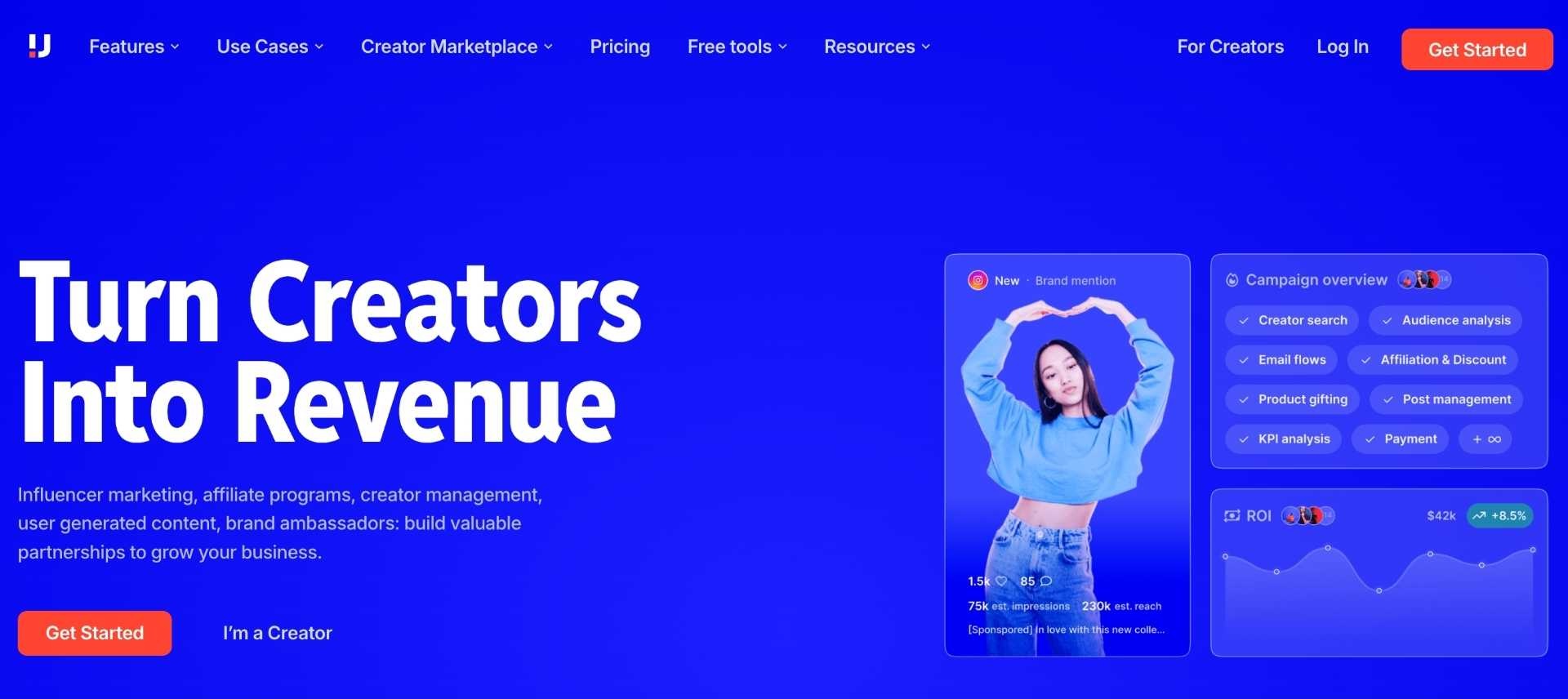
Upfluence is an all-in-one influencer and affiliate marketing platform for e-commerce brands that want to discover creators, automate outreach, manage campaigns, and track sales. Its positioning is especially strong for D2C merchants that want to connect influencer activity to storefront performance through affiliate links, promo codes, gifting, and payments.
Key features:
- Creator discovery: Upfluence helps brands find influencers across major channels and build curated lists around niche, audience, and campaign fit.
- AI-assisted outreach: Jaice AI helps draft, translate, and adjust creator outreach so teams can move faster at scale.
- Affiliate and promo-code automation: The platform can mass-create custom codes and affiliate links tied to major commerce systems.
- Campaign management: Upfluence centralizes creator status, draft submissions, sales generated, and payments issued inside one system.
- Bulk payments: Upfluence Pay streamlines creator payouts and finance tracking for global campaigns.
Pros:
- Particularly strong for e-commerce and affiliate-heavy influencer programs.
- Native integrations across major commerce and email tools make it easier to turn existing customers and subscribers into creator prospects.
- Good fit for brands that care about measurable ROI, not just reach and engagement.
Cons:
- Upfluence requires a 12-month minimum contract, which can be a barrier for brands that want a lighter commitment.
- Pricing is not publicly transparent, so buyers need to speak with sales.
- Some public feedback mentions occasional location-data inaccuracies and onboarding complexity.
Integrations:
- Shopify: Find influencers in your customer base, send products, and track creator-driven sales from one workflow.
- Amazon Attribution: Manage and optimize Amazon-focused influencer affiliate campaigns with native attribution support.
- Klaviyo: Identify influential subscribers in your lists, enrich their profiles, and run dedicated creator flows.
- Gmail: Sync email outreach and creator communication inside Upfluence instead of juggling inboxes manually.
- Stripe: Use Upfluence Pay to automate secure creator payments and transaction tracking.
Pricing:
Upfluence uses custom pricing (starts from $2,000/month). It does offer a free trial on some software directories, but the official site confirms a 12-month minimum contract, so Upfluence sits in the mid-to-high part of the market overall.
Reviews:
4.3 / 5.0 (Capterra)
4. Influencer Hero

Influencer Hero is an all-in-one influencer marketing platform focused on discovery, outreach, CRM, gifting, affiliate tracking, UGC collection, and reporting. It is positioned as a more accessible option for growing D2C and e-commerce brands that want a full workflow without stepping into top-end enterprise pricing too early.
Key features:
- Influencer discovery: Find creators across major platforms using advanced filters for audience, engagement, location, and niche, with built-in fraud detection and lookalike suggestions
- Outreach & automation: Scale personalized email outreach with AI-generated messages, automated follow-ups, and multi-step sequences
- Creator CRM: Manage influencer relationships in a centralized pipeline, tracking conversations, campaign stages, and deliverables
- Gifting workflows: Streamline product seeding with automated order creation, shipping, and delivery tracking
- Affiliate tracking & payouts: Generate unique links and discount codes, track performance, and handle commissions and payments in one system
- Campaign analytics & ROI tracking: Monitor performance across engagement, clicks, conversions, and revenue with real-time reporting dashboards
- UGC library: Automatically collect and organize influencer content for reuse across ads, social media, and product pages
- Application pages & storefronts: Capture inbound creators through branded application pages and enable influencers to promote products via custom storefronts
- eCommerce integrations: Sync with platforms like Shopify and WooCommerce to connect influencer activity directly to sales
- API & integrations: Extend workflows with API access and integrations like Klaviyo, Slack, Zapier, and email providers
Pros:
- More accessible pricing than many enterprise-focused competitors while still covering the core end-to-end workflow.
- Strong fit for D2C merchants that want Shopify or WooCommerce-linked gifting and affiliate tracking.
- Broad integration coverage makes it appealing for brands with mixed e-commerce and lifecycle-marketing stacks.
- Built for scale with automation, AI-powered workflows, and bulk outreach capabilities
Cons:
- May be more comprehensive than needed for brands looking for simple influencer sourcing tools
- Steep learning curve
Integrations:
- Shopify: Sync product catalogs, generate affiliate links and discount codes, track creator revenue, and simplify gifting.
- WooCommerce: Create discount codes and affiliate links and sync clicks and sales back into the CRM.
- Klaviyo: Match newsletter subscribers to influencers and export campaign data into Klaviyo segments and flows.
- Gmail: Run outreach from your own Gmail account while syncing threads back into Influencer Hero.
- Slack: Slack is listed among Influencer Hero’s help-center integrations, supporting operational collaboration around campaigns.
Pricing:
Influencer Hero offers flexible pricing based on outreach volume:
- Standard — $649/month (up to 1,000 reachouts/month)
- Pro — $1,049/month (up to 5,000 reachouts/month)
- Business — $2,490/month (up to 10,000 reachouts/month)
- Custom / Agency — Tailored pricing
In the broader market, it sits in the low-to-mid tier compared to enterprise influencer platforms, while offering a wider feature set than many entry-level tools.
Reviews:
5.0/5.0 (Capterra)
5. GRIN
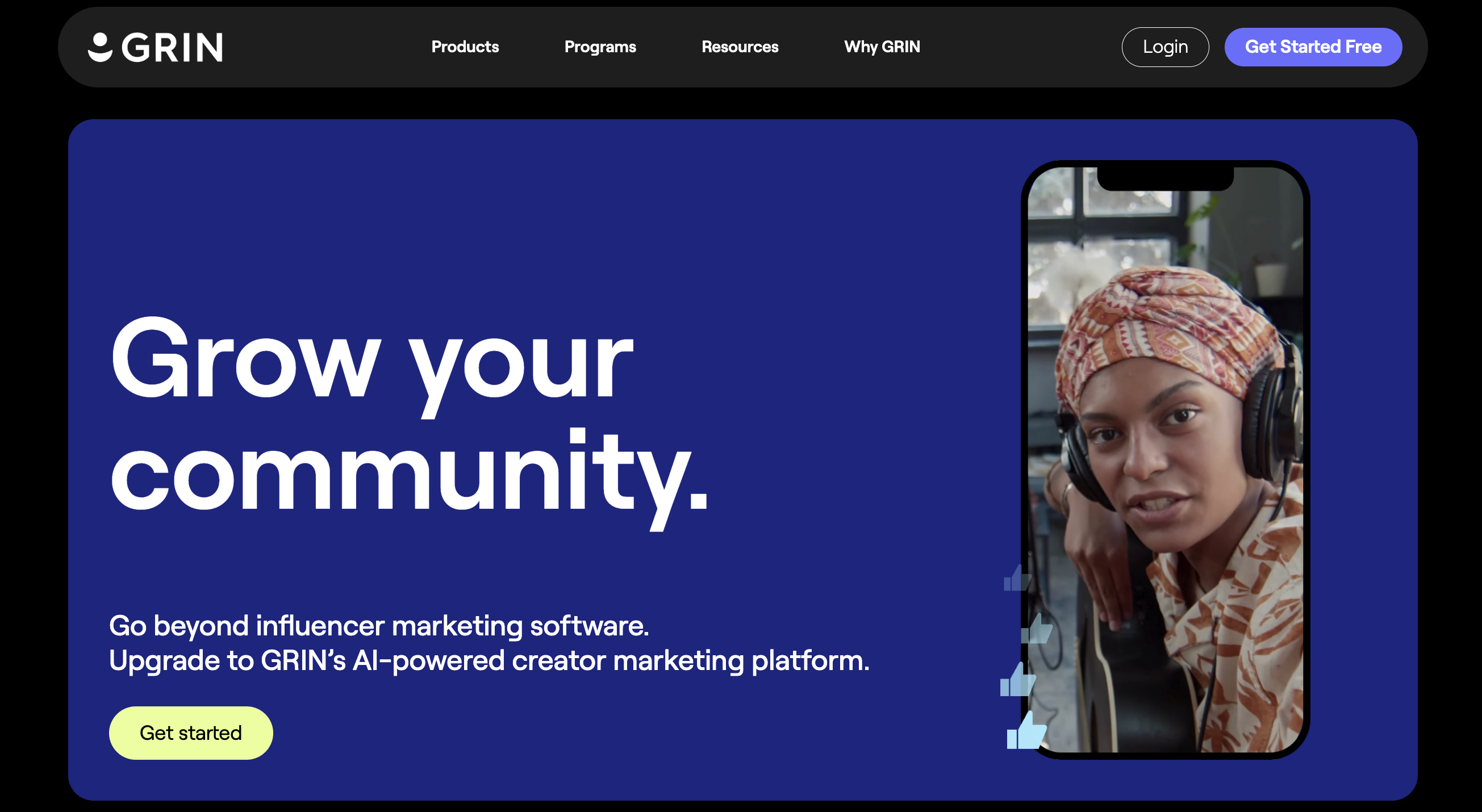
GRIN is a creator management platform built for DTC and e-commerce brands that want to manage creator discovery, gifting, campaign execution, content collection, payments, and ROI tracking in one system. Its current positioning leans heavily into helping brands launch and scale creator programs with self-serve access, gifting automation, and direct creator relationships.
Key features:
- Creator discovery: GRIN helps brands recruit brand-aligned creators and manage those relationships directly instead of relying on marketplace middlemen.
- Gifting automation: Its gifting workflows let creators pick products, automate fulfillment, and track preferences in one place.
- Campaign management: GRIN is built to manage creator programs end to end, from recruiting to content and revenue attribution.
- Social listening: The platform includes social listening for creator content, audience sentiment, and brand performance.
- Payment automation: GRIN supports creator payouts and tax-document support through its payment workflows.
Pros:
- Excellent fit for e-commerce brands that want gifting, content, and revenue attribution under one roof.
- Flexible access has improved, with a 30-day free trial and self-serve entry point now available.
- Particularly strong for brands that want direct creator relationships rather than depending on a marketplace model.
Cons:
- GRIN is still relatively expensive versus lighter-weight tools, especially once brands need more advanced workflows.
- Some public reviews mention a desire for richer influencer stats and better value for money at the price point.
- The platform is best suited to brands serious about creator programs rather than teams just testing a handful of TikTok collaborations.
Integrations:
- Shopify: Use GRIN to handle product fulfillment and seeding more efficiently through store-connected workflows.
- Klaviyo: Build more authentic creator communications with custom email templates tied to your lifecycle-marketing setup.
- Gmail: Manage creator communication and team collaboration directly from GRIN using your Gmail account.
- Outlook: Sync creator communication through Outlook inside the platform.
- PayPal: Upload funds, automate creator payment alerts, track payment history, and simplify 1099 handling.
Pricing:
Annual pricing starts at $25,000/year. Relative to the broader influencer platform market, GRIN sits in the high tier.
Reviews:
4.5/5.0 (G2)


6. HypeAuditor

HypeAuditor is a data-heavy influencer marketing platform built for brands that want to find creators, vet audience quality, manage campaigns, and track revenue in one place. It is especially strong for teams that care about fraud detection, audience authenticity, and eCommerce attribution across TikTok and other major social channels.
Key features:
- Influencer discovery: Search a very large creator database with filters for niche, audience demographics, engagement, brand safety, and platform.
- Audience quality analysis: HypeAuditor’s analytics help flag fake followers, weak audience quality, and questionable creator fit before you commit budget.
- Lookalike and competitor research: You can find similar creators and identify influencers already working with competing brands.
- Campaign workflows: The platform supports briefs, contracts, draft review, content tracking, and campaign-level messaging templates.
- eCommerce tracking: Brands can track clicks, orders, revenue, and commission-based performance through store integrations or a custom script.
- Creator applications: Branded landing pages let creators apply directly instead of relying only on outbound outreach.
Pros:
- Excellent for brands that want deeper vetting and audience authenticity checks before launching TikTok campaigns.
- Strong eCommerce measurement makes it more useful than discovery-only tools for D2C brands.
- Campaign workflows are more full-service than many lightweight discovery platforms.
Cons:
- Pricing can rise quickly for larger teams or broader campaign usage.
- Some buyers report that the platform can feel complex at first and may require onboarding to use well.
- Story tracking and some reporting workflows still require partial manual input in certain cases.
Integrations:
- Shopify: Connect your store to track clicks, orders, revenue, promo codes, and gifting workflows per influencer.
- WooCommerce: Track campaign sales and simplify free-product workflows for creator seeding.
- Magento: Sync product and revenue data into campaigns for stronger eCommerce attribution.
- PayPal: Use PayPal payouts to compensate creators directly from campaign workflows.
- Custom website JavaScript: If your store is not on a native commerce platform, HypeAuditor can still track conversions through a JavaScript snippet.
Pricing:
Capterra lists HypeAuditor from $399 per user/month, and the company also offers customizable plans based on usage. A free trial is available, and relative to the broader influencer platform market, HypeAuditor sits in the mid-to-high pricing tier.
Reviews:
4.8/5.0 (Capterra).
7. Skeepers
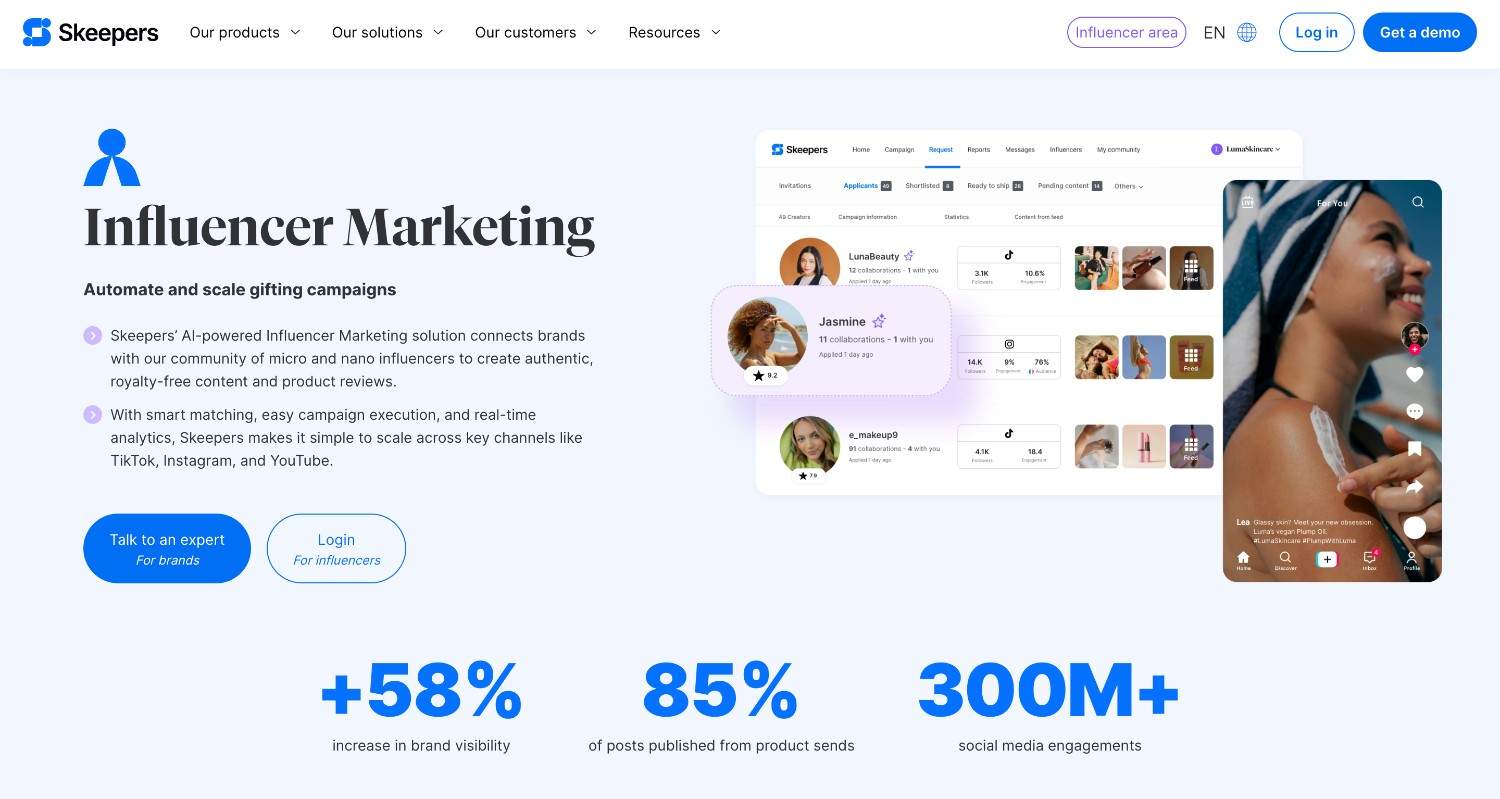
Skeepers is built around product seeding and micro/nano-influencer campaigns, making it a strong fit for brands that want to generate TikTok content, product reviews, and reusable UGC at scale. Rather than behaving like a traditional enterprise discovery database, it focuses more on automated gifting, creator matching, content licensing, and performance tracking.
Key features:
- Micro and nano influencer community: Skeepers gives brands access to a large vetted creator network tailored to gifting and content-generation campaigns.
- Automated gifting campaigns: The platform is designed to help brands seed products at scale without manually coordinating every creator shipment.
- Licensed content creation: Brands can collect royalty-free creator content and reuse it across their own marketing channels.
- Product reviews plus social content: Skeepers blends influencer content with review generation, which is useful for D2C brands that want both awareness and conversion assets.
- Real-time campaign analytics: Brands can monitor engagement, reach, and campaign performance from a central dashboard.
- Shoppable content workflows: Skeepers can help turn creator content into shoppable experiences on owned channels.
Pros:
- Very strong fit for D2C brands that want scalable TikTok gifting campaigns and reusable content, not just influencer discovery.
- The emphasis on micro and nano creators can be useful for brands prioritizing authenticity and lower content costs.
- Combines influencer content with product reviews and commerce use cases better than many traditional influencer-only tools.
Cons:
- Publicly documented pricing is less transparent than lower-cost self-serve tools.
- It is more gifting- and UGC-oriented than some platforms that offer very deep outbound discovery and CRM workflows.
- Some user feedback points to uneven creator quality and the need for tighter campaign selection and filtering.
Integrations:
- Shopify: Connect your store to run gifting campaigns, collect reviews, and push creator content onto product pages.
- TikTok: Launch influencer campaigns and collect TikTok-native creator content through Skeepers’ influencer workflow.
- Instagram: Source creator content and track campaign outcomes across Instagram campaigns.
- YouTube: Extend influencer campaigns into YouTube as part of multi-channel creator activations.
- Shopify App Store / Shoppable Content: Use Skeepers’ Shopify app to centralize UGC and make creator content commerce-ready on your storefront.
Pricing:
Capterra lists Skeepers Influencer Marketing pricing from €1,250/month, and it notes that a free trial is not available. Compared with the wider influencer marketing software market, that puts Skeepers in the mid pricing tier.
Reviews:
4.4/5.0 (G2)
8. Klear
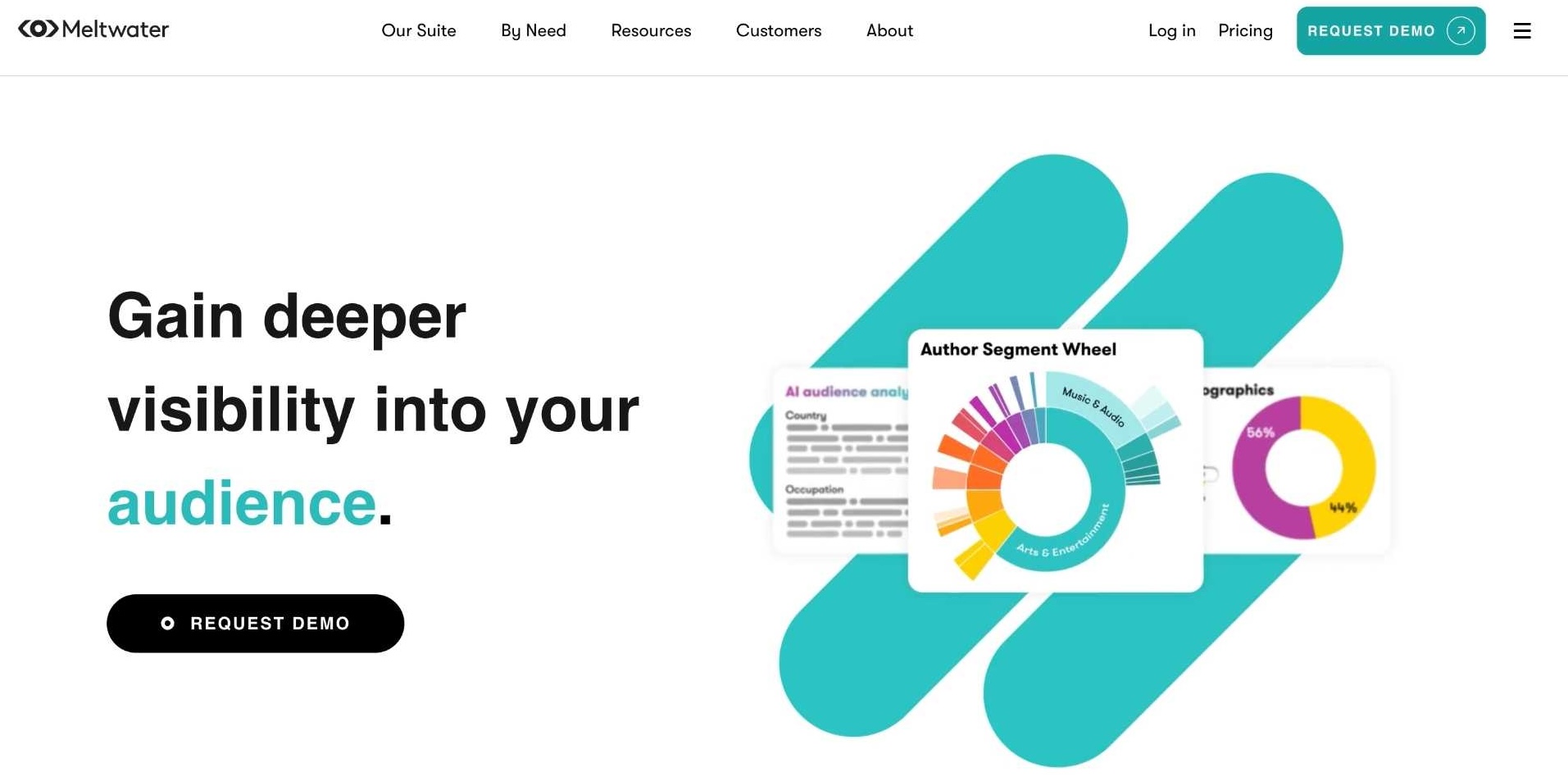
Klear, now fully integrated into Meltwater’s influencer marketing suite, is an end-to-end platform for discovering creators, running campaigns, measuring ROI, and connecting influencer activity with broader social intelligence. It stands out for global discovery, AI-powered search, and its “True Reach” model, which helps brands estimate real creator reach instead of relying on follower counts alone.
Key features:
- Global creator discovery: Klear gives brands access to a large influencer database with filters for topic, keywords, audience traits, and creator history.
- True Reach: Its proprietary reach metric helps brands estimate likely real exposure rather than assuming total followers equals actual impact.
- Visual and AI search: Klear supports keyword, topic, and visual-style discovery to help teams find creators faster.
- Campaign management: Brands can manage briefs, deliverables, communication, product gifting, and tracking in one place.
- Recruit tools: Branded forms let creators apply directly, which is useful for ambassador or inbound creator programs.
- Klear Pay: The platform includes built-in payment workflows for influencers and affiliates.
- Instant reporting: Teams can export visual, executive-friendly campaign reports without building everything manually outside the platform.
Pros:
- Strong fit for brands running global programs that need discovery, analytics, payments, and social listening under one roof.
- True Reach and deeper campaign analytics make it useful for brands that want more than surface-level TikTok metrics.
- Meltwater integration is a plus for teams already using its broader social or media intelligence stack.
Cons:
- Pricing is firmly enterprise-level and usually sold on annual contracts.
- Some users mention laggy workflows, reporting limitations, and friction when downloading or comparing data.
- It can feel heavier than necessary for smaller D2C teams that mainly need TikTok creator sourcing and campaign execution.
Integrations:
- Shopify: Identify influential customers, generate coupon codes, send gifts, and track creator-attributed conversions.
- Meltwater Engage: Combine influencer marketing data with broader social publishing and engagement workflows.
- Klear Pay: Handle influencer and affiliate payments directly inside campaign workflows.
- Email integration: Connect your email so brands can reach creators and manage communication inside Klear.
- Meltwater suite tools: Expand into media monitoring, social listening, and consumer intelligence from the same ecosystem.
Pricing:
Meltwater does not publish fixed Klear pricing on its main pricing page, but its packages are sold as custom annual plans. Klear packages ranged from $33,100 to $50,000 per year for smaller configurations, which puts it squarely in the high tier for influencer marketing software.
Reviews:
4.3 / 5.0 (G2)
9. Influencity

Influencity is an end-to-end influencer marketing platform that helps brands discover creators, manage outreach, organize campaigns, and report on results from one dashboard. It is especially appealing to brands that want broad discovery based on public social data instead of relying only on opt-in creator networks.
Key features:
- Large public-data discovery engine: Influencity lets brands search a very large creator database using audience, performance, content, and affinity filters.
- TikTok creator analysis: The platform supports TikTok discovery, audience analysis, and campaign management from the same system.
- Visual CRM: Teams can tag creators, build lists, and organize relationship data across campaigns and markets.
- Email outreach and tracking: Influencity supports email templates, bulk outreach, and metrics like opens, clicks, and replies.
- Campaign boards: Its workflow resembles a kanban-style campaign board, which helps teams track approvals, deliverables, and deadlines.
- Shopify gifting and affiliate tracking: Brands can seed products, create discount codes, and attribute sales back to creators.
- Exportable reporting: Reports can be exported in PDF, CSV, and XLS formats for internal sharing.
Pros:
- Strong value for brands that want an all-in-one platform without moving immediately into enterprise-level pricing.
- Public-data discovery gives brands access to a broader creator universe than many opt-in marketplaces.
- Shopify workflows make it especially relevant for D2C brands running gifting or affiliate-led TikTok campaigns.
Cons:
- No built-in messaging for negotiations, so some communication still flows through your own inbox.
- The auto-tracker is an add-on rather than fully included in the base plan.
- Some users mention filter friction and a learning curve with the discovery experience.
Integrations:
- Shopify: Manage gifting, discount codes, sales attribution, and influencer seeding directly from your store data.
- IMAP email: Connect your own inbox so outreach can be sent and tracked from inside Influencity.
- TikTok: Discover, analyze, and manage TikTok creators and campaign content from one platform.
- YouTube: Include YouTube creators in multi-platform campaign workflows and performance reporting.
- X / Twitter analytics: Track creator analytics and broader campaign context on X, even though it is not positioned as a primary outreach channel.
Pricing:
Influencity publicly lists a Professional plan at $318/month billed annually ($3,816/year), plus an Enterprise tier with custom pricing. A free trial is available, and relative to the wider market, Influencity lands in the low-to-mid price tier.
Reviews:
4.3 / 5.0 (G2)
10. IZEA
IZEA offers both managed services and its Flex software for brands that want to discover creators, manage relationships, handle offers and contracts, track performance, and measure campaign ROI. It is best suited to teams that want a mix of creator marketplace workflows, campaign operations, and performance measurement in a more established creator-economy platform.
Key features:
- Creator relationship management: Flex helps brands manage contacts, lists, campaign associations, and updated creator records in one place.
- Offer and negotiation workflows: IZEA added lower-friction offer negotiation so creators and brands can align on partnerships more easily.
- Tracking links and campaign measurement: Flex includes link tracking and KPI monitoring beyond vanity metrics.
- AI-enabled planning and optimization: IZEA positions Flex as an AI-infused operations platform for planning, collaboration, and campaign optimization.
- Stakeholder visibility: Flex Portal gives internal stakeholders a controlled way to monitor creator campaigns without needing full platform access.
- 10-day free trial: IZEA offers a trial period, which makes it easier for brands to evaluate the software before committing.
Pros:
- Good fit for brands that want both software and the option of managed services from the same provider.
- The platform is built around operational workflows, which is useful for teams managing multiple creators and internal stakeholders.
- Pricing starts lower than many enterprise-focused influencer suites.
Cons:
- Public review depth is lighter than with some category leaders, which makes benchmarking harder.
- Publicly surfaced integrations appear narrower than more commerce-native influencer platforms.
- IZEA’s public positioning now leans heavily into broader creator-economy and managed-service offerings, so software-specific detail can be less transparent than with some competitors.
Integrations:
- Shopify: Connect your store to see sales influenced by creators and support stronger commerce attribution.
- Google Analytics: Pull performance data into campaign measurement and benchmark creator impact more cleanly.
- Tracking links: IZEA’s enterprise link tracking works like an internal performance layer for campaign attribution.
- Flex Portal: Share campaign visibility with internal stakeholders through a controlled portal experience.
- Managed services workflow: Brands can pair the software with IZEA-run campaign execution if they want more hands-on support.
Pricing:
IZEA Flex publicly shows a Starter plan at $130/month and a Power plan at $500/month, and it offers a 10-day free trial. That makes it a low-to-mid priced option compared with many full-suite influencer platforms, although custom and managed-service costs can go much higher.
Reviews:
3.9/ 5.0 (G2)
Final Thoughts
Overall, TikTok has become a core growth engine for D2C brands, and influencer marketing platforms play a critical role in turning creator collaborations into scalable, performance-driven channels. The right platform can streamline creator discovery, automate campaign workflows, and connect content directly to revenue—making it easier to scale TikTok campaigns efficiently. Whether you’re focused on UGC production, affiliate-driven sales, or full-funnel influencer programs, these tools provide the infrastructure needed to move faster and drive measurable results. Ultimately, the best choice depends on your team size, budget, and how deeply you want to integrate influencer marketing into your growth strategy.

.png)


.jpg)