

10 Best Influencer Marketing Platforms for Micro-Influencer Campaigns
Influencer marketing has become a core growth channel for D2C brands, especially when working with micro influencers (10K–100K followers) who often drive stronger engagement and niche audience trust. For D2C brands, micro influencers are particularly valuable because they typically deliver higher engagement rates and more authentic product recommendations compared to larger creators. Platforms like Instagram, TikTok, and YouTube have made it easier than ever for brands to collaborate with these creators at scale, but managing discovery, outreach, and campaign tracking manually quickly becomes inefficient. This is where influencer marketing platforms help D2C teams streamline creator discovery, automate outreach, and track ROI from micro influencer campaigns.
In this article, we will explore the following tools: Aspire, Influencer Hero, Afluencer, Heepsy, HypeAuditor, Tribe, Modash, Influencity, Social Cat, and Insense.
Best Influencer Marketing Platforms for Micro Influencer Campaigns
| TOOL | REVIEWS | BEST FOR | TRIAL INFO | PRICING | ||
|---|---|---|---|---|---|---|
1 |

|
⭐ | Influencer partnerships | Book Demo | Pricing | Website |
2 |

|
⭐ | Influencer CRM & automation | Book Demo | Pricing | Website |
3 |

|
⭐ | Influencer marketplace campaigns | Book Demo | Pricing | Website |
4 |

|
⭐ | Influencer discovery | Book Demo | Pricing | Website |
5 |

|
⭐ | Influencer analytics | Book Demo | Pricing | Website |
6 |

|
⭐ | Creator marketplace | Book Demo | Pricing | Website |
7 |

|
⭐ | Influencer discovery | Book Demo | Pricing | Website |
8 |

|
⭐ | Campaign management | Book Demo | Pricing | Website |
9 |

|
⭐ | Influencer campaigns | Book Demo | Pricing | Website |
10 |

|
⭐ | UGC creator collaborations | Book Demo | Pricing | Website |
1. Aspire

Aspire is an end-to-end influencer marketing platform built for brands that want to discover creators, recruit inbound applicants, manage gifting and approvals, and track sales in one system. It supports both outbound discovery and an inbound creator marketplace, which makes it especially useful for D2C brands running recurring micro-influencer programs at scale.
Key features:
- Creator discovery — Lets brands search creators by channel, keyword, engagement, and audience demographics to find micro influencers that match niche D2C customer segments.
- Inbound creator marketplace — Brands can post projects and receive creator applications directly, which reduces manual sourcing for seeding and ambassador campaigns.
- Application pages — Custom landing pages help brands collect creator info, audience details, and campaign ideas before approving partnerships.
- Workflow automation — Built-in automations handle follow-ups, briefs, contracts, and campaign steps so lean teams can run more collaborations without extra admin work.
- Shopify gifting and fulfillment — Creators can shop approved products and brands can manage seeding, promo codes, and fulfillment without leaving the platform.
- Sales and commission tracking — Tracks clicks, conversions, sales, and commissions, which is critical for performance-driven micro-influencer campaigns.
- Content library and reporting — Stores creator content and campaign performance data in one place for reuse, stakeholder reporting, and optimization.
Pros:
- Strong fit for D2C brands that want both inbound and outbound creator sourcing, which is valuable when scaling micro-influencer gifting programs.
- First-party data partnerships with platforms like Meta, TikTok, and Pinterest are a meaningful advantage for brands that care about cleaner audience data.
- Well-suited for structured campaign workflows like product seeding, approvals, sales tracking, and affiliate management, rather than just discovery alone.
Cons:
- Pricing is on the expensive side for smaller D2C teams or brands only testing influencer marketing, and Aspire does not publicly list standard pricing on its main site.
- Clunky workflows, occasional technical issues, and integration/analytics friction in day-to-day use.
- It can be more platform than needed for merchants only running a handful of manual micro-influencer deals each month.
Integrations:
- Shopify — Run product seeding, create promo codes, identify influential customers, and connect revenue data back to creator campaigns.
- Gmail — Send outreach from your brand email and manage creator conversations in a shared inbox.
- Microsoft Outlook — Sync Outlook-based creator communication so teams can manage replies and outreach centrally.
- Klaviyo — Push influencer contacts into Klaviyo to build segmented nurture flows and retention campaigns.
- Impact — Pass affiliate links into Aspire’s sales tracking and pay creators through connected affiliate workflows.
Pricing:
Aspire’s pricing is high relative to the broader influencer platform market.
All plans are custom made. Plans usually start at $2,000/month, with annual agreements.
Reviews:
- 4.0 /5.0 (Capterra)
2. Influencer Hero

Influencer Hero is an all-in-one platform for discovering creators, sending outreach, managing gifting and affiliate campaigns, collecting UGC, and tracking influencer ROI. Its strongest angle is campaign-centric CRM automation, which makes it particularly useful for D2C teams running many micro-influencer relationships at once.
Key features:
- Advanced influencer discovery — Filters by location, demographics, interests, and engagement rate help brands narrow in on qualified micro influencers quickly.
- Fake follower detection and lookalikes — Helps brands avoid low-quality creators and expand from profiles that already perform well.
- Chrome extension — Pulls live creator insights while browsing Instagram, TikTok, or YouTube and lets teams import creators directly into campaigns.
- Bulk outreach with AI personalization — Supports one-to-one and scaled outreach with templates, drip sequences, and reply tracking.
- Campaign CRM boards — Tracks creators across outreach, deliverables, approvals, and ROI with bulk actions and workflow automation.
- Gifting and seeding tools — Connects eCommerce stores so brands can send products, monitor shipping, and tie deliveries to campaign performance.
- Affiliate tracking and payouts — Generates custom codes and links, tracks commissions, and automates creator payouts through eCommerce connections.
- UGC library and storefronts — Collects creator content for repurposing and supports application pages and creator storefronts for inbound growth.
Pros:
- Very strong fit for micro-influencer programs at scale because the CRM, campaign board automations, and bulk actions reduce manual campaign operations.
- Broader eCommerce flexibility, with Shopify, WooCommerce, and custom tracking options instead of Shopify-only dependence.
- Ease of use, centralized campaign tracking, and mass gifting/outreach support.
Cons:
- Teams new to full‑stack influencer marketing platforms may experience a steeper learning curve.
Integrations:
- Shopify — Send products, create discount codes and affiliate links, and track affiliate sales tied to creators.
- WooCommerce — Track affiliate sales and generate discount codes for creator campaigns outside Shopify.
- Gmail — Send creator outreach directly from your own Gmail address inside the platform.
- Outlook — Manage creator communication from your Outlook account without leaving Influencer Hero.
- Slack — Receive real-time notifications for replies, UGC posts, shipments, and influencer-driven sales.
- Zapier — Allows brands to automate workflows and connect Influencer Hero with hundreds of other marketing tools.
- DocuSign — Allows brands to send influencer contracts and agreements for electronic signature directly from campaign workflows.
Pricing:
Influencer Hero is low-to-mid priced compared with the wider influencer platform market, depending on outreach volume:
- Standard Plan — $649/month for 1,000 outreaches/month
- Pro Plan — $1,049/month for 5,000 outreaches/month
- Business Plan — $2,490/month for 10,000 outreaches/month
- Custom / Agency Plan — Custom pricing
Reviews
- 5.0 / 5.0 (Capterra)
3. Afluencer

Afluencer is an influencer marketing platform focused on connecting brands with active micro-influencers and content creators across Instagram, TikTok, YouTube, Facebook, and X. Brands create collaboration opportunities ("Collabs"), set targeting criteria such as niche, audience size, and location, and interested creators apply directly. Brands can then review profiles, communicate with creators, and manage campaigns from within the platform.
Key Features
- Influencer Marketplace — Brands can discover and connect with active creators instead of searching through a passive database.
- Collab Listings — Create campaign opportunities and receive applications from interested influencers.
- Audience & Demographic Filters — Search creators by niche, follower count, location, engagement, and social platform.
- CreatorGPT AI Assistant — AI-powered recommendations help brands identify suitable creators faster.
- Built-In Messaging — Communicate directly with influencers inside the platform.
- Campaign Management — Organize influencer collaborations from application through execution.
- Micro-Influencer Discovery — Strong emphasis on nano and micro influencers with engaged audiences.
- Verified Creator Community — Influencers are active users who have opted into the marketplace.
- Multi-Platform Support — Supports Instagram, TikTok, YouTube, Facebook, and X campaigns.
- Newsletter Promotion — Premium users can feature campaigns to increase creator visibility.
- Live Support & Strategy Calls — Includes onboarding assistance and influencer strategy sessions for paid users.
- Shopify App Integration — Allows Shopify merchants to run influencer campaigns directly from their stores.
Pros
- Excellent for Micro-Influencer Campaigns — Designed specifically for nano and micro influencers, making it easier to find creators with smaller but highly engaged audiences.
- Easy-to-Use Interface — Users frequently highlight the clean dashboard and straightforward workflow.
- Active Creator Community — Since creators are registered users, brands interact with influencers who are already open to collaborations.
Cons
- Limited Free Functionality — Free users have restrictions on invitations and campaign capabilities.
- Some Search Filters Could Be More Advanced — Users have mentioned wanting deeper filtering and more dashboard customization.
- Campaign Responses Can Be Slow — Some brands and creators report applications remaining pending for extended periods.
- Not Ideal for Large-Scale Enterprise Campaigns — Community discussions suggest manual outreach may provide better ROI when scaling to hundreds of creators.
Integrations
- Shopify — Launch influencer campaigns directly from a Shopify store and manage creator collaborations alongside ecommerce operations.
- Instagram — Find creators and run Instagram-based collaborations from within the platform.
- TikTok — Source TikTok creators and manage video campaigns targeting short-form content audiences.
- YouTube — Identify YouTube influencers for long-form reviews and sponsored content campaigns.
- Facebook — Coordinate influencer campaigns and audience targeting through Facebook creators.
Pricing
- Free Plan: Available for brands that want to explore the platform before committing
- VIP Plan: Starts at $49/month, providing premium filters, additional influencer invites, priority support, and access to CreatorGPT.
- Concierge Plan: Starts at $99/month and includes more hands-on support and campaign assistance.
- Free Trial: Yes. Shopify users receive a 60-day free trial.
- Billing: Monthly subscription pricing with no long-term contracts required.
- Pricing Benchmark: Low-cost influencer marketing platform compared with most influencer marketing software, which often starts at several hundred dollars per month. This makes Afluencer particularly attractive for startups, small businesses, and brands running micro-influencer campaigns.
Reviews
4.6/5.0 – G2
4. Heepsy

Heepsy is a lighter-weight influencer marketing platform focused on creator discovery, outreach, campaign tracking, and eCommerce attribution. It is a strong option for brands that want a simpler and more affordable way to run micro-influencer campaigns without jumping into enterprise software.
Key features:
- Large creator database — Roughly 50M influencers globally, which gives brands broad coverage for micro-influencer discovery.
- Advanced filters — Search by follower count, engagement, location, audience demographics, keywords, and authenticity to narrow down niche creators fast.
- Detailed influencer profiles — Shows engagement, audience data, recent brand collaborations, and lookalike results for creator vetting.
- Lists and Kanban CRM — Organizes creators across campaign stages like emailed, approved, shipped, sales, and paid.
- Automated outreach — Supports bulk outreach and follow-up emails, which helps brands contact many micro influencers efficiently.
- Media gallery and reports — Stores campaign content and tracks performance metrics like likes, views, comments, and shares.
- Shopify sales tracking — On higher plans, Heepsy can generate tracking links and discount codes and connect sales data to influencer performance.
Pros:
- Affordable relative to most all-in-one platforms, making it attractive for brands testing micro-influencer campaigns or running smaller teams.
- Well-suited to micro-influencer discovery because its filters and authenticity indicators help narrow creators quickly without enterprise complexity.
- Good balance of search + outreach + tracking for D2C brands that want more than a database but less than a heavyweight CRM.
Cons:
- Sales attribution and Shopify features are gated behind higher tiers, so the cheapest plans are less useful for ROI-focused D2C teams.
- No AI-generated outreach and that authenticity detection is still an estimation rather than a guarantee.
Integrations:
- Shopify — Connect your store to track influencer-driven sales and campaign performance.
- WooCommerce — Track sales and performance from influencer campaigns on WooCommerce stores.
Pricing:
Heepsy is low-to-mid priced versus the broader influencer platform market.
- Starter Plan: Starts at $89/month. You get up to 15k results, 50 profiles and 50 outreach emails.
- Plus Plan: Starts at $249/month. Offers 40K results, 1,000 advanced profiles, and 1,000 outreach emails.
Reviews:
4.5 / 5.0 (G2)
5. HypeAuditor

HypeAuditor is an AI-focused influencer marketing platform centered on creator discovery, audience quality analysis, campaign management, and performance tracking. It is especially useful for D2C brands that care deeply about authenticity, brand safety, and identifying micro influencers with real rather than inflated audiences.
Key features:
- Deep discovery filters — Search by location, audience size, age, gender, language, verified status, account quality, and brand safety indicators to find better-fit micro influencers.
- AI-powered category search — Goes beyond keywords by analyzing bios, captions, images, and videos, which can improve discovery in niche D2C verticals.
- Lookalike search — Finds creators similar to profiles you already know convert well.
- Social listening and competitor discovery — Lets brands find creators talking about them or competitors and spot relevant organic mentions early.
- Audience quality scoring — Provides authenticity, demographic, brand affinity, and quality metrics to reduce wasted spend on low-value creators.
- Outreach and approvals — Supports email, DM, and internal messaging plus content approvals, contracts, and e-signatures.
- Campaign management and reporting — Tracks performance across discovery, outreach, payments, and results in one environment.
- Shopify-linked revenue tracking — Connects influencer work to clicks, sales, revenue, links, and promo codes for eCommerce brands.
Pros:
- One of the strongest options for authenticity analysis, which matters a lot in micro-influencer campaigns where fake engagement can distort smaller audience pools.
- Strong for brand safety and competitive intelligence, helping brands avoid risky creators and spot who already mentions competitors.
- Useful for both discovery and tracking, not just one-off audits, which broadens its value for D2C teams.
Cons:
- Can be expensive for small teams, especially if the main need is simple discovery rather than a fuller analytics and campaign stack.
- Sales responsiveness and transparency around audience validation can be frustrating during evaluation.
- For very lightweight D2C use cases, it may feel more analytical and robust than necessary
Integrations:
- Shopify — Generate affiliate links and promo codes, manage product sampling, and track sales and ROI from influencer campaigns.
- PayPal — Pay creators directly through HypeAuditor’s campaign management flow.
- Zapier — Connect HypeAuditor to thousands of other apps for workflow automation and data syncing.
- Gmail — Official HypeAuditor materials describe Gmail sync as part of campaign management workflows.
- Outlook — Official HypeAuditor materials also reference Outlook sync for centralized creator communication.
Pricing:
HypeAuditor is mid-to-high priced among influencer marketing platforms. Starts from $10,000/year with annual commitment
Reviews:
4.8/5.0 (Capterra)


6. Tribe
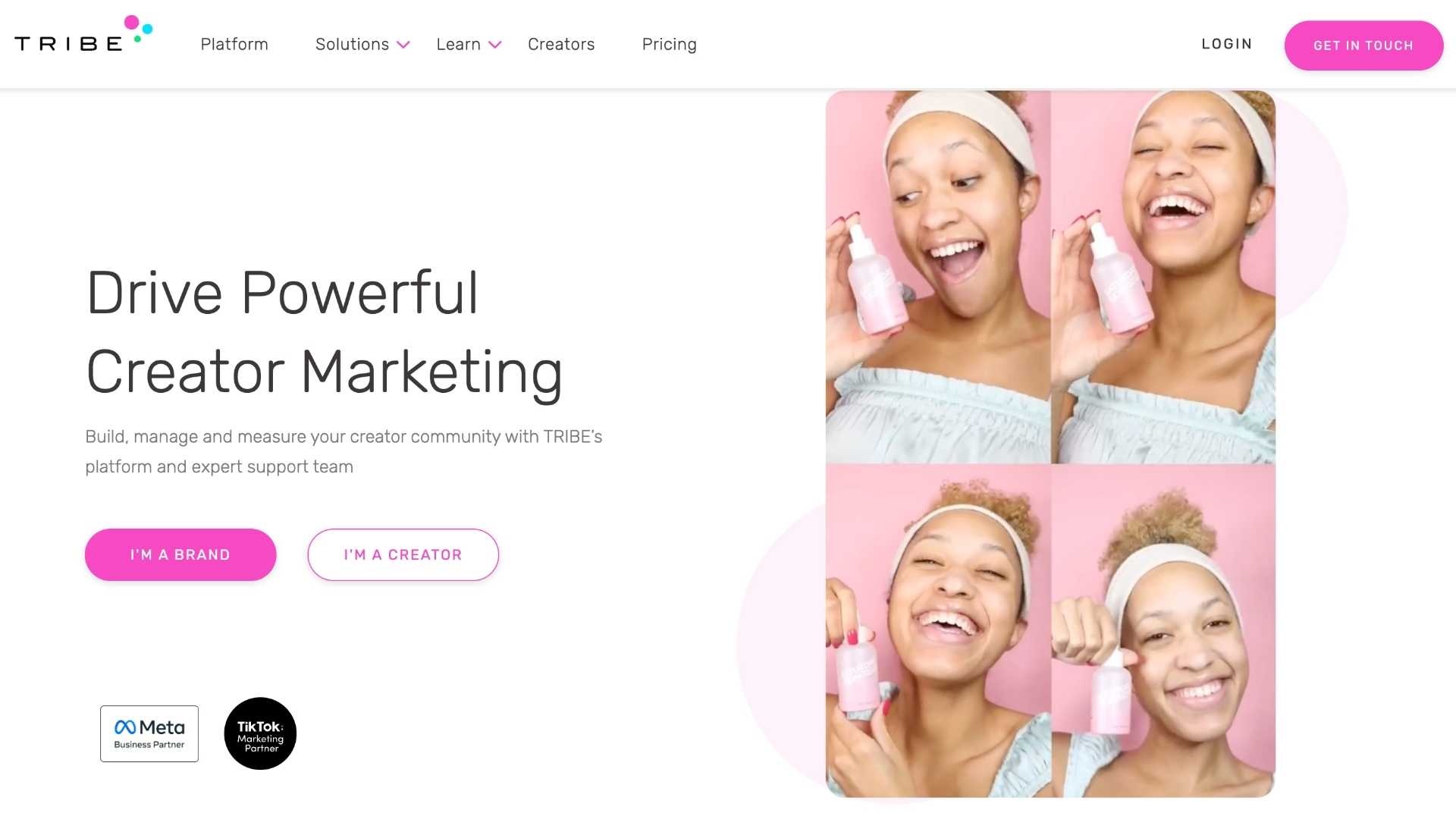
TRIBE is a creator marketplace and campaign platform where brands publish briefs, creators pitch content ideas, and the brand approves the creators and assets it wants to buy. It is built more around sourcing opt-in creators and buying ready-to-go branded content than around deep eCommerce CRM workflows, which can work well for D2C brands that want fast micro-influencer content production.
Key features:
- Brief-led creator marketplace — Brands launch a campaign brief and receive creator pitches tailored to the deliverables they need.
- Opt-in creator network — TRIBE works with a large creator community, which helps brands source creators who actively want to collaborate rather than relying only on cold outreach.
- Content-first workflow — Creators submit content ideas up front, giving brands more confidence in fit before committing budget.
- Multi-platform campaign support — Supports campaigns across TikTok, Instagram, Snapchat, and Pinterest for broad short-form creator coverage.
- Measurement and support team — TRIBE positions itself as a managed-plus-software platform, with customer success and support layered into campaign execution.
- UGC and premium content workflows — The platform is strong for brands that want creator-made content for social, ads, and broader brand channels.
Pros:
- Very good for fast micro-influencer content sourcing because creators come to the brief with ideas, which reduces prospecting time.
- Strong fit for brands prioritizing UGC creator and campaign speed over complex CRM or affiliate infrastructure.
Cons:
- Less eCommerce-native, especially for affiliate-heavy D2C programs.
- Creator breadth can be a limitation in some use cases
- Pricing is less transparent than low-cost self-serve tools, especially if you move into TRIBE Plus or annual-fee structures.
Integrations:
- Not publicly disclosed
Pricing:
TRIBE is mid-to-high priced versus the wider influencer platform market. Official pricing is a mix of custom annual fees for ongoing access and tailored TRIBE Plus pricing, while TRIBE’s own fee explainer also says standard campaigns can carry a 30% margin on total campaign spend; public sources point to a sales-led process rather than a simple fixed monthly SaaS plan.
Reviews:
4.3 / 5.0 (G2)
7. Modash
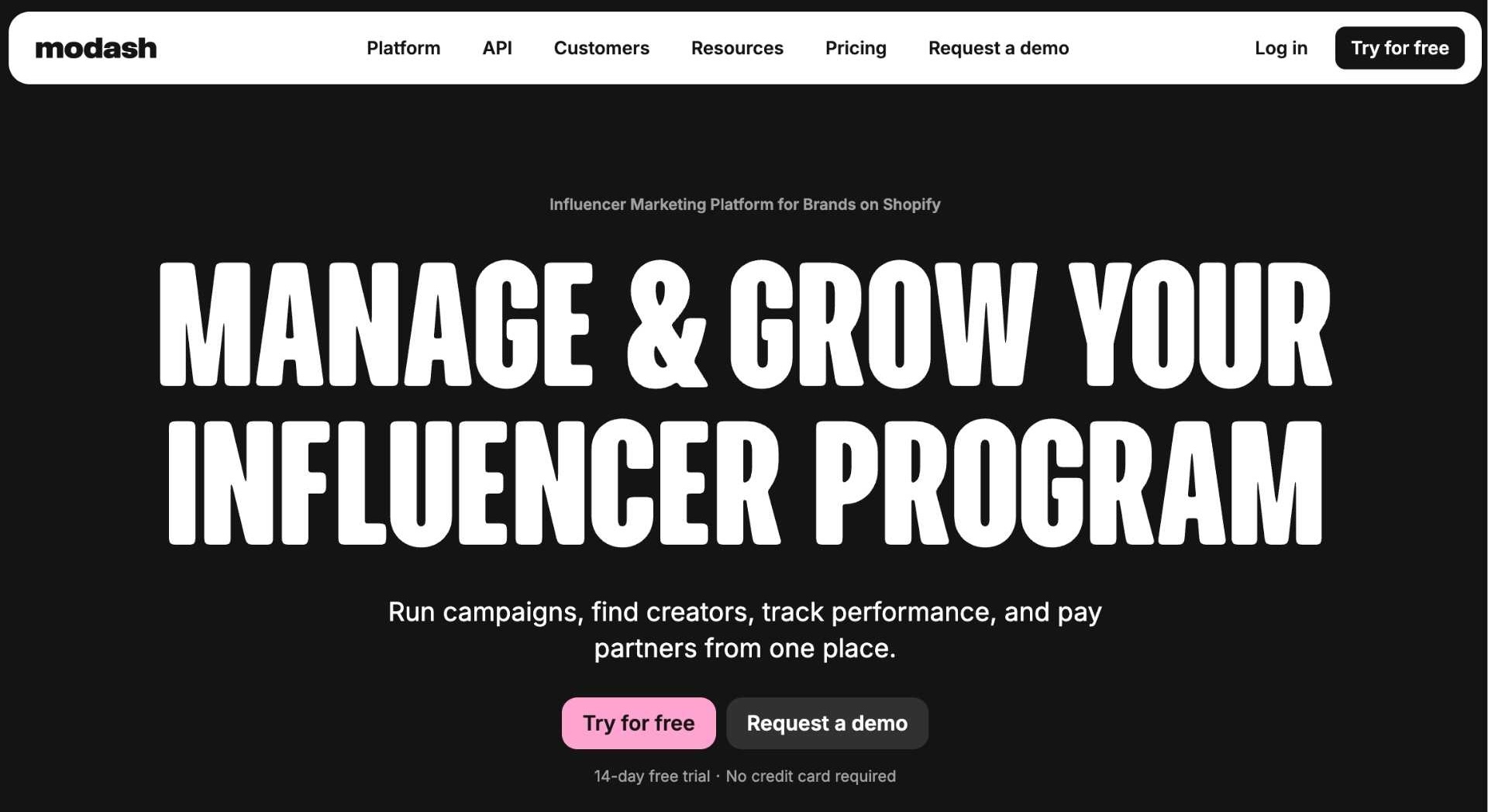
Modash is an end-to-end influencer marketing platform focused on discovery, outreach, campaign management, gifting, affiliate tracking, and payouts. For D2C brands, its biggest draw is a strong Shopify integration combined with an easy-to-use interface and a large creator database across Instagram, TikTok, and YouTube.
Key features:
- Large creator discovery engine — Modash helps brands search creators across major platforms with detailed filtering and audience analysis.
- Audience vetting — Includes fake follower and audience-quality data to improve creator selection.
- Automated post tracking — Captures creator posts automatically so campaign monitoring is less manual.
- Campaign and CRM workflows — Lets teams organize creators, monitor outreach, and track active partnerships in one place.
- Shopify gifting and affiliate tools — Supports promo codes, affiliate links, product gifting, redemptions, and order tracking.
- Inbox sync — Connects Gmail or Outlook so influencer communication stays inside the workflow.
- Automated payouts — Supports creator payouts in multiple currencies as part of affiliate workflows.
Pros:
- One of the best fits for Shopify-first D2C brands because gifting, promo code creation, affiliate tracking, and order management are unusually well integrated.
- Easy to learn and operate
- Good balance of power and affordability compared with enterprise-heavy platforms.
Cons:
- More limited native eCommerce integrations, with Shopify clearly the main commerce connection.
- Some users report loading delays or occasional complexity as campaigns scale.
- UGC rights management is not its strongest differentiator, so brands may still need contract discipline outside the platform.
Integrations:
- Shopify — Create promo codes, track clicks and redemptions, manage affiliate links, automate gifting, and track orders.
- Gmail — Sync creator outreach and manage email conversations from inside Modash.
- Outlook — Keep outreach and follow-ups inside Modash while using your existing Outlook inbox.
- Creator payout rails — Support creator payouts tied to affiliate workflows in 36+ currencies.
- QR codes / UTM links / affiliate links — Generate trackable commerce assets directly from the Shopify-connected workflow.
Pricing:
Modash is low-to-mid priced compared with the broader influencer platform market. Official pricing starts at $199/month billed yearly or $299 month-to-month for entry access,
Reviews:
- 4.9/5.0 (Capterra)
8. Influencity

Influencity is an end-to-end influencer marketing platform for discovery, outreach, influencer relationship management, campaign tracking, and reporting. It is especially relevant for D2C teams that want a full workflow tool with flexible subscriptions and Shopify support, without stepping into enterprise-only pricing.
Key features:
- Influencer discovery — Search a large influencer database and filter by audience, platform, niche, and campaign fit.
- IRM / CRM tools — Organize creators, lists, notes, and workflows inside a relationship-management system.
- Email integration — Connect your existing email so 1:1 creator communication stays centralized.
- Campaign management — Build and monitor campaigns with performance data and structured workflows.
- Shopify integration — Connect your store for influencer programs tied to commerce activity.
- Analytics and reporting — Evaluate influencer profiles, campaign performance, and social outcomes from one dashboard.
- Pricing flexibility — Offers multiple subscription tiers with upgrade and cancellation flexibility.
Pros:
- Solid all-around platform for D2C brands that want discovery, outreach, and reporting in one place.
- More flexible billing than many enterprise competitors, since Influencity says there is no mandatory account permanence and cancellations can be managed from account settings.
- Helpful for teams that need a real IRM layer, not just search and outreach.
Cons:
- Some users report limitations in certain filters and social-network data depth
- Less creator-marketplace oriented, so it can require more active operator work.
Integrations:
- Shopify — Connect your store to build influencer programs tied to products, codes, and commerce activity.
- Brand email provider — Sync your existing inbox for 1:1 influencer communication inside the IRM.
- Zexel Pay — Influencity’s creator-payment help center references Zexel Pay for secure creator payouts.
- CSV / export workflows — Supports campaign and influencer data export for broader reporting needs.
- Social platform analytics — Works across major creator platforms as part of discovery and campaign tracking.
Pricing:
Influencity is mid priced in the influencer-platform category. Official pricing is tiered, and starts from $318/month or $3,816/year
Reviews:
4.3 / 5.0 (G2)
9. Social Cat

Social Cat is a lightweight influencer platform built mainly for small brands and micro-influencer campaigns on Instagram and TikTok. Brands create gifted, affiliate, or paid campaigns, invite or receive applications from vetted creators, manage messaging and contracts inside the platform, and collect licensed UGC from each collaboration.
Key features:
- Micro-influencer database — Social Cat gives brands access to a large pool of manually vetted creators geared toward smaller-scale collaborations.
- Campaign creation — Brands can launch gifted, paid, or affiliate campaigns and start receiving applications quickly.
- Search and invitations — Filter creators by engagement rate, niche, collaboration type, location, or hashtags and invite them directly.
- Built-in messaging — Manage creator conversations with messaging templates inside the platform.
- Contracts — Draft and send contracts before product shipments or collaboration kickoff.
- Content library with usage rights — Store creator content in one place and reuse it across brand channels, with licensing included on paid plans.
Pros:
- Very accessible for small D2C brands thanks to low pricing, free trial access, and no long-term commitment.
- Purpose-built for micro-influencer work, which makes it relevant for brands that do not need enterprise bells and whistles.
- Licensing included is a practical advantage for D2C teams that want UGC for paid social and owned channels.
Cons:
- More limited platform coverage, since Social Cat is focused mainly on Instagram and TikTok.
- Less advanced analytics and stack depth than larger tools, which becomes a limitation as brands scale.
Integrations:
- Meta — Used to verify creator accounts and improve metric accuracy.
- TikTok — Also used for creator verification and campaign support.
- Instagram — Core campaign channel for influencer collaborations.
- TikTok creator campaigns — Core campaign channel for short-form creator collaborations.
- Internal contracts / messaging / content library stack — Social Cat replaces the need for separate lightweight workflow tools for many smaller programs.
Pricing:
Social Cat is low priced compared with nearly all full influencer marketing platforms. Official pricing starts at $99/month for Essentials, then $199/month for Performance and $299/month for Pro; the company says plans are cancel anytime, no commitments, and the pricing page includes a free trial.
Reviews:
4.3 / 5.0 (Trustpilot)
10. Insense
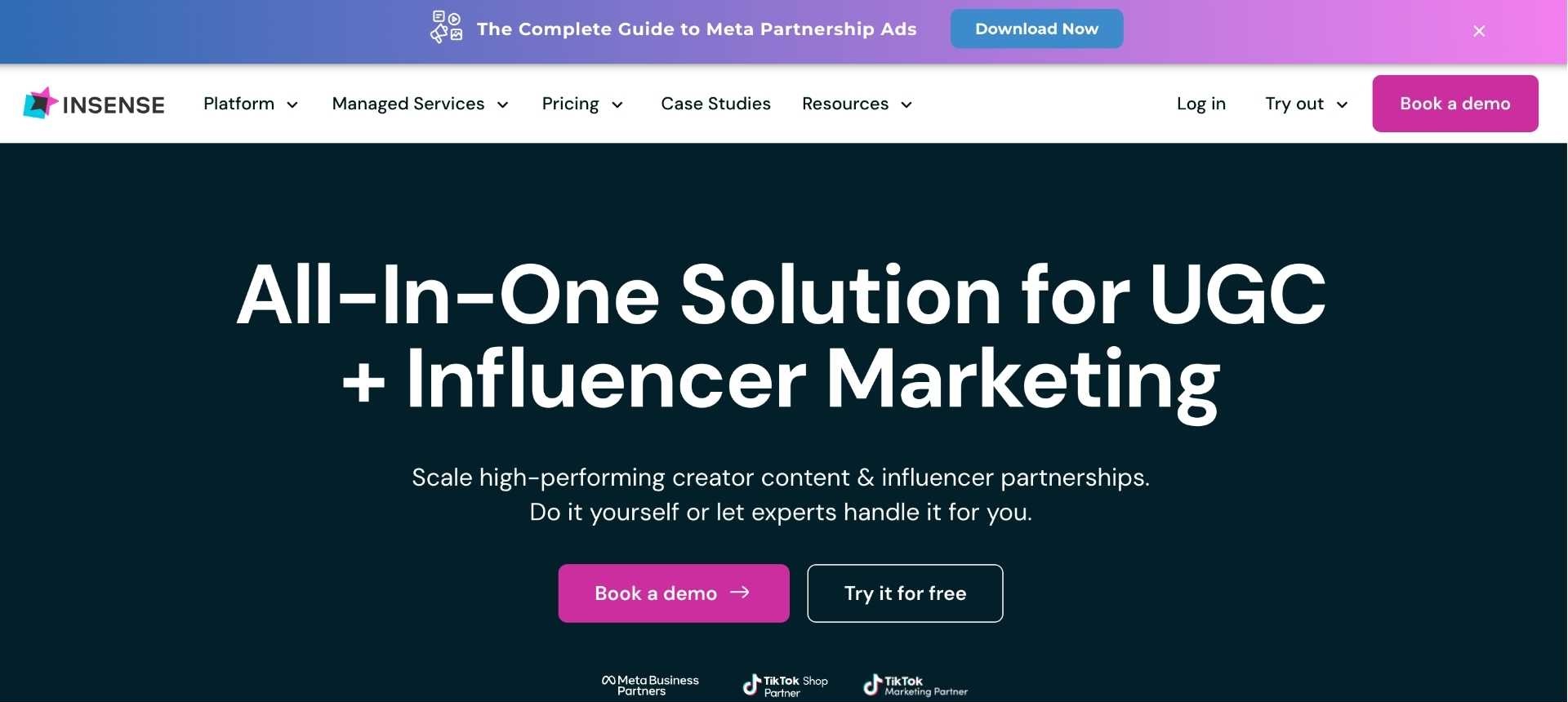
Insense is a creator marketing platform focused on UGC, influencer posts, product seeding, affiliate campaigns, and creator ads. It is especially relevant for D2C brands that want to combine micro-influencer collaborations with paid social amplification through Meta Partnership Ads, TikTok Spark Ads, and TikTok Shop workflows.
Key features:
- Creator marketplace — Brands can hire creators for UGC, influencer posts, affiliate work, and seeding programs from one platform.
- Automated outreach — Insense says it supports targeted outreach to a large creator base with AI-powered workflows.
- Product seeding — Shopify-linked seeding simplifies creator shipping details and campaign activation.
- Direct chat and campaign management — Manage briefs, communication, and execution inside the platform.
- Payments and copyrights — Insense automates contracts, payments, and usage-right handling, which is useful for D2C creative reuse.
- Meta Partnership Ads — Brands can identify eligible creators and request account-level access for whitelisting-style ad workflows.
- TikTok Spark Ads and TikTok Shop — Supports creator-led TikTok ad workflows and affiliate/TikTok Shop activation.
Pros:
- Strongest for D2C brands that want both content and paid amplification, not just organic influencer posts.
- Good fit for micro-influencer seeding plus UGC ads, which is a practical growth model for many consumer brands.
- Flexible operating model because brands can self-serve or add managed services when needed.
Cons:
- Support quality is not uniformly praised, with some users reporting slow responses or reimbursement friction.
- Best value comes when brands actually use the ad and content workflows together; otherwise simpler tools may be enough.
Integrations:
- Shopify — Run product seeding, simplify shipping workflows, and connect creator campaigns to commerce operations.
- Meta — Support Meta Partnership Ads and creator-whitelisting-style paid social workflows.
- TikTok — Run influencer campaigns and Spark Ads through TikTok-focused creator workflows.
- TikTok Shop — Find affiliate-enabled creators and manage TikTok Shop-related creator commerce campaigns.
- Gmail — Official homepage lists Gmail among the core integrations for brand workflows.
Pricing:
Insense is mid priced overall. Official pricing shows a self-serve Agency/Brand entry point from $500/month billed quarterly
Reviews:
4.5 / 5.0 (G2)
Micro-Influencer Campaign Strategy Tips for D2C Brands
Focus on Niche Relevance Over Follower Count
When running micro-influencer campaigns, audience relevance matters more than raw follower numbers. Influencers with 10K–100K followers often have highly niche communities around topics like skincare, fitness, parenting, or cooking. D2C brands should prioritize creators whose audience demographics, interests, and content style align closely with their product category to maximize engagement and conversions.
Work With Multiple Micro Influencers Instead of One Large Creator
Instead of investing the entire budget into one macro influencer, many D2C brands see better results by collaborating with multiple micro influencers simultaneously. Running campaigns with 20–50 smaller creators can generate more authentic content, broader reach across niche communities, and diversified risk if one collaboration underperforms.
Leverage Product Seeding Campaigns
Product gifting is one of the most effective strategies for micro-influencer campaigns. Many micro influencers are open to collaborations in exchange for free products, especially if they genuinely like the brand. Product seeding campaigns help brands generate authentic reviews, unboxing videos, and organic product mentions while keeping marketing costs relatively low.
Prioritize Authentic Content Over Scripted Promotions
Micro influencers perform best when they can create content in their own style. Rather than giving rigid scripts, brands should provide creative guidelines and let influencers present the product naturally. Authentic product reviews, tutorials, and lifestyle integrations tend to perform better than highly polished advertisements.
Build Long-Term Influencer Relationships
Many successful D2C brands treat micro influencers as long-term brand partners rather than one-time campaign collaborators. Repeated collaborations help build trust with audiences, improve creator familiarity with the product, and generate consistent content over time.
Repurpose Influencer Content as Paid Ads
One of the biggest advantages of micro-influencer campaigns is the amount of user-generated content they produce. Brands can repurpose high-performing creator content for paid ads on platforms like Instagram, TikTok, and Meta. This approach often results in higher-performing ads because the content feels more native and authentic.
Test and Scale Winning Creators
The most effective strategy is to treat influencer marketing like a performance channel. Brands should test multiple creators, analyze which ones generate the best engagement and conversions, and then scale campaigns with top-performing influencers through larger collaborations or ambassador programs.
Final Thoughts on Top 10 Influencer Marketing Platforms for Micro Influencer Campaigns
Micro-influencer marketing has become one of the most effective growth strategies for D2C brands because it combines authentic creator relationships with highly engaged niche audiences. Platforms like Aspire, Influencer Hero, Afluencer, Heepsy, HypeAuditor, Tribe, Modash, Influencity, Social Cat, and Insense help brands streamline the entire process—from influencer discovery and outreach to campaign management and ROI tracking. Choosing the right platform ultimately depends on your campaign goals, budget, and preferred workflow, whether that’s product seeding, affiliate programs, or large-scale creator partnerships. By leveraging the right tools and building long-term relationships with micro influencers, D2C brands can generate authentic content, expand reach, and drive measurable revenue growth.

.png)


.jpg)