

10 Best Influence4You Alternatives for Influencer Marketing
Influencer marketing software has become a core growth lever for D2C brands, helping teams streamline creator discovery, automate outreach, manage campaigns, and track performance across channels. Influence4You is one such platform that offers a mix of influencer discovery, UGC workflows, and a built-in creator marketplace, making it a solid option for brands looking to scale content production. However, many teams start exploring Influence4You alternatives due to rising costs as they unlock more features, a pricing structure that can feel complex, limited eCommerce integrations beyond Shopify, and a relatively smaller pool of detailed user feedback. For founders and marketing teams evaluating influencer marketing software, finding the right balance between ease of use, integrations, and ROI tracking is critical.
In this article, we’ll compare the 10 best Influence4You alternatives—Influencer Hero, Upfluence, Aspire, CreatorIQ, Later, IZEA, Traackr, Influencity, Heepsy, and Lefty—to help you find the platform that best fits your growth strategy.
Key Criteria for Evaluating Influencer Marketing Platforms
Core Features
Evaluation of essential influencer marketing capabilities, including influencer discovery, outreach, CRM, campaign management, reporting, and content workflows.
Pricing & Flexibility
Comparison of pricing models, subscription plans, and contract terms to match different budgets and growth stages.
Customer Reviews & Satisfaction
Analysis of user feedback from trusted review platforms, focusing on usability, reliability, customer support, and overall performance.
Pros & Cons
Review of each platform’s strengths and limitations to highlight where it performs well and where it may fall short based on different use cases.
Integrations
Review of the most important integrations (e.g., Shopify and other tech tools), highlighting what each integration enables in one sentence.
Influence4You Overview
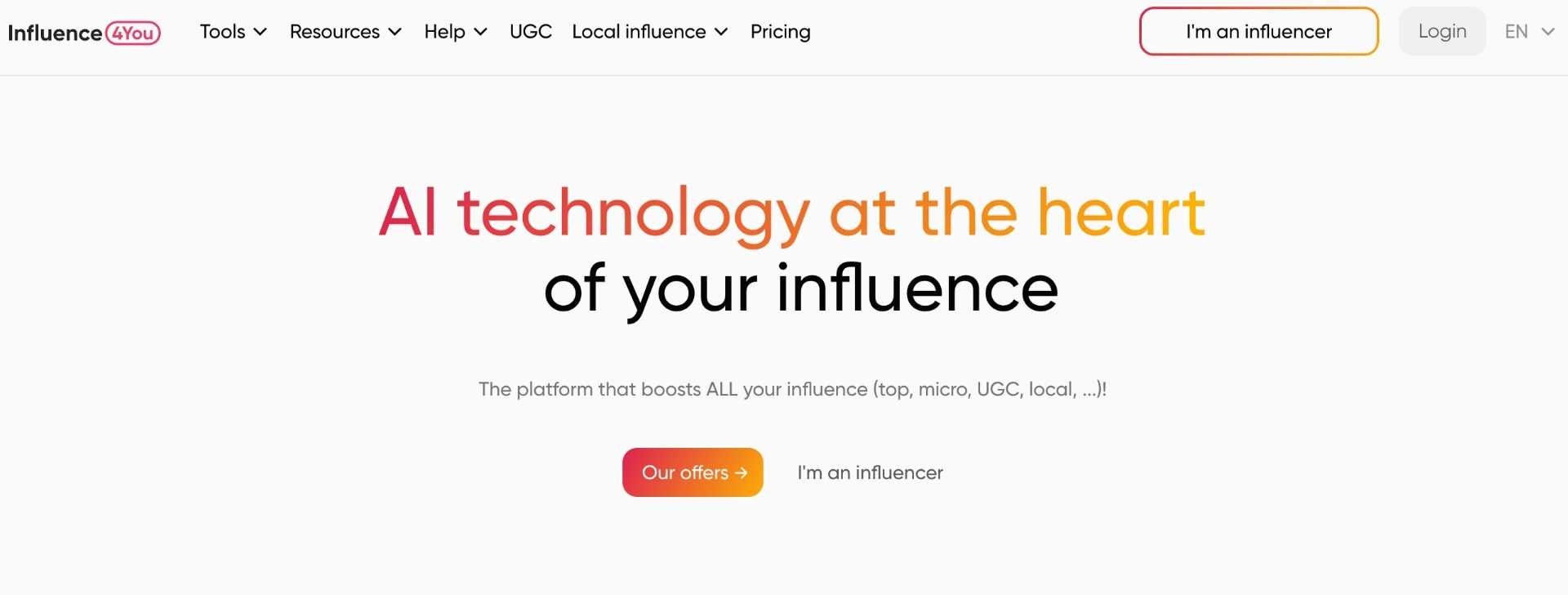
Influence4You is a full-service influencer marketing platform designed to help brands discover creators, manage campaigns, and scale user-generated content (UGC) initiatives. Built with both brands and agencies in mind, the platform combines influencer discovery, campaign management, and a built-in creator marketplace, making it a flexible solution for running both outbound and inbound influencer campaigns.
With over a decade in the market, Influence4You focuses heavily on UGC production workflows and AI-assisted campaign management, positioning itself as a hybrid between a traditional influencer CRM and a creator content marketplace.
Key Features
• Large Influencer Discovery Database Search through hundreds of millions of creator profiles using advanced filters like audience demographics, engagement rate, and niche. Save creators into lists and casting pipelines for structured outreach.
• Integrated Influencer Quality Data (via HypeAuditor) Access detailed audience insights, including fake follower detection, engagement quality, and demographics directly within creator profiles to make better partnership decisions.
• Creator Marketplace (Inbound Applications) Launch campaigns and receive applications from a network of opted-in creators. This reduces manual outreach and speeds up campaign casting, especially for gifting or UGC campaigns.
• End-to-End Campaign & Project Management Manage campaigns using Kanban-style workflows with task tracking, budgeting, contracts, and team collaboration tools—ideal for agencies and multi-stakeholder teams.
• AI-Powered Campaign Tools (Project.AI) Get AI-driven influencer recommendations, automated reporting, and assistance in campaign setup, helping teams reduce manual work and improve targeting.
• UGC Campaign Engine (Video Ads Module) Run structured UGC campaigns where creators submit content and brands only pay for approved assets—ideal for performance marketing and paid social creatives.
• Automated Content Tracking & Reporting Track influencer posts (including Stories), engagement metrics, and Earned Media Value (EMV) in real time with auto-generated reports.
• Flexible Compensation Models Support for fixed payments, gifting campaigns, and performance-based compensation depending on campaign goals.
• Browser Extension for Influencer Scouting Analyze creators directly on Instagram, TikTok, YouTube, and Twitch while browsing, and save them instantly into your campaign pipeline.
Pricing
Influence4You uses a modular pricing model, where brands can choose individual tools or bundle them:
• Free Chrome Plugin: Free
• Discovery Plan: From ~590/month
• Project.AI: From ~€1,190/month
• Marketplace: From ~€1,490/month
• Full Influence Pack: From ~€1,990/month (bundled solution)
Pricing varies based on discounts and commitment terms (monthly vs. annual), with bundled plans offering reduced rates.
Reviews
Not available
Integrations
• Shopify – Manage product gifting, discount codes, and influencer-driven sales workflows directly within campaigns.
• HypeAuditor – Access advanced audience quality and fraud detection data within influencer profiles.
• YouSign – Handle influencer contracts and e-signatures seamlessly inside the platform.
• Google Chrome Extension – Discover and analyze influencers directly while browsing social platforms.
• Mozilla Firefox Extension – Alternative browser extension for real-time influencer insights and list building.
Pros
• Strong UGC-first approach with pay-for-performance model The Video Ads module allows brands to only pay for approved content, making it highly efficient for paid social and creative testing.
• Dual sourcing model (database + marketplace) Combines outbound influencer discovery with inbound creator applications, giving brands more flexibility and faster campaign execution.
• AI-assisted campaign management (recent focus) Project.AI introduces automation in influencer selection, reporting, and brief creation—reducing manual workload for marketing teams.
Common Drawbacks of Influence4You
Costs increase significantly for full functionality
While discovery starts relatively affordable, accessing the full workflow (AI, marketplace, reporting) requires higher-tier plans and onboarding fees.
Pricing structure can feel complex
Multiple modules, discounts, and plan variations make it harder to quickly understand total cost compared to more transparent competitors.
Limited eCommerce integrations beyond Shopify
Brands using platforms like WooCommerce or Magento may find fewer native integrations compared to other influencer platforms.
Smaller volume of publicly available user feedback
Despite high ratings, the number of detailed user reviews is relatively limited, making it harder to evaluate long-term performance and support quality.
Best Influence4You Alternatives
| TOOL | REVIEWS | BEST FOR | TRIAL INFO | PRICING | ||
|---|---|---|---|---|---|---|
1 |

|
⭐ | Influencer CRM & automation | Book Demo | Pricing | Website |
2 |

|
⭐ | Influencer discovery | Book Demo | Pricing | Website |
3 |

|
⭐ | Influencer partnerships | Book Demo | Pricing | Website |
4 |

|
⭐ | Enterprise influencer marketing | Book Demo | Pricing | Website |
5 |

|
⭐ | Social media & influencer campaigns | Book Demo | Pricing | Website |
6 |
|
⭐ | Influencer marketplace | Book Demo | Pricing | Website |
7 |

|
⭐ | Enterprise influencer analytics | Book Demo | Pricing | Website |
8 |

|
⭐ | Campaign management | Book Demo | Pricing | Website |
9 |

|
⭐ | Influencer discovery | Book Demo | Pricing | Website |
10 |

|
⭐ | Influencer analytics & discovery | Book Demo | Pricing | Website |

Influencer Hero
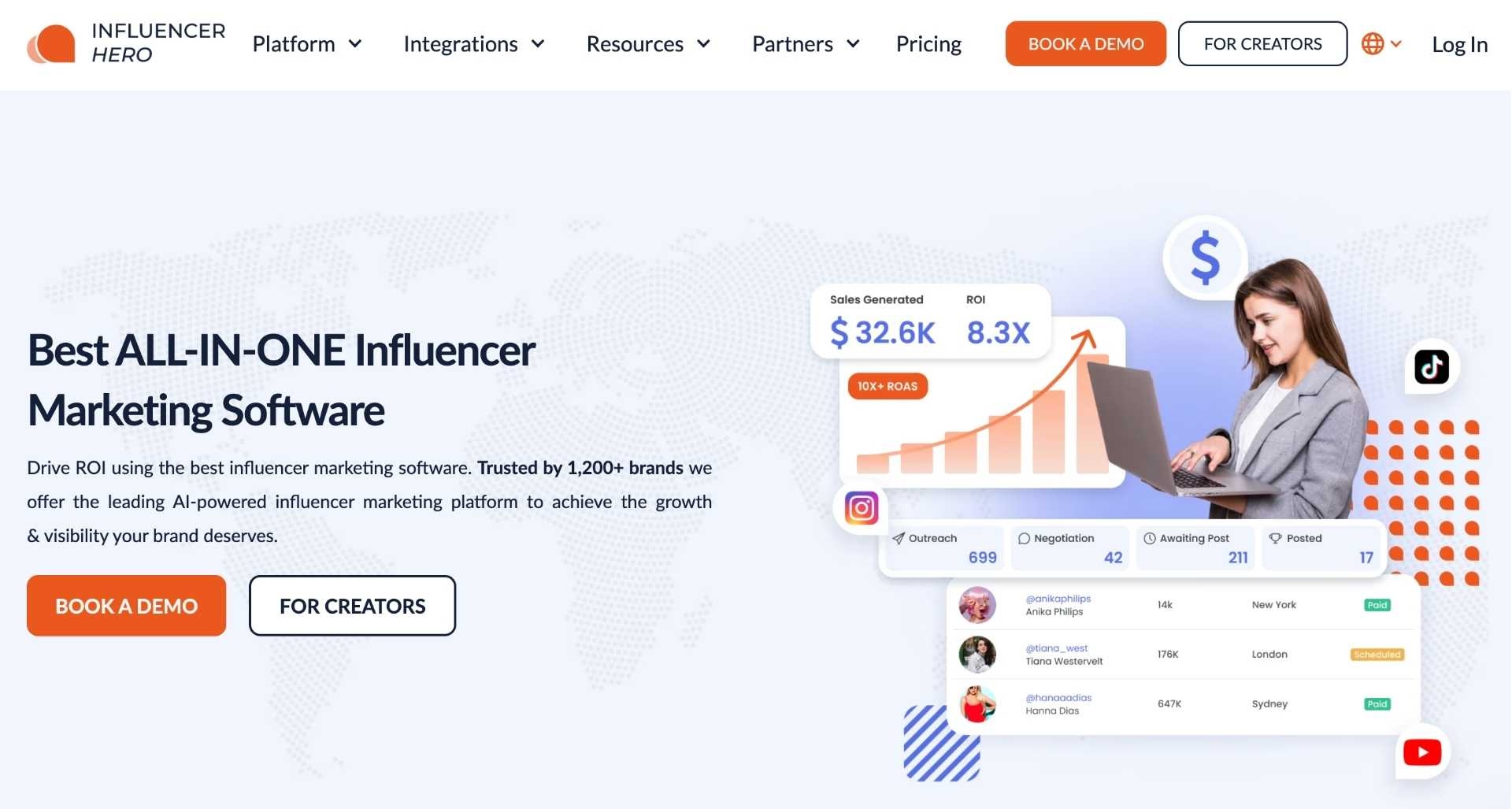
Influencer Hero is an all-in-one influencer marketing platform built for DTC and eCommerce brands that want discovery, outreach, CRM, gifting, affiliate tracking, UGC collection, and ROI reporting in one system. Compared with older enterprise tools, it leans heavily into workflow automation, flexible eCommerce integrations, and revenue attribution, which makes it especially appealing for brands that care about tying creator activity back to sales.
Key Features
• AI-powered influencer discovery Influencer Hero offers AI search plus advanced filters for audience demographics, niche, engagement, and fraud detection, with a database it markets at 450M+ creators across major platforms.
• High-volume outreach automation The platform supports bulk outreach, AI-assisted messaging, templates, reply tracking, and workflow automation so teams can scale creator recruitment without relying on spreadsheets.
• Campaign-centric CRM Its CRM is built around dealflow, campaign stages, deliverables, and influencer history, making it easier to manage both one-off collaborations and always-on programs.
• Affiliate and revenue tracking Brands can generate links and discount codes, attribute clicks and conversions, track creator sales, and connect influencer performance to revenue outcomes.
• Product seeding and gifting Influencer Hero integrates product gifting with store data so brands can manage seeding, fulfillment, and posting status inside one workflow.
• UGC collection and post tracking It automatically captures creator content into a centralized library for reuse, with filters to identify top-performing assets for ads or organic social.
• Application pages and storefronts Brands can launch branded sign-up pages for creators and affiliates, then move approved applicants directly into campaign workflows.
• Broad integrations and API access The platform supports eCommerce, email, support, and workflow integrations, plus API access for deeper customization.
Pricing
Influencer Hero offers flexible pricing based on outreach volume and you can have unlimited creators in your CRM:
• Standard — $649/month (up to 1,000 outreach messages per month)
• Pro — $1,049/month (up to 5,000 outreach messages per month)
• Business — $2,490/month (up to 10,000 outreach messages per month)
• Custom / Agency — Tailored pricing
Custom pricing is available for agencies and larger teams
Reviews
4.9/5.0 (Capterra)
Pros
• Very strong eCommerce integration layer Influencer Hero stands out for supporting not just Shopify and WooCommerce, but a wider commerce stack plus Amazon, letting brands tie gifting, affiliate sales, and attribution into one reporting flow.
• Stronger creator-brand fit through data Features like brand follower identification and AI-powered UGC search help teams find creators who already engage with the brand or produce relevant content, improving authenticity and campaign performance.
• Application pages plus creator storefronts The combination of branded creator intake pages and storefront-based monetization gives brands more ways to scale inbound creators and affiliate-style programs.
Cons
• Setup can take some initial work Because the platform covers CRM, outreach, gifting, affiliate tracking, and reporting, teams may need onboarding help to configure workflows properly.
• No free trial: Makes it harder for teams to evaluate the platform before committing
Integrations
• Shopify – Sync products, create gifting orders, generate creator-specific links and codes, and track influencer-driven revenue.
• WooCommerce – Connect store data to influencer workflows for gifting, affiliate tracking, and sales attribution.
• Amazon – Track creator-driven marketplace sales and connect influencer activity to Amazon revenue.
• Klaviyo – Sync influencer data with email marketing flows and connect creator activity with retention workflows.
• Zapier – Push influencer data into other tools and automate custom workflows across thousands of apps.
Influence4You vs Influencer Hero
Influence4You is stronger if you want a modular platform with a built-in creator marketplace and a UGC-first payment model. Influencer Hero is stronger if you want a more operationally complete system for DTC execution, especially around outreach automation, affiliate tracking, gifting, and store-linked ROI reporting. Influence4You emphasizes discovery, AI-assisted project management, and inbound creator applications; Influencer Hero leans more into CRM automation, eCommerce attribution, and multi-system integrations.
Another key difference is flexibility. Influence4You offers more modular product packaging, while Influencer Hero provides clearer public SaaS pricing and deeper integration coverage across commerce and marketing tools. For brands that prioritize creator content sourcing and campaign casting, Influence4You remains attractive. For brands that want creator programs tied tightly to revenue and lifecycle workflows, Influencer Hero is usually the more commerce-oriented option.
Upfluence

Upfluence is an influencer and affiliate marketing platform built primarily for eCommerce brands that want to discover creators, automate outreach, manage gifting, track affiliate performance, and connect influencer activity directly to commerce data. Its positioning is especially strong for Shopify- and Amazon-led brands because it focuses on turning customers into creators, tracking attributable sales, and managing creator payments inside one platform.
Key Features
• Influencer discovery with audience and brand-fit data Upfluence lets teams search millions of creators using filters for location, niche, engagement, audience demographics, and brand affinity.
• AI campaign co-pilot (Jaice AI) Upfluence now markets Jaice AI as a campaign co-pilot that helps with creator matching, strategic setup, and faster campaign launches.
• Bulk outreach and CRM workflows Brands can run creator outreach, track communication, organize lists, and manage campaign stages without switching between inboxes and spreadsheets. (G2)
• Strong eCommerce integrations Upfluence is particularly strong for Shopify and Amazon use cases, including identifying influencer-customers, managing gifting, and attributing conversions.
• Affiliate links, promo codes, and sales attribution The platform supports affiliate-style campaigns with trackable links and store-compatible discount codes to measure revenue and ROI.
• Creator payouts Upfluence supports one-click or automated creator payments, legal document collection, and multi-currency payouts.
• Social listening and content performance tracking Teams can monitor brand mentions, content performance, reach, engagement, and conversions from one system.
Pricing
• Pricing model: Upfluence uses custom pricing rather than a public fixed plan table.
• All plans are custom made. There’s a minimum full year of service you have to commit to with monthly payments. On average plans start around $2,000/month ($24,000 yearly)
Reviews
4.3/5.0 (Capterra)
Pros
• Excellent for Shopify and Amazon-led brands Upfluence’s biggest differentiator is how tightly it connects influencer marketing with commerce data, especially customer-as-creator discovery, gifting, promo codes, and Amazon attribution.
• Jaice AI is a meaningful recent addition Its newer AI layer goes beyond copy generation and is positioned as a campaign co-pilot for planning, creator selection, and launch decisions.
• Built-in payments and ROI tracking Upfluence is one of the more commerce-minded platforms when it comes to affiliate tracking, payout workflows, and proving campaign sales impact.
Cons
• Pricing and contract flexibility can be a hurdle Upfluence is often seen as expensive for smaller brands, especially because full functionality usually comes with annual commitments.
• Some teams report a learning curve and clunkier workflow setup Reviews and research notes point to campaign editing friction, organizational complexity, and a UI that can feel less intuitive than newer tools.
• Automation is not always as deep as expected Some teams find that email sequencing and certain workflow automations stop short of what they want for high-volume creator comms.
Integrations
• Shopify – Identify influential customers, send products, and track influencer-driven sales from your store.
• Amazon – Attribute marketplace sales and run creator programs tied to Amazon performance.
• Klaviyo – Enrich subscriber records with creator data and activate influencer-led email workflows.
• Gmail – Run creator outreach directly from your own inbox environment.
• Stripe / Upfluence Pay – Automate creator payments and track payout transactions.
Influence4You vs Upfluence
Influence4You is more modular and marketplace-oriented, while Upfluence is more commerce-native. If your main goal is to discover creators, manage projects, and source UGC with flexible campaign modules, Influence4You has a cleaner fit. If your priority is identifying creators from your customer base, automating gifting, and tying influencer campaigns directly to store sales, Upfluence is the stronger option.
Upfluence also goes deeper on Shopify, Amazon, affiliate codes, and payouts, whereas Influence4You is more centered on discovery, UGC workflows, and its built-in creator marketplace. For pure DTC revenue attribution, Upfluence usually has the edge. For brands that want simpler modular buying and a stronger UGC-content workflow, Influence4You can be easier to rationalize.
Aspire

Aspire is an influencer marketing platform aimed at eCommerce brands that want to scale creator, affiliate, ambassador, and UGC programs from one system. It is best known for combining a large creator marketplace with direct platform partnerships, strong inbound application workflows, and a product experience built around ROI-focused brands rather than pure discovery alone.
Key Features
• Creator search plus a large sponsorship marketplace Aspire combines searchable public creator discovery with an inbound marketplace where creators can apply directly to brand opportunities.
• Direct partnerships with major social platforms Aspire highlights direct relationships with Meta, TikTok, and Pinterest for first-party data and richer creator insights.
• Workflow automation and CRM Teams can organize creators into groups, automate follow-ups, manage briefs and approvals, and move creators through campaign stages more systematically.
• Shopify-powered gifting and customer enrichment Aspire syncs Shopify buyer data, enriches customer profiles with creator signals, and automates shipping and tracking for product seeding.
• Paid social and advertiser rights workflows Through its Meta partnership, Aspire helps brands request advertiser rights and monitor content performance for creator-led paid media.
• Affiliate and ambassador program support Aspire supports codes, links, creator stores, and sales tracking for more performance-led programs.
• Reporting and exports The platform supports campaign, creator, sales, and performance reporting with exportable data for stakeholders.
Pricing
Aspire does not publish full public package pricing on its website. Public and recent market sources indicate:
• Custom pricing
• Often reported at about $2,000+/month
• Recent quoting indicated around $2,300/month for a mid-tier setup
• Typically sold with a 12-month commitment rather than month-to-month self-serve plans
Reviews
4.0/5.0 (Capterra)
Pros
• Direct platform partnerships are a real differentiator Aspire’s official partnerships with Meta, TikTok, and Pinterest are a standout advantage for first-party data, advertiser rights, and campaign accuracy.
• Inbound marketplace plus public profile discovery Many tools are stronger in one sourcing model than the other; Aspire is unusually strong at combining both.
• Well-suited for creator-led commerce and paid social Aspire is especially good for brands running gifting, affiliate, ambassador, and creator-ads workflows from one place.
Cons
• Pricing is better suited to mid-market and enterprise budgets Aspire is rarely the cheapest option and is usually sold through annual contracts and custom packages.
• Some users find campaign structure and navigation confusing at first Public review summaries mention a learning curve and occasional friction in setup or integrations.
• Support is praised, but technical issues still come up Reviews note helpful support, but also occasional glitches, connection issues, and reporting limitations.
Integrations
• Shopify – Sync customer and product data, automate gifting, and update campaign records with store activity.
• Meta / Facebook Ads Manager – Request advertiser rights and extend high-performing creator content into paid campaigns.
• TikTok – Find, manage, and pay TikTok creators using first-party data through Aspire’s direct partnership.
• Pinterest – Run creator campaigns with Pinterest support via Aspire’s vetted partner relationship.
• Gmail – Sync creator communications and manage outreach from connected email workflows.
Influence4You vs Aspire
Influence4You is more modular and often easier to understand from a product-packaging standpoint, while Aspire is more full-program and commerce-focused. Influence4You shines for creator marketplace campaigns, UGC sourcing, and AI-assisted project management. Aspire is stronger for brands that want a richer creator marketplace, first-party platform partnerships, more structured paid-social workflows, and deeper product gifting tied to Shopify.
Aspire also feels more enterprise-ready for brands building ambassador, affiliate, and creator ads programs at once. Influence4You is still attractive for teams prioritizing modular discovery plus UGC execution. But if creator commerce, inbound recruiting, and social-platform partnerships matter most, Aspire usually offers the more advanced ecosystem.
CreatorIQ

CreatorIQ is an enterprise creator marketing platform designed for large brands and agencies managing global creator programs with high governance, measurement, and integration requirements. Its newer positioning emphasizes being an AI-native, content-first operating system for creator-led growth rather than just an influencer campaign tool, with a strong focus on centralized governance, brand safety, workflow control, and analytics.
Key Features
• Content-first creator discovery CreatorIQ emphasizes discovery based on creator content, fit, and brand relevance rather than profile data alone, with AI-backed filtering and evaluation.
• The Creator Graph Its proprietary data layer powers creator discovery and evaluation using direct platform integrations and enriched creator intelligence.
• Enterprise governance and workflow controls CreatorIQ is built for organizations that need approvals, permissions, compliance, and structured cross-team collaboration at scale.
• CreatorIQ Recruit, Convert, and Pay The platform includes modules for creator recruitment, commerce activation, and payment workflows.
• SafeIQ and brand safety focus CreatorIQ has recently leaned hard into safety and governance, including AI-native brand safety tooling under SafeIQ.
• ExchangeIQ and integrations ExchangeIQ connects CreatorIQ data with BI tools, CRMs, and internal systems so influencer data can flow into broader reporting and operations.
• Measurement and benchmarking The platform is built for executive reporting, multi-market measurement, and tying creator programs to broader business outcomes.
Pricing
There are different plans:
• Basic Plan: Starts at $35,000/year. Includes 1,000 contact creators per month
• Standard Plan: Starts at $50,000/year. Includes 2,500 contact creators per month
• Professional Plan: Starts at $90,000/year. Includes 5,000 contact creators per month
• Enterprise Plan: Starts at $200,000/year. Includes 7,500 contact creators per month
Reviews
4.4/5.0 (Capterra)
Pros
• One of the strongest enterprise governance platforms in the category CreatorIQ is built for large, multi-team, multi-market programs where approvals, brand safety, and centralized control matter as much as discovery.
• The new AI-native product direction is a major platform update Its recent repositioning around the new CreatorIQ, SafeIQ, and content-first discovery signals a meaningful platform evolution rather than a cosmetic refresh.
• ExchangeIQ is valuable for enterprise data teams The integration layer is a standout for brands that need creator data connected to BI, CRM, and internal systems, not just campaign dashboards.
Cons
• Pricing is out of reach for many mid-sized brands CreatorIQ is firmly enterprise-priced and rarely makes sense for leaner DTC teams.
• The platform can feel complex for day-to-day operators Even strong reviews often note a learning curve and a heavier operational feel compared with more agile DTC tools.
• Some users mention stale or incomplete analytics in certain cases Public review feedback includes complaints about outdated data or reporting limitations for some creators.
Integrations
• ExchangeIQ / API integrations – Connect CreatorIQ data with internal systems, BI environments, and custom enterprise workflows.
• Meta – Use direct social platform data for creator insights and more reliable measurement.
• TikTok – Pull direct platform data for creator evaluation and campaign reporting.
• YouTube – Support creator discovery and analytics through direct platform integrations.
• CRM / BI tools – Sync creator and campaign data into broader enterprise reporting and operations workflows.
Influence4You vs CreatorIQ
Influence4You is better suited to brands that want a more accessible, modular influencer platform with creator marketplace functionality and UGC workflows. CreatorIQ is built for global enterprise brands that need governance, compliance, integration depth, and executive-grade reporting across multiple markets and teams. Influence4You feels more campaign-operator friendly; CreatorIQ feels more like infrastructure.
CreatorIQ also goes much deeper on enterprise safety, data architecture, and cross-functional oversight. Influence4You is the more practical option for many growth-stage brands. But for organizations where creator marketing has to plug into governance, BI, finance, and brand-safety requirements, CreatorIQ is in another tier.
Later
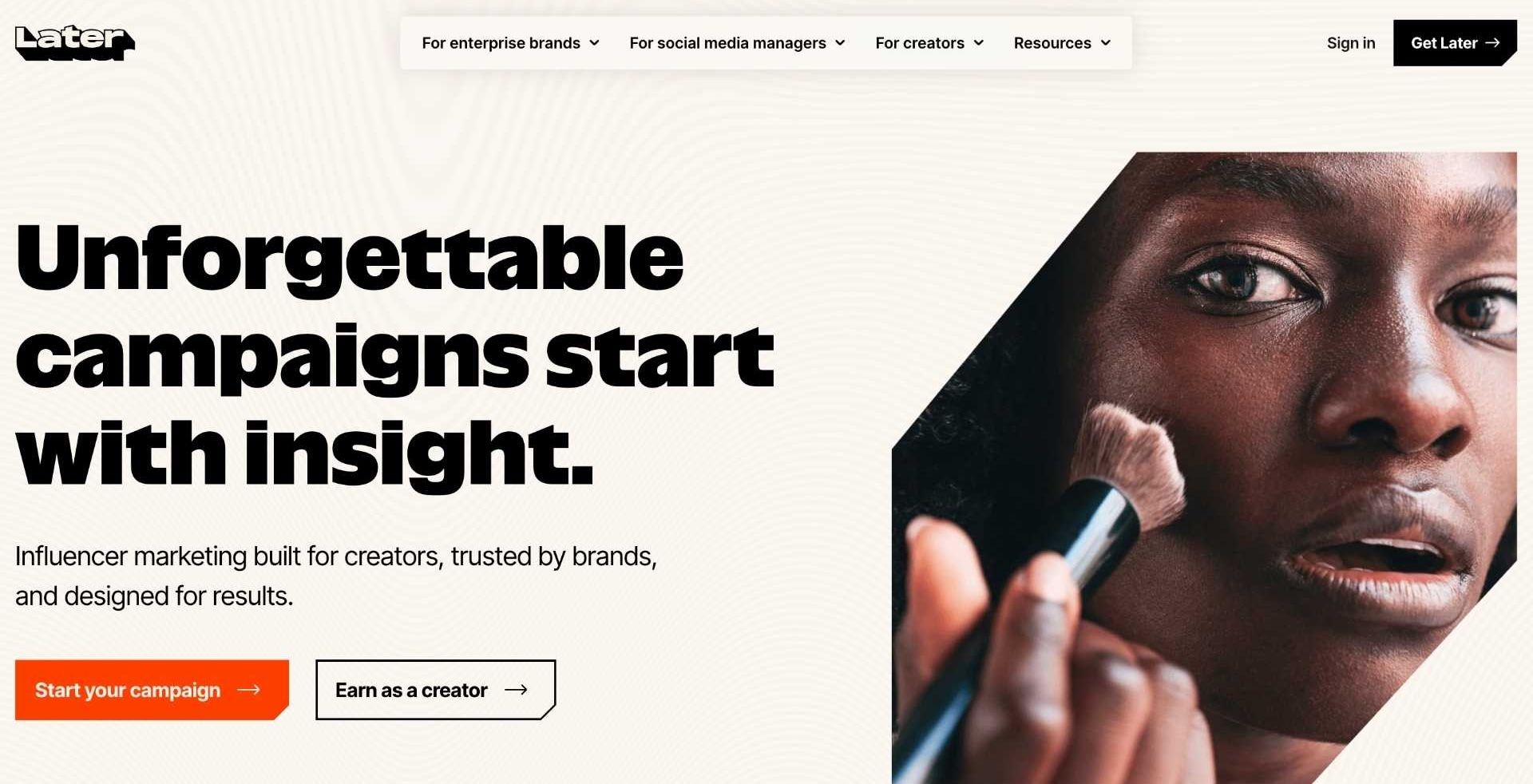
Later Influence is the enterprise influencer marketing arm of Later, following the Mavrck rebrand, and it now sits inside a broader social, creator commerce, and AI ecosystem. The platform combines influencer campaign management with affiliate capabilities, social proof, creator insights, and managed-service options, positioning itself as a full-funnel creator marketing platform rather than just a discovery tool.
Key Features
• End-to-end influencer campaign management Later Influence supports creator discovery, outreach, campaign execution, content production, performance tracking, and creator relationships from one system.
• Content creation and scale The platform puts heavy emphasis on scaling creator-generated content for use across channels, not just running isolated influencer activations.
• Ratings and reviews generation Later is differentiated by its ability to source influencer and advocate reviews that can be syndicated to eCommerce environments as social proof.
• Affiliate and conversion tracking It supports affiliate links and conversion tracking through Later and Mavely integrations.
• Social listening and brand health monitoring Official pricing materials call out social listening and sentiment monitoring as part of the platform’s value proposition.
• Unlimited campaigns and users on platform plans Later explicitly markets unlimited users, campaigns, and creator partnerships across its influencer plans.
• Later EdgeAI Later’s newer AI layer uses first-party campaign and commerce data to predict performance, creator fit, and outcomes before launch.
Pricing
Later’s influencer marketing platform (Later Influence) uses custom pricing, and brands need to request a demo for exact costs.
Based on our research, there are different plans:
• Essentials Plan: Starts at $28,500/year. Best for brands starting in influencer marketing.
• Pro Plan: Starts at $42,000/year. Best for data and automation to make your campaigns run faster and achieve better ROI.
• Premier Plan: Starts at $60,000/year. Everything you need for a scaled influencer program.
• All plans come with an additional one-time onboarding fee of $5,000 for all new customers.
Reviews
4.4 / 5.0 (Capterra)
Pros
• Later EdgeAI is one of the more ambitious recent launches in the category Later says EdgeAI is trained on 16 million creators, 136 billion annual impressions, and more than $2 billion in verified influencer-driven purchases, making it a notable recent differentiator.
• Strong blend of software plus services Unlike many pure-SaaS tools, Later lets brands choose self-serve, hybrid, or heavily managed models under one umbrella.
• Deeper social-proof and review use cases than many competitors Later is unusually strong for brands that want influencer campaigns to produce not just awareness content, but reviews, UGC, affiliate conversions, and broader social commerce outcomes.
Cons
• Pricing is opaque Brands need to request pricing, which makes quick budgeting harder than with more transparent SaaS competitors.
• Some users report technical issues and campaign complexity Public review summaries mention glitches, creator-management friction, and a learning curve for new users.
• Affiliate functionality depends on supported network setup Certain affiliate workflows require being on one of the networks supported through Mavely.
Integrations
• Shopify – Connect your store to automate gifting, creator selection, and campaign result tracking.
• Mavely – Power affiliate deliverables and creator commerce through Later’s creator commerce integration.
• Impact – Use Later’s affiliate workflow through supported affiliate network integrations.
• CJ Affiliate – Support creator affiliate campaigns across approved network connections.
• Rakuten / AWIN / Partnerize – Extend Later’s affiliate conversion tracking into broader commerce ecosystems via supported networks.
Influence4You vs Later
Influence4You is more of a modular influencer software platform with strong discovery, UGC, and creator marketplace mechanics. Later is broader and more enterprise-service oriented, combining software, managed services, affiliate infrastructure, social proof, and now predictive AI. If you want a hands-on SaaS platform with clear modules and UGC pay-per-asset logic, Influence4You stays compelling. If you want a bigger ecosystem spanning creator campaigns, reviews, affiliate commerce, and hybrid service support, Later has the wider footprint.
Later also has a stronger story around full-funnel social commerce and managed execution, while Influence4You is more straightforward for brands focused on campaign building, creator sourcing, and UGC production. In practice, Influence4You is often the simpler operator tool; Later is the broader strategic platform.

IZEA
IZEA is one of the longer-standing players in influencer marketing, positioning itself as a tech-powered creator economy company that combines managed services, enterprise software, and a self-serve creator marketplace. Today, its lineup spans managed campaign execution, the IZEA Marketplace, and newer AI-infused workflow products like ZED, making it relevant for both brands that want hands-on software and those that prefer done-for-you support.
Key Features
• Managed services plus software options — IZEA offers both fully managed campaign services and self-serve tools, so brands can choose between outsourcing execution or running campaigns in-house.
• IZEA Marketplace for direct creator hiring — brands can search creator listings, purchase content packages, or launch casting calls and receive pitches from creators directly.
• ZED creator operations platform — ZED is IZEA’s newer AI-infused operating layer built around creator relationship management, approvals, payments, reporting, and workflow automation.
• Flex-style campaign infrastructure — IZEA has historically emphasized campaign planning, creator payments, tracking links, content monitoring, and creator relationship management for brands and agencies.
• Commerce and ROI tracking — IZEA highlights Shopify and Google Analytics integrations so brands can connect creator activity with revenue, engagement, and on-site behavior.
• AI content tools via FormAI — the company also offers AI tools for image and text generation tailored to creator workflows and campaign creative production.
Pricing
• Starter Plan: starts at $130/month.
• Power Plan: starts at $500/month.
• Free trial: 10 days.
• Managed Services: custom proposal-based pricing for fully managed campaigns.
Reviews
3.9/ 5.0 (G2)
Pros
• ZED is its biggest recent product move — IZEA launched ZED in March 2026 as an AI-infused creator operations platform focused on planning, approvals, reporting, payments, and optimization.
• Unusually flexible go-to-market model — few competitors combine managed services, enterprise software, AI creative tools, and a self-serve marketplace under one brand as cleanly as IZEA does.
• Strong commerce measurement foundation — Shopify, Google Analytics, tracking links, and creator payments make it better suited than many marketplace tools for brands that care about measurable ROI.
Cons
• Business-facing pricing is not especially transparent — the public pricing is clearest for Marketplace memberships, while enterprise software and managed-service costs still require a sales conversation.
• The product lineup can feel fragmented — with Marketplace, managed services, FormAI, and ZED, IZEA can be harder to evaluate quickly than competitors with one core platform.
• Some teams report cumbersome influencer communication flows — public review feedback points to creator response friction and a less-than-smooth back-and-forth in some use cases.
Integrations
• Shopify — connects creator campaigns to order-level sales tracking and commerce workflows.
• Google Analytics — ties influencer campaigns to on-site engagement, revenue, and conversion data.
• PayPal — supports creator payouts in the Marketplace payout flow.
• FormAI — adds AI image and copy generation for creator campaign production.
• E-signature / contract templates — supports contract workflows and signing within IZEA’s broader campaign process.
Influence4You vs IZEA
Influence4You is more straightforward if you want a modular influencer platform centered on discovery, creator applications, and UGC campaigns. IZEA is broader: it combines a creator marketplace, managed services, commerce measurement, and newer AI workflow tooling, which can make it more flexible but also more complex to buy and operate. For brands that want self-serve marketplace access plus optional full-service support, IZEA has the wider operating model; for brands that want a cleaner influencer-software experience with less product sprawl, Influence4You is easier to navigate.
Traackr
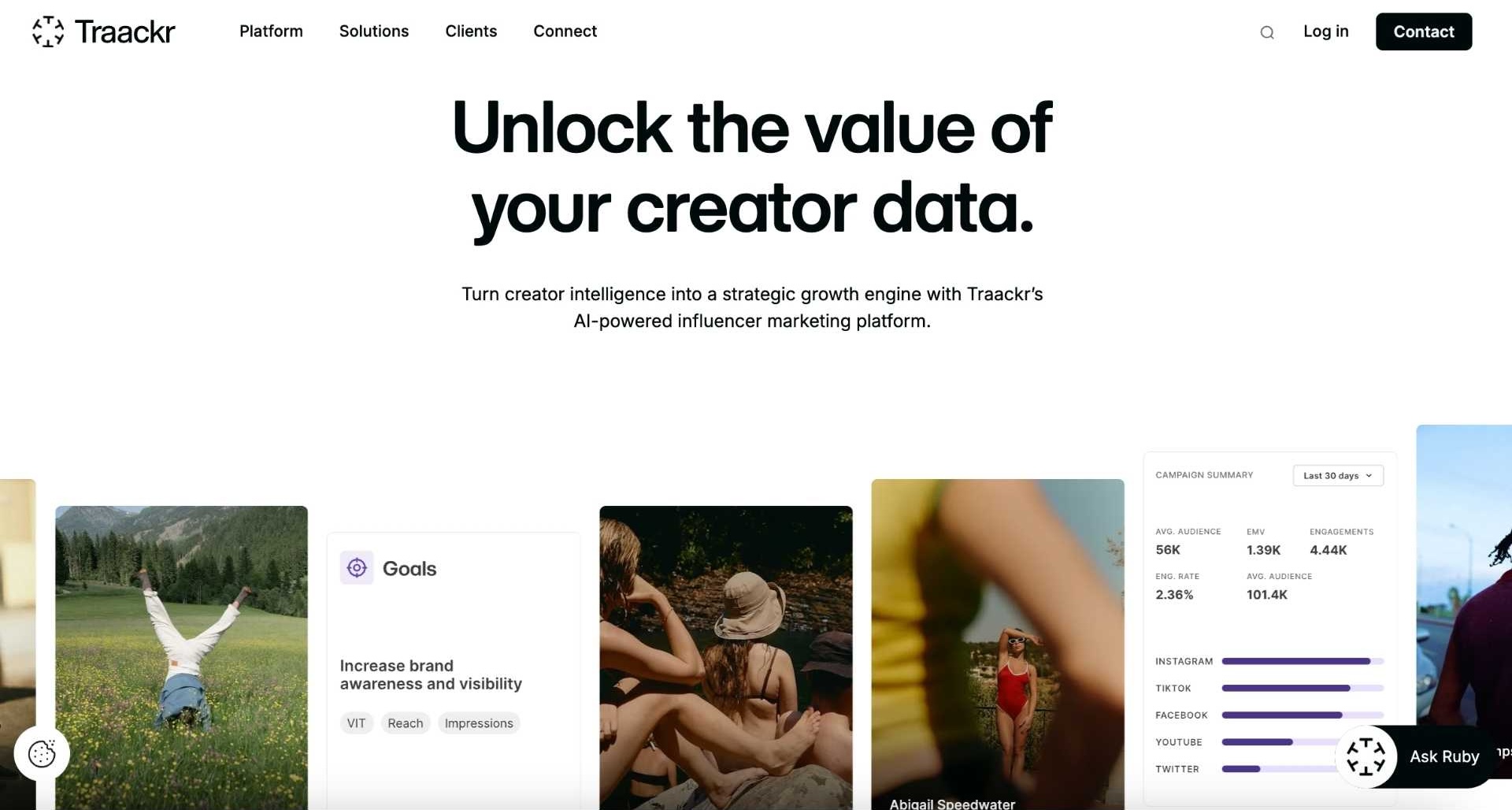
Traackr is an enterprise influencer marketing platform built around measurement, benchmarking, and budget efficiency rather than lightweight discovery alone. Its positioning is strongest with global brands that want to compare creator performance across markets, understand spend efficiency, and treat influencer marketing as a measurable growth channel with executive-level reporting.
Key Features
• Creator discovery with first-party platform data — Traackr emphasizes direct social platform partnerships and creator intelligence for vetting and performance analysis.
• Campaign and relationship management — the platform supports campaign workflows, creator relationship tracking, and team visibility across ongoing creator programs.
• Brand Vitality Score (VIT) — Traackr’s proprietary metric measures brand performance in creator content using visibility, impact, and trust.
• Budget optimization and spend efficiency — Traackr highlights budget optimization tools and cost-per metrics like CPE, CPV, and related efficiency measures.
• Benchmarking and strategy analytics — it is particularly strong for competitive benchmarking, market comparisons, and executive reporting.
• Commerce and gifting support — Traackr supports Shopify-based product seeding, ecommerce tracking, creator payments, and revenue attribution.
Pricing
• Official pricing: custom / request a quote.
• Public benchmark: pricing starts around $32,500/year for a standard plan, with additional modules available on request.
• Contract type: generally annual enterprise contracts.
Reviews
4.3 / 5.0 (G2)
Pros
• Brand Vitality Score is a real differentiator — Traackr’s VIT metric remains one of the most recognizable proprietary frameworks in creator measurement.
• Strong spend-efficiency tooling — Traackr is unusually focused on budget optimization, target cost metrics, and linking influencer investment to measurable business outcomes.
• Deep strategic benchmarking — it is built for brands that want comparative market intelligence and executive reporting, not just campaign operations.
Cons
• High entry price — Traackr sits firmly in the enterprise tier and is rarely a fit for smaller brands.
• Can feel analytics-heavy for lean teams — public reviews often describe it as data-rich but less intuitive for everyday campaign execution.
• Best suited to structured programs, not fast-moving outreach — its strengths are measurement and benchmarking, not lightweight SaaS simplicity.
Integrations
• Shopify — automates product seeding and fulfillment while tying gifting back to performance.
• Email — sends individual and bulk creator emails while tracking conversations across the team.
• Ecommerce tracking — tracks clicks, conversions, and revenue from creator links and promo codes across ecommerce sites.
• Payments — automates global creator payouts and payment data collection inside the platform.
• SSO / Data Lake — supports enterprise login workflows and combines creator data with broader organizational reporting.
Influence4You vs Traackr
Influence4You is better suited to brands that want modular discovery, creator applications, and UGC execution in a more campaign-operator-friendly environment. Traackr is more enterprise and measurement-led, with stronger benchmarking, budget optimization, and executive reporting. If your priority is creator sourcing and campaign management, Influence4You is more practical; if your priority is proving performance across markets and optimizing spend at scale, Traackr is the stronger fit.
Influencity
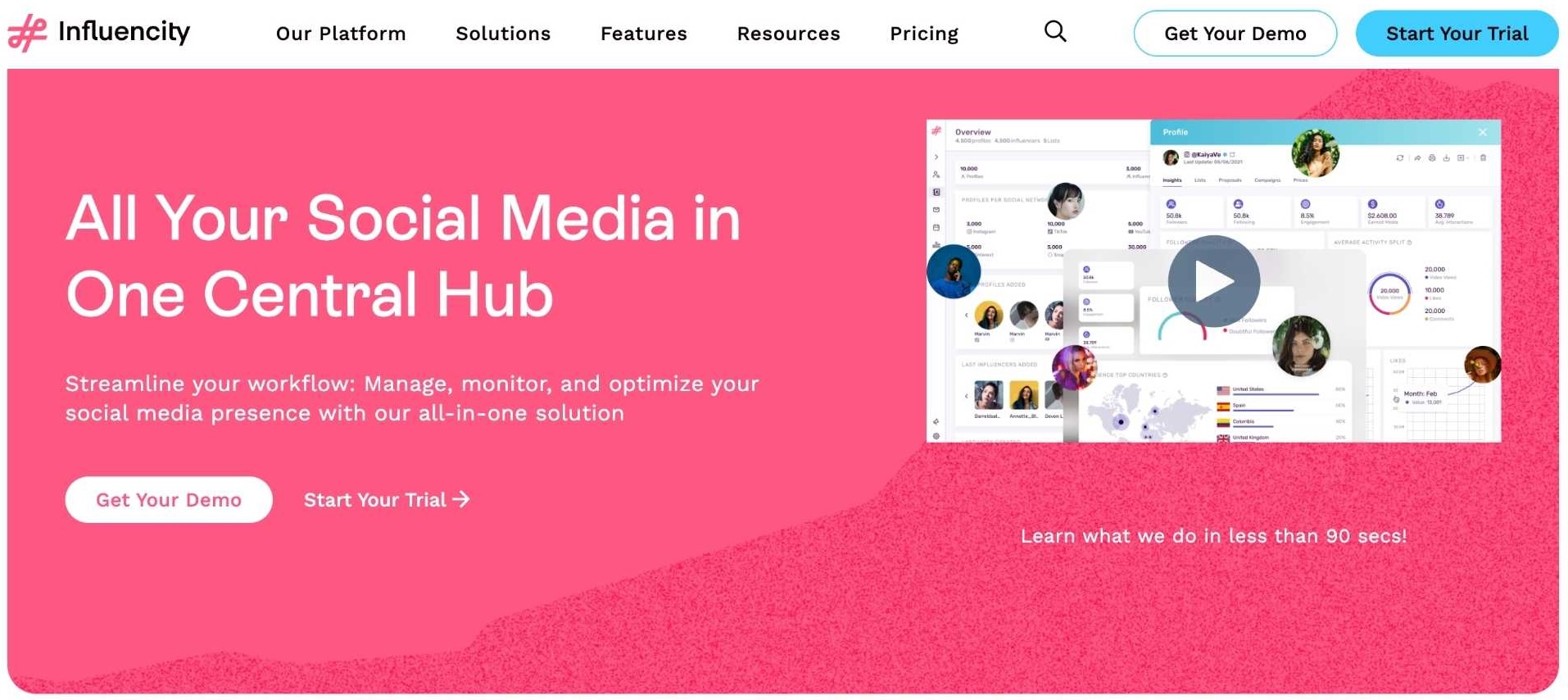
Influencity is an end-to-end influencer marketing platform focused on discovery, outreach, CRM, reporting, and social listening, with a notable emphasis on pricing flexibility compared with many enterprise-led alternatives. It positions itself as a platform for brands and agencies that want large-scale creator data and campaign tools without being locked into long-term contract permanence.
Key Features
• Large influencer database — Influencity says brands can search across 200M+ influencers using real-time data and 20+ filters.
• Discovery and profile analysis — the platform supports influencer search, audience analysis, fake-follower screening, and list-building.
• Outreach and IRM — Influencity includes influencer outreach, relationship management, stored proposals, and campaign workflows.
• Campaign management and reports — users can manage multiple campaigns and export reports in PDF, CSV, and XLS formats.
• Business-plan extras — higher tiers add bulk influencer payments, inbox and comments, social profile analytics, content planning, and paid ads support.
• Flexible subscriptions — the platform explicitly allows month-to-month subscriptions and cancellation without mandatory permanence.
Pricing
Influencity offers three main pricing tiers, along with add-ons:
• Professional Plan: $318/month or $3,816/year
• Business Plan: $798/month or $9,576/year
• Enterprise Plan: Custom pricing
• Auto-Tracker Add-On: $660/year (for 50 influencers)
Reviews
4.3 / 5.0 (G2)
Pros
• Much more flexible contract structure than many rivals — Influencity explicitly supports month-to-month subscriptions and self-serve cancellation.
• Strong value for feature depth — discovery, outreach, reporting, Shopify integration, and campaign management are available at lower public pricing than many enterprise platforms.
• Broad product scope beyond influencer CRM — the Business and Enterprise tiers extend into social analytics, paid ads, content planning, and monitoring, which gives it a wider operating footprint.
Cons
• Credit and usage limits can still be restrictive — public review feedback mentions limits around analyses and credits on lower tiers.
• Some users want more accurate filtering — reviews mention occasional issues with search/filter precision.
• Lower public review volume on some sources — its G2 footprint is strong, but some other review sites show a much smaller sample size.
Integrations
• Shopify — included across paid plans for gifting, affiliate tracking, and commerce-linked reporting.
• Bulk influencer payments — Business and Enterprise add bulk payment functionality inside the platform.
• Inbox & Comments — integrates creator and social communication inside the Business and Enterprise workflows.
• Paid Ads — higher tiers include paid ads support as part of broader social operations.
• Export formats (PDF, CSV, XLS) — lets teams move campaign and creator data into external reporting workflows.
Influence4You vs Influencity
Influence4You is stronger on modular packaging, creator marketplace access, and UGC-specific campaign options. Influencity is stronger on billing flexibility and on offering a broader all-in-one operating layer at public SaaS pricing, especially for brands that want discovery, outreach, reporting, and adjacent social tools without an annual contract. If you want creator applications and UGC sourcing, Influence4You has the edge; if you want a more flexible month-to-month operating platform, Influencity is more attractive.
Heepsy

Heepsy is an influencer marketing platform built mainly around creator discovery, vetting, outreach, and campaign tracking. It is usually a better fit for small to mid-sized brands that want practical search filters, authenticity analysis, and bulk outreach without stepping into enterprise pricing too early.
Key Features
• Influencer discovery on major social platforms — Heepsy supports creator search across Instagram, YouTube, and TikTok with filters for location, category, followers, and engagement.
• Audience and authenticity analysis — paid tiers add audience search, creator detection, and deeper profile analytics for vetting creator quality.
• Lists, CRM, and outreach — Heepsy includes lists, CRM features, outreach tools, messaging, and email templates.
• Campaign offers and landing pages — the tool supports offer listings, application landing pages, and creator payments.
• Bulk outreach and reporting — Plus and Advanced tiers add bulk outreach and reporting.
• Lookalikes and ecommerce integrations on Advanced — its top tier adds media monitoring, lookalike search, offer distribution, and multiple eCommerce integrations.
Pricing
• Free — limited free access is available.
• Starter — recent official Heepsy blog references place Starter at $89/month.
• Plus — recent official Heepsy blog references place Plus at $249/month.
• Advanced — recent official Heepsy blog references place Advanced at $369/month.
• Heepsy also says users can choose monthly or annual billing, with annual subscriptions discounted versus monthly rates.
Reviews
4.5 / 5.0 (G2)
Pros
• Clear pricing ladder for smaller teams — Heepsy is more transparent and accessible than many influencer platforms in the category.
• Strong discovery-to-outreach value — its mix of filters, authenticity analysis, CRM, and bulk outreach gives small teams a lot without enterprise overhead.
• Advanced tier keeps improving commerce support — Advanced includes lookalikes, media monitoring, and multiple ecommerce integrations, making it more operational than a basic discovery tool.
Cons
• Best commerce features are locked to higher tiers — stronger monitoring and ecommerce integrations are reserved for Advanced.
• Search precision is not perfect for every team — public feedback includes complaints about irrelevant search results or filtering limitations in some cases.
• Less suitable for large enterprise programs — it is better as a practical creator search and outreach platform than as a full enterprise operating system.
Integrations
• Ecommerce integrations — Advanced adds multiple ecommerce integrations for deeper campaign tracking and operational workflows.
• Application landing pages — lets brands collect inbound creator applications into campaign workflows.
• Creator payments — supports creator payment workflows inside the platform.
• Messaging — enables direct communication with creators from within Heepsy.
• Export results / reporting — exports creator and campaign data for external analysis and reporting.
Influence4You vs Heepsy
Influence4You is more robust for brands that want creator applications, UGC campaigns, and a broader modular platform. Heepsy is more attractive for smaller teams focused on cost-effective discovery, vetting, and outreach. In practice, Influence4You is the more complete campaign platform, while Heepsy is the lighter and more accessible tool for brands that want to get moving quickly without enterprise-style complexity.
Lefty
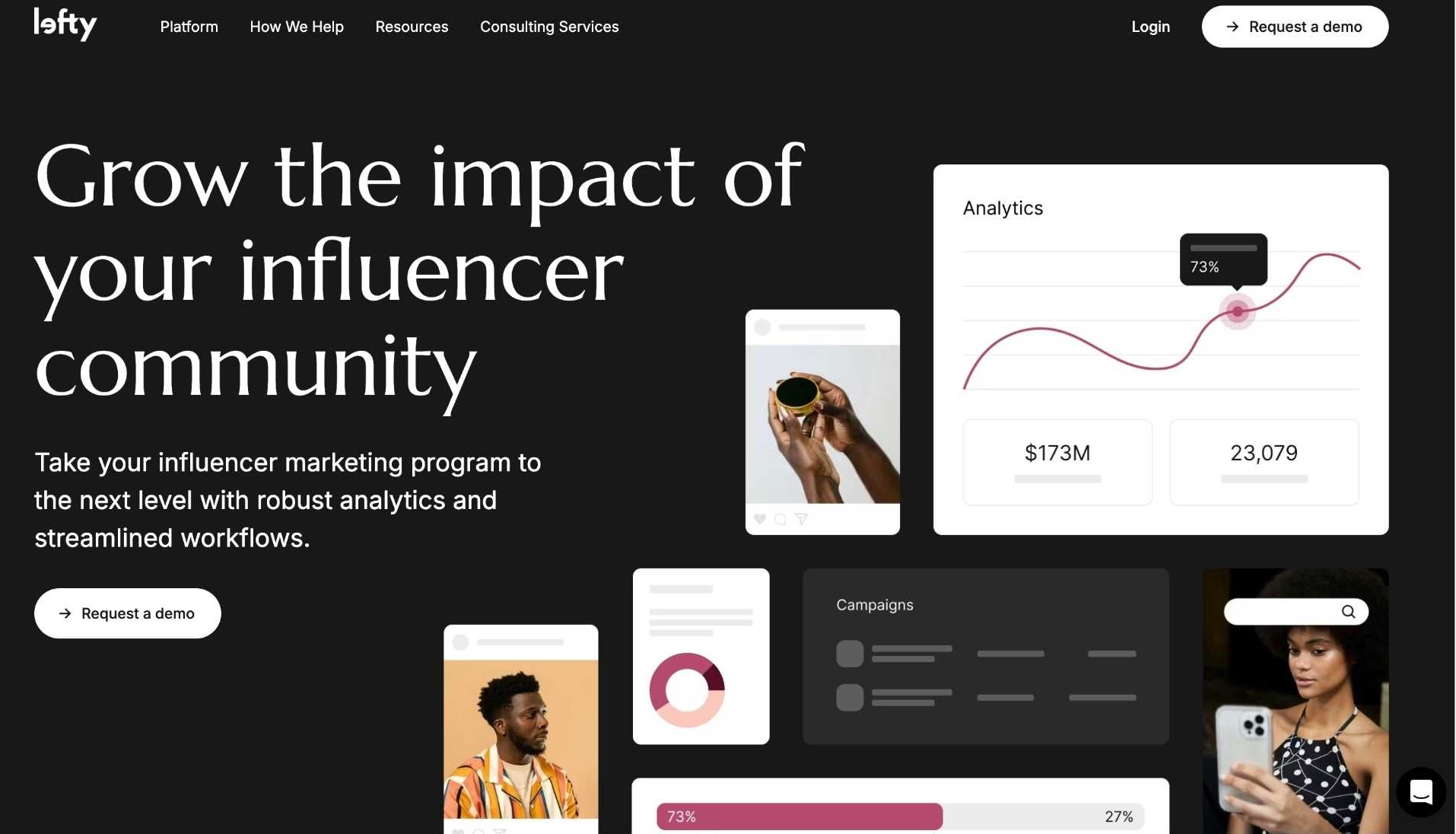
Lefty is an influencer marketing platform aimed especially at lifestyle, fashion, beauty, and luxury brands that want strong analytics, campaign reporting, and streamlined workflows. Its positioning leans heavily into qualified influencer discovery, content tracking, affiliate and seeding workflows, and polished reporting for brand and agency teams.
Key Features
• Qualified influencer discovery — Lefty gives brands access to a large database of qualified creator profiles with demographic filters, audience quality signals, and historical statistics.
• Campaign management and reporting — users can build campaigns, track creator content automatically, monitor sales, and export presentation-ready reports.
• Social commerce and affiliation — Lefty supports affiliate programs, sales tracking, commissions, and conversion reporting.
• Product gifting and seeding workflows — the platform supports gifting, promo campaigns, and variant-aware product workflows.
• Recent ecommerce upgrades — Lefty has highlighted newer ecommerce automation and affiliate campaign updates in its product releases.
• Forecasting and visual sharing tools — review feedback consistently points to strong forecasting, content capture, and shareable reporting links for collaboration.
Pricing
• Starting Price: ~€590 per month.
• Pro Plan: ~€990/month, including 2 users, 5 campaigns, and unlimited reports.
• Premium Plan: ~€1,690/month, which adds a dedicated manager.
• Premium+ Plan: ~€3,490/month for 10 users and 25 campaigns.
Reviews
4.7/5.0 (G2)
Pros
• Strong fit for lifestyle and luxury programs — Lefty’s positioning and customer base are unusually aligned with fashion, beauty, and premium-brand use cases.
• Recent ecommerce and affiliate updates are meaningful — 2024–2025 product updates focused on ecommerce automation, seeding, promo codes, affiliate earnings, and a refreshed UI.
• Excellent reporting and forecasting reputation — public review feedback repeatedly highlights content tracking, clear reports, casting tools, and forecasting as standout strengths.
Cons
• Pricing is opaque — brands need to go through sales to understand cost, which makes quick comparison harder.
• Discovery can feel overwhelming — some users say the database can be hard to filter efficiently when searching for new talent.
• Plan caps and investment level can be limiting — some users mention monitoring caps and describe Lefty as a significant spend.
Integrations
• Shopify — connects store inventory, gifting, lending, and fulfillment tracking to influencer workflows.
• Magento — plugs product inventory and gifting operations into Lefty campaign workflows.
• Salesforce Commerce — supports product requests, tracking, and ecommerce-linked influencer operations.
• Affiliate / promo code tracking — tracks conversions, affiliate earnings, and promo campaign performance in-platform.
• Gmail / Outlook — Lefty’s ecommerce solution page highlights direct creator outreach via connected Gmail or Outlook accounts.
Influence4You vs Lefty
Influence4You is stronger for brands that want a modular platform with creator marketplace access and UGC-specific workflows. Lefty is stronger for lifestyle and luxury teams that care more about polished analytics, forecasting, seeding, and affiliate-linked ecommerce reporting. If your team prioritizes marketplace casting and flexible modules, Influence4You has the simpler proposition; if you want a more premium workflow for brand tracking, gifting, and social commerce, Lefty is the more specialized alternative.
Final Thoughts on Influence4You Alternatives
Choosing the right alternative to Influence4You ultimately depends on your team’s priorities—whether that’s creator discovery, campaign execution, eCommerce integration, or enterprise-level analytics. Platforms like Influencer Hero, Upfluence, and Aspire stand out for their strong commerce integrations and ROI tracking, while tools like CreatorIQ and Traackr cater more to large organizations needing advanced governance, benchmarking, and reporting. On the other end, solutions like Heepsy and Influencity offer more accessible pricing and flexibility, making them better suited for smaller teams or those just scaling their influencer programs.
At the same time, Influence4You remains competitive with its modular structure, built-in marketplace, and UGC-focused workflows. However, many alternatives differentiate themselves through deeper automation, clearer pricing models, or stronger integrations with eCommerce and affiliate ecosystems. As a result, the best choice will depend on whether your focus is on simplicity and UGC sourcing, or on building a more integrated, performance-driven influencer marketing engine.

.png)


.jpg)