


10 Best Hypeo AI Alternatives for Influencer Marketing
Hypeo AI exists because global creator databases are thin across North Africa and the Gulf. It holds roughly 60,000 Moroccan creators, generates briefs and scripts with AI, and handles contracts and payment in markets where a lot of creator work still runs informally. That is a real gap, filled deliberately.
The reasons to look elsewhere are just as concrete. The company was founded in mid-2024, no price or pricing model is published anywhere, there is no listing on G2, Capterra or Trustpilot, and no integration of any kind is documented.
Ten alternatives follow, in order: Influencer Hero, NeoReach, Insense, Afluencer, Aspire, Influencity, IMAI, HypeAuditor, Julius and Brandbassador.
Key Criteria for Evaluating Influencer Marketing Platforms
Core Features
Evaluation of essential influencer marketing capabilities, including influencer discovery, outreach, CRM, campaign management, reporting, and content workflows.
Pricing & Flexibility
Comparison of pricing models, subscription plans, and contract terms to match different budgets and growth stages.
Customer Reviews & Satisfaction
Analysis of user feedback from trusted review platforms, focusing on usability, reliability, customer support, and overall performance.
Pros & Cons
Review of each platform’s strengths and limitations to highlight where it performs well and where it may fall short based on different use cases.
Integrations
Review of the most important integrations (e.g., Shopify and other tech tools), highlighting what each integration enables in one sentence.
Hypeo AI Overview
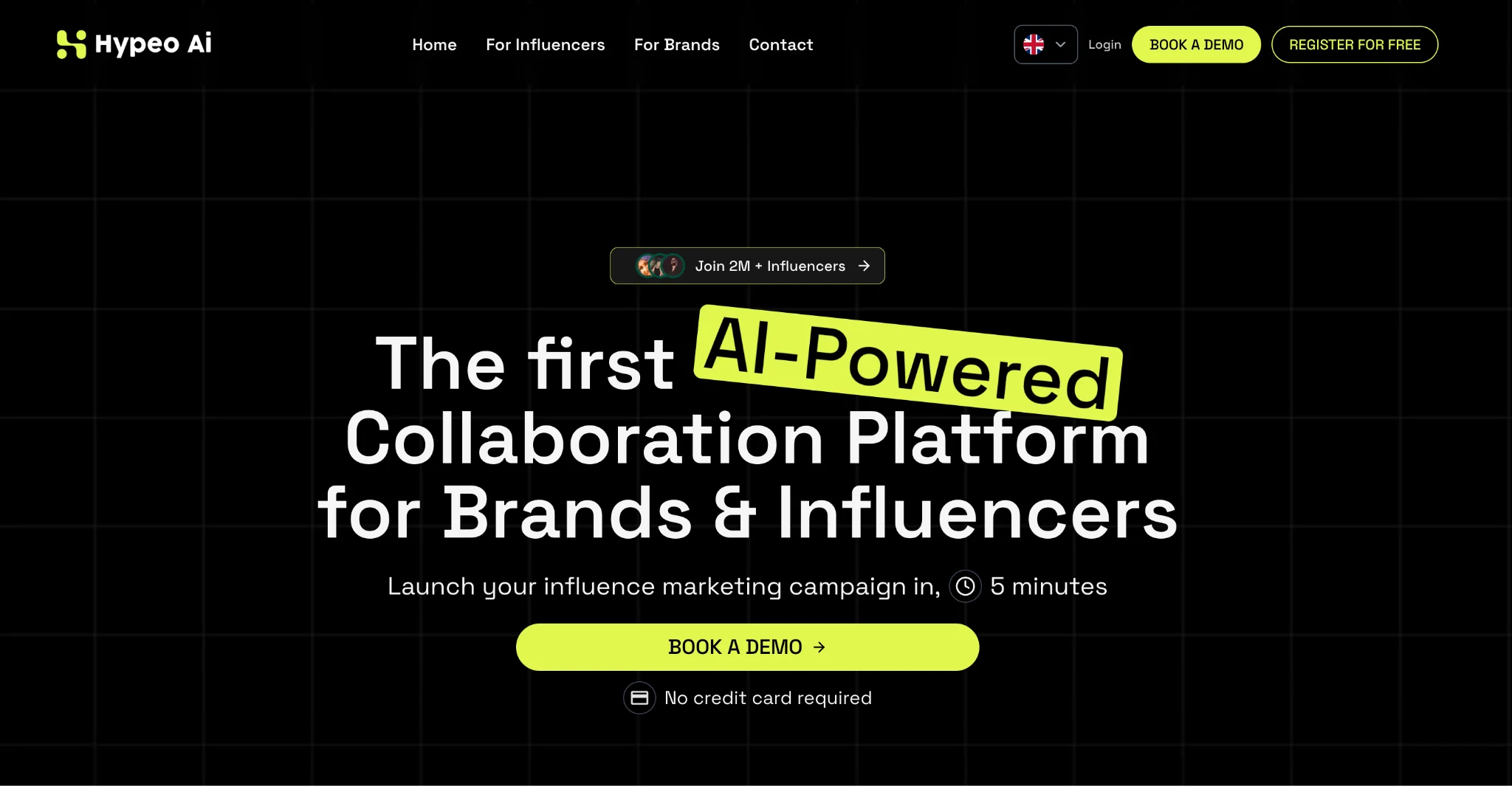
Hypeo AI is a MENA-focused creator platform founded in June 2024 and run from Casablanca, with around 60,000 Moroccan creators and stated coverage across Morocco, wider Africa and the Gulf. The product compresses campaign setup into a single session: AI matches creators, writes briefs and scripts, estimates fair rates, then contracts, product shipping and payment all run in the same place. Its AI creator search is the centre of the product, and a 14-day trial with no card lets you test it before anyone quotes a price.
Key Features
- AI creator matching: Creators scored against campaign parameters rather than surfaced through manual filtering.
- Brief and script generation: Campaign strategy and per-creator scripts written automatically, reportedly in under fifteen minutes.
- Smart price estimator: Suggested creator compensation for markets where published rates are scarce.
- Contract generation and signing: Agreements created and signed in-platform, which matters where creator work is often informal.
- Product shipping and payment: Send product to creators and pay them without leaving the workflow.
Pricing
Nothing published, and the model itself is undisclosed, so it is not clear publicly whether this is a subscription, a commission on creator payments, or both. The mitigating detail is a 14-day free trial that needs no credit card, which reverses the usual order and lets you evaluate before a quote is written.
Reviews
No verifiable rating. There is no G2, Capterra or Trustpilot listing, which is expected for a platform founded in mid-2024 but leaves nothing independent to check.
Integrations
- eCommerce platforms: None named, so orders and creator activity are never linked automatically.
- Payment providers: Payment runs in-platform rather than through a named processor, worth confirming per market.
- E-signature tools: Contracts are generated natively rather than routed through DocuSign or similar.
- Analytics and BI: No named connections, so reporting stays inside the dashboard.
- API and automation: No public API and no Zapier connector documented.
Pros
- Coverage nothing global matches: 60,000 Moroccan creators and real market knowledge across the Gulf.
- A trial with no card: Fourteen days of hands-on access before any sales conversation.
- Contracts and payment built in: Infrastructure most platforms assume already exists around them.
Common Drawbacks of Hypeo AI
The pricing model is missing, not just the number
Nothing public says whether you would pay a subscription, a percentage of creator payments, or both. Those behave very differently as spend grows, and you cannot compare against anything until you know which it is.
Barely a year old with no review record
Founded in June 2024 and carrying no listing on any major review site. There is no independent account of what happens when a campaign goes wrong or how support performs under pressure.
Regional by design
The creator pool is concentrated in Morocco and the wider MENA region. A brand selling into Europe or North America would be buying a database aimed at markets it does not serve.
No integrations and no documented attribution
Nothing connects to a store, there is no published API, and the dashboard’s attribution mechanism is not described. Tying a creator to an order means a second system.
Best Hypeo AI Alternatives
| TOOL | REVIEWS | BEST FOR | TRIAL INFO | PRICING | ||
|---|---|---|---|---|---|---|
1 |

|
⭐ | Influencer CRM & automation | Book Demo | Pricing | Website |
2 |
|
⭐ | Influencer campaigns & data analytics | Book Demo | Pricing | Website |
3 |

|
⭐ | UGC creators & paid social ads | Book Demo | Pricing | Website |
4 |

|
⭐ | Influencer marketplace campaigns | Book Demo | Pricing | Website |
5 |

|
⭐ | Influencer partnerships | Book Demo | Pricing | Website |
6 |

|
⭐ | Campaign management | Book Demo | Pricing | Website |
7 |

|
⭐ | AI influencer discovery & analytics | Book Demo | Pricing | Website |
8 |

|
⭐ | Influencer analytics | Book Demo | Pricing | Website |
9 |
-1.webp)
|
⭐ | Discovery and campaign platform | Book Demo | Pricing | Website |
10 |

|
⭐ | Ambassador Marketing | Book Demo | Pricing | Website |
Influencer Hero

Influencer Hero is an all-in-one influencer marketing platform for D2C and eCommerce brands, spanning 8 social platforms with Instagram, YouTube and TikTok at the core. Discovery, outreach, gifting, content, affiliate tracking and creator payouts run in one system, with published pricing set by outreach volume. It is bought by brands that want the whole program in one place rather than assembled from parts.
Key Features
- Natural-language and filtered discovery: Over 20 filters plus AI search across eight networks, with global coverage.
- Fake-follower and fraud screening: Authenticity checked before a creator receives budget.
- Multichannel outreach: Email, Instagram DM and WhatsApp with drip sequences and one shared inbox.
- Brand-risk alerts: AI reads creator replies for negative sentiment and warns the team early.
- Creator storefronts: Each creator gets a shoppable page tied to their own affiliate tracking.
- Affiliate codes and commission: Codes and links per creator, with commission calculated in-platform.
- Payouts and invoicing: Bulk and scheduled bank-debit payments at 0.1% to 0.4%, invoices attached.
- Free scanning tools: Fake-follower scanners and engagement calculators available without an account.
Pricing
- Standard: $649 a month, up to 1,000 reachouts a month
- Pro: $1,049 a month, up to 5,000 reachouts a month
- Business: $2,490 a month, up to 10,000 reachouts a month
- Custom & Agency: custom pricing
Quarterly billing saves 20% and yearly saves 30%. The model is a flat subscription with no share of creator payments.
Reviews
5.0/5.0 (Capterra)
Pros
- The model is visible: A published subscription, not an undisclosed mix of fee and commission.
- Global creator coverage: Eight networks worldwide rather than one region.
- Revenue is attributable: Codes, links and store integration tie creators to orders.
Cons
- No free trial
- Expensive for smaller brands
- Steep learning curve
Integrations
- Shopify: Raises gifting orders and books creator revenue against the right person.
- WooCommerce: The same for WordPress stores, with scripts covering Magento and custom builds.
- Klaviyo: Creator and customer segments into lifecycle email.
- DocuSign: Creator agreements signed and filed on the deal record.
- Zapier: 8,000-plus further apps for anything not covered natively.
Hypeo AI vs Influencer Hero
Hypeo AI wins on one axis and loses on the rest. Its Moroccan and Gulf creator coverage is genuinely unmatched by global databases, and the price estimator solves a problem specific to markets without public rate benchmarks. Influencer Hero covers eight social platforms worldwide with over 20 filters and fake-follower screening, outreach across email, Instagram DM and WhatsApp, campaign boards with automations, gifting raised straight from Shopify or WooCommerce, a searchable content library with approvals, affiliate codes with commission calculated in-platform, and creator payouts at 0.1% to 0.4%. It also names its integrations, where Hypeo AI publishes none at all.
On cost the comparison cannot be run in both directions, which is itself the finding. Hypeo AI publishes no figure and no model, so a brand cannot tell whether it would pay a subscription or a percentage of creator spend until a sales call. Influencer Hero publishes $649, $1,049 and $2,490 a month, takes nothing from creator payments, and drops the entry tier to $5,452 a year when paid annually. For any brand outside MENA, one of these can be budgeted this afternoon and the other cannot.
NeoReach
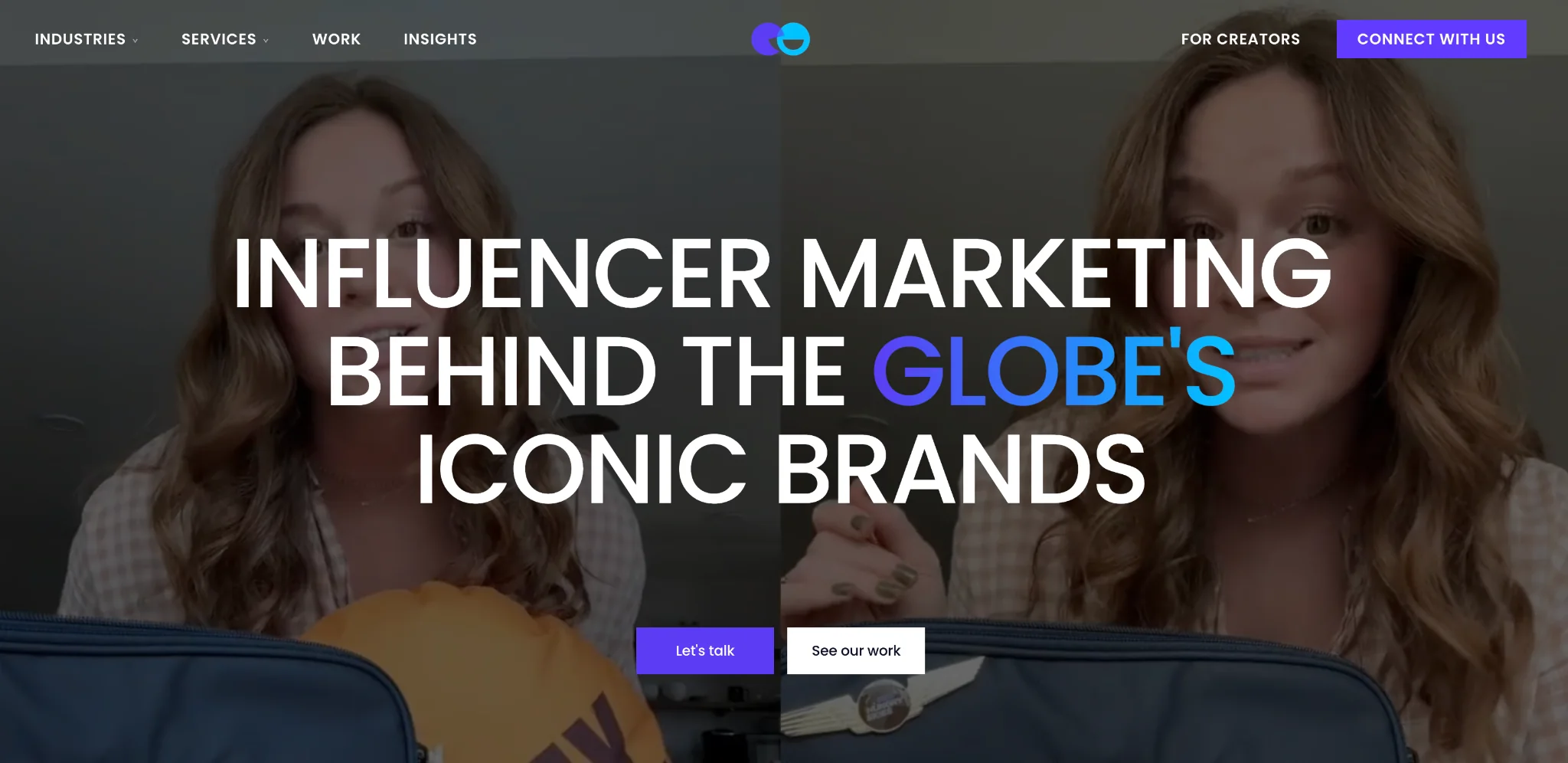
NeoReach sells software and a campaign team together, with a large share of its work delivered as managed activations. Reviewers rate the audience analysis and segmentation above the category average. It is bought by brands and agencies with significant budgets and nobody in-house to spend them.
Key Features
- Managed activation delivery: Strategy and execution run by NeoReach staff rather than your team.
- Audience segmentation: Creator audiences broken down deeply enough to plan paid media against.
- Multi-network discovery: Creator search with industry filters across the major consumer platforms.
- Campaign dashboards: Results tracked live across every creator in an activation.
- Custom reporting: Output shaped for stakeholders who do not work in marketing.
Pricing
Not published, and quoted per engagement rather than per seat, because the managed element rather than software access sets the figure.
Reviews
4.5/5.0 (G2, low review volume at 11 reviews).
Pros
- Expertise is included: A team runs the campaign when you have nobody who can.
- Analysis depth: Audience segmentation rated among the strongest in the category.
- Established vendor: A longer operating history than a 2024 startup.
Cons
- Quote-only: The same missing price, at a much higher expected figure.
- Eleven reviews: Thin, though still more than none.
- Not built for MENA: Coverage is strongest in Western consumer markets.
Integrations
- Shopify: Store connection for tracking creator-driven sales.
- Instagram and TikTok: Creator performance pulled into campaign reporting.
- YouTube: Long-form creator data alongside short-form.
- Google Analytics: Campaign traffic tied to on-site behaviour.
- Reporting exports: Campaign data out for internal analysis.
Hypeo AI vs NeoReach
Both answer the same problem for brands without an influencer specialist, and they answer it in opposite ways. Hypeo AI automates the expertise with AI briefs, scripts and rate estimates. NeoReach supplies actual people who have run campaigns before.
Neither publishes a price, so both start with a call. The difference is scale: a managed service is priced for brands with real activation budgets, while an AI tool with a free trial is reachable by a team testing the channel. And only one of them has a track record you can ask about.
Insense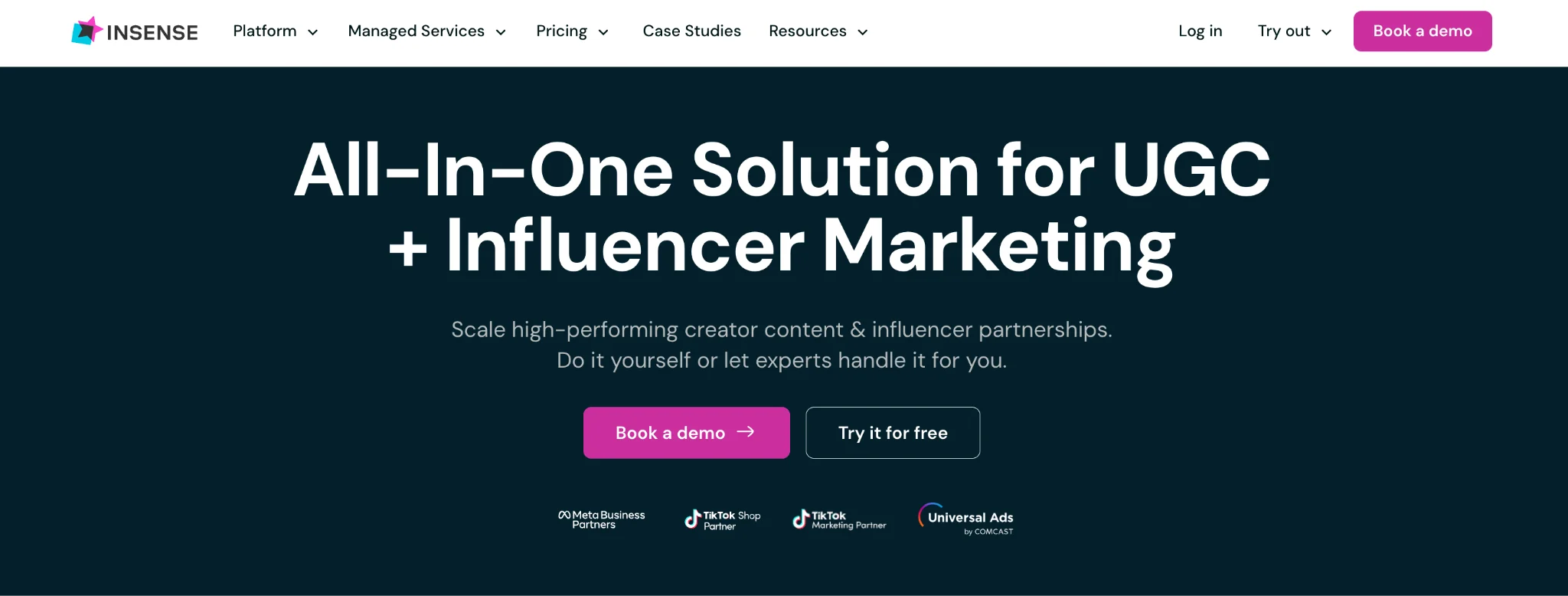
Insense is a marketplace for brands that need video for paid social on a schedule. Vetted UGC creators apply to briefs, deliver inside roughly ten business days, and contracts and payment run in the platform with usage rights included. Performance teams buying ad creative are its core users.
Key Features
- Applicant guarantee: At least five creators matching your brief, or the subscription is refunded.
- Brief and revision flow: Structured creative direction with up to three revision rounds.
- Product seeding: Physical product shipped to creators as part of the campaign.
- Meta Partnership Ads: Creator handles connected for whitelisted paid social.
- Contracts and payment: Agreements and creator fees handled without leaving the platform.
Pricing
- Trial: $650 for one month, 1 campaign and 10 creators, 20% marketplace fee
- Brand: $500 a month billed quarterly, or $400 a month annually, 10% fee
- Agency: $800 a month billed quarterly, or $640 a month annually, 7% fee
Campaigns and creators are unlimited on both paid plans, and the fee falls as the tier rises.
Reviews
4.5/5.0 (G2, 373 reviews).
Pros
- Both numbers are published: Subscription and marketplace fee, stated openly.
- 373 reviews: A real evidence base rather than none.
- Content arrives on a timetable: Applications in days, delivery inside two weeks.
Cons
- Two costs, not one: A percentage on creator payments sits on top of the plan.
- Western creator pool: No meaningful MENA coverage.
- Content, not campaigns: Built for ad creative rather than organic reach.
Integrations
- Meta: Powers Partnership Ads and whitelisted creator content.
- TikTok: Creator content routed into TikTok ad formats.
- Shopify: Named store connection for seeding and creator orders.
- Stripe: Creator payment processing.
- Content library: Approved assets exported into ad accounts.
Hypeo AI vs Insense
Both handle briefs, contracts and payment in one flow, which makes the workflows more alike than the positioning suggests. The difference is what you get back. Insense produces video assets with usage rights attached; Hypeo AI produces creator posts in markets where finding the creator was the hard part.
On transparency there is no contest. Insense publishes a subscription and a marketplace fee, so the total is knowable in advance. Hypeo AI publishes neither, which is the harder position for a buyer regardless of how good the product turns out to be.
Afluencer
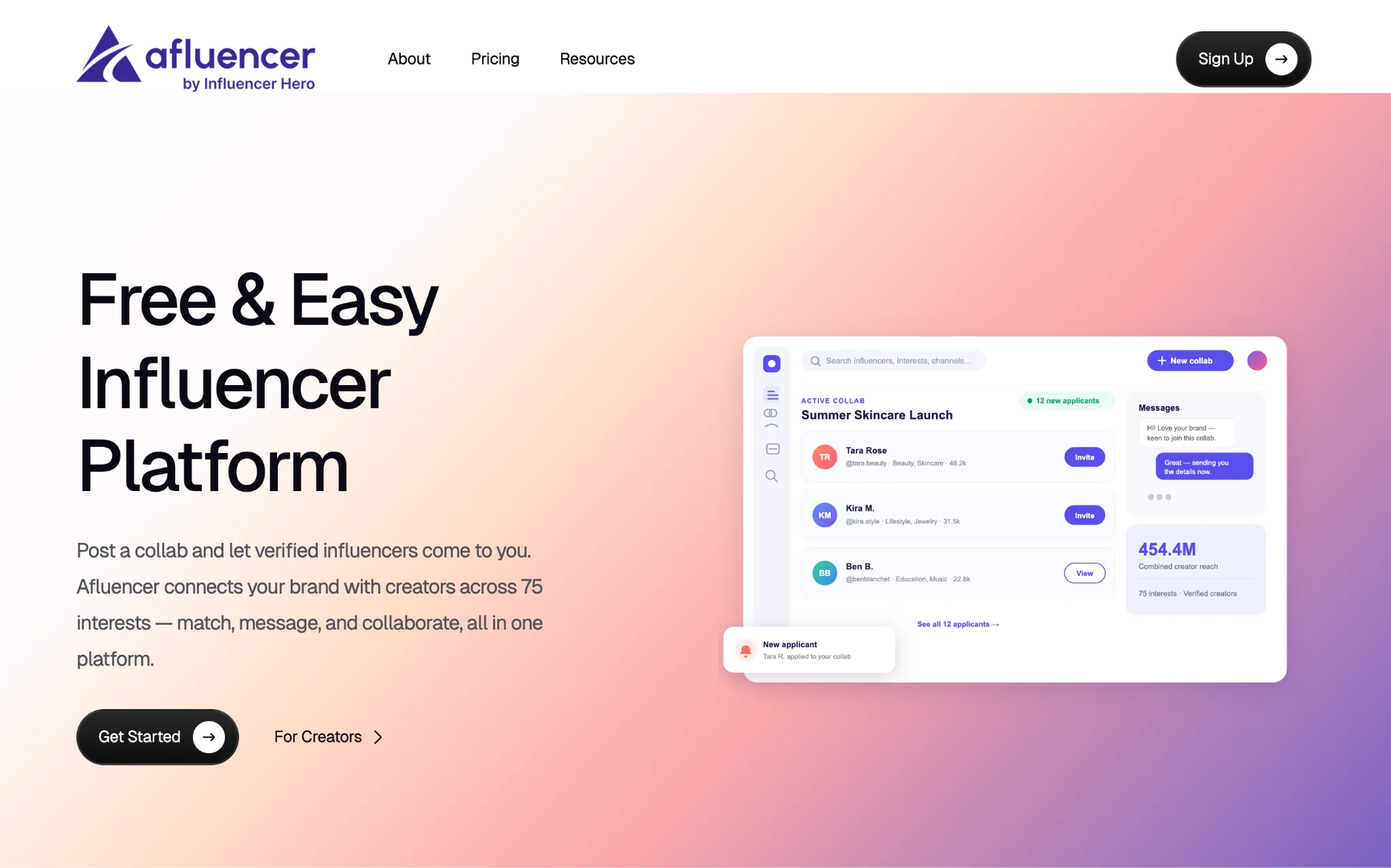
Afluencer works by application rather than search. Brands post a collaboration listing, verified creators across Instagram, TikTok, YouTube, Facebook and X apply, and the brand picks from the queue. Shopify merchants and small D2C teams are its typical users, on a flat published monthly fee.
Key Features
- Campaign listings: Creators come to you, so no database and no search skill is required.
- Verified applicants: Members registered and checked before they can apply.
- CreatorGPT ranking: AI sorts applicants against the brief before a person reviews them.
- Invite credits: Direct outreach when the inbound queue is thin.
- Codes and payments: Discount codes and creator fees handled through the store connection.
Pricing
From $49 a month on the Marketplace plan, with higher tiers for more outbound invites. Creator-side plans are billed separately.
Reviews
4.6/5.0 (G2, 738 reviews) and 4.7/5.0 (Shopify App Store, 34 reviews). The G2 pool leans creator-side, so read it beside the Shopify score.
Pros
- $49 and published: The cheapest known-cost entry in this comparison.
- No expertise needed either: A useful route to finding micro-influencers without AI or a specialist.
- 738 reviews: The deepest evidence base of the ten.
Cons
- Applicant-led: A weak listing draws weak interest.
- North America weighted: Almost no MENA creator supply.
- Light analytics: Campaign-level numbers with no audience analysis.
Integrations
- Shopify: Named connection for codes, referrals and creator orders.
- BigCommerce: The same for BigCommerce merchants.
- Klaviyo: Creator contacts into email campaigns.
- DocuSign: Collaboration terms signed inside the flow.
- Slack: Application alerts to the team.
Hypeo AI vs Afluencer
Both lower the expertise required to start, one with AI and one by removing the search step entirely. For a small team with no influencer marketer, either approach works better than a database and a blank filter screen.
Geography decides it. Afluencer costs $49 a month, publishes that figure, connects to Shopify and carries 738 reviews, but its creator supply is North American. If your campaigns run in Casablanca or Riyadh, none of that helps, and the regional database is the only thing that matters.
Aspire
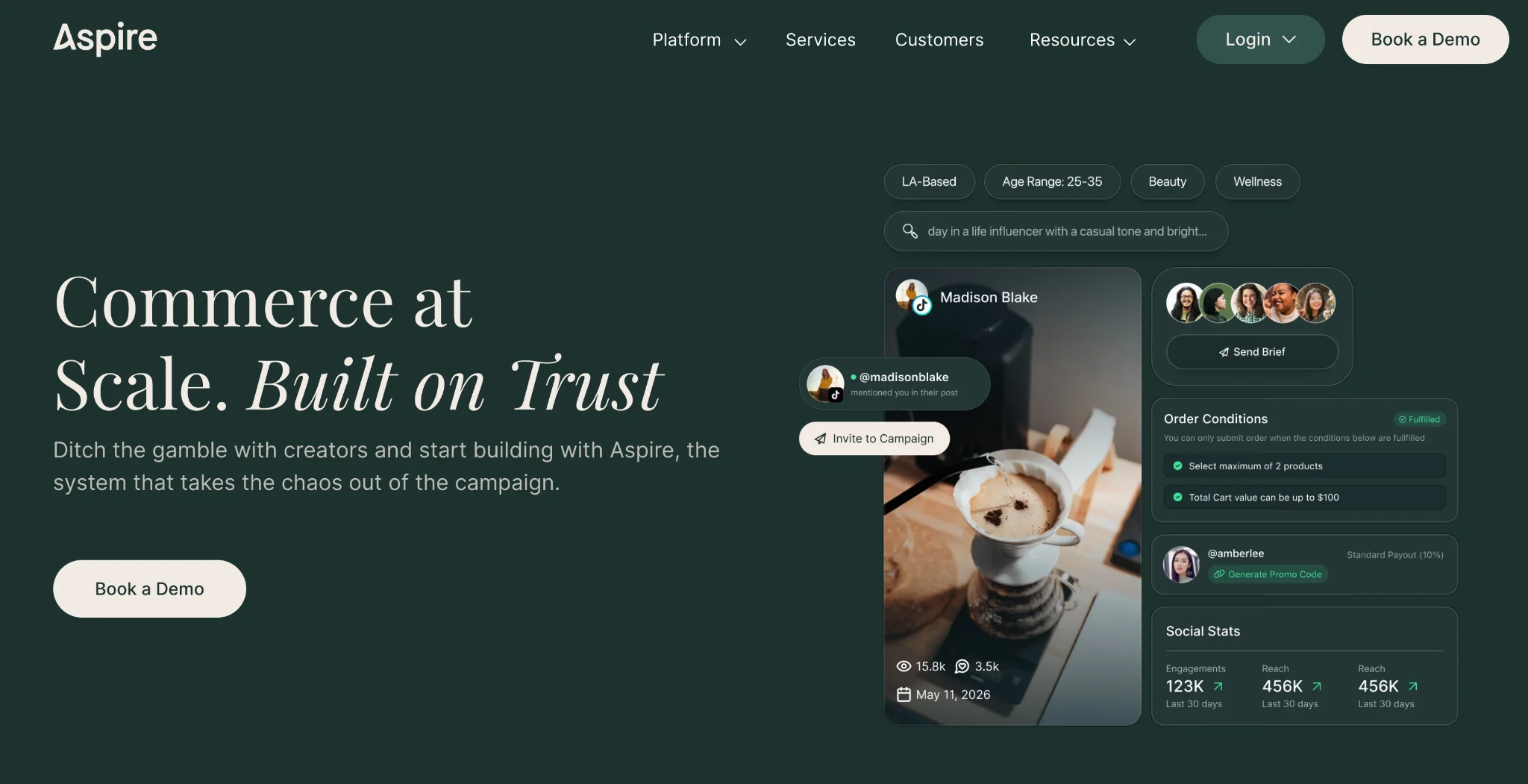
Aspire is an established influencer marketing platform for mid-market and enterprise eCommerce brands, combining creator discovery with campaign workflow, seeding and affiliate tracking. It suits always-on programs with a roster that compounds over time. Reviewers most often cite ease of use and influencer management.
Key Features
- Discovery with lookalikes: Cross-network search that turns one good creator into a shortlist of similar ones.
- Seeding workflows: Product send-outs managed at volume rather than tracked by hand.
- Content briefs and approvals: Requested, reviewed and signed off inside the platform.
- Affiliate attribution: Codes and links tying creator activity to real orders.
- Rights-managed library: Approved assets held with usage terms for paid reuse.
Pricing
Not published. Third-party sources report an annual commitment starting around $2,000 a month, with other estimates near $2,499, and they disagree enough that only a quote settles it. No free trial.
Reviews
4.6/5.0 (G2, 146 reviews).
Pros
- Mature and proven: Years of iteration behind it and 146 reviews to read.
- Whole-program coverage: Discovery, seeding, content and attribution together.
- Commerce is connected: Named store integrations with revenue tracking.
Cons
- No price and no trial: A closed evaluation, at a reported $2,000-plus a month.
- Enterprise-shaped: More platform than a small regional program needs.
- Western focus: Not built for the markets Hypeo AI serves.
Integrations
- Shopify: Seeding orders and creator revenue attribution.
- WooCommerce: The same coverage for WordPress stores.
- Klaviyo: Creator contacts into email programs.
- Slack: Campaign alerts into team channels.
- Zapier: Wider stack connections where no native option exists.
Hypeo AI vs Aspire
This is a young regional specialist against a mature global generalist, and each is stronger exactly where the other is weak. Aspire brings seeding, content rights, affiliate attribution and named store integrations. Hypeo AI brings creators in markets Aspire barely indexes.
Neither publishes a price, but the reported figures differ enormously. Aspire is said to start near $2,000 a month, which is at least a number to argue against. Hypeo AI offers a free trial instead, which is a better way to evaluate and a worse way to budget.


Influencity

Influencity is a discovery and audience-analysis platform covering Instagram, TikTok, YouTube and Twitch, with published tiers and a trial. Reviewers single out the interface and the support team, and plans meter usage rather than seats. Teams doing their own creator research are its core buyers.
Key Features
- Four-network discovery: Instagram, TikTok, YouTube and Twitch searched together.
- Audience composition analysis: Demographics, interests and authenticity assessed before contact.
- Cross-account profile linking: One creator’s several accounts joined into a single record.
- Campaign tracking: Briefs and performance monitored alongside discovery.
- Metered plans: Analyses and tracked creators capped per tier rather than per user.
Pricing
Published from around $318 a month, with annual billing lowering the effective rate and a 7-day free trial on every plan.
Reviews
4.5/5.0 (G2, 282 reviews).
Pros
- Price and trial together: You can evaluate and budget at the same time.
- 282 reviews: Enough to judge reliability from.
- Worldwide search: No regional restriction on the creator pool.
Cons
- No payments or contracts: Discovery and analysis rather than execution.
- Usage caps: Heavy research runs into plan limits.
- Thin regional depth: Global coverage does not mean deep MENA coverage.
Integrations
- Instagram and TikTok: Creator data and campaign performance.
- YouTube: Channel analytics alongside short-form.
- Twitch: Streaming creator coverage.
- Shopify: Store connection for creator sales tracking.
- Exports: Campaign and creator data for internal reporting.
Hypeo AI vs Influencity
Both hand you a shortlist, and they justify it differently. Influencity shows you the audience data behind a creator and lets you decide. Hypeo AI scores the match and tells you who to approach, which is more useful when you know nothing about the market and less useful when you do.
Influencity also does the thing a buyer needs most at this stage, which is publish a price and offer a trial at the same time. Around $318 a month with seven days free lets you evaluate the data and the cost together, rather than one and then the other.
IMAI

IMAI, also sold as InfluencerMarketing.ai, is an influencer discovery platform built on a very large creator index, with campaign management and white-label reporting on higher tiers. Agencies handling several clients are a large part of its base. Prices are published and a free trial is available.
Key Features
- Index in the hundreds of millions: Discovery across a database far larger than any regional pool.
- Fraud screening in search: Fake-follower detection surfaced with the results.
- Per-client campaign separation: Multiple accounts run side by side without collision.
- White-label reporting: Agency-branded outputs on higher plans.
- Social listening: Brand and category monitoring above the entry tiers.
Pricing
Published tiers reported from about $175 a month, through roughly $349 and $499, to $1,200 and up for enterprise and white-label, with report volumes varying by tier and a free trial offered.
Reviews
4.1/5.0 (GetApp, low review volume at 16 reviews). Sourcing speed and fraud detection draw praise; support and account access draw the criticism.
Pros
- Both a price and a trial: From roughly $175 a month, testable first.
- Enormous reach: Scale no regional database can match.
- Agency-ready: Client separation and branded reports included.
Cons
- Support is the recurring complaint: Slow responses and, in one report, lost access.
- Sixteen reviews: Small, though not absent.
- No contracts or payouts: Discovery rather than the full workflow.
Integrations
- Shopify: Named store connection for creator-driven orders.
- WooCommerce: Coverage for WordPress storefronts.
- Instagram and TikTok: Creator data and campaign performance.
- YouTube: Channel-level analytics.
- Exports: Creator and campaign data out for client reporting.
Hypeo AI vs IMAI
Scale against specificity. IMAI indexes hundreds of millions of creators globally and screens them for fraud; Hypeo AI indexes 60,000 in one country and knows what they cost. For a brand entering MENA, the smaller number is the more useful one.
Everywhere else the larger index wins, and it wins on terms too. IMAI publishes tiers from around $175 a month and offers a trial, so a brand can compare cost and coverage in the same week rather than waiting on a quote.
HypeAuditor
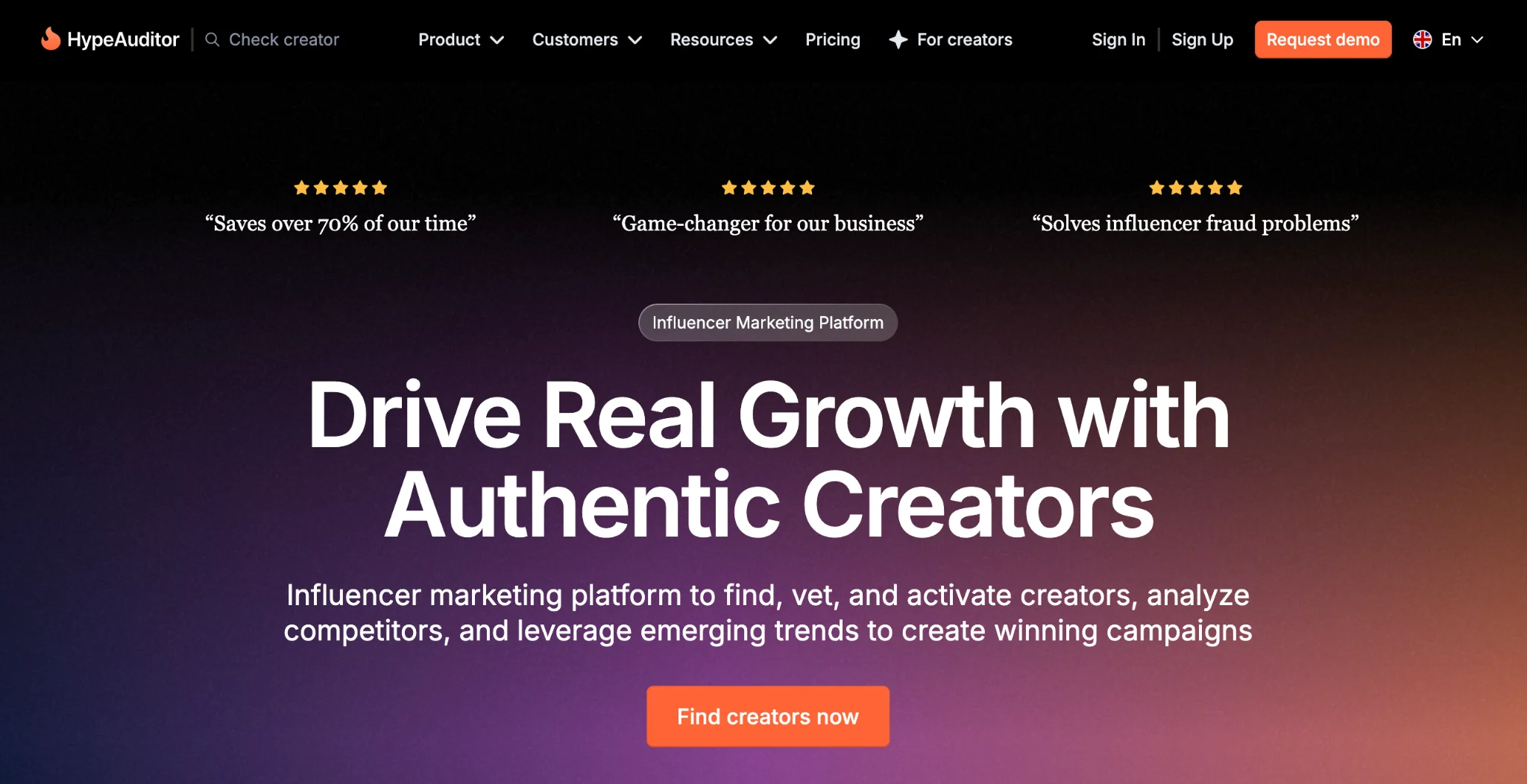
HypeAuditor is built on fraud detection, with audience quality analysis at the centre of the product. Discovery, campaign tracking, competitor visibility and market analytics sit around it across the main consumer networks. Teams that vet hard before spending are its natural buyers.
Key Features
- Audience authenticity scoring: The deepest fraud analysis in this comparison.
- Discovery on verified data: Search filtered by the same audience quality metrics.
- Live campaign tracking: Posts and results measured against the goals set at kickoff.
- Competitor creator visibility: Which creators rival brands are already using.
- Free public tools: Account audits available without an account or a call.
Pricing
Not published. Quotes come through a demo, with a free entry point covering media plans and limited versions of the paid features.
Reviews
4.6/5.0 (G2, 262 reviews).
Pros
- Verifiable before you talk: Free tools let you check the data on creators you know.
- 262 reviews: A solid basis for judging reliability.
- Global creator analysis: Any creator, any market, including MENA accounts.
Cons
- No published price: The free tier does not remove the sales call.
- No execution layer: No contracts, payments or product shipping.
- Analysis only: It tells you who is real, not how to work with them.
Integrations
- Instagram and TikTok: Creator data and audience analysis.
- YouTube: Channel analytics and audience breakdowns.
- Twitch: Limited streaming coverage.
- API access: Creator data programmatically on higher plans.
- Report exports: Audits shared as files with stakeholders.
Hypeo AI vs HypeAuditor
The interesting thing is that these can work together rather than against each other. HypeAuditor will analyse a MENA creator’s audience just as readily as a US one, so a brand using a regional platform for sourcing can still verify authenticity independently.
As a straight comparison, neither publishes a price, and both offer a way in without paying, one through a trial and one through free public tools. HypeAuditor has 262 reviews behind it; Hypeo AI has none, which is the gap that matters most at the point of signing.
Julius
Julius compiles its creator profiles by hand rather than scraping them, holding interests, brand affinities and past partnerships in more detail than most indexes. Smaller teams and agencies make up its user base, and ease of setup is its most cited strength. Search quality is the argument for it.
Key Features
- Human-compiled profiles: Creator records assembled by researchers, including previous brand work.
- Search beyond follower count: Filters covering attributes an automated index does not hold.
- Audience analytics: Demographic breakdowns reviewers rate highly.
- Campaign workflow: Briefs, tracking and reporting in the same place.
- Free trial: Hands-on evaluation before any contract.
Pricing
Not published and quoted per account, though a free trial is available, which is the same concession Hypeo AI makes.
Reviews
4.5/5.0 (G2, 96 reviews).
Pros
- Depth per creator: Curated data an algorithm would not surface.
- Trial without a contract: Testable despite quote-only pricing.
- 96 reviews: Enough to see patterns in.
Cons
- No published price: Budgeting waits for sales.
- No payments or contracts: Discovery-focused throughout.
- Curation limits scale: A smaller index than scraped databases.
Integrations
- Instagram and TikTok: Creator data and campaign performance.
- YouTube: Channel analytics.
- Twitter/X: Additional creator coverage.
- Email tools: Outreach run from the creator record.
- Exports: Creator lists and reports for client work.
Hypeo AI vs Julius
Both argue that better creator data beats more creator data, and both back it with human effort rather than scale. Julius employs researchers to build profiles; Hypeo AI built a regional database in a market the scrapers ignore.
They are also the two platforms here that pair quote-only pricing with a free trial, which is the fairest version of an opaque model. The separator is evidence: Julius has 96 reviews and years of operation, and Hypeo AI has a year and none.
Brandbassador (Club)

Brandbassador, now also sold as Club, converts customers and micro-creators into an ongoing ambassador community driven by gamified missions and rewards. It presumes an existing base of people who like the brand, which puts it closer to loyalty software than campaign tooling. Community management is the job it does.
Key Features
- Missions with rewards: Tasks published to the community and completed for points, product or commission.
- Leaderboards and tiers: Gamification that keeps ambassadors active between campaigns.
- Community recruitment: Customers converted into a managed roster at scale.
- Reward and commission tracking: Payments and incentives handled per ambassador.
- Participation analytics: Activity and content output measured across the programme.
Pricing
Not published, with third-party listings reporting no free trial. Quotes come through the vendor.
Reviews
4.7/5.0 (G2, 107 reviews), the highest score here. Ease of use and support are praised; ambassador search and filtering draw the criticism.
Pros
- Highest-rated in this set: 4.7 across 107 reviews.
- Four named store integrations: Against none at all.
- Works anywhere you have customers: Geography matters less when the roster is your own base.
Cons
- Quote-only and no trial: Less open than a platform offering fourteen free days.
- Weak search: Finding the right ambassadors is the recurring complaint.
- Needs an existing community: Useless for a brand entering a new market cold.
Integrations
- Shopify: Discount codes and ambassador sales tracked from the store.
- WooCommerce: The same for WordPress storefronts.
- Adobe Commerce: Enterprise commerce coverage.
- BigCommerce: Additional storefront support.
- Instagram and TikTok: Ambassador content tracked against missions.
Hypeo AI vs Brandbassador
These suit opposite moments. Brandbassador works when you already have customers in a market and want them promoting you; Hypeo AI works when you have none and need to find creators who can introduce you.
A brand entering MENA cannot start with an ambassador platform, because the community it activates does not exist yet. A brand already selling there could reasonably run both, and only one of the two publishes named store integrations to track affiliate payments against orders.
Final Thoughts on Hypeo AI Alternatives
The decision here barely involves the feature list. If your customers are in Morocco, the Gulf or the wider MENA region, Hypeo AI covers ground the global platforms do not, and the free trial costs nothing to run, so there is no good reason not to test it. If your customers are anywhere else, the regional database is the whole product and it is pointed away from you. Either way, use the trial to establish the two things the website will not tell you: whether you would be paying a subscription or a percentage of creator spend, and how many creators your real filters return in the specific markets you sell in. Those answers decide it far more than the five-minute setup claim does.

.png)


.jpg)










