


10 Best HelloInfluencer Alternatives for Influencer Marketing
Data protection is usually the reason a brand looks at HelloInfluencer, and it is a fair one. The platform runs in Europe, publishes in eight languages and leads with GDPR before it leads with features.
The problem is what happens next. There is a prices page and no numbers on it, no review base to check the claims against, and no published integration list. You cannot budget, benchmark or plan an implementation from what is on the site.
Ten platforms below give you at least one of those things, and most give you all three. They are, in order: CreatorIQ, Traackr, Influencer Hero, Klear, Afluencer, SARAL, Lefty, Humanz, Modash and Glewee.
Key Criteria for Evaluating Influencer Marketing Platforms
Core Features
Evaluation of essential influencer marketing capabilities, including influencer discovery, outreach, CRM, campaign management, reporting, and content workflows.
Pricing & Flexibility
Comparison of pricing models, subscription plans, and contract terms to match different budgets and growth stages.
Customer Reviews & Satisfaction
Analysis of user feedback from trusted review platforms, focusing on usability, reliability, customer support, and overall performance.
Pros & Cons
Review of each platform’s strengths and limitations to highlight where it performs well and where it may fall short based on different use cases.
Integrations
Review of the most important integrations (e.g., Shopify and other tech tools), highlighting what each integration enables in one sentence.
HelloInfluencer Overview
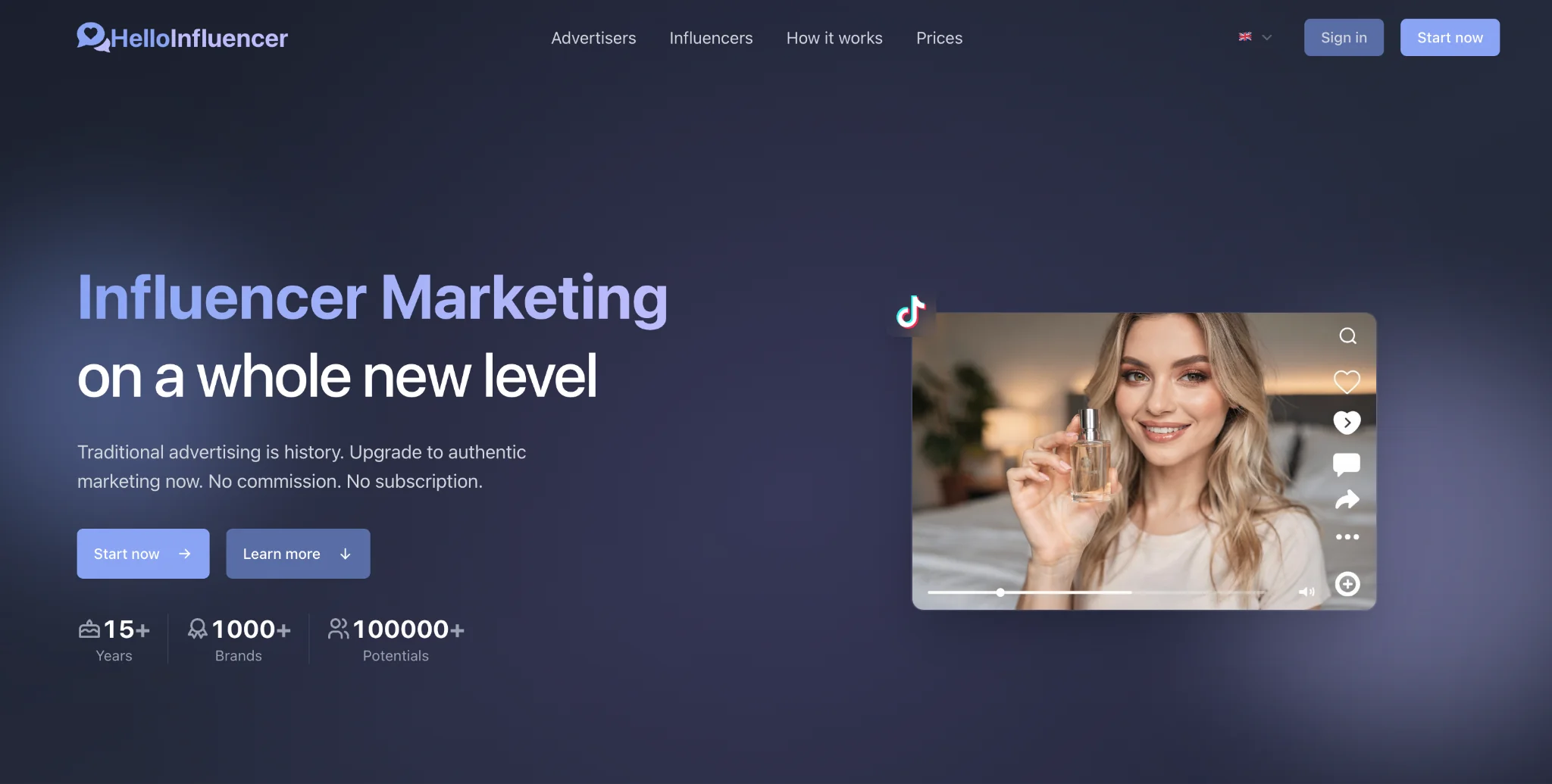
HelloInfluencer is a European influencer marketing platform that connects brands, agencies and creators directly, without an agency sitting in the middle. Its site runs in eight languages and its creator database is strongest in Germany, Austria and Switzerland. Brands can either search that database with filters or post a campaign and wait for creators to apply, and the whole thing is built around European data handling, which is what most of its marketing talks about first.
Key Features
- Two routes to a shortlist: Filter the creator database yourself, or publish a campaign and let creators apply to it.
- German-speaking creator supply: Coverage is deepest across Germany, Austria and Switzerland, where global databases usually thin out.
- Wide channel list: Instagram, TikTok, YouTube, Facebook, Pinterest and Twitch, plus blogs and websites.
- European data handling: Processing under EU rules, which is the platform’s main pitch to regulated buyers.
- Separate tracks by user type: Brands, agencies, creators and affiliates each get their own signup and workflow.
Pricing
Nothing usable. There is a prices page and no figure resolves on it. Third-party listings describe tiers quoted on request, and separately describe a commission taken on campaign budget instead of a subscription, which are two different models. Until a written quote arrives, treat the cost as unknown.
Reviews
No verifiable rating. HelloInfluencer does not hold a listing with meaningful review volume on the major software review sites, so there is no score worth reporting.
Integrations
- Instagram: Connects creator profiles and campaign posts for reporting.
- TikTok: The same connection for short-form deliverables.
- YouTube: Covers longer creator work alongside social posts.
- Facebook: Included for creators who still publish there.
- Blogs and websites: Creators publishing off-platform are supported, which most tools in this list ignore.
No eCommerce, CRM or email integration directory is published anywhere on the site, so assume there is none until a sales conversation says otherwise.
Pros
- Built for EU rules: European processing matters to buyers who cannot compromise on it.
- Strong in the DACH market: German-speaking creators are the depth here, and that is genuinely hard to find elsewhere.
- Works both ways round: Search when you know who you want, listings when you do not.
Common Drawbacks of HelloInfluencer
No price you can see
A prices page with no prices on it means every evaluation starts with a sales call. You cannot compare it against anything on this list without one, and you cannot put a number in a budget before you have had it.
Nothing to check the claims against
There is no review base of any size on the major software sites. Whatever the demo shows, you have no independent read on support, reliability or whether brands stay past year one.
Europe or nothing
The creator supply is built around Germany, Austria and Switzerland. That is a real strength inside those markets and a hard stop outside them, so a brand launching in the US or APAC needs a second platform anyway.
No commerce layer
Nothing is published about store integrations, affiliate codes, commission tracking or creator payouts. For a D2C brand measuring creators on revenue, that is the entire back half of the program missing.
Best HelloInfluencer Alternatives
| TOOL | REVIEWS | BEST FOR | TRIAL INFO | PRICING | ||
|---|---|---|---|---|---|---|
1 |

|
⭐ | Enterprise influencer marketing | Book Demo | Pricing | Website |
2 |

|
⭐ | Enterprise influencer analytics | Book Demo | Pricing | Website |
3 |

|
⭐ | Influencer CRM & automation | Book Demo | Pricing | Website |
4 |
|
⭐ | Influencer analytics | Book Demo | Pricing | Website |
5 |

|
⭐ | Influencer marketplace campaigns | Book Demo | Pricing | Website |
6 |

|
⭐ | Influencer outreach | Book Demo | Pricing | Website |
7 |

|
⭐ | Influencer analytics & discovery | Book Demo | Pricing | Website |
8 |

|
⭐ | Data-led influencer platform | Book Demo | Pricing | Website |
9 |

|
⭐ | Influencer discovery | Book Demo | Pricing | Website |
10 |

|
⭐ | Small brands running influencer and UGC campaigns | Book Demo | Pricing | Website |
CreatorIQ

CreatorIQ sits at the top end of the category, running influencer programs for global brands and the agencies that service them. Creators connect their own accounts, so the data behind a decision comes from the platform rather than from an estimate. Its customers are usually managing many markets, many teams and a compliance requirement at the same time.
Key Features
- Creator-connected data: Creators link their own accounts, giving verified reach and demographics instead of scraped numbers.
- Fraud and brand-safety checks: Audience quality and content history screened before a creator is approved.
- Paid amplification workflow: Creator content pushed into paid social with the rights already handled.
- Agency and team permissions: Multiple teams work in one instance without seeing each other’s programs.
- Program-level analytics: Results rolled up by market, brand and campaign for reporting outside marketing.
Pricing
Not published. Procurement data puts entry near $30,000 a year, with a median around $39,250 and top deals near $59,500. Annual contracts only.
Reviews
4.6/5.0 (G2, 581 reviews).
Pros
- Verified numbers: Creator-connected data holds up when someone senior questions a reach figure.
- Runs many markets at once: One instance, many teams, without programs colliding.
- Large, current review base: Nearly 600 reviews to read before you commit anything.
Cons
- Priced for enterprises: A $30,000 floor puts it out of reach for most mid-market brands.
- Annual commitment first: You sign for a year before you have run a campaign in it.
- Heavy to set up: The configuration that makes it useful takes weeks, not an afternoon.
Integrations
- Shopify: Ties creator activity to real orders rather than to estimated value.
- Salesforce: Keeps partner records in step with whatever the wider business already uses.
- Snowflake: Sends creator performance into the warehouse for teams that model it themselves.
- Google Drive: Keeps briefs, assets and approvals attached to the campaign.
- Slack: Moves approvals out of email and into the channel where work happens.
HelloInfluencer vs CreatorIQ
These are different purchases in almost every respect. One is a European marketplace you can start using without much ceremony; the other is a governed enterprise system with verified creator data and permissions for a dozen teams.
Cost is where the decision usually lands. CreatorIQ starts near $30,000 a year on an annual contract, which is a serious commitment, but at least it is a number. HelloInfluencer may well be far cheaper, and there is no way to know before you book a call.
Traackr

Traackr is built for brands that run creator programs as a managed, always-on budget rather than as a series of campaigns. It puts a lot of weight on measurement discipline: standard scoring, spend tracking and comparison across markets. Beauty and personal care make up a large share of its customer list.
Key Features
- Always-on creator tiering: Sort a roster into VIP, ambassador and one-off tiers and manage each differently.
- Brief and approval workflow: Send briefs, collect content and approve it against the agreement in one place.
- Market-level dashboards: Each country program reported the same way so results compare honestly.
- Cost-per-engagement tracking: Spend measured against output rather than against reach alone.
- Category benchmarking: Your creator share of voice set against named competitors.
Pricing
Not published. Reported entry figures gather around $25,000 a year, with senior tiers past $55,000, and third-party sources disagree enough that only a quote settles it.
Reviews
4.3/5.0 (G2, 377 reviews).
Pros
- Discipline around spend: Budget pacing and cost per engagement are core, not an afterthought.
- Consistent across markets: Twelve country programs read the same way in one dashboard.
- Plenty of independent feedback: A 377-review base to weigh before signing.
Cons
- Quote-only pricing: No figure on the site, and the reported ones do not agree.
- Weakest score in this list: 4.3 on a big sample, with the interface a common complaint.
- Thin on revenue tracking: Store attribution is lighter than in eCommerce-first tools.
Integrations
- Shopify: Connects orders so creator work can be judged on sales, not just engagement.
- Gmail and Outlook: Keeps creator conversations attached to the right record automatically.
- Tableau: Feeds spend and performance into dashboards the wider team already reads.
- Slack: Flags approvals and campaign changes without another login.
- Google Drive: Holds briefs and creative where creators and teams can both reach them.
HelloInfluencer vs Traackr
Both are strongest in Europe, and there the similarity ends. Traackr is for a team running a permanent creator budget across several countries and reporting on it every month, which needs standard scoring and benchmarking that a marketplace does not attempt.
Neither publishes a price, which makes this the one comparison where you are quoting both. The difference is that Traackr has 377 reviews behind it and reported figures to anchor against, so at least you know roughly what you are walking into.
Influencer Hero

Influencer Hero is an all-in-one influencer marketing platform for D2C and eCommerce brands, covering 8 social platforms with Instagram, YouTube and TikTok at the centre. Everything a creator program touches runs in one place: finding people, contacting them, shipping product, collecting content, tracking sales and paying out. Its three price tiers are published on the site and set by outreach volume.
Key Features
- Multichannel messaging: Reach creators by email, Instagram DM and WhatsApp, with every reply landing in one inbox.
- Automated outreach sequences: Bulk sends, AI personalisation, drip follow-ups and reply tracking without a spreadsheet.
- Application pages: Branded landing application pages where creators apply, with auto-accept rules and product selection built in.
- Content review workflows: Request content from the deal page, then approve it or ask for an edit with a reason attached.
- AI UGC search: Find past creator content by keyword, media type, visual quality or whether the product is visible.
- Coupon leakage prevention: Leaked discount codes spotted on aggregator sites, rotated automatically and flagged to the creator.
- Brand-risk alerts: AI reads creator replies for negative sentiment and pushes a Slack or email warning early.
- Creator storefronts: Each creator gets a shoppable page of your products tied to their affiliate tracking.
Pricing
- Standard: $649 a month, up to 1,000 reachouts a month
- Pro: $1,049 a month, up to 5,000 reachouts a month
- Business: $2,490 a month, up to 10,000 reachouts a month
- Custom & Agency: custom pricing
Pay quarterly and take 20% off, pay yearly and take 30% off. All of it is on the pricing page.
Reviews
5.0/5.0 (Capterra)
Pros
- You can price it in five minutes: Three tiers on a public page, no call needed to start planning.
- Revenue is tracked, not estimated: Codes, links and commission tie creator work to actual orders.
- Works on any store: Shopify and WooCommerce natively, Magento and custom builds through a script.
Cons
- No free trial
- Expensive for smaller brands
- Steep learning curve
Integrations
- Shopify: Sends gifting orders automatically and attributes revenue to the creator behind it.
- WooCommerce: Brings WordPress stores into the same tracking, with scripts for everything else.
- Klaviyo: Lets creator segments feed the email program rather than sitting apart from it.
- Gorgias and Zendesk: Creator conversations reach the support team without being forwarded.
- Zapier: Opens 8,000-plus further apps for anything not covered natively.
HelloInfluencer vs Influencer Hero
HelloInfluencer does one thing well: it puts European creators, especially German-speaking ones, in front of brands under EU data rules. What it does not publish is anything about the rest of a program. Influencer Hero covers discovery with over 20 filters and fake-follower screening, outreach across email, Instagram DM and WhatsApp with drip sequences, a CRM board per campaign with automations, gifting through Shopify or WooCommerce, a searchable UGC library with approval workflows, affiliate codes with commission calculated in-platform, and creator payouts at 0.1% to 0.4% with invoicing attached. That is the operating layer a growing program needs once the shortlist exists.
The pricing difference is not about the amount, it is about whether there is one. HelloInfluencer publishes no figure at all, so a budget line has to wait for a sales call. Influencer Hero publishes $649, $1,049 and $2,490 a month, with 20% off quarterly and 30% off yearly, which brings the entry tier to $5,452 a year prepaid. Tiers are set by outreach volume rather than by roster size, so growing your creator list does not move the bill, and nothing is taken as a share of what you pay creators. For a D2C brand that needs to plan spend before it books a demo, that is the more workable model.
Klear
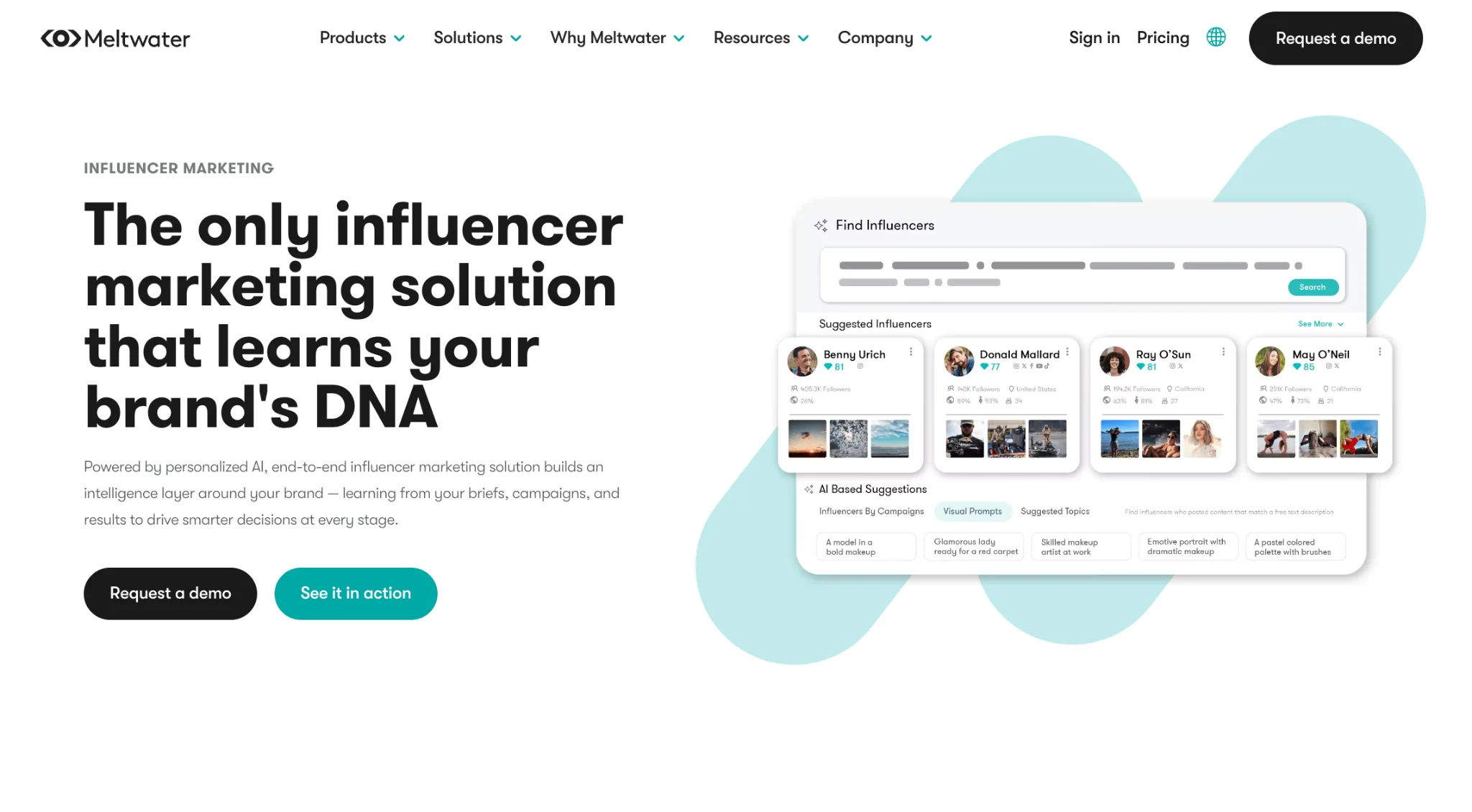
Klear is the influencer arm of Meltwater, folded into the wider media intelligence suite after the 2021 acquisition. Its strength has always been audience analysis: who follows a creator, what they care about and how well that matches a brand. Communications and PR teams are the usual buyers, since creator results end up in the same report as press coverage.
Key Features
- Deep audience profiling: Follower demographics, interests and location broken down per creator.
- Topic and skill scoring: Creators ranked on what they actually post about rather than on follower count.
- Historical brand affinity: See which brands a creator has worked with and how that content performed.
- Campaign measurement: Live post tracking with results reported against the original goal.
- Listening from the parent suite: Category and brand conversation data feeding creator planning.
Pricing
Not published, and rarely quoted on its own. Klear is packaged inside a Meltwater contract, which is annual and sized to the wider suite rather than to the influencer module.
Reviews
No standalone listing remains on the major review sites. The parent product scores 4.1/5.0 (G2, 2,640 reviews), which describes the whole Meltwater suite rather than the creator tool. Brands weighing it up often end up reading through Klear alternatives for a clearer picture.
Pros
- Audience data is the best part: Demographic depth that supports a planning decision, not just a shortlist.
- Creator history included: Past brand work is visible before you approach anyone.
- One report for earned media: Creator and press results land in the same place.
Cons
- Sold as part of a bundle: Buying just the influencer piece is difficult.
- Reach, not revenue: Reporting is built for comms teams, not for performance ones.
- Judged by proxy: With no module-level reviews, the suite score is all you get.
Integrations
- Meltwater listening: Category conversation feeds straight into creator planning.
- Instagram and TikTok: Verified post performance pulled into campaign reports.
- Salesforce: Aligns contacts and coverage with the wider commercial record.
- Google Analytics: Ties campaign traffic to what visitors then did on site.
- Slack: Sends mentions and campaign alerts to the team channel.
HelloInfluencer vs Klear
Klear knows far more about a creator’s audience than a marketplace ever will, and that is the reason to look at it. Demographic breakdowns, interest data and past brand work are all there before you send a first message.
What you pay for that is a Meltwater contract you cannot see the price of, sized to a suite you may not want. Both platforms leave you asking for a quote; only one of them also gives you a listening tool you did not ask for.
Afluencer
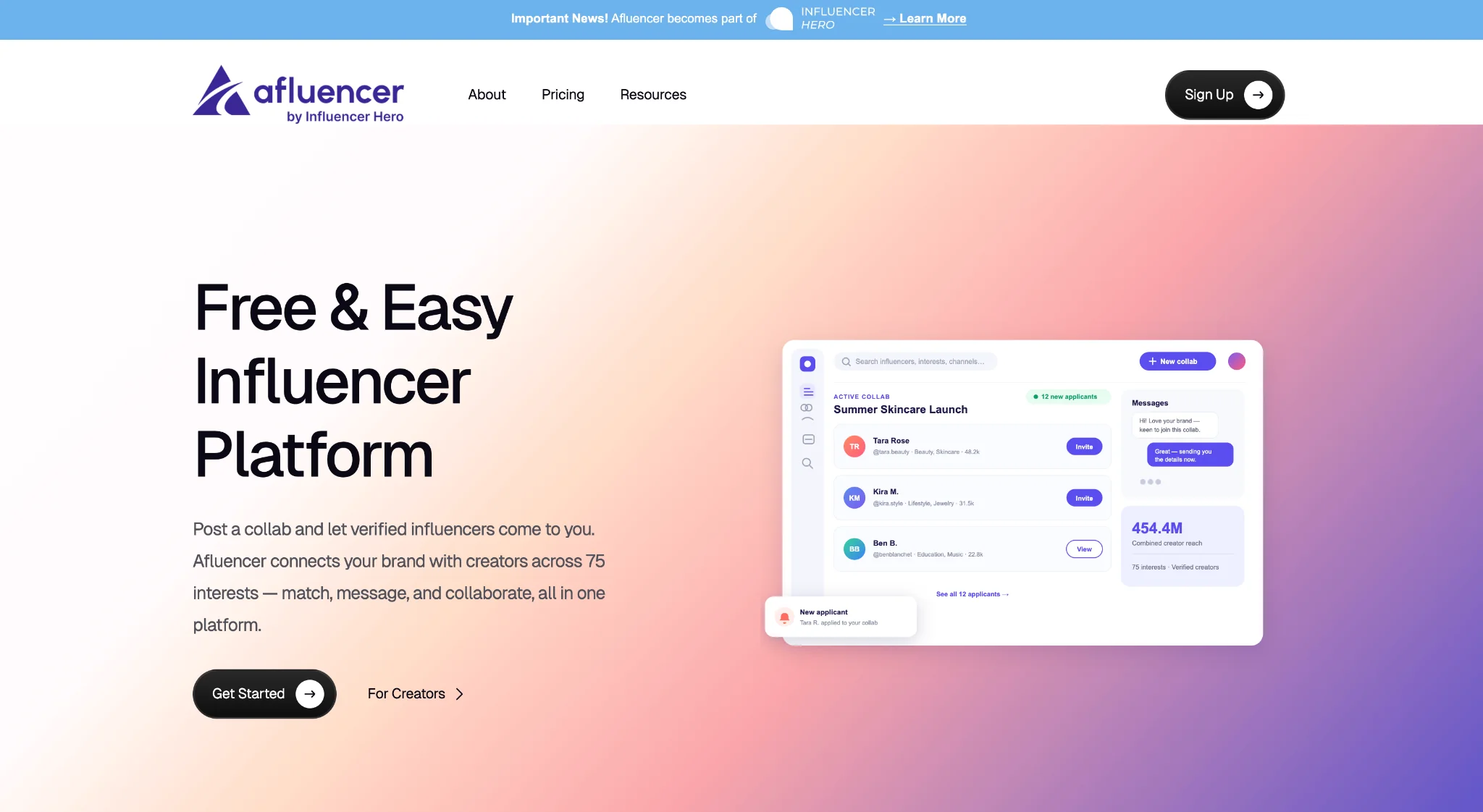
Afluencer runs on applications rather than searches. A brand posts a collaboration, verified creators across Instagram, TikTok, YouTube, Facebook and X apply, and the brand chooses from who turned up. It is aimed at Shopify merchants and small D2C teams who need creators this month rather than a reporting layer.
Key Features
- Collaboration listings: Post what you want and creators come to you, no searching required.
- Creator profiles with stats: Applicants arrive with audience numbers attached, so review is quick.
- CreatorGPT matching: AI sorts applicants against your brief before a person opens the list.
- In-platform messaging: Negotiation and briefing handled without moving to email.
- Invite credits: Approach specific creators directly when the inbound list is thin.
Pricing
From $49 a month on the Marketplace plan, rising with outbound invite volume. Creator-side plans are billed separately from brand plans.
Reviews
4.6/5.0 (G2, 738 reviews) and 4.7/5.0 (Shopify App Store, 34 reviews). The G2 sample leans creator-side, so read it alongside the Shopify score rather than on its own.
Pros
- You know the price: $49 a month, published, with no quote in the way.
- Inbound does the work: Useful when the job is to find micro-influencers quickly rather than analyse them.
- Nothing to implement: A listing can be live the same afternoon you sign up.
Cons
- Only as good as the listing: A dull offer attracts dull applicants, and invites often go unanswered.
- North America weighted: Creator supply is thinner outside the US and Canada.
- Reporting is basic: Campaign-level numbers, with no audience analysis worth the name.
Integrations
- Shopify: Handles discount codes and creator orders straight from the store.
- BigCommerce: Same setup for merchants who are not on Shopify.
- Klaviyo: Moves creator contacts into the email programme.
- DocuSign: Gets collaboration terms signed without leaving the flow.
- Slack: Tells the team when a new application arrives.
HelloInfluencer vs Afluencer
Both work on the same principle, which makes the comparison unusually clean: brands post, creators apply. The split is geography and transparency. HelloInfluencer’s supply is European and German-speaking, Afluencer’s is largely North American.
Then there is the number. Afluencer costs $49 a month and says so, and carries 738 reviews you can read tonight. If your market is the US, that is a decision you can make without speaking to anyone.


SARAL

SARAL is an influencer marketing platform for eCommerce brands that want ambassador programs rather than one-off posts. Outreach, relationship tracking, affiliate attribution and payment all sit in one flow, and every plan comes with onboarding and a named success manager. DTC founders and small in-house teams are the typical buyers.
Key Features
- Ambassador program automation: Long-running creator relationships tracked and renewed without manual chasing.
- Personalised email at volume: Sequences that read as individual messages, sent in batches.
- Product shipment tracking: Send-outs recorded against the creator so nothing goes missing mid-campaign.
- Content rights collection: Usage permissions gathered as content comes in, not chased afterwards.
- Full-funnel reporting: Outreach through to revenue in one view rather than three exports.
Pricing
$12,000 a year for Starter, $15,000 for Business and $25,000 for Professional, or $3,600, $4,500 and $7,500 quarterly. Tiers are set by active partnerships and how many creators you save each month. A trial is available first.
Reviews
No verifiable rating. SARAL does not hold a listing with enough reviews on the main software sites to quote a score fairly.
Pros
- Everything is published: Three tiers with annual and quarterly figures on the site.
- Attribution comes included: Cookieless affiliate tracking rather than a bolt-on tool.
- Help is part of the plan: A success manager on every tier, not only at enterprise level.
Cons
- Entry is steep: $12,000 a year is a lot for a brand testing the channel.
- Little outside evidence: Almost no independent reviews to weigh the claims against.
- Three networks: Instagram, TikTok and YouTube, and nothing beyond them.
Integrations
- Shopify: Runs the affiliate attribution, codes and gifting orders end to end.
- Gmail and Outlook: Sends outreach from your own address so replies look normal.
- Klaviyo: Passes creator contacts into lifecycle email flows.
- Slack: Pings the team when content lands or a creator replies.
- Zapier: Fills the gaps where no native connection exists.
HelloInfluencer vs SARAL
SARAL starts where a marketplace stops. It assumes you can find creators and focuses on what happens over the following year: sequences, shipments, rights, commission and renewal.
The trade is cost and geography. SARAL is a US-shaped product priced from $12,000 a year, and every figure is public. For a European brand with a DACH-heavy roster, the creator supply question still needs answering somewhere else.
Lefty
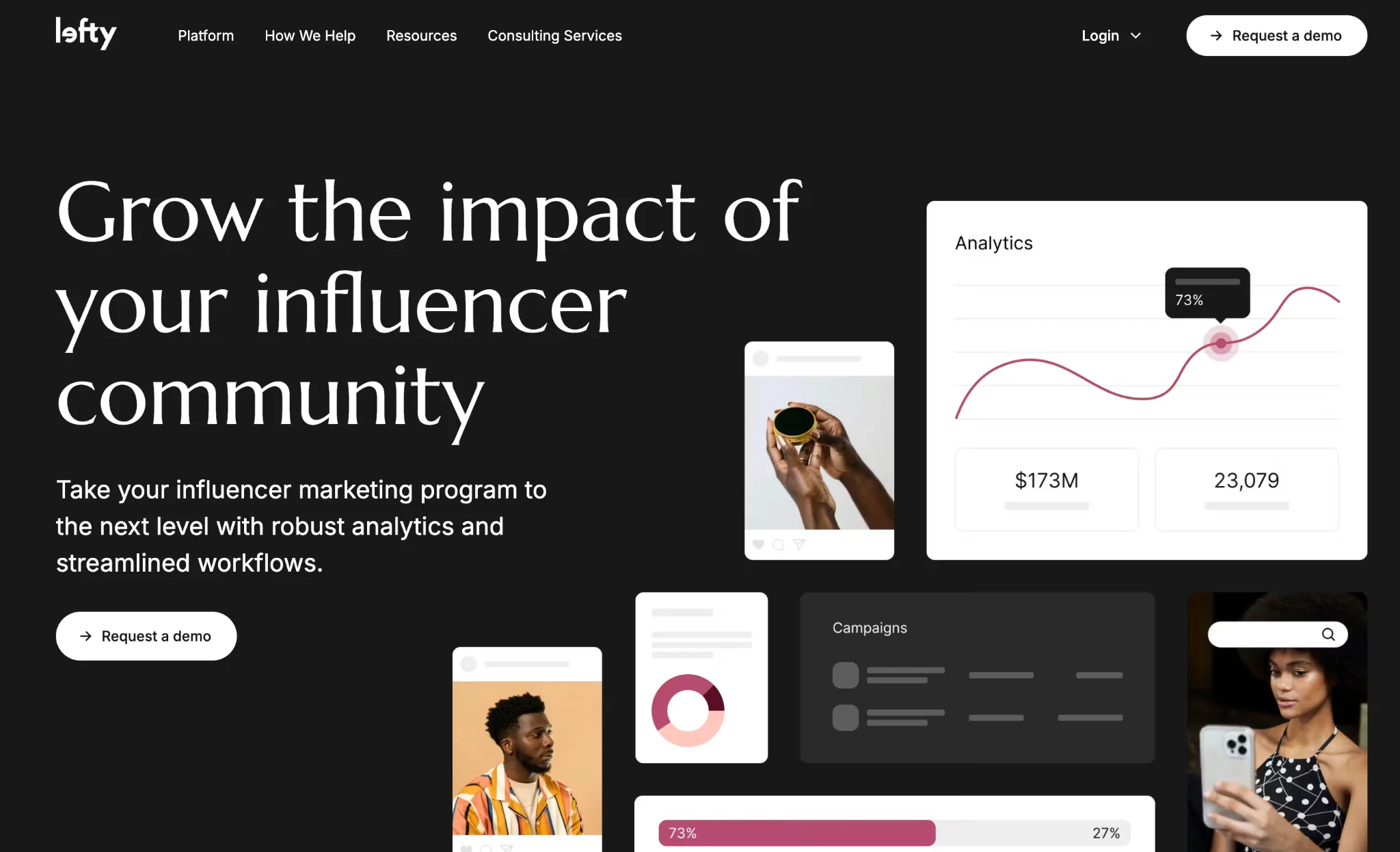
Lefty is the platform of choice for luxury and beauty houses, with Louis Vuitton, Clarins and Vans among its named clients. It reports in earned media value, tracks seeding and affiliate work in the same system, and covers Weibo, Douyin and RED alongside the western networks. Creator teams inside large consumer brands are its usual home.
Key Features
- Seeding at scale: Product send-outs planned, tracked and measured across hundreds of creators.
- Earned media valuation: Every post priced in EMV so campaigns compare across markets.
- Creator health scores: One record per creator showing engagement quality over time, not a single snapshot.
- Stripe-settled payments: Commission and flat fees paid to creators from inside the platform.
- Chinese platform coverage: Weibo, Douyin and RED tracked alongside Instagram and TikTok.
Pricing
Not published. There is no pricing page at all, and a demo request is the only way in.
Reviews
4.7/5.0 (G2, 91 reviews).
Pros
- Payments are handled: Creators get paid through Stripe without a second system.
- Reaches markets others miss: Chinese platforms are covered properly rather than mentioned.
- Highest score in this list: 4.7 on 91 reviews, which is a solid sample for a specialist tool.
Cons
- Costly by reputation: Reviewers describe paying for capability they never use.
- Roster caps: Limits on tracked creators that larger programs run into.
- Sales-led only: No self-serve route and no published figure.
Integrations
- Shopify: Connects the store for affiliate attribution and seeding logistics.
- Magento: Covers Adobe Commerce storefronts, which few competitors bother with.
- Salesforce Commerce Cloud: Enterprise commerce connection for large retail groups.
- Stripe: Settles commission and flat-fee payments to creators.
- Gmail and Outlook: Keeps creator pitching inside the CRM record.
HelloInfluencer vs Lefty
Both are European in origin and both work with brands that care about who represents them. Lefty goes considerably further: seeding at scale, EMV valuation, competitor share of voice and creator payments settled through Stripe.
Neither will tell you what it costs before a call. The difference is that Lefty has 91 reviews and a client list you can check, so the demo starts from a known position.
Humanz
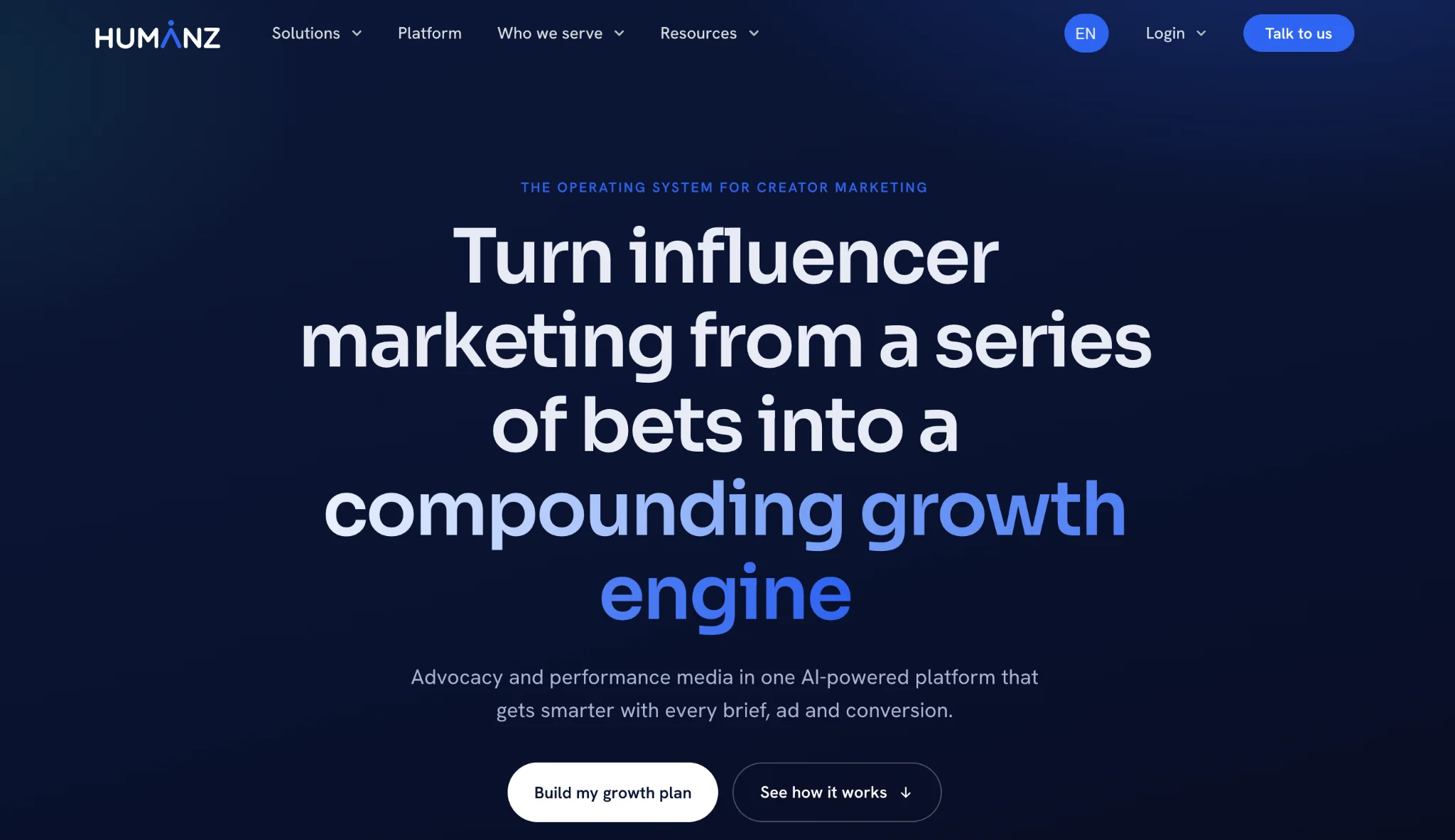
Humanz is a data-led platform used by brands including McDonald’s, L’Oréal and Nestlé. Creators connect their accounts through official APIs, and the platform handles briefs, contracts, performance bonuses and sales attribution from the same screen. It suits brands that want a campaign judged on what it sold.
Key Features
- API-permissioned creator data: Metrics come from connected accounts rather than from public estimates.
- Performance bonuses in the contract: Extra payment tied to results, agreed before the campaign runs.
- Marketplace sales attribution: Amazon and Shopify orders traced back to individual creators.
- Predictive campaign modelling: Expected reach and return forecast before budget is committed.
- Talent manager portal: Agents running several creators get their own workspace.
Pricing
Quoted per campaign as a share of media budget, with the percentage falling as spend rises. There is no subscription, so nothing is owed between campaigns.
Reviews
4.8/5.0 (G2, 27 reviews), a high score on a small sample.
Pros
- Pay only when you run: No standing fee for months when nothing is live.
- Amazon attribution: Marketplace sales tracked to creators, which is rare anywhere.
- Bonuses align incentives: Creators earn more when the campaign performs.
Cons
- The fee grows with success: A percentage of budget costs more exactly as you scale.
- You pick from applicants: Reviewers note the creator pool depends on who opts in.
- Only 27 reviews: Not much evidence for a platform working at this level.
Integrations
- Amazon: Attributes marketplace orders to the creator who drove them.
- Shopify: Does the same for your own store, in the same report.
- Meta Ads Manager: Turns creator posts into paid media without exporting anything.
- TikTok: Pulls deliverable performance into the campaign view.
- Google Tag Manager: Gets tracking live without a developer queue.
HelloInfluencer vs Humanz
Both avoid the standing subscription that most of this list charges, which is the main thing they have in common. Humanz then does something a marketplace does not attempt: it ties campaign results to affiliate payments and marketplace orders, including Amazon.
The catch is the same in both cases. A percentage of media budget is a real cost you cannot forecast from the website, so you are quoting either way. At least Humanz tells you what the percentage is based on.
Modash
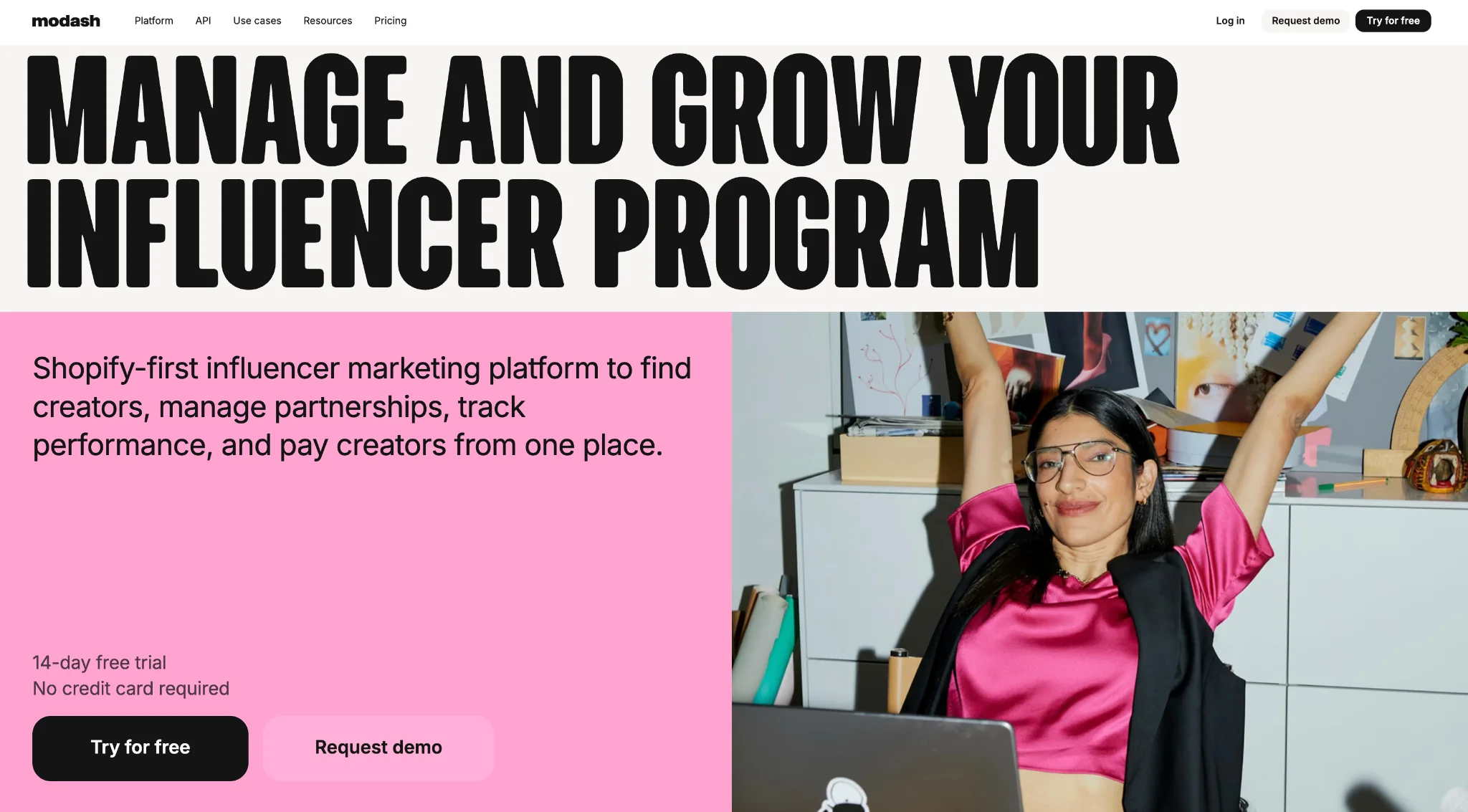
Modash built its reputation on search. Its index covers more than 380 million creator profiles on Instagram, TikTok and YouTube, and any creator with 1,000 followers or more is in it. Around that sit tracking, a light CRM, an email inbox and creator payments, all priced openly with a trial in front.
Key Features
- Complete creator index: Every profile above 1,000 followers on three networks, not a curated subset.
- Fake-follower analysis: Audience credibility checked before you spend a euro on anyone.
- Story and post tracking: Content collected automatically for as long as a campaign runs.
- Influential fans: Surface creators already following your brand or buying from it.
- In-platform payments: Pay creators free up to $10,000 a year, and at 5% above that.
Pricing
- Essentials: $199 a month, with 300 profile opens and 100 tracked creators
- Performance: $499 a month, with 800 profile opens and 250 tracked creators
- Enterprise: custom, starting at $14,700 a year
Both published plans include a 14-day free trial with no card, and annual billing lowers the monthly rate.
Reviews
4.9/5.0 (G2, low review volume at 19 reviews).
Pros
- Test it before paying: Two weeks free, no card, which nothing else on this list matches.
- The index is the product: Search depth is the reason teams pick it and the reason they stay.
- Global by default: European creators are in there alongside everyone else, with no regional limit.
Cons
- Everything is capped: Profile opens, email unlocks and tracked creators all run out per tier.
- No wider social work: Nothing for publishing, listening or community management.
- 5% over $10k: The payment fee starts to matter once the roster is active.
Integrations
- Shopify: Links store data so creator sales and gifting are visible in one place.
- Gmail and Outlook: Runs outreach through your own mailbox with replies synced back.
- Slack: Notifies the team the moment tracked content goes live.
- Zapier: Connects whatever else your stack needs.
- API: Pulls creator data into internal tools on higher tiers.
HelloInfluencer vs Modash
This is the clearest contrast in the list. One publishes no price and no reviews; the other publishes $199 a month, hands you a 14-day trial with no card, and lets you search 380 million profiles including every European creator you were looking for.
What Modash will not give you is a European hosting story or an application flow that brings creators to you. If GDPR positioning is the reason you were looking, that gap is the whole conversation.
Glewee
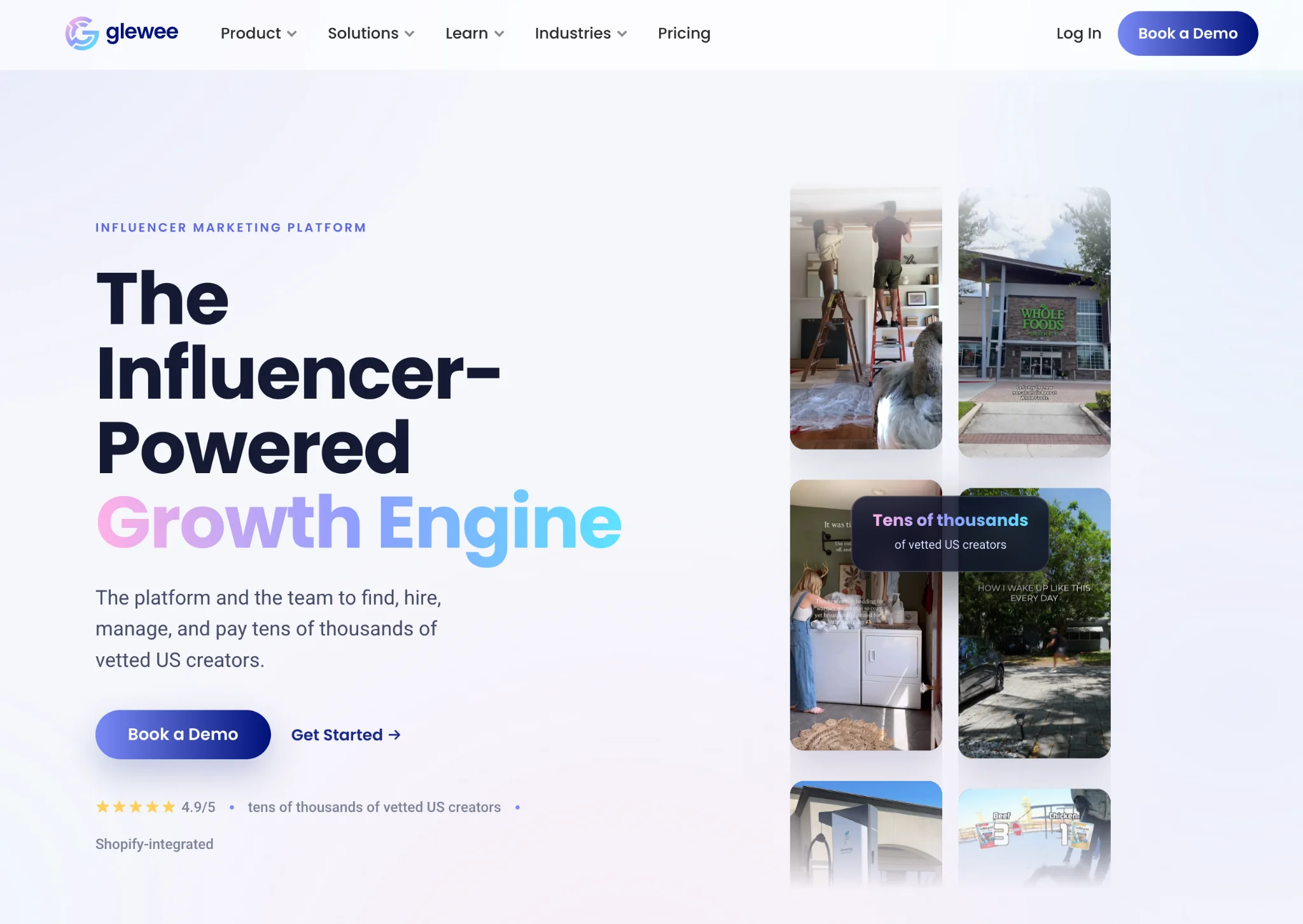
Glewee is a US creator marketplace with more than 50,000 pre-vetted creators in its network. Brands post a campaign, creators opt in, and briefing, chat, contracts, content delivery and payment all happen in the app. Pricing is aimed squarely at small and mid-market brands, and the platform takes nothing from what creators are paid.
Key Features
- Vetted opt-in network: 50,000-plus creators already checked before they reach your brief.
- Campaign chat and contracts: Terms agreed and content delivered in one conversation thread.
- Gifting collaborations: Product-only campaigns run alongside paid ones on the same plan.
- Zero platform fee: Whatever you agree with a creator is what leaves your account.
- Lifetime organic rights: Campaign content can be reused organically with no further licence.
Pricing
- Build: $199 a month, or $150 a month billed annually, with 3 seats and 10 gifting collaborations a month
- Scale: $499 a month, or $375 a month billed annually, with unlimited seats and gifting
- Full-Service: custom, with campaigns managed by the Glewee team
Both self-serve plans run month to month with no contract, and annual payment saves 25%.
Reviews
4.8/5.0 (G2). Capterra carries the product with no reviews at all, so the sample behind the score is thin.
Pros
- Prices are public: Two tiers on the page, plus what the annual discount does to them.
- No lock-in: Cancel at the end of any month on either self-serve plan.
- The creator fee is the whole cost: Nothing skimmed off the top of a hire.
Cons
- US network only: Almost no use for a campaign running in Germany or the wider EU.
- Closed pool: You choose from the 50,000 in the network, not from the open creator market.
- Light analytics: Delivery reporting rather than audience analysis.
Integrations
- Shopify: Connects the store for creator sales and gifting orders.
- Stripe: Handles brand payment and creator payout in one flow.
- Instagram: Pulls deliverable performance into campaign reports.
- TikTok: Same tracking for short-form work.
- Meta Business Suite: Routes creator content through for paid use.
HelloInfluencer vs Glewee
These are mirror images of each other. Both are marketplaces where creators opt into brand campaigns, both keep the workflow simple, and both are strongest in exactly one region. One is Europe, the other is the United States.
Glewee wins the part you can check from a browser. It publishes $199 and $499 a month, runs month to month, and takes no cut of creator fees. If your campaigns are European, none of that helps, and the comparison ends there.
Final Thoughts on HelloInfluencer Alternatives
HelloInfluencer solves a specific problem well. If you need German-speaking creators and your legal team wants European data handling, the shortlist of platforms that do both is genuinely short. What the site will not tell you is what it costs, what other brands think of it or what it connects to. Ask for the price in writing, ask how many active creators sit in your specific market, and ask what happens to affiliate tracking and payouts once a campaign ends. Those three answers decide it faster than any demo will.

.png)


.jpg)










