

10 Best BrandChamp Alternatives for Influencer Marketing
Influencer marketing software has become a core part of the D2C growth stack, helping brands streamline creator discovery, manage outreach at scale, run campaigns efficiently, and track real ROI from partnerships. BrandChamp is a strong option for ambassador programs, offering gamification, referral tracking, and community engagement features—but it falls short when it comes to influencer discovery, outbound outreach, and advanced performance analytics. That’s why many brands start exploring BrandChamp alternatives that offer a more complete influencer marketing workflow, especially as campaigns scale beyond existing customers. For founders and marketing teams evaluating influencer marketing software, understanding these trade-offs is key to choosing the right platform.
In this article, we compare the 10 best BrandChamp alternatives—Aspire, Influencer Hero, CreatorIQ, Upfluence, Skeepers, Klear, Traackr, IMAI (InfluencerMarketing.AI), Heepsy, and Social Cat—to help you find the right fit for your growth strategy.
Key Criteria for Evaluating Influencer Marketing Platforms
Core Features
Evaluation of essential influencer marketing capabilities, including influencer discovery, outreach, CRM, campaign management, reporting, and content workflows.
Pricing & Flexibility
Comparison of pricing models, subscription plans, and contract terms to match different budgets and growth stages.
Customer Reviews & Satisfaction
Analysis of user feedback from trusted review platforms, focusing on usability, reliability, customer support, and overall performance.
Pros & Cons
Review of each platform’s strengths and limitations to highlight where it performs well and where it may fall short based on different use cases.
Integrations
Review of the most important integrations (e.g., Shopify and other tech tools), highlighting what each integration enables in one sentence.
BrandChamp Overview
BrandChamp is an ambassador, influencer, affiliate, referral, loyalty, and UGC marketing platform built for brands that want to turn customers, fans, creators, and employees into active advocates. Its strongest focus is not influencer discovery, but managing an owned ambassador community through activities, rewards, referral tracking, gamification, branded portals, and automated program workflows.
Key Features
• Referral tracking: Brands can create branded referral links and codes, track referral performance with attribution windows and UTM analytics, and reward affiliates or ambassadors based on sales results.
• Activities and campaigns: Teams can create online or offline tasks with instructions, deliverables, approval workflows, and outcome-based rewards.
• Rewards and incentives: BrandChamp supports points, reward catalogs, Shopify discounts, Shopify gift cards, cash commissions, and tiered incentives.
• Branded ambassador portal and mobile app: Ambassadors can access tasks, resources, rewards, community updates, and program progress through a branded portal or app experience.
• Community and gamification: Leaderboards, rankings, points, milestones, tiers, featured content feeds, and segmented activities help keep ambassadors engaged over time.
• Content and resource library: Brands can provide campaign assets to participants and collect submitted content in a downloadable gallery.
• Workflow automation: Pro plans and above include automations for segmentation, communication, tiers, engagement tracking, requirements, and scheduled workflows.
• Reporting and social metrics: BrandChamp includes reporting features for program activity, referrals, rewards, and campaign participation.
• API, webhooks, and Zapier: Higher-tier plans support real-time integrations with external systems, CRMs, internal workflows, and custom storefronts.
Pricing
BrandChamp’s public pricing page lists five plans but does not publish exact plan prices. The plans are:
• Launch: Includes points and rewards catalog, activities and campaigns, community hub, referral/commission tools, media/resource library, reports, branded mobile app, branded private portal, and email/push notifications.
• Essential: Adds leaderboards, featured content feed, multiple programs, segmentation for activities, emails, onboarding, and resources, plus cash activity rewards.
• Pro: Adds mobile push messaging, segmented rewards, gifting and milestones, workflow automations, activity scheduling, points expiration, branded portal URL, Zapier, and webhooks.
• Premium: Adds API access, custom referral sales, lead referrals, multi-stage referrals, upcoming AI automation, monthly coaching calls, and services discounts.
• Enterprise: Custom plan for brands with specific volume, customization, or workflow requirements.
Third-party software listings show BrandChamp starting at $249 per feature/month, with no free trial listed. Contract length is not clearly published, so brands should confirm whether pricing is monthly, annual, or usage-based during the sales process.
Reviews
Not available
Integrations
• Shopify: Sync orders, track referral sales, create discount codes, issue gift cards, and embed ambassador application forms into a Shopify store.
• WooCommerce: Track referral sales, generate coupons, issue gift-card-style rewards, and manage referral cookie settings.
• Zapier: Connect BrandChamp with tools like Slack, Google Sheets, Klaviyo, Airtable, and other apps for no-code workflow automation.
• Webhooks: Send real-time event notifications for applicants, task submissions, transactions, and other program events into CRMs or internal systems.
• BrandChamp API: Build custom integrations for referral tracking, rewards, custom storefronts, CRMs, and advanced automation workflows.
Pros
• Strong ambassador engagement engine: BrandChamp stands out for points, reward catalogs, missions, leaderboards, tiers, milestones, and branded community experiences, making it useful for long-term ambassador programs rather than one-off influencer campaigns.
• Flexible reward and referral infrastructure: It supports referral links, discount codes, commissions, Shopify gift cards, points, cash rewards, and custom referral workflows, which gives brands more incentive options than basic influencer CRM tools.
• Recent automation and extensibility upgrades: Zapier, webhooks, API access, multi-stage referrals, and upcoming AI automation make BrandChamp more adaptable for brands with custom ecommerce, CRM, or internal workflow needs.
Common Drawbacks of BrandChamp
Not built around influencer discovery
BrandChamp is better for managing ambassadors after they join than for finding new creators. Brands that need large creator databases, lookalike search, audience demographics, or AI influencer discovery may need a separate tool.
Pricing transparency is limited
The official pricing page requires contacting sales for plan costs, while third-party listings only show a starting price. This makes it harder for smaller teams to compare total cost upfront.
Advanced features sit behind higher tiers
Workflow automations, Zapier, webhooks, API access, custom referral tracking, and multi-stage referrals are not available across all plans.
Some analytics needs may require workarounds
BrandChamp covers program reporting and referral tracking, but brands looking for deeper creator vetting, audience authenticity checks, competitor benchmarking, or advanced social analytics may find it less complete than influencer-first platforms.
Best BrandChamp Alternatives
| TOOL | REVIEWS | BEST FOR | TRIAL INFO | PRICING | ||
|---|---|---|---|---|---|---|
1 |

|
⭐ | Influencer partnerships | Book Demo | Pricing | Website |
2 |

|
⭐ | Influencer CRM & automation | Book Demo | Pricing | Website |
3 |

|
⭐ | Enterprise influencer marketing | Book Demo | Pricing | Website |
4 |

|
⭐ | Influencer discovery | Book Demo | Pricing | Website |
5 |

|
⭐ | Influencer gifting & UGC campaigns with micro-influencers | Book Demo | Pricing | Website |
6 |
|
⭐ | Influencer analytics | Book Demo | Pricing | Website |
7 |

|
⭐ | Enterprise influencer analytics | Book Demo | Pricing | Website |
8 |

|
⭐ | AI influencer discovery & analytics | Book Demo | Pricing | Website |
9 |

|
⭐ | Influencer discovery | Book Demo | Pricing | Website |
10 |

|
⭐ | Micro-Influencer Campaigns | Book Demo | Pricing | Website |
Aspire
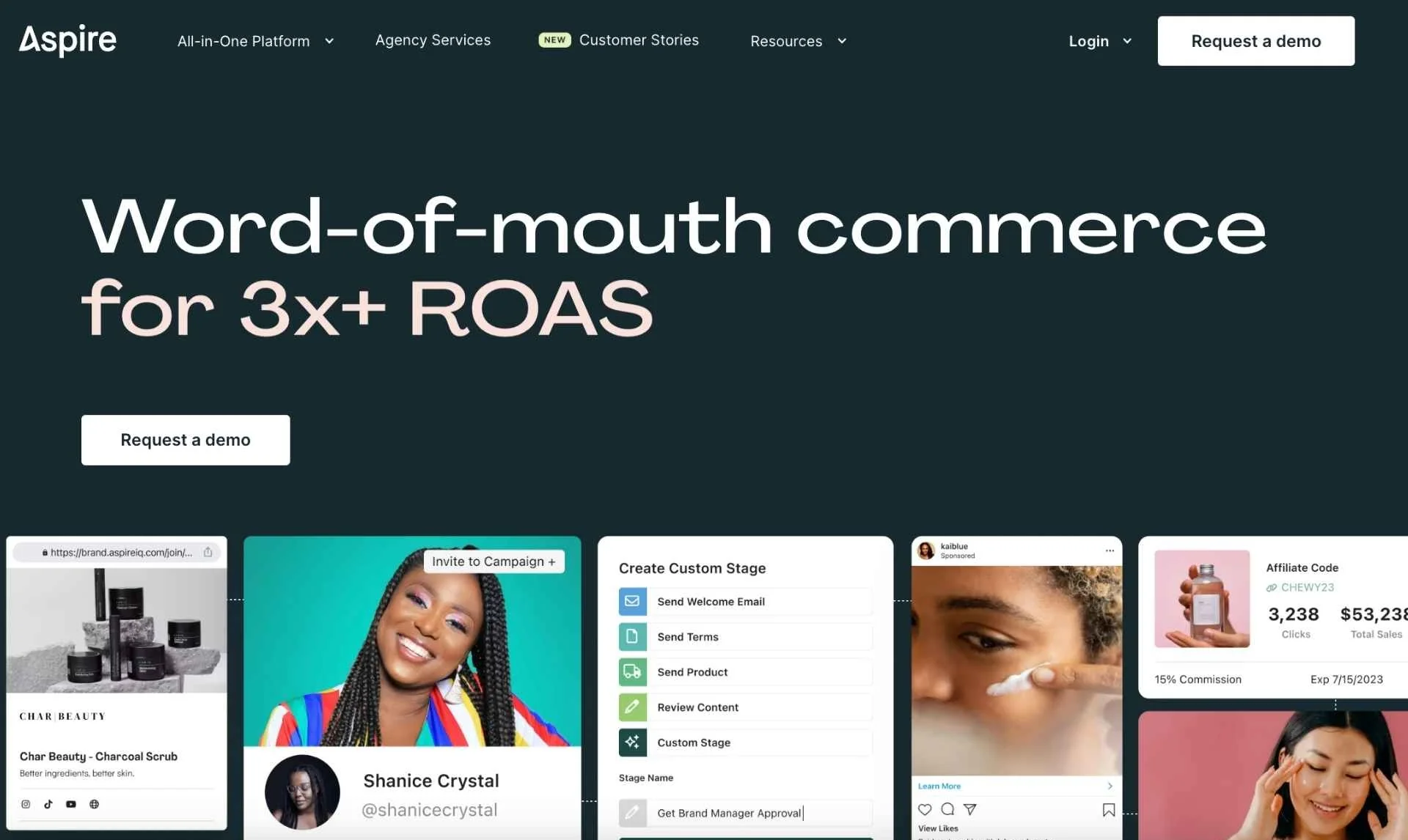
Aspire is a creator marketing platform for ecommerce brands that want to manage influencer, affiliate, ambassador, and UGC campaigns in one place. It focuses on creator discovery, inbound applications, content approvals, Shopify-powered gifting, sales tracking, and long-term creator relationship management.
Key Features
• Influencer discovery: Search creators by channel, keyword, engagement, audience demographics, location, and lookalike profiles.
• Creator marketplace: Brands can post campaign opportunities and receive inbound creator applications, reducing manual outreach.
• Application pages: Create branded signup pages to collect creator details, product experience, campaign ideas, and audience data.
• Workflow and CRM: Manage invitations, briefs, contracts, content approvals, deadlines, and post tracking from a centralized campaign pipeline.
• Product gifting: Shopify integration lets creators select approved products while brands track fulfillment without leaving Aspire.
• Affiliate and sales tracking: Generate discount codes, links, creator stores, and commission tracking for performance-based programs.
• Content library: Store influencer content, track usage rights, and reuse approved UGC across paid, organic, and ecommerce channels.
• Reporting: Export campaign, sales, social performance, and creator-level reports.
Pricing
Aspire does not publish full public package pricing on its website. Public and recent market sources indicate:
• Custom pricing
• Often reported at about $2,000+/month
• Recent quoting indicated around $2,300/month for a mid-tier setup
• Typically sold with a 12-month commitment rather than month-to-month self-serve plans
Reviews
4.0/5.0 (Capterra)
Pros
• First-party data partnerships: Aspire emphasizes first-party data relationships with major social platforms, helping brands access more reliable creator and audience insights.
• Strong inbound creator marketplace: Its marketplace is a standout for brands that want creators to apply directly instead of relying only on cold outreach.
• Deep Shopify gifting workflow: Product selection, approvals, shipping, fulfillment tracking, discount codes, and creator commerce workflows are tightly connected to Shopify.
Cons
• Higher entry cost: Aspire can be expensive for smaller brands because pricing often starts around the low-thousands per month.
• Feature depth can create a learning curve: The platform covers many workflows, so setup and navigation may take time for smaller teams.
• Occasional technical friction: Some users report slow loading, account connection issues, or integration glitches.
Integrations
• Shopify: Sync customers, products, orders, product gifting, fulfillment, creator codes, and sales attribution.
• Gmail: Manage creator outreach and sync email conversations inside Aspire.
• PayPal: Support creator payouts and commission-related payment workflows.
• Meta: Access social data and support creator performance tracking across Instagram and Facebook.
• TikTok: Use creator and campaign data for discovery, tracking, and campaign measurement.
BrandChamp vs Aspire
BrandChamp is stronger for owned ambassador programs, gamified missions, rewards, referrals, and loyalty-style advocacy. Aspire is stronger for influencer campaign execution, creator discovery, inbound applications, content approvals, Shopify gifting, and UGC licensing.
BrandChamp fits brands that already have customers or fans they want to turn into ambassadors. Aspire fits ecommerce teams that want to source new creators, manage structured influencer campaigns, approve content, track sales, and scale creator relationships through a more influencer-first workflow.
Influencer Hero
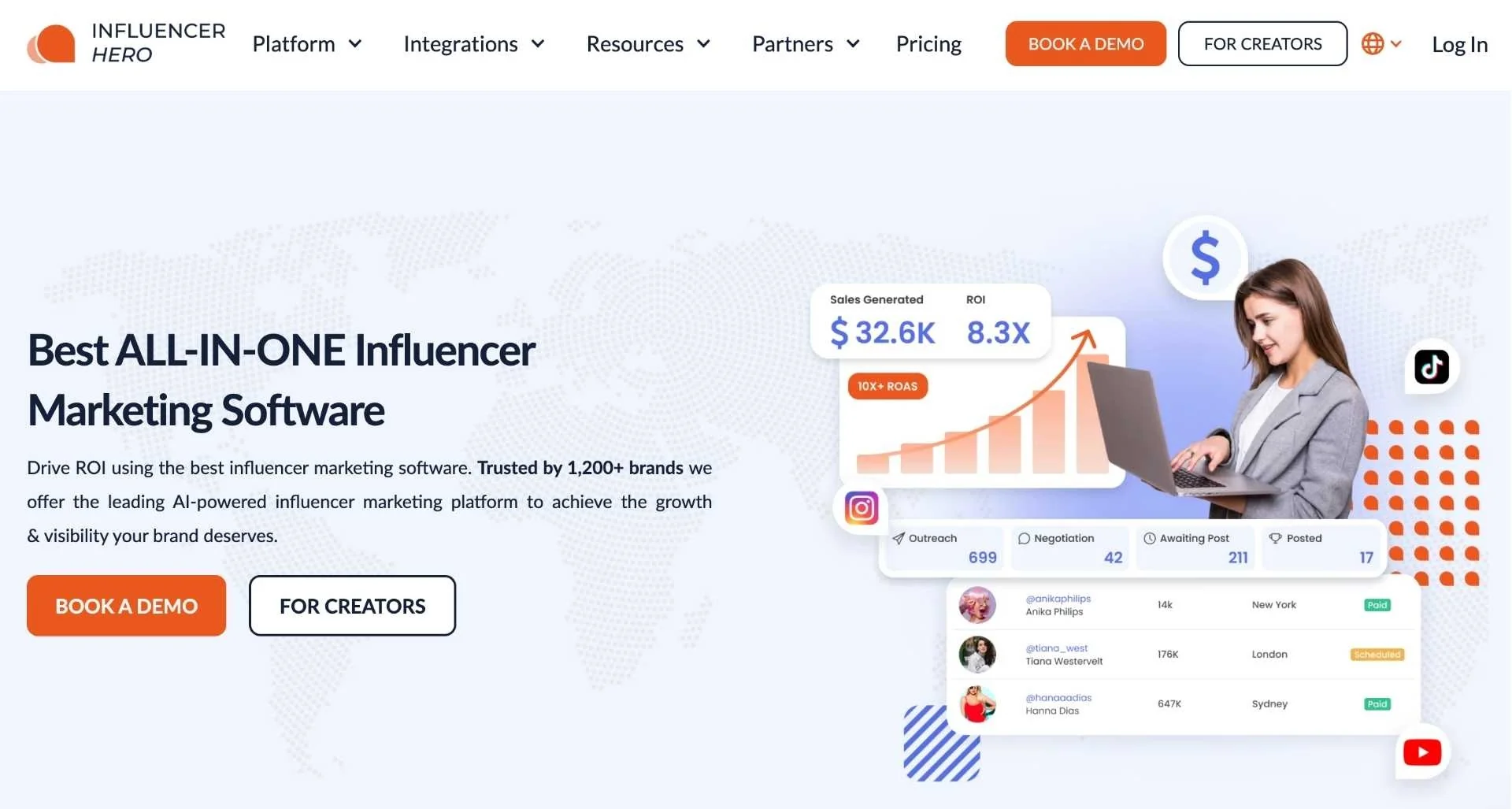
Influencer Hero is an all-in-one influencer marketing platform for D2C and ecommerce brands. It combines creator discovery, outreach automation, CRM, gifting, affiliate tracking, UGC collection, reporting, and ecommerce integrations in one workflow.
Key Features
• Influencer discovery: Find creators across Instagram, TikTok, YouTube, Facebook, Pinterest, Snapchat, X, and Twitch using filters for niche, audience, engagement, and demographics.
• Fake follower and audience analysis: Review creator quality before outreach to avoid low-quality partnerships.
• Chrome extension: Import creators from social platforms while browsing and add them directly into campaigns.
• Automated outreach: Send bulk or one-to-one emails with templates, AI personalization, follow-ups, and reply tracking.
• Campaign CRM: Track creators by stage, manage deliverables, approve or decline creators, and use bulk actions for high-volume campaigns.
• Gifting and seeding: Connect ecommerce platforms to send products and monitor fulfillment.
• Affiliate tracking: Generate links and codes, track clicks and sales, calculate commissions, and manage creator payouts.
• UGC library: Automatically collect, organize, download, and repurpose influencer content.
• Application pages and storefronts: Create branded creator signup pages and storefront-style experiences.
Pricing
Influencer Hero offers flexible pricing based on outreach volume and you can have unlimited creators in your CRM:
• Standard — $649/month (up to 1,000 outreaches per month)
• Pro — $1,049/month (up to 5,000 outreaches per month)
• Business — $2,490/month (up to 10,000 outreaches per month)
• Custom / Agency — Tailored pricing
Custom pricing is available for agencies and larger teams
Reviews
4.9/5.0 (Capterra)
Pros
• Campaign-centric CRM automation: Influencer Hero is built around structured campaign boards, bulk actions, automated follow-ups, and scalable outreach.
• Influencer Brand Followers: Identify creators who already follow or engage with your brand to boost campaign authenticity and improve outreach success.
• Strong outreach automation: AI-assisted email personalization and automated sequences make it useful for brands contacting hundreds or thousands of creators.
Cons
• No free trial: Makes it harder for teams to evaluate the platform before committing
• Higher pricing for smaller teams: May be less accessible for early-stage brands or those with limited budgets
• Steep learning curve: Feature depth means onboarding and setup can take time
Integrations
• Shopify: Manage product gifting, generate codes, track orders, and attribute revenue to influencers.
• WooCommerce: Connect store data to influencer links, sales tracking, and affiliate performance.
• Magento: Sync ecommerce activity and track creator-driven revenue.
• Amazon: Connect marketplace sales data to influencer campaign tracking.
• Slack: Send campaign updates, approvals, and internal alerts to team channels to keep workflows aligned and moving faster.
BrandChamp vs Influencer Hero
BrandChamp is more focused on ambassador engagement, gamification, referral rewards, and long-term community activation. Influencer Hero is more focused on outbound influencer discovery, automated outreach, CRM workflows, ecommerce gifting, affiliate tracking, and campaign reporting.
BrandChamp is better when the main goal is to motivate an existing customer or ambassador base. Influencer Hero is better when the team needs to find new creators, contact them at scale, manage campaign stages, track revenue, and centralize influencer operations.
CreatorIQ
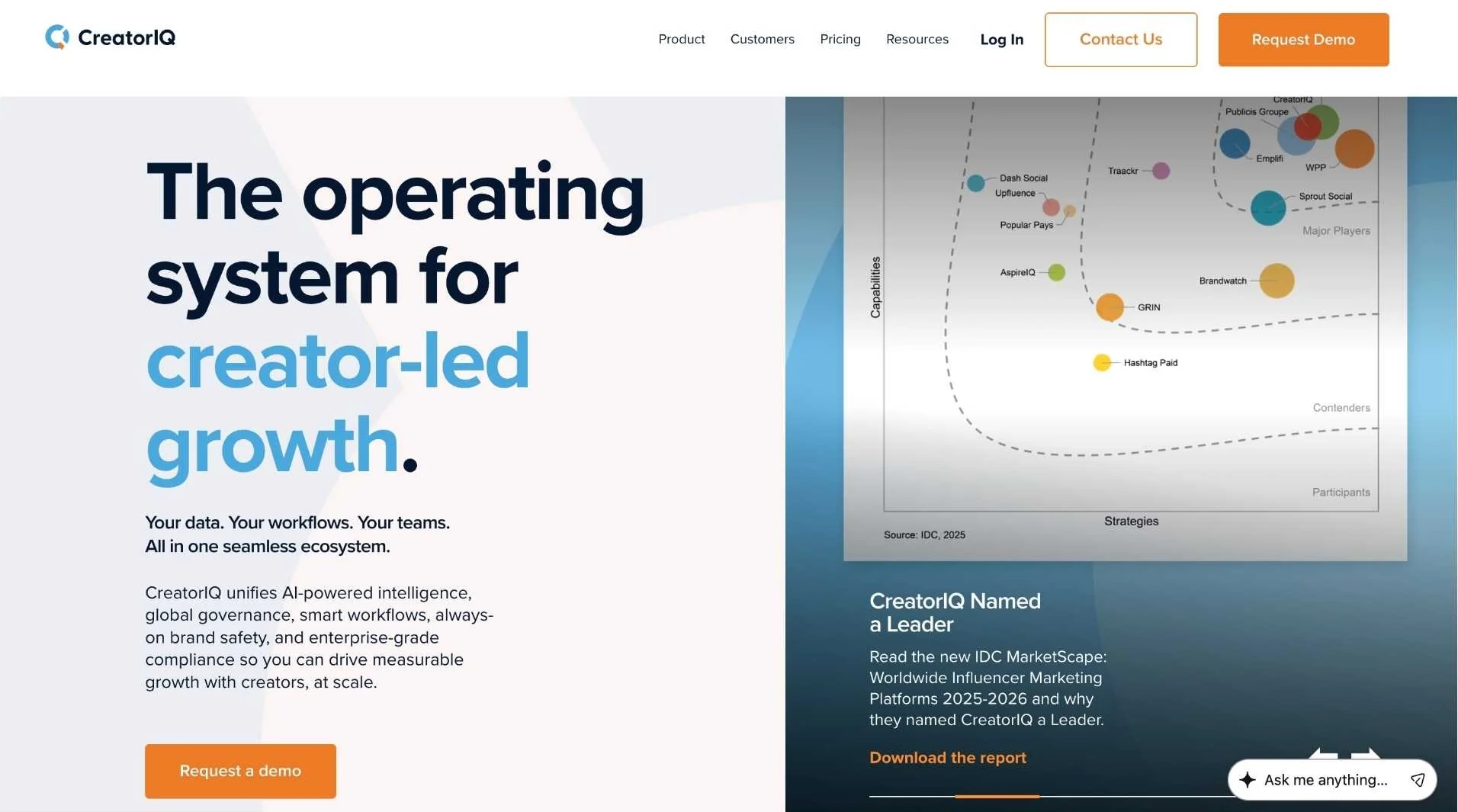
CreatorIQ is an enterprise influencer marketing platform built for large brands and agencies managing complex creator programs across discovery, activation, campaign management, measurement, payments, and reporting. It is known for deep social platform integrations, enterprise reporting, and global scalability.
Key Features
• Creator discovery: Search public creator profiles across Instagram, TikTok, YouTube, Facebook, Pinterest, Twitch, and X using filters for audience, content, location, engagement, brand mentions, and niche.
• AI and semantic search: Find creators using natural-language style queries and topic-based discovery.
• Private creator CRM: Store creator notes, tags, contact details, campaign history, questionnaires, and relationship data.
• Campaign management: Build campaign briefs, manage deliverables, configure approvals, duplicate campaign templates, and track creator progress.
• One-sheet approvals: Share creator shortlists with stakeholders through live links for approval without requiring platform access.
• UGC and content library: Collect campaign assets, organize content, download assets, and request usage rights.
• Reporting dashboards: Build live, customizable dashboards with creator-level and campaign-level data.
• Creator payments: Centralize creator payouts and tax documentation, with payment processing fees after annual thresholds.
Pricing
There are different plans:
• Basic Plan: Starts at $35,000/year. Includes 1,000 contact creators per month
• Standard Plan: Starts at $50,000/year. Includes 2,500 contact creators per month
• Professional Plan: Starts at $90,000/year. Includes 5,000 contact creators per month
• Enterprise Plan: Starts at $200,000/year. Includes 7,500 contact creators per month
Reviews
4.4/5.0 (Capterra)
Pros
• Enterprise-grade API data: CreatorIQ has direct integrations with major social platforms, supporting more reliable reporting and compliance.
• Highly customizable reporting: Live dashboards, executive-ready reporting, and shareable links make it strong for global stakeholder reporting.
• Strong approval and governance workflows: One-sheets, campaign briefs, creator approvals, content approvals, and payment workflows are built for large teams.
Cons
• Expensive for smaller teams: Annual pricing can be too high for brands still testing influencer marketing.
• Affiliate tracking can be manual: Conversion and affiliate workflows may require more manual reporting than ecommerce-first tools.
• Complex setup: Enterprise depth can create onboarding and workflow complexity.
Integrations
• Meta: Pull creator and campaign performance data from Instagram and Facebook through official data connections.
• TikTok: Track campaign and creator performance across TikTok campaigns.
• YouTube: Access creator and content performance data for YouTube campaigns.
• Shopify: Support gifting, shipping details, and product information for creator campaigns.
• Meta Ads: Track and report performance when creator content is reused in paid social workflows.
BrandChamp vs CreatorIQ
BrandChamp is best for brands building ambassador, referral, and loyalty-style advocacy programs. CreatorIQ is designed for enterprise influencer teams that need global creator discovery, campaign governance, stakeholder approvals, payments, and advanced reporting.
BrandChamp is easier to position for customer advocacy and gamified ambassador engagement. CreatorIQ is more appropriate for large brands managing multi-market influencer programs, multiple teams, strict approval workflows, and executive reporting needs.
Upfluence

Upfluence is an influencer and affiliate marketing platform built for ecommerce brands that want to discover creators, automate outreach, manage campaigns, track sales, and run affiliate programs. It is especially known for Shopify and Amazon integrations that connect influencer activity to revenue.
Key Features
• Influencer discovery: Search a large creator database using filters for niche, location, audience, engagement, follower size, and platform.
• AI-assisted outreach: Use AI tools and templates to create outreach messages, run bulk outreach, and manage follow-ups.
• Influencer CRM: Manage creator relationships, campaign stages, communication history, and internal notes.
• Multi-platform coverage: Supports Instagram, TikTok, YouTube, X, Twitch, Pinterest, and blogs.
• Shopify integration: Identify influential customers, manage gifting, generate discount codes, track sales, and connect creator campaigns to ecommerce revenue.
• Amazon integration: Track affiliate links, campaign performance, and sales attribution for Amazon-focused brands.
• Affiliate tracking: Create links and codes, measure conversions, and attribute sales to individual creators.
• Creator payouts: Manage bulk payments and compensation workflows.
• Social listening: Monitor creators, competitors, keywords, and content trends.
Pricing
• Pricing model: Upfluence uses custom pricing rather than a public fixed plan table.
• All plans are custom made. There’s a minimum full year of service you have to commit to with monthly payments. On average plans start around $2,000/month ($24,000 yearly)
Reviews
4.3/5.0 (Capterra)
Pros
• Strong Shopify and Amazon attribution: Upfluence is particularly useful for ecommerce teams that sell through Shopify, Amazon, or both.
• Customer-to-creator discovery: Brands can identify existing customers with social influence and turn them into affiliates or ambassadors.
• No commission-based software fees: Upfluence generally does not charge based on sales volume or number of influencers contacted.
Cons
• Annual commitment limits flexibility: Smaller teams may find the contract structure difficult if they want to test before committing.
• Learning curve for beginners: The platform is broad, so setup and campaign configuration can feel complex at first.
• Workflow rigidity: Some campaign setup fields and automation steps may be less flexible than teams expect.
Integrations
• Shopify: Identify influential customers, manage product gifting, create codes, and track influencer-driven sales.
• Amazon: Attribute Amazon sales and affiliate performance to creator campaigns.
• WooCommerce: Connect ecommerce sales and product data to influencer and affiliate campaigns.
• Klaviyo: Support customer and creator communication workflows using ecommerce marketing data.
• PayPal: Manage creator payments and compensation workflows.
BrandChamp vs Upfluence
BrandChamp is built around ambassador engagement, missions, rewards, referrals, and community-led advocacy. Upfluence is more of a full influencer and affiliate marketing engine, with stronger creator discovery, outreach, ecommerce attribution, and marketplace-style campaign management.
BrandChamp fits brands that want to activate owned fans and reward participation. Upfluence fits brands that want to discover new influencers, automate outreach, connect Shopify or Amazon sales, and measure ROI from influencer and affiliate campaigns.
Skeepers
Skeepers is a UGC and influencer marketing platform that helps brands generate authentic content, reviews, and social posts through a community of nano and micro-influencers. Its influencer marketing solution focuses on product gifting, smart creator matching, real-time analytics, and royalty-free UGC for TikTok, Instagram, and YouTube.
Key Features
• Nano and micro-influencer community: Access a vetted creator community for product gifting, reviews, and social content.
• AI-powered matching: Match products and campaigns with creators who fit the brand’s goals, audience, and category.
• Product gifting campaigns: Automate gifting workflows so creators can receive products in exchange for authentic reviews and content.
• UGC generation: Collect social posts, product reviews, photos, and videos that can be reused across social and ecommerce channels.
• Royalty-free content: Use creator-generated content without additional licensing complexity, depending on campaign terms.
• Real-time analytics: Track creator participation, campaign performance, social content, and review outcomes.
• Shoppable UGC: Repurpose influencer posts and UGC into ecommerce experiences to support product discovery and conversion.
• Reviews and product-page content: Use influencer posts and gifted reviews to strengthen product pages and buyer confidence.
Pricing
• Skeepers does not publicly list a detailed pricing table for Influencer Marketing on its main site.
• Capterra lists a starting price of €1,250/month and says no free trial is available.
Reviews
4.3/5.0 (Capterra)
Pros
• UGC-first influencer model: Skeepers is especially strong for brands that want product reviews, social proof, and reusable content rather than large-scale outbound influencer prospecting.
• Large creator community for gifting: Its nano and micro-influencer community helps brands generate authentic content at scale.
• Connected UGC suite: Skeepers combines influencer content, verified reviews, shoppable content, and product-page UGC in a broader conversion-focused ecosystem.
Cons
• Less focused on outbound discovery: It is not as strong for brands that want to search the open web for any creator profile.
• Pricing transparency is limited: Public pricing does not clearly break down plans, limits, or contract terms.
• Creator availability can vary: Product-based gifting campaigns may depend on creator interest, product stock, and campaign-market fit.
Integrations
• Shopify: Connect your store to manage product gifting, orders, discounts, fulfillment, and UGC workflows.
• Magento 2: Connect ecommerce data and UGC/review workflows for Magento-based stores.
• Salesforce: Use customer and ecommerce data to support review, UGC, and customer experience workflows.
• Klaviyo: Use review and UGC data in email and SMS journeys to improve customer engagement.
• Zapier: Connect Skeepers workflows with other tools for automation and data movement.
BrandChamp vs Skeepers
BrandChamp is stronger for structured ambassador programs, referral rewards, gamified missions, and long-term community management. Skeepers is stronger for product gifting, nano/micro-influencer content generation, verified reviews, and shoppable UGC.
BrandChamp is better when the brand wants to continuously engage its own ambassador base. Skeepers is better when the goal is to generate authentic content, reviews, and product-page social proof from a creator community.


Klear

Klear is an influencer marketing platform developed by Meltwater, designed to help brands discover influencers, manage campaigns, and measure performance using data-driven insights. It combines influencer discovery, CRM, outreach, and analytics with Meltwater’s broader social listening and media intelligence capabilities, making it a strong option for brands focused on performance and brand monitoring.
Key Features
• Influencer discovery: Access a database of 30M+ influencers with advanced filters for audience demographics, engagement, location, brand affinity, and past collaborations.
• AI-powered “True Reach”: Estimates actual audience reach rather than follower count to avoid inflated metrics.
• Detailed influencer profiles: Includes audience demographics, engagement rates, estimated pricing, content themes, and brand alignment.
• Campaign management: Create campaigns, assign deliverables, manage communication, and track performance in one dashboard.
• Built-in communication tools: Chat directly with influencers inside the platform, reducing reliance on external email tools.
• Performance analytics: Measure reach, engagement, media value, sentiment, conversions, and ROI across campaigns.
• Social listening integration: Track brand mentions, competitors, and trends across social media using Meltwater’s broader ecosystem.
• Reporting and exports: Generate branded, visual reports for stakeholders with campaign insights.
Pricing
Klear does not publish self-serve pricing on Meltwater’s public site. Pricing is handled through custom quotes with no free trial.
Based on research, the pricing start from $2,300/month
Reviews
4.3 / 5.0 (G2)
Pros
• True Reach metric: One of the more advanced audience estimation tools, helping brands avoid misleading influencer metrics.
• Deep integration with social listening: Combines influencer marketing with broader brand monitoring and media intelligence.
• End-to-end campaign + communication: Built-in chat and campaign tools reduce reliance on external communication platforms.
Cons
• High cost and enterprise focus: Pricing makes it inaccessible for small and mid-sized brands.
• Interface performance issues: Some users report lag and slower performance when handling large datasets.
• Limited reporting flexibility: Comparing multiple competitors or exporting advanced insights may require extra work.
Integrations
• Meltwater Suite: Combine influencer campaigns with media monitoring, PR tracking, and social listening insights.
• Shopify: Track product gifting, influencer-driven sales, and ecommerce attribution.
• Google Analytics: Measure traffic and conversions from influencer campaigns.
• Slack: Share campaign updates and reports internally with teams.
• Looker Studio: Export influencer data for custom dashboards and reporting.
BrandChamp vs Klear
BrandChamp focuses on ambassador programs, gamification, and community engagement, while Klear is a data-driven influencer platform focused on discovery, analytics, and campaign performance.
Klear is better suited for enterprise teams needing advanced analytics and social listening, while BrandChamp is better for brands building long-term ambassador relationships and referral-based programs.
Traackr
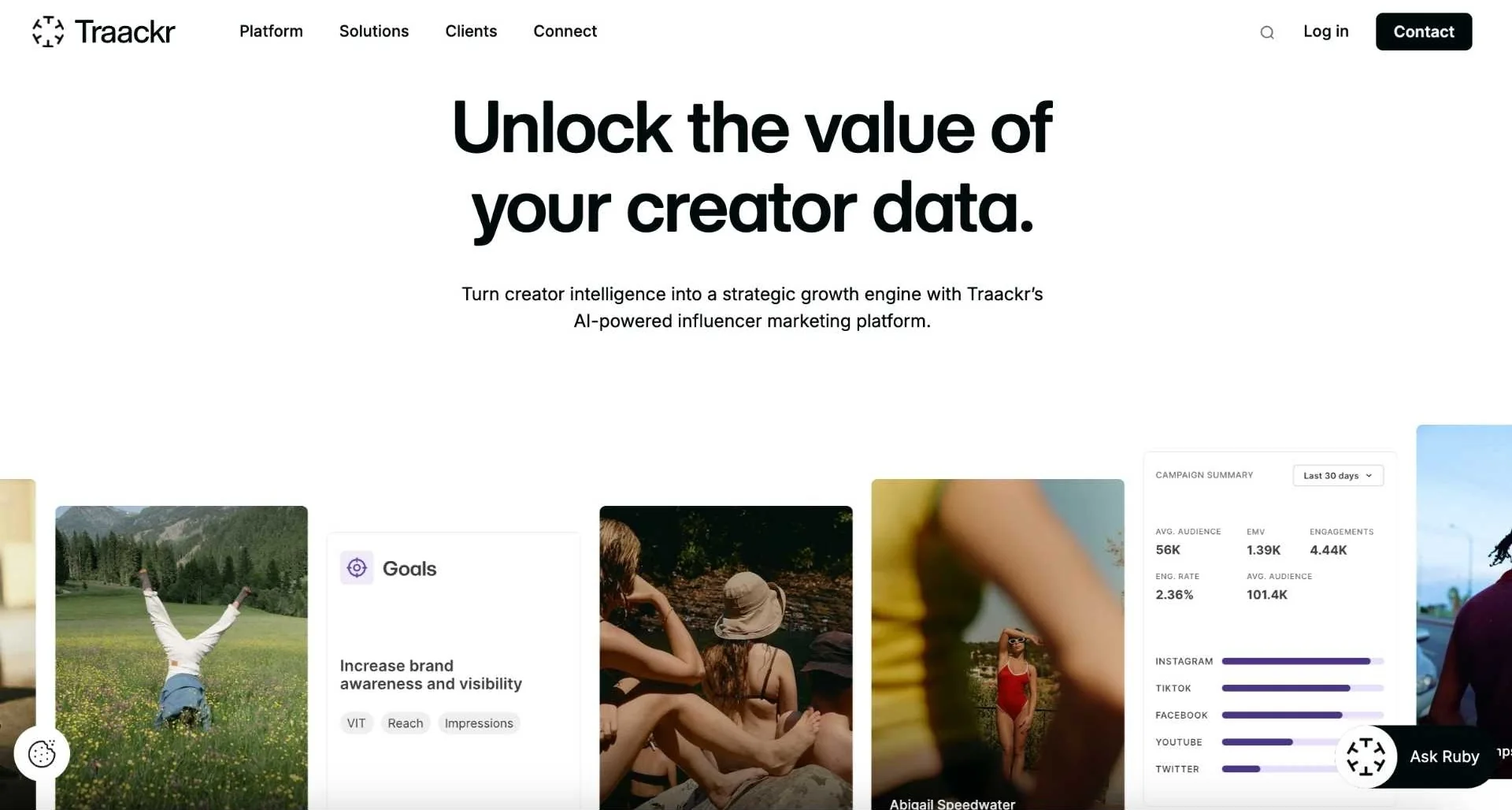
Traackr is an enterprise influencer marketing platform built for brands focused on performance measurement, benchmarking, and ROI optimization. It is widely used by global teams that need advanced analytics and budget allocation tools across multiple markets.
Key Features
• Influencer discovery: Access over 6M influencers with filters for demographics, engagement, past brand collaborations, and performance.
• Outreach tools: Personalized messaging, templates, and automated follow-ups for scalable creator communication.
• Influencer CRM: Track relationships, notes, tags, and campaign history across teams.
• Performance analytics: Track CPC, CPE, CPV, ROI, engagement, and reach in granular reports.
• Brand Vitality Score (BVS): Proprietary metric combining brand visibility, trust, and influence.
• Budget optimization tools: Allocate spend based on historical performance and expected ROI.
• Content and UGC tracking: Collect and repurpose influencer-generated content across campaigns.
• Affiliate and payments: Manage commissions and payouts within the platform.
Pricing
• Official pricing: custom / request a quote.
• Public benchmark: pricing starts around $32,500/year for a standard plan, with additional modules available on request.
• Contract type: generally annual enterprise contracts.
Reviews
4.3 / 5.0 (G2)
Pros
• Brand Vitality Score (BVS): Unique benchmarking metric for measuring brand impact across influencer campaigns.
• Advanced cost-performance analytics: Tracks cost-per metrics (CPC, CPE, CPV) to optimize budget allocation.
• Global benchmarking capabilities: Compare performance against industry and competitors.
Cons
• High entry price: Not suitable for small teams or short-term campaigns.
• Occasional performance issues: Reports of lag or delayed data syncing.
• Learning curve: Advanced analytics tools may require onboarding.
Integrations
• Shopify: Track influencer-driven sales and manage affiliate campaigns.
• Google Analytics: Connect campaign data with website performance.
• Salesforce: Sync influencer data with CRM and sales workflows.
• Slack: Share campaign updates internally.
• Tableau: Export data for advanced analytics dashboards.
BrandChamp vs Traackr
BrandChamp is focused on engagement and ambassador-driven programs, while Traackr is built for performance-driven influencer marketing with deep analytics and benchmarking.
Traackr is better for enterprises optimizing ROI and budgets, while BrandChamp is better for brands prioritizing community building and long-term ambassador engagement.
IMAI (InfluencerMarketing.AI)
InfluencerMarketing.AI (IMAI) is a full-suite influencer marketing platform powered by AI, designed to help brands discover influencers, automate outreach, manage campaigns, and track ROI. It emphasizes data-driven decision-making and fraud detection to improve campaign performance.
Key Features
• AI-powered discovery: Search millions of influencers using advanced filters, keywords, and AI recommendations.
• Fraud detection: Analyze fake followers, engagement authenticity, and audience quality.
• Campaign management: Plan campaigns, assign tasks, track deliverables, and manage creators.
• Automated outreach: Send bulk emails, track responses, and manage communication workflows.
• Social listening: Monitor brand mentions, competitor campaigns, and trending topics.
• Analytics and reporting: Measure engagement, reach, ROI, and campaign performance.
• Content tracking: Monitor influencer posts, hashtags, and mentions automatically.
• API access: Integrate influencer data into internal systems.
Pricing
IMAI currently shows four plan tiers on its official pricing page, with both annual and monthly billing options.
• Starter: $499/month when billed annually ($5,988/year) or $599/month billed monthly
• Growth: $999/month when billed annually ($11,988/year) or $1,199/month billed monthly
• Teams: $2,999/month when billed annually ($35,988/year) or $3,599/month billed monthly
• Enterprise: Custom pricing
Reviews
4.5 / 5.0 (G2)
Pros
• Strong AI-driven discovery and fraud detection: Helps brands avoid fake influencers and improve targeting.
• Comprehensive analytics suite: Covers performance, audience quality, and campaign ROI in detail.
• Flexible pricing tiers: More accessible than enterprise-only platforms.
Cons
• UI complexity: Some users report that the interface can feel overwhelming.
• Limited CRM depth: Not as strong as dedicated influencer CRM platforms.
• Requires data interpretation: Advanced analytics may need expertise to fully utilize.
Integrations
• Shopify: Track ecommerce sales and influencer-driven revenue.
• Google Analytics: Measure traffic and conversions from campaigns.
• Instagram API: Access creator performance data.
• YouTube API: Track video performance and engagement.
• Zapier: Automate workflows across marketing tools.
BrandChamp vs IMAI
BrandChamp is designed for ambassador engagement and referral-driven programs, while IMAI focuses on AI-powered discovery, analytics, and campaign optimization.
IMAI is better for brands needing data-heavy influencer analysis, while BrandChamp is better for managing and motivating an existing community of advocates.
Heepsy

Heepsy is an influencer marketing platform focused on discovery, outreach, and campaign tracking, particularly for ecommerce brands and agencies. It is known for its large influencer database and ease of use for finding niche creators.
Key Features
• Influencer discovery: Access ~50M influencers with filters for niche, location, audience demographics, engagement, and authenticity.
• Fake follower detection: Estimate audience authenticity and identify low-quality influencers.
• Detailed profiles: View engagement rates, audience breakdown, past collaborations, and performance metrics.
• CRM pipeline: Manage influencer campaigns using a Kanban-style workflow.
• Bulk outreach: Send up to thousands of emails with templates and follow-ups.
• Campaign tracking: Monitor engagement, content, and performance across campaigns.
• Shopify integration (advanced plan): Track sales, conversions, and affiliate performance.
Pricing
• Free — limited free access is available.
• Starter — recent official Heepsy blog references place Starter at $89/month.
• Plus — recent official Heepsy blog references place Plus at $249/month.
• Advanced — recent official Heepsy blog references place Advanced at $369/month.
• Heepsy also says users can choose monthly or annual billing, with annual subscriptions discounted versus monthly rates.
Reviews
4.5 / 5.0 (G2)
Pros
• Massive influencer database: One of the largest searchable influencer pools available.
• Strong filtering and niche targeting: Helps brands find highly specific creators quickly.
• User-friendly interface: Simple and easy to navigate compared to enterprise tools.
Cons
• Limited analytics on lower plans: Sales tracking requires higher-tier plans.
• No AI outreach generation: Email automation is less advanced than some competitors.
• Fake follower detection is estimated: Not fully precise.
Integrations
• Shopify: Track sales and affiliate campaigns.
• Google Sheets: Export influencer data for external management.
• Zapier: Automate workflows and integrations.
• Email platforms: Send outreach campaigns.
• Stripe/PayPal: Manage influencer payments externally.
BrandChamp vs Heepsy
BrandChamp focuses on ambassador engagement and referral programs, while Heepsy focuses on influencer discovery and outreach.
Heepsy is better for finding new creators, while BrandChamp is better for managing and engaging an existing ambassador community.
Social Cat
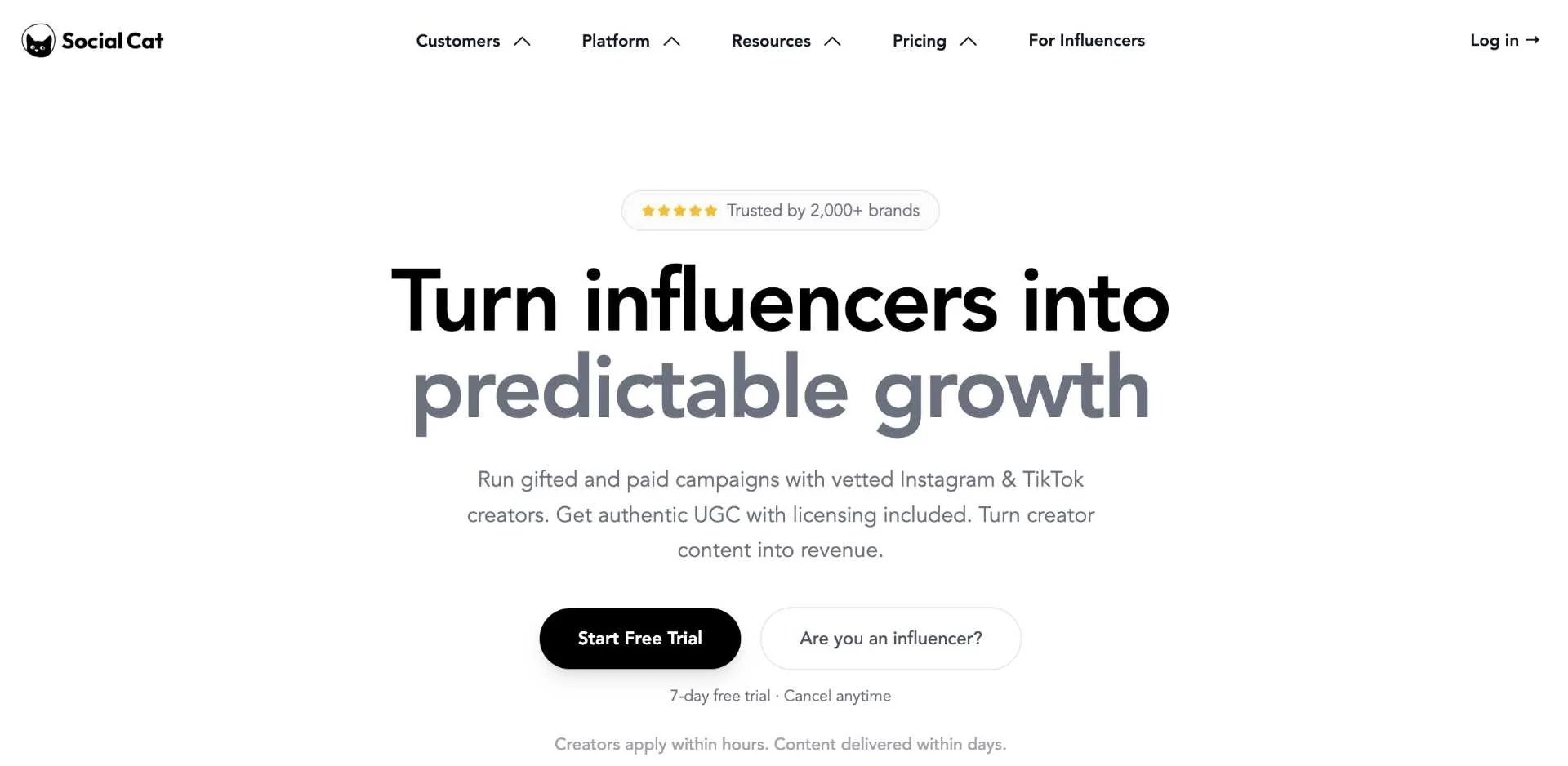
Social Cat is an influencer marketing platform designed for small and medium-sized brands, focusing on simplicity, product seeding, and creator collaboration. It emphasizes ease of use and affordability for brands starting with influencer marketing.
Key Features
• Campaign builder: Create campaigns where influencers can apply directly.
• Application management: Review influencer applications with detailed profiles and performance metrics.
• Product seeding workflows: Send products and track collaborations within the platform.
• Influencer discovery: Filter creators by location, engagement, gender, and audience size.
• In-app messaging: Communicate and negotiate with influencers directly.
• Basic CRM: Manage collaborations, contracts, and communication threads.
• Content uploads: Collect influencer-generated content for reuse.
• Content usage rights: Included across all plans.
Pricing
Social Cat offers flexible monthly pricing with no long-term contracts, making it accessible for smaller brands and teams.
• Essentials Plan – $99/month
• Performance Plan – $199/month
• Pro Plan – $299/month
Reviews
4.3 / 5.0 (Trustpilot)
Pros
• Application-based influencer sourcing: Creators apply to campaigns, reducing outbound effort.
• Affordable pricing: Accessible for small brands and startups.
• Built-in content usage rights: Simplifies legal use of influencer content.
Cons
• Limited analytics: No deep reporting on ROI or conversions.
• Basic CRM functionality: Not suitable for large-scale campaigns.
• No AI or advanced automation: More manual compared to advanced platforms.
Integrations
• Shopify: Manage product gifting and track collaborations.
• Stripe: Handle payments and subscriptions.
• Email tools: Communicate with creators.
• Slack: Coordinate campaigns internally.
• Zapier: Automate workflows with other tools.
BrandChamp vs Social Cat
BrandChamp focuses on structured ambassador programs with rewards and gamification, while Social Cat focuses on simple influencer campaigns and product seeding.
Social Cat is better for small brands launching influencer campaigns, while BrandChamp is better for building long-term ambassador communities with engagement and incentives.
Final Thoughts on BrandChamp Alternatives
BrandChamp stands out for its focus on ambassador engagement, gamification, and referral-driven programs, but it lacks the influencer discovery, influencer outreach automation, and advanced analytics offered by many alternatives. Platforms like Aspire, Upfluence, and Influencer Hero provide more comprehensive end-to-end influencer marketing workflows, while tools like Traackr, Klear, and IMAI emphasize data, benchmarking, and performance optimization. Meanwhile, solutions like Heepsy and Social Cat cater to smaller teams with simpler discovery and campaign needs. Overall, the right choice depends on whether a brand prioritizes community-driven advocacy or scalable influencer acquisition, campaign execution, and measurable ROI.

.png)


.jpg)