


10 Best Bazaarvoice Alternatives for Influencer Marketing
Bazaarvoice does not publish a price, but the buying data is unusually clear. Procurement platform Vendr puts the median annual contract at $36,002, with individual deals running from $12,300 to $98,843. Mid-market deployments are commonly quoted at $100,000 to $200,000, and implementation adds $10,000 to $50,000 on top.
That money buys reviews infrastructure, and it is genuinely the best in the category. More than 13,000 brands and retailers, over a billion reviews and photos, and a syndication network that pushes your reviews onto Target and Walmart product pages is not something a smaller vendor replicates.
Creator marketing is the smaller half of the product, though. If you came here because you need creators briefed, seeded, tracked and paid, you are looking at enterprise reviews pricing for a module rather than a platform.
Ten alternatives follow in this order: Influencer Hero, CreatorIQ, Upfluence, Aspire, Afluencer, SARAL, IMAI, Brandbassador, Lefty and Insense.
Key Criteria for Evaluating Influencer Marketing Platforms
Core Features
Evaluation of essential influencer marketing capabilities, including influencer discovery, outreach, CRM, campaign management, reporting, and content workflows.
Pricing & Flexibility
Comparison of pricing models, subscription plans, and contract terms to match different budgets and growth stages.
Customer Reviews & Satisfaction
Analysis of user feedback from trusted review platforms, focusing on usability, reliability, customer support, and overall performance.
Pros & Cons
Review of each platform’s strengths and limitations to highlight where it performs well and where it may fall short based on different use cases.
Integrations
Review of the most important integrations (e.g., Shopify and other tech tools), highlighting what each integration enables in one sentence.
Bazaarvoice Overview
Bazaarvoice is a user-generated content platform built around ratings and reviews. It collects reviews and questions on your own product pages, moderates them, then syndicates them across a retail network so the same review appears wherever your product is sold. Social commerce, visual UGC galleries, product sampling, creator marketing and in-store activations sit around that core.
The scale is the argument. The company reports more than 13,000 brands and retailers, over a billion reviews, photos and videos, 18 billion shopper touchpoints and a creator network above 21 million. For a brand selling through Target, Walmart and a dozen other accounts, that syndication reach genuinely has no close equivalent, and it explains why the reviews product rather than the creator relationship management layer is what buyers are really paying for.
Key Features
- Ratings and reviews: Collection, moderation and display of reviews and questions on your product pages.
- Retail syndication: The same reviews distributed across a network of retailer sites.
- Visual and social UGC: Shoppable galleries built from customer photos and video.
- Creator marketing: Campaigns run against a stated network of more than 21 million creators.
- Product sampling: Physical sampling programs attached to review collection.
Pricing
Not published. Procurement data puts the median contract at $36,002 a year, ranging from $12,300 to $98,843, with mid-market deployments commonly at $100,000 to $200,000 and large enterprise deals passing $250,000. Implementation adds $10,000 to $50,000 and premium support another 10% to 20%. Three-year terms cut 15% to 25% off annual pricing. There is no free trial.
Reviews
4.2/5.0 (G2, 809 reviews), 4.3/5.0 (Capterra, 32 reviews) and 7.6/10 (TrustRadius, 79 reviews). Syndication reach and implementation speed draw the praise; cost, contract rigidity, a dated interface and inconsistent support draw the criticism.
Integrations
- Retailer network: Reviews syndicated onto major retailer product pages including Target and Walmart.
- Shopify: A review syndication app for merchants on Shopify.
- Salesforce Commerce: Reviews and Q&A rendered inside enterprise storefronts.
- Social platforms: Visual UGC pulled from Instagram and TikTok into galleries.
- API access: Review and content data pushed into your own systems.
Pros
- Syndication nobody matches: One review appearing across every retailer that stocks you.
- 809 G2 reviews: Among the deepest evidence bases in this entire category.
- One system for UGC: Reviews, Q&A, galleries, sampling and creators under one contract.
Common Drawbacks of Bazaarvoice
The price is a range, not a number
A median of $36,002 with deals from $12,300 to nearly $99,000 means your quote depends on SKU count and negotiation. Implementation and premium support are separate lines again.
Creator marketing is a module, not the product
The platform is organised around reviews. Creator campaigns exist, but nothing here works like a creator CRM with outreach sequences, gifting from your own store and per-creator commission.
Contracts are rigid
Reviewers repeatedly cite inflexible terms and difficult renewals, and the real discounts come from committing two or three years. That is a heavy structure for a first creator program.
Syndication and the interface draw complaints
Users report reviews failing to appear on retailer sites despite correct setup, and describe the back end as clunky and dated with a steep learning curve after the initial install.
Best Bazaarvoice Alternatives
| TOOL | REVIEWS | BEST FOR | TRIAL INFO | PRICING | ||
|---|---|---|---|---|---|---|
1 |

|
⭐ | Influencer CRM & automation | Book Demo | Pricing | Website |
2 |

|
⭐ | Enterprise influencer marketing | Book Demo | Pricing | Website |
3 |

|
⭐ | Influencer discovery | Book Demo | Pricing | Website |
4 |

|
⭐ | Influencer partnerships | Book Demo | Pricing | Website |
5 |

|
⭐ | Influencer marketplace campaigns | Book Demo | Pricing | Website |
6 |

|
⭐ | Influencer outreach | Book Demo | Pricing | Website |
7 |

|
⭐ | AI influencer discovery & analytics | Book Demo | Pricing | Website |
8 |

|
⭐ | Ambassador Marketing | Book Demo | Pricing | Website |
9 |

|
⭐ | Influencer analytics & discovery | Book Demo | Pricing | Website |
10 |

|
⭐ | UGC creators & paid social ads | Book Demo | Pricing | Website |
Influencer Hero
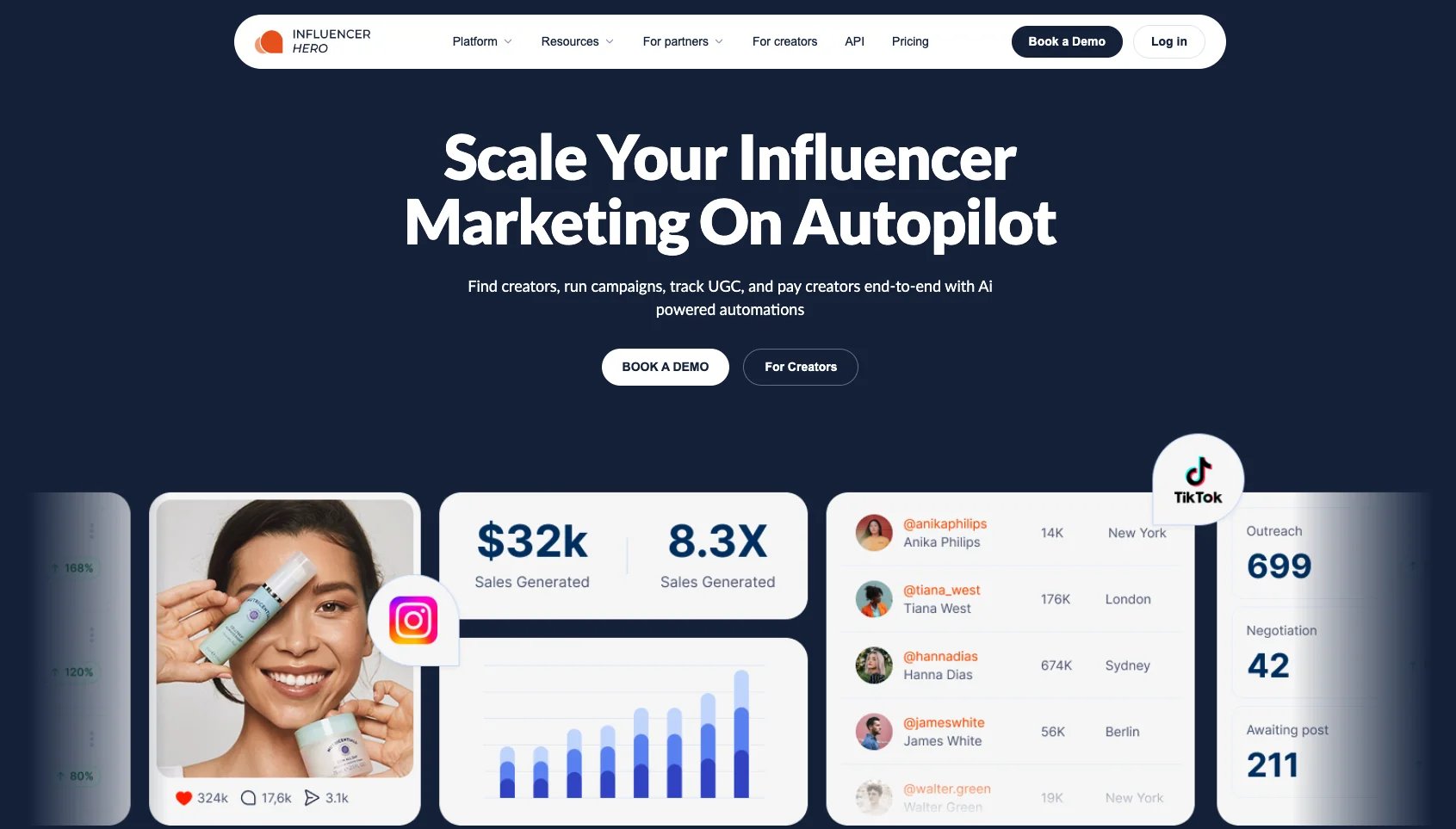
Influencer Hero is an all-in-one influencer marketing platform for D2C and eCommerce brands across 8 social platforms, with Instagram, TikTok and YouTube leading. Every stage of a creator program lives in one place: influencer discovery, outreach, gifting, content, affiliate attribution and payouts. Pricing is published and sized by outreach volume.
Key Features
- Creator discovery: Over 20 filters and AI search across eight networks.
- Fake-follower screening: Audience authenticity checked on any creator before budget commits.
- Brand-follower detection: Creators who already follow and buy from you, surfaced automatically.
- Multichannel outreach: Email, Instagram DM and WhatsApp sequences with replies in one inbox.
- Campaign boards: Stage-triggered automations and custom fields for per-creator logic.
- Gifting through your store: Product orders raised in Shopify or WooCommerce and tracked to delivery.
- Affiliate codes and payouts: Commission calculated in-platform and paid at 0.1% to 0.4% with invoices attached.
- Campaign reporting: ROI, sales by creator and product cost against return, compiled automatically.
Pricing
- Standard: $649 a month, up to 1,000 reachouts a month
- Pro: $1,049 a month, up to 5,000 reachouts a month
- Business: $2,490 a month, up to 10,000 reachouts a month
- Custom & Agency: custom pricing
Quarterly billing saves 20% and yearly saves 30%, with every figure published.
Reviews
5.0/5.0 (Capterra)
Pros
- Creators are the product: Not a module attached to a reviews platform.
- A price before the call: Three tiers published, with no implementation fee to negotiate.
- Monthly if you want it: No multi-year term required to reach a sensible rate.
Cons
- No free trial
- Expensive for smaller brands
- Steep learning curve
Integrations
- Shopify: Gifting orders raised and creator sales attributed automatically.
- WooCommerce: The same for WordPress, with scripts covering Magento and custom builds.
- Klaviyo: Creator and customer segments pushed into lifecycle email.
- DocuSign: Creator agreements signed and filed on the deal record.
- Zapier: Over 8,000 further apps for anything not handled natively.
Bazaarvoice vs Influencer Hero
These two platforms solve different parts of the same problem. Bazaarvoice focuses on collecting, managing, moderating, and displaying product reviews across the places where you sell. Creator campaigns are one part of what it offers. Influencer Hero, on the other hand, focuses entirely on managing creators. You can find creators across eight networks, contact them by email, Instagram DM, or WhatsApp, send products directly from Shopify or WooCommerce, manage campaigns through a campaign board, and track commission-based sales.
The cost difference depends on what you need. Influencer Hero Business costs $2,490 per month, or $29,880 per year, compared with Bazaarvoice's $36,002 median annual contract. Influencer Hero Standard costs $649 per month, or around $7,800 per year, which is below even the lowest recorded Bazaarvoice deal. Bazaarvoice can also involve additional costs for implementation, premium support, and longer-term contracts.
If your main goal is collecting and syndicating product reviews, Bazaarvoice is built for that. If your main goal is finding, managing, and paying creators, Influencer Hero is designed specifically for that.
CreatorIQ
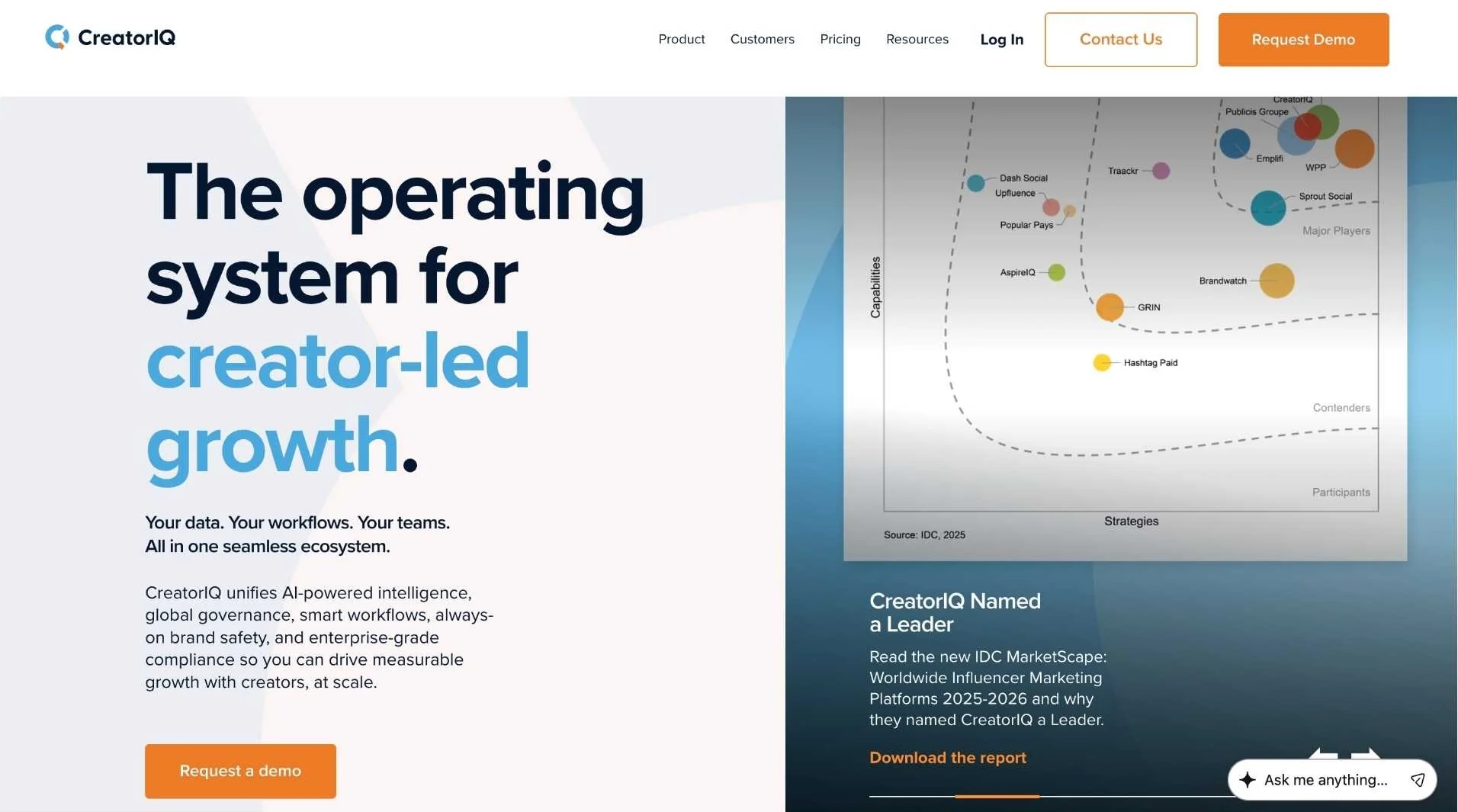
CreatorIQ is the enterprise creator platform, built for teams running programs across many brands, markets and agencies under one governance model. Vetting, briefs, approvals, payments and stakeholder reporting all live in the same system.
Key Features
- Creator vetting: Audience and performance data beyond what the native platforms expose.
- Multi-market workflow: Briefs, approvals and deliverables tracked across regions simultaneously.
- Payment processing: Creator payments handled without routing through finance.
- Client one-sheets: Stakeholder summaries generated straight from campaign data.
- Performance analytics: Per-creator reporting at the depth an enterprise review demands.
Pricing
Nothing published. CreatorIQ quotes per engagement on annual enterprise contracts, so there is no benchmark without a sales conversation.
Reviews
4.6/5.0 (G2, 581 reviews).
Pros
- Built for creators at enterprise scale: The governance Bazaarvoice applies to reviews, applied to creators.
- 4.6 across 581 reviews: A higher score on a comparable evidence base.
- Payments included: Creators paid inside the platform rather than through finance.
Cons
- Quote-only as well: No published figure and no procurement benchmark to lean on.
- Discovery gaps reported: Reviewers say relevant creators sometimes fail to surface.
- Busy interface: Users describe it as doing too much at once, with slow loading.
Integrations
- Shopify: Store connection tying creator activity to orders.
- Instagram and TikTok: Creator data and campaign performance pulled in directly.
- YouTube: Long-form results measured alongside short-form.
- Salesforce: Campaign data into enterprise reporting stacks.
- API access: Creator and campaign data available programmatically.
Bazaarvoice vs CreatorIQ
This is the straight swap for an enterprise buyer. Both sell annual contracts through a sales team, both carry huge review bases, and both are built for organisations with legal sign-off and multiple markets. The difference is what sits at the centre: reviews and syndication for one, a creator roster with briefs, approvals and payments for the other.
Score and price both tilt slightly. CreatorIQ holds 4.6 across 581 reviews against 4.2 across 809, and neither publishes a figure, though Bazaarvoice at least has procurement data in the open. If creators are the programme rather than an add-on, CreatorIQ is the more honest use of an enterprise budget.
Upfluence

Upfluence starts from your customer list. It matches buyers against creator profiles, activates the ones with real audiences, and carries them through outreach, affiliate tracking and payment, with modules bought separately rather than as one bundle.
Key Features
- Customer-creator matching: Your own buyers checked against creator profiles and activated.
- Modular purchase: Find, Scale or Autopilot bought separately rather than as a ladder.
- Discovery with demographics: Filters and audience data reviewers rate well for targeting.
- Affiliate commission tracking: Creator revenue attributed through the store connection.
- Workflow to payment: Discovery through to paying the creator inside one platform.
Pricing
Not published. Quoted per engagement based on modules, team size and program volume, on twelve-month annual plans including a dedicated account manager. A free trial follows a consultation call, and the company states it never takes a percentage of creator sales.
Reviews
4.6/5.0 (G2, 140 reviews).
Pros
- Buy only what you use: Modules purchased separately rather than one large bundle.
- Twelve months, not three years: A shorter commitment than the discounted Bazaarvoice term.
- A trial exists: Hands-on access after the first call, where Bazaarvoice offers none.
Cons
- Quote-only: No published figure to budget against.
- Needs a dedicated owner: Reviewers describe the interface as demanding.
- 140 reviews: A far smaller evidence base than Bazaarvoice’s.
Integrations
- Shopify: Customer data mined for creators, with affiliate revenue tracked back.
- WooCommerce: The same coverage for WordPress storefronts.
- Klaviyo: Creator segments moved into email flows.
- PayPal: Creator payments processed inside the workflow.
- API access: Campaign and creator data into your own reporting.
Bazaarvoice vs Upfluence
Both mine what your customers already do, from different angles. Bazaarvoice collects what they wrote and pushes it to every retailer that sells you. Upfluence looks at who they are, spots the ones with an audience, and turns them into paid creators with affiliate codes attached.
Commercially, Upfluence is the lighter version of the same shape. It also quotes privately and wants a year, but a twelve-month term with modules you select is easier to unwind than a three-year platform contract with implementation fees. Neither is a quick experiment; one is simply a smaller bet.
Aspire
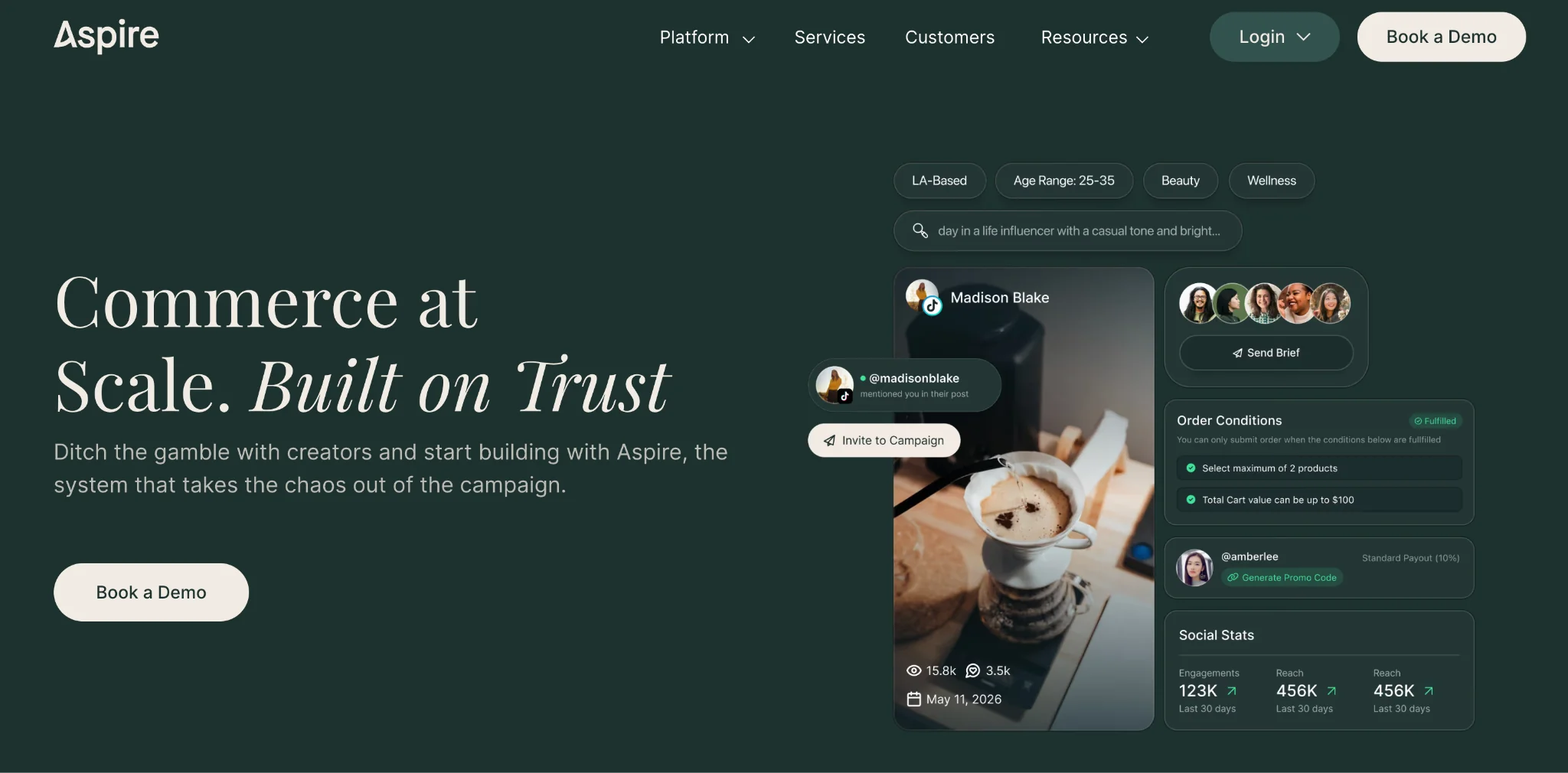
Aspire runs the whole brand-side program for companies already at scale. Lookalike discovery feeds seeding at volume, briefs and approvals move content through review, affiliate attribution ties it to orders, and a rights-managed library holds the finished assets for paid reuse.
Key Features
- Lookalike discovery: One creator who performed becomes a shortlist of similar profiles.
- Seeding workflows: Product send-outs run at volume with tracking attached.
- Briefs and approvals: Content requested, reviewed and signed off in the platform.
- Affiliate attribution: Codes and links tying creator activity to real orders.
- Rights-managed library: Approved assets held with usage terms for paid reuse.
Pricing
Not published. Third-party sources report an annual commitment starting around $2,000 a month, with other estimates near $2,499, and they disagree enough that only a quote settles it. There is no free trial.
Reviews
4.6/5.0 (G2, 146 reviews).
Pros
- Cheaper than the median: Around $24,000 a year reported, against $36,002.
- UGC with rights attached: Assets licensed for paid media rather than displayed in galleries.
- 4.6 across 146 reviews: A better score than Bazaarvoice on a smaller base.
Cons
- No trial and no rate card: A closed evaluation with no procurement data behind it.
- Annual commitment: A year signed up front.
- No review syndication: Nothing that pushes ratings to retailer product pages.
Integrations
- Shopify: Seeding orders raised and creator revenue attributed.
- WooCommerce: Equivalent coverage for WordPress stores.
- Klaviyo: Creator contacts into email programs.
- Slack: Campaign alerts into team channels.
- Zapier: Wider stack connections where no native option exists.
Bazaarvoice vs Aspire
Both hold a library of customer and creator content, and they hold it for different purposes. Bazaarvoice builds shoppable galleries and pushes reviews outward to retailers. Aspire builds a rights-cleared asset library you draw from for paid social, with each asset traceable to the campaign that produced it.
On money, Aspire is roughly two-thirds of the median Bazaarvoice contract at a reported $2,000-plus a month, with no implementation line. What it cannot do is put a review on a Walmart product page, which for a brand fighting for conversion at retail is the entire reason Bazaarvoice exists.
Afluencer
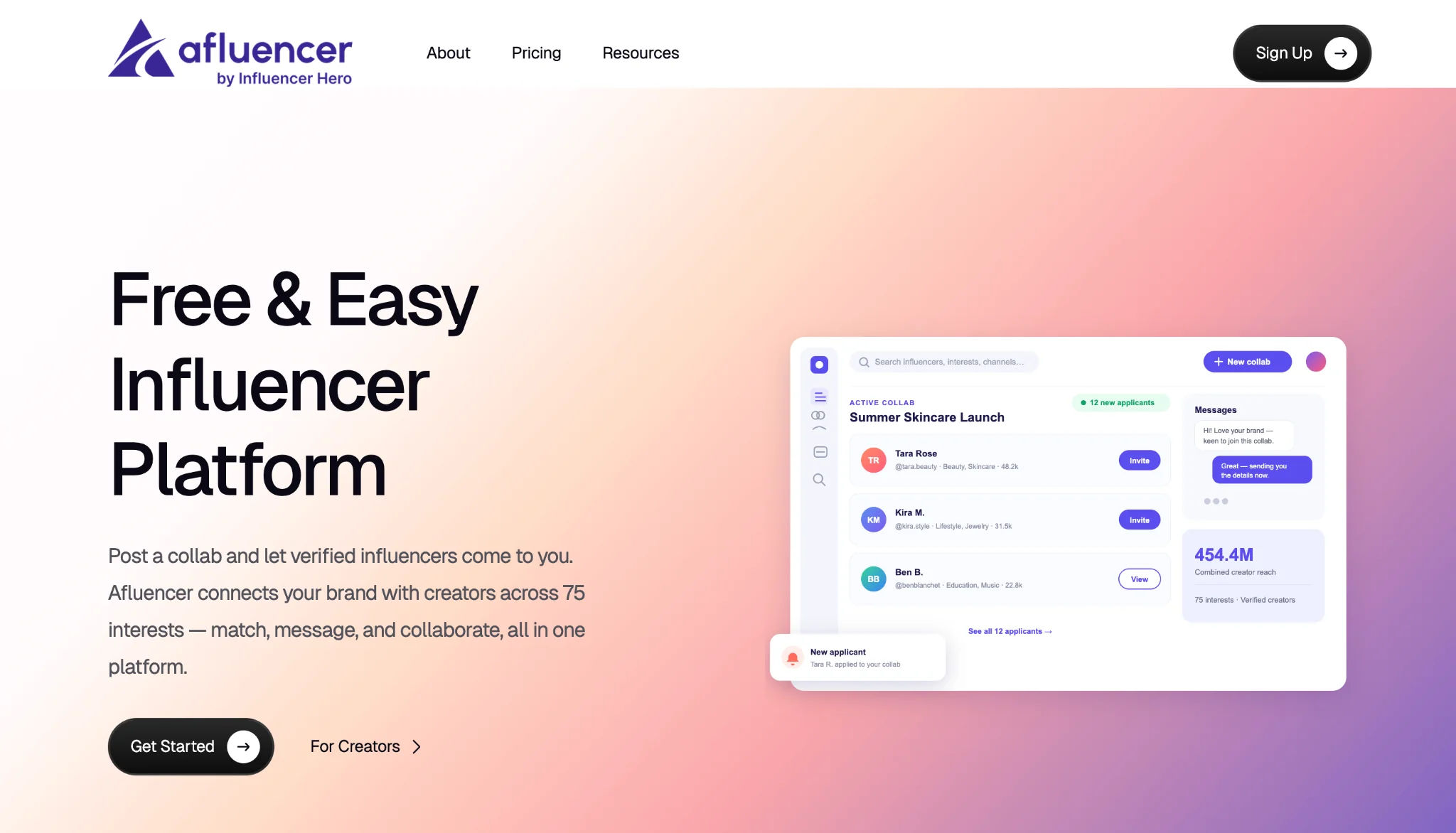
Afluencer works on inbound applications rather than outbound search. You publish a collaboration, verified creators apply, and AI ranks the queue against your brief. At $49 a month it is the smallest commitment on this page by several orders of magnitude.
Key Features
- Inbound applications: Creators respond to your brief instead of being sourced one by one.
- Verified members: Accounts registered and checked before anyone can apply.
- CreatorGPT ranking: AI sorts the applicant queue against your brief before review.
- Invite credits: Outbound approaches for the months when applications run thin.
- Store-linked codes: Discount codes and creator fees handled through the storefront connection.
Pricing
- VIP: $49 a month
- Concierge: $99 a month
No minimum term, with creator-side plans billed separately.
Reviews
4.6/5.0 (G2, 738 reviews) and 4.7/5.0 (Shopify App Store, 34 reviews). The G2 pool leans creator-side, so read it beside the Shopify score.
Pros
- $588 a year: Roughly 1.6% of the median Bazaarvoice contract, published openly.
- No implementation: Live the same day, with no professional services line.
- Simple booking of creators: Applications reviewed and collaborations agreed in the platform.
Cons
- Inbound quality varies: A weak listing brings weak applicants.
- No reviews product: Nothing for ratings collection, moderation or syndication.
- North America weighted: Creator supply thins outside its main markets.
Integrations
- Shopify: Codes, referrals and creator orders tracked from the store.
- BigCommerce: The same connection for BigCommerce merchants.
- Klaviyo: Creator contacts pushed into your email lists.
- DocuSign: Collaboration terms signed inside the flow.
- Slack: Application alerts sent to the team as they arrive.
Bazaarvoice vs Afluencer
The gap here is so wide it is really a question about your stage. Bazaarvoice is bought by brands with thousands of SKUs across dozens of retailers, where a syndication network changes conversion at scale. Afluencer is bought by brands who want ten creators posting this month and have not yet decided whether creator marketing works for them.
If you are the second brand and someone has quoted you a five-figure annual contract, that is a signal about fit rather than ambition. Spend $49 for a few months, learn what a collaboration actually returns, and revisit the enterprise conversation when the numbers justify it.


SARAL
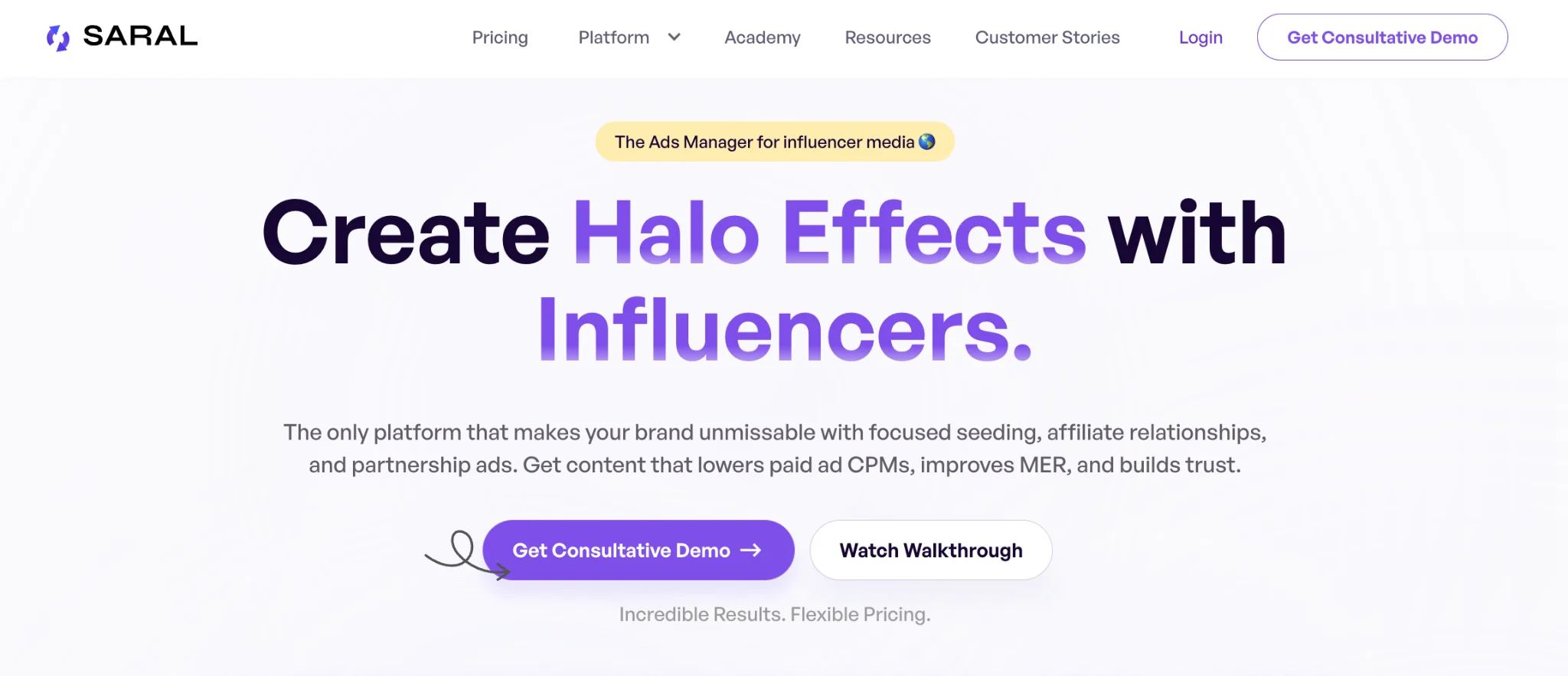
SARAL prices by relationships. Plans are sized on active partnerships, outreach runs as drip sequences from your own Gmail, Shopify connects in one click, and a former influencer strategist is included as a success manager.
Key Features
- Partnership-based plans: Sized by active partnerships and creators saved per month.
- Email drip sequences: Automated outreach run from your own Gmail rather than a vendor’s system.
- One-click Shopify: Store connection established without development work.
- Unlimited post tracking: Creator content monitored without a cap from Business up.
- Dedicated success manager: Former influencer strategists included in the plan.
Pricing
- Starter: $12,000 a year or $3,600 a quarter, 100 active partnerships, 1 seat
- Business: $15,000 a year or $4,500 a quarter, 500 partnerships, 3 seats
- Professional: $25,000 a year or $7,500 a quarter, 1,000 partnerships, 10 seats
No contracts, cancellation at any time, and a free trial before you pay.
Reviews
4.8/5.0 (G2, 56 reviews).
Pros
- An annual figure in the open: $12,000 to $25,000 published, against a quoted range.
- No contract: Cancellable at any time, where the discounts elsewhere need three years.
- 4.8 across 56 reviews: The strongest satisfaction score on this page.
Cons
- Fifty-six reviews: A fraction of the evidence base Bazaarvoice carries.
- Bugs are reported: Gmail sync delays and glitches recur in reviews.
- No reviews or syndication: Nothing for ratings on retailer product pages.
Integrations
- Shopify: One-click connection for seeding, codes and creator revenue.
- Gmail: Sequences sent and tracked from your own mailbox.
- Klaviyo: Creator contacts moved into lifecycle email.
- Slack: Support and campaign alerts routed to the team.
- Zapier: Wider stack connections without engineering time.
Bazaarvoice vs SARAL
SARAL Starter at $12,000 a year sits just below the lowest Bazaarvoice contract on record, and Professional at $25,000 lands under the $36,002 median. The difference is that you can read those numbers on a website rather than negotiating toward them, and cancel without arguing about a renewal clause.
What that budget buys is narrower and deeper. One hundred to a thousand active creator partnerships, contacted from your own mailbox, tracked against Shopify, with a strategist attached. No reviews, no Q&A, no galleries and nothing appearing on a retailer’s product page.
IMAI

IMAI is a discovery and analytics platform serving agencies as much as brands, with fraud screening in search, client account separation, white-label reporting on higher plans and social listening above the entry tiers.
Key Features
- Hundreds of millions of profiles: Search across a very large creator index.
- Fraud screening in search: Fake-follower detection surfaced with the results.
- Client account separation: Multiple programs run side by side without collision.
- White-label reporting: Agency-branded outputs on the higher plans.
- Social listening: Brand and category monitoring above the entry tiers.
Pricing
Published tiers reported from about $175 a month, through roughly $349 and $499, to $1,200 and up for enterprise and white-label, with report volumes varying by tier. A free trial is offered.
Reviews
4.1/5.0 (GetApp, low review volume at 16 reviews). Sourcing speed and fraud detection draw praise; support and account access draw the criticism.
Pros
- Around $2,100 a year: The entry tier costs less than most Bazaarvoice implementation fees.
- A real free trial: Hands-on evaluation without a procurement cycle.
- Among the useful AI influencer marketing tools: Fraud scoring surfaced inside search results.
Cons
- Support is the complaint: Slow responses and, in one report, lost account access.
- Sixteen reviews: Almost no evidence next to 809.
- Discovery only: No reviews, no syndication and no content library.
Integrations
- Shopify: Named store connection for creator-driven orders.
- WooCommerce: Coverage for WordPress storefronts.
- Instagram and TikTok: Creator data and campaign performance.
- YouTube: Channel-level analytics alongside short-form.
- Exports: Creator and campaign data out for client reporting.
Bazaarvoice vs IMAI
Nothing about these two is comparable except that both claim enormous numbers. Bazaarvoice counts a billion reviews and 13,000 brands. IMAI counts hundreds of millions of creator profiles. One is a distribution network, the other is a search index.
IMAI is on this list for buyers whose real requirement was always creator discovery. At around $175 a month with a free trial and published tiers, it answers that requirement for less than the annual support uplift on an enterprise reviews contract. It answers nothing else.
Brandbassador (Club)

Brandbassador converts existing customers into a managed ambassador community, kept active through gamified missions, points, leaderboards and commission, with rewards and output tracked per person.
Key Features
- Reward missions: Tasks published to the community and completed for points, product or commission.
- Gamified retention: Leaderboards and tiers keeping ambassadors posting between campaigns.
- Community recruitment: Customers converted into a managed roster at scale.
- Creator storefronts and codes: Ambassadors given their own links and discount codes to share.
- Programme analytics: Participation and output measured across the community.
Pricing
Not published, with third-party listings reporting no free trial. Quotes come through the vendor.
Reviews
4.7/5.0 (G2, 107 reviews). Ease of use and support are praised; ambassador search and filtering draw the criticism.
Pros
- Advocates who keep posting: Missions and rewards rather than a one-time review request.
- 4.7 across 107 reviews: A higher score than Bazaarvoice from brand-side users.
- Four store integrations: Commission tracked to orders in your own store.
Cons
- Quote-only and no trial: The same closed evaluation, without procurement data to guide it.
- Weak ambassador search: Finding the right people is the recurring complaint.
- Needs existing customers: No use for a brand starting from nothing.
Integrations
- Shopify: Discount codes and ambassador sales tracked from the store.
- WooCommerce: The same for WordPress storefronts.
- Adobe Commerce: Enterprise commerce coverage.
- BigCommerce: Additional storefront support.
- Instagram and TikTok: Ambassador content tracked against missions.
Bazaarvoice vs Brandbassador
Both turn customers into advocates and ask for very different things from them. Bazaarvoice asks for a review, moderates it and distributes it to every retailer that stocks you. Brandbassador asks for a post, a story or a referral, rewards it with points or commission, and asks again next month.
Neither publishes a price, though only Bazaarvoice has enough deal volume for procurement benchmarks to exist. The choice is between a review that sits on a product page indefinitely and an ambassador roster that keeps producing, which is less a comparison of features than of what your growth actually depends on.
Lefty
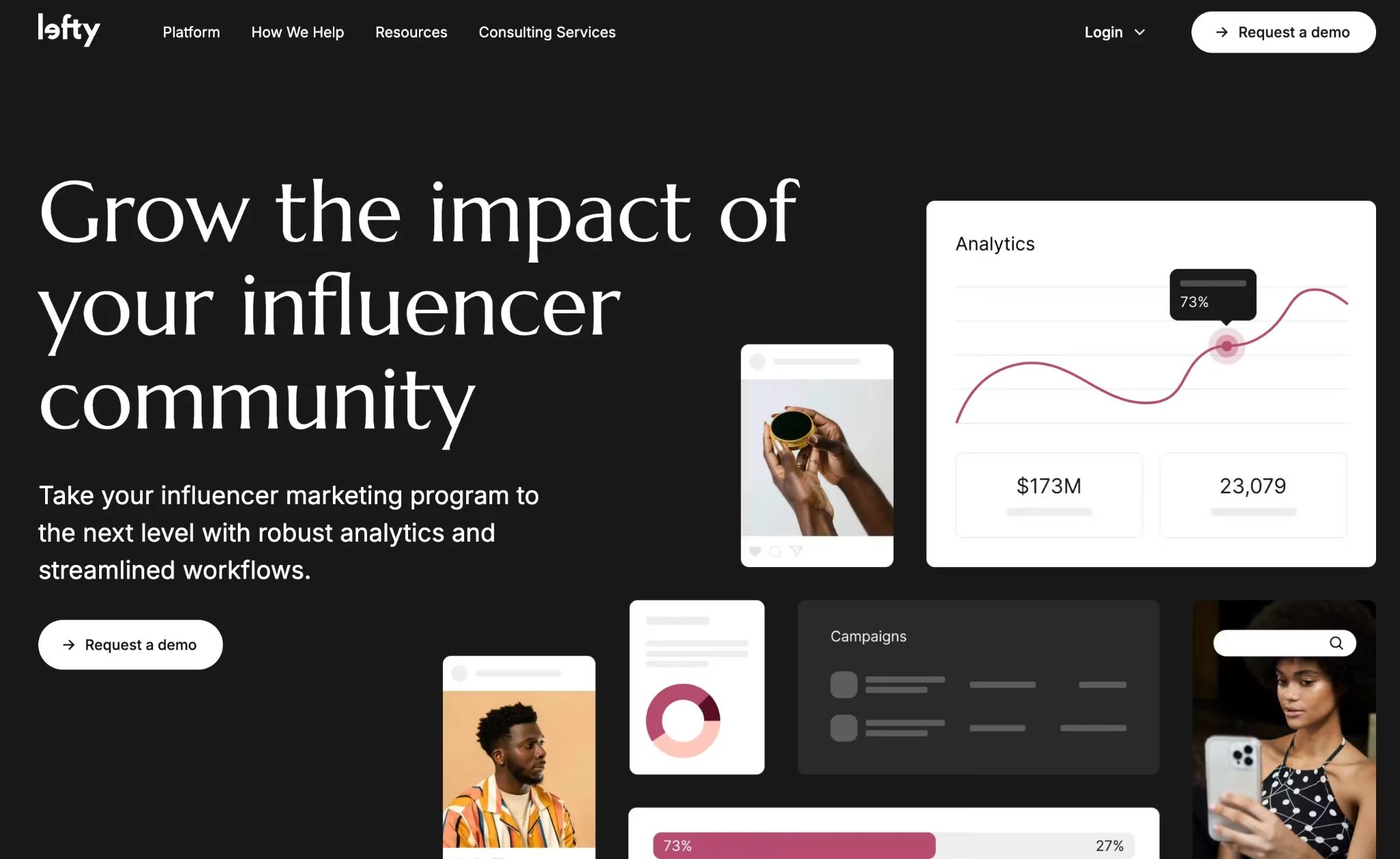
Lefty pairs faceted discovery across a multi-million profile index with campaign management, ROI reporting and social monitoring, plus Android and iOS apps. Its Instagram depth suits beauty, fashion and lifestyle programs.
Key Features
- Faceted discovery: Layered filters across a multi-million profile index.
- Campaign management: Briefs, deliverables and creator relationships in one place.
- ROI reporting: Campaign returns measured rather than reach alone.
- Social monitoring: Brand mentions tracked alongside campaigns.
- Mobile apps: Android and iOS access, which most brand-side tools skip.
Pricing
Nothing published on the company’s own site. Its Capterra listing shows a starting figure of around €590 a month with a free trial available, so treat that as indicative rather than a rate card.
Reviews
5.0/5.0 (Capterra, very low review volume at 2 reviews). Ease of use scores 5.0, features and value 4.5, and customer service 4.0.
Pros
- Roughly €7,000 a year indicated: A fifth of the median Bazaarvoice contract.
- Mobile access: Apps for Android and iOS, where reviewers call the alternative dated.
- A trial is offered: Listed alongside the indicative monthly figure.
Cons
- Two reviews: No meaningful evidence base at all.
- No rate card: The only figure comes from a directory listing.
- Instagram weighted: Less depth on TikTok and YouTube.
Integrations
- Instagram: The deepest connection, powering discovery and reporting.
- TikTok: Creator data and campaign tracking on short-form.
- YouTube: Channel performance alongside the social networks.
- Exports: Campaign and creator data out for reporting.
- Mobile apps: Campaign access from Android and iOS as well as the browser.
Bazaarvoice vs Lefty
Social monitoring is the only real overlap, and even that points different ways. Bazaarvoice watches for customer content to pull into galleries and syndicate. Lefty watches mentions as campaign context, sitting beside briefs, deliverables and an ROI figure for the creators it hired.
Lefty is far cheaper at an indicated €590 a month and far less proven, with two reviews against 809. For a European fashion or beauty brand running Instagram-first campaigns that trade often works. For anyone who needs evidence before signing, it clearly does not.
Insense
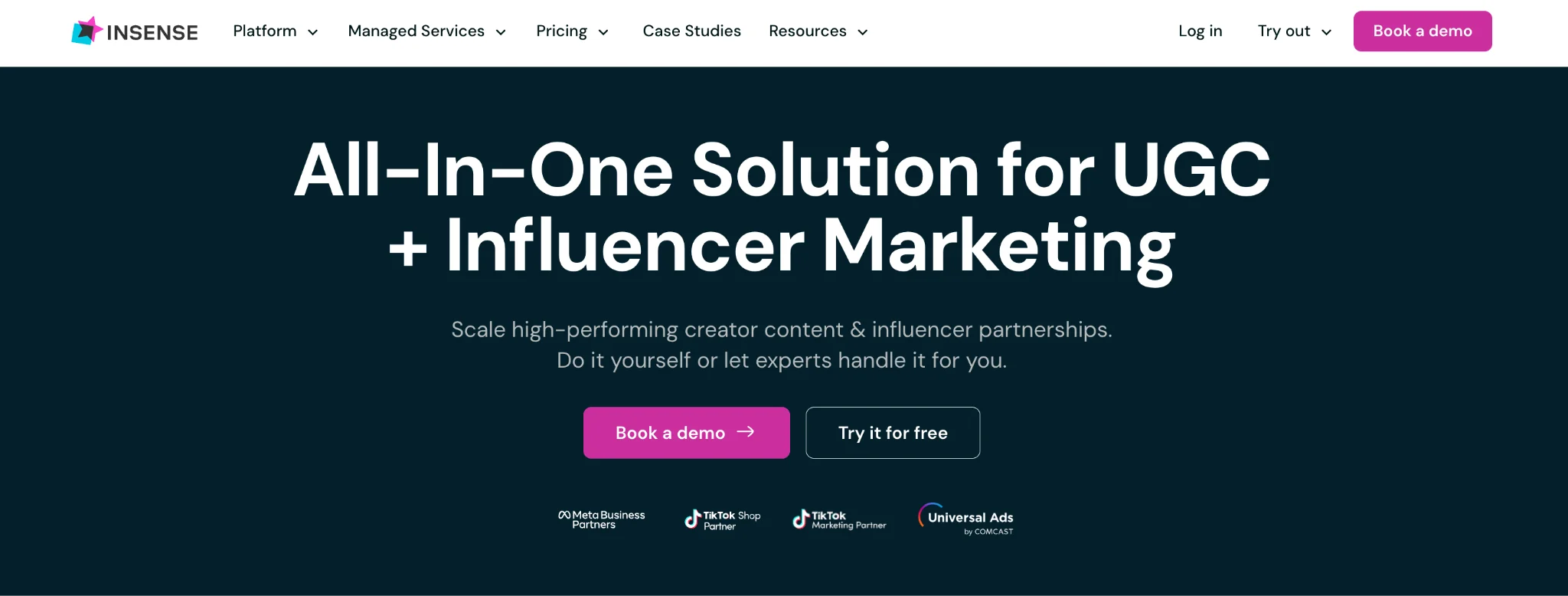
Insense is a creative supply line. You post a brief, creators apply, and finished video comes back with usage rights cleared and Meta Partnership Ads ready to run from the creator’s own handle. Product seeding is part of the campaign.
Key Features
- Guaranteed applicants: Five creators on a brief, with delivery in roughly two weeks.
- Content revisions: Up to three feedback rounds built into the brief.
- Whitelisted advertising: Meta Partnership Ads run from the creator’s own handle.
- Seeding included: Product shipped to creators as part of the campaign.
- Cleared usage rights: Paid usage licensed in the deal rather than negotiated later.
Pricing
- Trial: $650 for one month, 1 campaign and 10 creators, 20% marketplace fee
- Brand: $500 a month billed quarterly, or $400 a month annually, 10% fee
- Agency: $800 a month billed quarterly, or $640 a month annually, 7% fee
Campaigns and creators are unlimited on both paid plans, and both numbers are published.
Reviews
4.5/5.0 (G2, 374 reviews).
Pros
- Both costs published: Subscription and marketplace fee stated openly.
- A paid trial month: $650 to test properly, rather than a procurement cycle.
- 374 reviews: A substantial record, if smaller than 809.
Cons
- A percentage on top: 7% to 20% of creator payments above the plan price.
- Ad creative, not reviews: Nothing for ratings, Q&A or retailer syndication.
- Narrow scope: Content production rather than a full program.
Integrations
- Meta: Partnership Ads and whitelisted creator content run directly.
- TikTok: Assets routed into ad formats without re-uploading.
- Shopify: Seeding orders raised from your product catalogue.
- Stripe: Creator payments processed inside the workflow.
- Ad account export: Approved content pushed into live campaigns.
Bazaarvoice vs Insense
Both turn other people’s content into something you can put in front of shoppers. Bazaarvoice displays it as social proof on product pages and retailer listings. Insense commissions it as advertising, licensed for paid media and ready to run from the creator’s own handle.
Cost and commitment separate them completely. Insense publishes $400 to $800 a month plus a marketplace fee and sells a $650 trial month. Bazaarvoice quotes a five-figure annual contract with implementation and no trial. If the requirement is ad creative rather than review infrastructure, that is an easy call.
Final Thoughts on Bazaarvoice Alternatives
Bazaarvoice earns its position. Nothing else pushes a review from your site onto Target and Walmart product pages, and 809 G2 reviews confirm that the syndication network is what customers actually value about it.
The question is whether that is your problem. If you are shopping for creator marketing, you are looking at a $36,002 median contract, implementation fees and a multi-year term to get the module rather than the platform. Price the creator half on its own and compare it against a tool that does only that, because the gap is usually larger than a renewal conversation will reveal.

.png)


.jpg)










