


Bazaarvoice Pricing and Review: Features, Pros, Cons & Costs
Most brands think they are buying a reviews tool. What Bazaarvoice really sells is distribution, and the price follows that.
Collecting reviews is the cheap part of this category. Getting those reviews onto the product pages of more than 1,750 retailers is the part nobody else can copy, and it is why contracts here run into five and six figures while a Shopify reviews app costs less than a hundred dollars a month.
Below is the one figure Bazaarvoice publishes, what brands actually pay, what scales the bill, and where the platform stops.
Bazaarvoice Overview
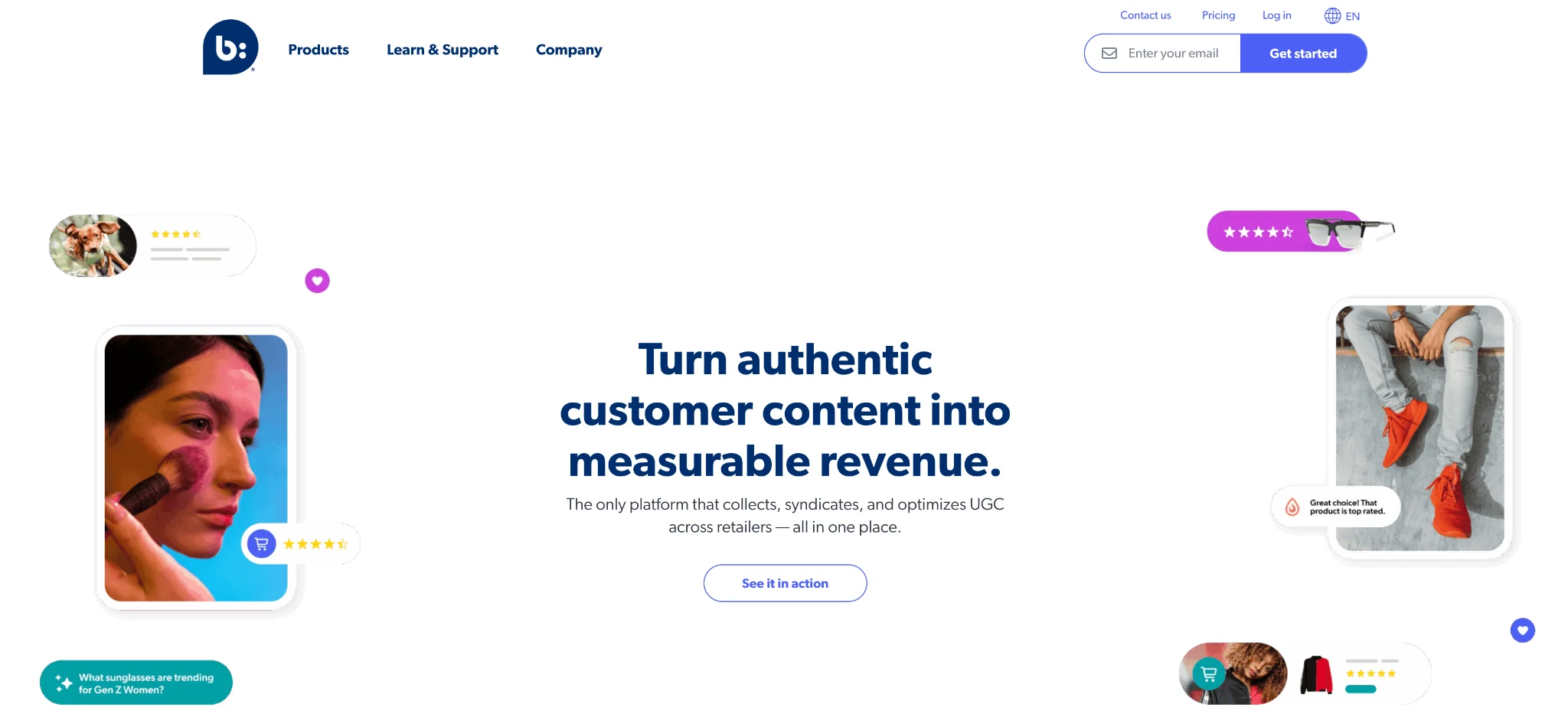
Bazaarvoice is a user-generated content platform used by more than 13,000 brands and retailers. It collects ratings, reviews, questions and customer photos, moderates them, and pushes them out across the web.
The platform has grown well past reviews. It now covers questions and answers, product sampling through Influenster, creator marketing, social commerce galleries, social media management and a reporting layer, sold as packages rather than as one product. Sampling runs on Influenster, the community Bazaarvoice owns, which the sampling product page puts at more than nine million engaged shoppers with over 1,000 data points available per member for targeting.
What holds it together is the retail network. Reviews collected once appear on your own site and on retailer product pages across the network, which is a different job from the UGC content library a D2C brand builds to feed its own ads and channels.
Who Should Use Bazaarvoice
The fit tracks how you sell, not how big you are:
- Brands selling through retailers: If your product sits on Walmart, Target or Sephora product pages, syndication is the whole reason to be here.
- Teams launching new SKUs regularly: Sampling fills empty review sections before a launch rather than after it.
- Brands with large catalogues: Moderation and authentication at thousands of SKUs is a real operational problem this solves.
- Regulated or scrutinised categories: Authenticated reviews and a documented moderation process matter when claims get challenged.
- Global brands running many markets: Content collected in one market can be reused across regions and retailers.
- Teams with someone to own it: This needs a named administrator, not a marketer squeezing it in around other work.
Key Features
Ratings and Reviews
The core product. Collection forms, review request emails, moderation and display templates for your product pages. It is mature software and it shows, though the configuration depth is also where new teams get stuck.
Retail Syndication
The reason the rest exists. A review written once on your site can appear on product pages across more than 1,750 retailers in the network. No competitor has a network at that scale, and for a brand fighting for conversion on someone else’s shelf page, that is the argument.
Questions and Answers
Shoppers ask, you answer, and the answers stay on the page as content. Bazaarvoice also offers a free basic tier of this for answering questions, which is worth knowing if you want to test the waters without a contract.
Sampling on Influenster
Products go to targeted members of the Influenster community in exchange for honest reviews. Targeting draws on more than 1,000 data points per member. The published numbers are strong: 85% content completion within eight weeks, and around 500,000 pieces of UGC created monthly across the platform.
Creator Marketing
A creator layer sits alongside sampling for brands that want content rather than only reviews. It works from the same community, which means your reach comes from who has already joined rather than from open AI creator search across the wider web.
Social Commerce Galleries
Customer photos and videos collected into shoppable galleries for your site, with product tagging so a picture leads to a cart. This is the piece most brands underuse, and it is usually already included in the package they bought.
Moderation and Authentication
Every piece of content passes through moderation, with authentication marking verified purchasers. In a market where fake reviews are a live problem and regulators are paying attention, being able to show how content was vetted has value beyond marketing.
Insights and Reporting
Reporting covers review volume, sentiment themes, conversion impact and competitive benchmarking, with an AI visibility package aimed at how products surface in AI-driven search. Useful, and priced as part of the package rather than thrown in.
Bazaarvoice Pricing
Bazaarvoice does not publish a pricing page, but it does publish one number, and procurement data fills in the rest. The gap between the two is the important part.
The Published Entry Point
Bazaarvoice advertises network access from $6,500 a year. What that covers:
- Syndication to more than 1,750 retailers in the network
- Ratings and reviews collection
- Connections for answering customer questions
- Product sampling campaigns
- Content moderation and authentication
A free basic tier of Connections also exists for responding to questions, with no contract attached.
What Brands Actually Pay
The median annual contract sits around $36,000, which is five times the advertised entry point. Procurement figures by catalogue size:
- 1,000 to 5,000 SKUs: $40,000 to $80,000 a year
- 5,000 to 15,000 SKUs: $100,000 to $200,000 a year
- 15,000 or more SKUs: $250,000 and up, with some past $400,000
What Moves the Number
Four things decide where you land. How many SKUs you are collecting reviews for, how many retailers you syndicate to, which modules you switch on, and how long you sign for. SKU count is the one that bites, because a catalogue grows on its own and the bill grows with it.
Sampling and Creator Campaigns Cost Extra
Sampling is a campaign, not a feature. Products, fulfilment and the campaign itself are quoted separately from the subscription, so a brand budgeting $36,000 for the platform can find the launch programme adds a similar amount again. Ask for both numbers in one document.
Where the Maths Turns
Work out your cost per syndicated review. At $36,000 a year across 200 SKUs you are paying $180 per product page, per year, for content that appears on retailer sites you do not control. If most of your revenue comes through your own store, that same budget buys a lot elsewhere. Platforms with published monthly plans covering creator discovery, outreach, affiliate tracking and payouts start well below it.
Bazaarvoice Reviews
Bazaarvoice holds 4.2/5.0 (G2, 809 reviews). That is a large, current sample and the score is respectable rather than glowing, which for enterprise software is usually a more honest signal than a perfect rating on twelve reviews.
Reviewers consistently praise the syndication network, the speed at which review volume grows once it is live, responsive implementation help and solid campaign management. The complaints are just as consistent: a steep learning curve, heavy customisation needed to get value, high cost, rigid contracts that are hard to change mid-term, slow support responses once onboarding ends, and navigation that makes routine tasks take longer than they should.
Integrations
The integration surface is broad and enterprise-shaped. Five that matter most:
- Shopify: Certified technology partner, with review display and collection built into the storefront.
- Klaviyo: Triggers review requests inside email flows and segments customers on the content they leave.
- Salesforce: Puts review and question data into Service Cloud so support teams respond without a second login.
- Zendesk: Routes reviews and questions into the same queue as support tickets.
- Attentive: Pulls customer photos and reviews into SMS campaigns.
Others include Sprinklr, MovableInk, Contentsquare, Monetate and Annex Cloud, which tells you the intended buyer runs a full marketing stack already.
Pros of Bazaarvoice
A Network Nobody Can Copy
More than 1,750 retailers is not a feature, it is fifteen years of partnership work. If your growth depends on converting shoppers on a retailer’s product page, this is the only tool that puts your content there at scale, and no amount of budget builds an alternative.
Sampling That Reliably Produces Content
An 85% content completion rate within eight weeks is a number worth respecting. Most seeding programs quietly accept that a large share of recipients never post. Pairing a nine-million-member community with deep targeting is what makes that rate possible.
Evidence You Can Actually Check
More than 13,000 brands and 809 published reviews mean you can research this properly before signing. In a category full of platforms with five reviews and a perfect score, being able to read hundreds of accounts of what implementation really involves is worth something.
Cons of Bazaarvoice
The Bill Follows Your Catalogue
This is the cost trap. Pricing scales with SKU count, so adding products raises the price whether or not those products need reviews. A brand at 5,000 SKUs can be paying $80,000 a year while a competitor at 400 SKUs pays a fraction for the same capability. Count the SKUs you genuinely need syndicated and negotiate on that number, not your whole catalogue.
Long Contracts, Little Flexibility
Deals are annual and hard to adjust once signed. If your catalogue shrinks, a retailer relationship ends, or a module goes unused, you will usually carry it to renewal anyway. Get downgrade rights and a cap on renewal uplift written in before you sign, because you will not get them later.
It Is Not a Creator Program
There is no open creator search across the web, no outreach sequencing, no affiliate codes, no commission tracking and no creator payouts. Sampling and creator campaigns draw on Influenster members rather than creators you choose and build relationships with, so anyone running partnerships properly still needs a creator CRM alongside it.
It Needs an Owner
Setup, moderation rules, display templates and syndication mapping all take configuration, and reviewers routinely describe the learning curve as the hardest part. Without someone whose job includes this platform, you will pay enterprise money for the basic review widget.


Is Bazaarvoice Worth It?
If you sell through retailers, it is hard to argue against. Syndication to 1,750-plus retail sites, a nine-million-member sampling community and a moderation process that stands up to scrutiny are capabilities you cannot assemble from cheaper parts. The 4.2 score across 809 reviews says it works, with effort.
If you sell mainly on your own store, the maths gets uncomfortable. You would be paying a median $36,000 a year, scaling with a catalogue rather than with results, for a network you barely use, while everything about finding creators, running outreach and tracking revenue happens elsewhere. That is a lot of budget for review collection.
Brands comparing options in this space usually look at these:
- Influencer Hero: Covers the creator side Bazaarvoice does not, with a 450M+ creator index and fake-follower screening, automated influencer outreach, gifting, a campaign CRM, affiliate codes and payouts at 0.1% to 0.4%.
- Afluencer: Brings creators to you through campaign listings and sorts applicants with AI matching, which suits brands that want partners rather than anonymous samplers. Its own roundup of AI creator tools is a useful primer on that model.
- Yotpo: Pairs reviews with loyalty programs and SMS marketing in one eCommerce suite, aimed at brands selling direct.
- PowerReviews: Offers review collection with its own retail syndication network, positioned as the lighter competitor in this exact category.
- Okendo: A Shopify-first reviews platform with quizzes, referrals and deep Klaviyo integration for D2C brands.
Final Thoughts
The trade-off is plain. You are buying reach onto other people’s product pages, and you pay for it by catalogue size rather than by how much value you get back. For a brand whose sales happen at retail, that is money well spent and the network justifies it. For a brand whose sales happen on its own site, the same budget covers a creator program end to end with room left over. Work out what share of your revenue passes through a retailer product page, and if the answer is small, the Bazaarvoice alternatives built for direct selling will serve you better.

.png)


.jpg)










