


Archive Pricing and Review: Features, Pros, Cons & Costs
Archive sells two products under one name, and only one of them has a price on it. There is a Shopify app with published tiers you can sign up for this afternoon, and there is the creator marketing platform the company actually markets, which routes every visitor to a demo form. Knowing which one you are being quoted is the first thing to establish on a sales call.
The published side is unusually specific for this category, and specific enough to be uncomfortable. Content capture is metered. You buy a number of UGC assets per month, and when you divide the plan price by that allowance the cost per piece of content lands between $2.38 and $4.33 depending on the tier and the billing term. Most platforms hide that number inside a seat licence. Archive puts it on the pricing page whether it means to or not.
What follows is what each tier costs, what the per-asset maths looks like at the point where brands usually upgrade, where the platform genuinely does something competitors cannot, and what it will not do at any price.
Archive Overview
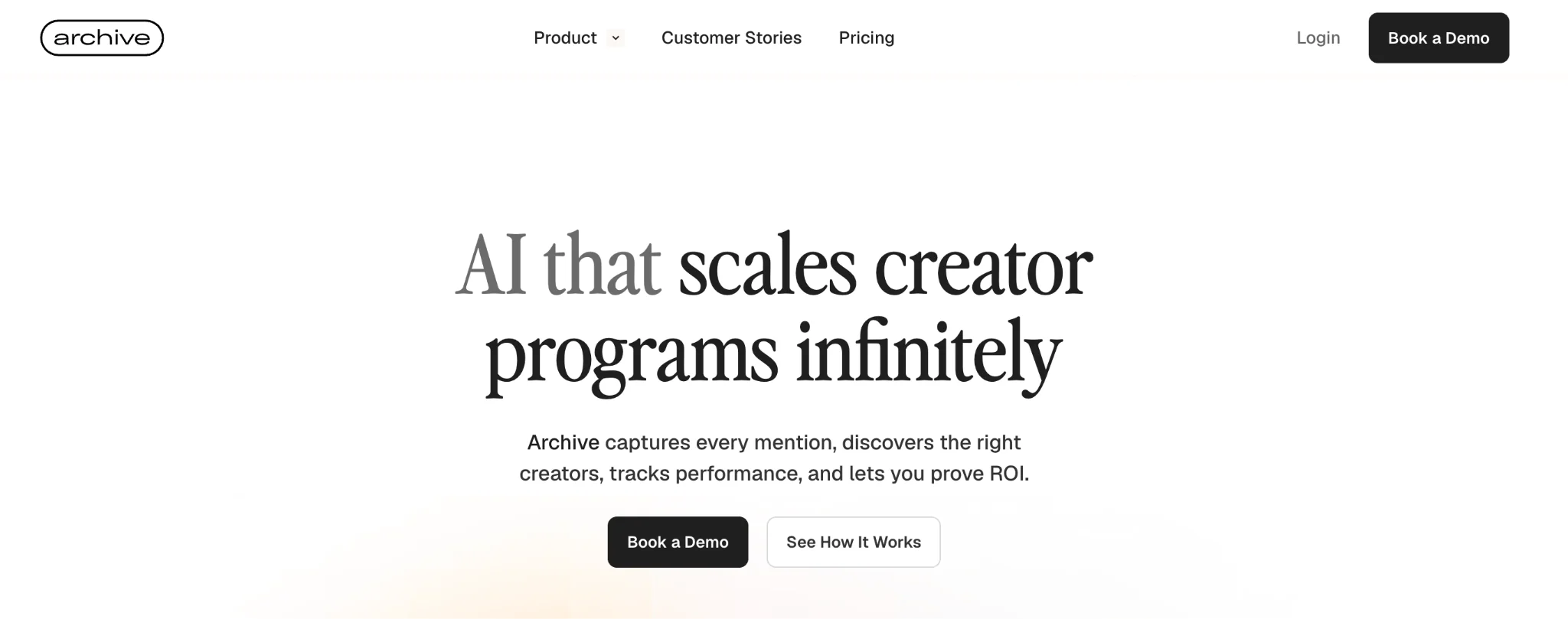
Archive was founded in 2021 by Paul Benigeri and Geoffrey Woo, raised a $4 million seed round led by Stripe followed by an $8 million round led by Tiger Global and Human Capital, and reached a reported $100 million valuation inside eighteen months. It now claims more than 1,000 brands, with Allbirds, DoorDash, Uniqlo, Notion, Grüns and Ketone-IQ named on the site.
The original product was narrow and good at one thing: automatically capturing Instagram Stories that mentioned your brand before they expired. That has since expanded into a creator marketing platform built around social listening, with Archive Radar detecting brand mentions across TikTok, Instagram and YouTube Shorts even when the post carries no tag and no handle, and Super Search turning everything it finds into a queryable library.
The category framing matters here. Archive is a detection and content platform, not a program management platform. It finds who is already posting about you, ranks them, secures usage rights and pushes the winning assets into paid social. It does not send products, negotiate deals, issue affiliate codes or pay creators. If your problem is that you do not know what is being said about your brand, this is built for you. If your problem is running a creator program end to end, you will need creator discovery tools and campaign infrastructure alongside it.
Who Should Use Archive
The fit here is narrower than the marketing suggests, and it tracks almost entirely with how much organic mention volume a brand already generates.
- Brands with meaningful untagged mention volume. Archive Radar earns its money by finding posts that never tagged you. A brand nobody talks about yet gets very little from it.
- Consumer brands living on TikTok and Instagram Stories. Stories vanish in 24 hours, and 24/7 Story Detection is the feature that originally made the product worth buying.
- Teams running creator whitelisting into paid social. Rights management is built into the capture flow rather than bolted on, so the asset arrives ad-ready.
- Shopify merchants who want a self-serve starting point. The app installs in minutes and the free tier lets you see your own mention volume before committing to anything.
- Performance teams who care about which creator drove sales. Campaign reporting ties post-level performance back to store data, which is the loop most listening tools never close.
- Brands with an in-house paid social function. The output of Archive is a content library. Somebody has to test it, or the spend is wasted.
Key Features
Archive Radar
The centrepiece. AI video detection scans TikTok, Instagram and YouTube Shorts for content featuring your brand, including posts with no tag, no handle and no hashtag, where the product only appears on screen or gets mentioned out loud. Untagged detection is the hardest thing in this category to build and the clearest reason Archive exists as a separate product rather than a feature inside a social suite.
24/7 Story Detection
Continuous monitoring and capture of Instagram Stories before they expire. This was the original product and it is still the capability reviewers name most often. Stories that disappear at the 24-hour mark are permanently lost content and permanently lost proof of a creator relationship, and manual screenshotting does not scale past a handful of creators.
Super Search
Everything detected becomes searchable structured data rather than a feed you scroll. You can query the library by creator, product, sentiment, format or performance, which is what makes a large capture volume usable instead of overwhelming.
AI Creator Search and Lookalikes
Discovery built on top of detection rather than a licensed database. Archive ranks creators it has already seen posting about you or your category, then generates lookalikes and layers in audience data and verified email addresses. The advantage is relevance; the limitation is that it is anchored to the three platforms it monitors.
Creator Leaderboard
A performance ranking of everyone who has mentioned your brand, ordered by what their content actually did. Its practical use is re-engagement: it tells you which of the people already talking about you unprompted are worth putting on a paid deal.
Usage Rights and Whitelisting
Rights requests are triggered from inside the platform, tracked to approval, and the approved asset flows into paid social with whitelisting permissions attached. This is the step that separates a UGC library from a UGC ad pipeline, and skipping it is how brands end up with a folder of content they are not legally clear to run.
Campaign Reporting
Real-time performance by creator and by post, tied back to sales data through the Shopify connection. Reporting is gated to the Pro tier on the app side, which matters: the cheaper plan captures content but tells you very little about what the content did.
Competitor Insights
The same detection engine pointed at rival brands, showing which creators are working with your competitors and how that content is performing. It is a genuinely useful prospecting input, and the closest thing in the product to a discovery database.
Video Sentiment Analysis and AI Insider
Sentiment scoring on detected video tells you whether a mention was a recommendation or a complaint, which is the difference between a UGC asset and a customer service ticket. AI Insider packages the week into an automated report naming top creators, trending content and campaign movements, so the platform pushes findings out rather than waiting for someone to log in.
Archive Pricing
There are two pricing realities. The Shopify app publishes three tiers with exact figures and a 3-day trial on the paid ones. The wider Archive platform, which is what the website is selling, publishes nothing at all and sends every enquiry through a demo form that asks for company size and revenue before anyone quotes you. Revenue-qualified sales forms exist for one reason, and it is not to quote everyone the same number.
The published tiers are metered on UGC assets captured per month, not seats, which makes the real unit of cost easy to calculate and worth calculating before you sign.
Free
- $0 per month, no trial required, no card.
- 5 UGC assets captured per month across up to 2 social accounts.
- Usage rights management and incentive offers included.
- 2 years of UGC storage, capture from TikTok and Instagram.
- Five assets a month is a sampler, not a plan. Its real job is showing you your own mention volume so the upgrade decision is informed.
Starter
- $260 per month billed monthly, or $2,160 per year, a 31% saving worth $960 annually.
- 60 UGC assets per month across up to 2 social accounts.
- Usage rights, incentives and 2 years of storage.
- No influencer profile management, no campaigns and no reporting. This tier captures content and stops there.
- 3-day free trial, which is short enough that you should install the free plan first and let it gather data before you start the clock.
Pro
- $858 per month billed monthly, or $7,128 per year, a 31% saving worth $3,168 annually.
- 250 UGC assets per month across up to 5 social accounts.
- Adds influencer profile management, campaigns, reporting and priority support.
- 3-day free trial. Billing is in USD on a 30-day recurring cycle.
The Upgrade Maths
- Pro costs 3.3 times Starter and delivers 4.2 times the capture allowance, so the per-asset rate falls from $4.33 to $3.43 on monthly billing.
- The crossover sits at roughly 198 assets a month. Below that you are paying Pro money for Starter-sized volume; above it Pro is straightforwardly cheaper per piece of content.
- Annual billing takes the effective rate to $3.00 on Starter and $2.38 on Pro, the lowest published number in the range.
- Reporting only exists on Pro, which means the tier decision is really about whether you need to measure the content or just collect it. That is a feature gate dressed as a volume gate.
- Nothing is published about what happens when you exceed your monthly allowance. Get the overage terms in writing.
The Platform Price Nobody Publishes
- The main Archive product has no pricing page. Every route ends at a demo form requesting company size and revenue.
- An early company breakdown put the enterprise community offering at around $10,000 per month. That figure is several years old and Archive has never confirmed it, so treat it as an order of magnitude rather than a quote.
- No contract length, no minimum term and no onboarding fee is disclosed anywhere. All three are sales-call questions.
- The gap between $260 a month on the app store and an unpublished enterprise number is the single largest unknown in this evaluation.
Archive Reviews
The public evidence base is small and concentrated in one place, so read it for what it is.
- 5.0/5.0 (Shopify App Store, 43 reviews, 98% five-star)
- No meaningful G2 or Capterra presence for the creator marketing platform. The G2 listing that surfaces under the name Archive is a different product entirely.
What reviewers consistently praise is exactly what the product was built to do: automatic capture of Stories and untagged posts, the hours it saves against manual collection, the built-in rights request flow, tagging and organisation, and the weekly email summaries. Support comes up repeatedly and positively, with issues described as sorted quickly.
The criticism is almost entirely about price. One reviewer dropped the app from five stars to two over what they called absurd pricing tiers and the removal of free options, then moved back to four after the company adjusted rates, and specifically objected to cost scaling off store sessions rather than usage. That is a useful signal for a smaller brand: this pricing has moved before, and it moved because customers pushed back.
Integrations
The integration surface is narrow and Archive does not publish a directory, so this list is what is actually verifiable rather than what a marketplace page claims.
- Shopify. The native app, and the connection that ties creator content back to store performance. This is the deepest integration in the product.
- Instagram. Feed posts, Reels and Stories, with continuous Story capture before expiry.
- TikTok. Full detection including untagged video where the brand appears on screen or is mentioned verbally.
- YouTube Shorts. Detection coverage, though the emphasis across the product is clearly on the first two platforms.
- Paid social whitelisting. Approved creator assets carry usage permissions into ad accounts, which is the practical output of the rights workflow.
There is no published WooCommerce, BigCommerce or Magento integration, no public API documentation, no Zapier connector and no named CRM or email platform partners. For a Shopify-native brand that is a non-issue. For anyone on another stack it is a hard stop.
Pros of Archive
Untagged Detection Is a Real Technical Advantage
Most listening tools find you when someone types your handle. Archive Radar finds the video where your product sits on the counter for four seconds and nobody tagged anything. That is a materially harder problem, it is the source of the mentions brands never knew existed, and it is the one capability here that competitors genuinely cannot match by adding a filter.
Rights and Whitelisting Live Inside the Capture Flow
Collecting UGC is easy; being legally clear to run it in paid media is the part brands get wrong. Archive requests rights, tracks approval and hands the asset over with whitelisting permissions attached, which turns a content library into an ad pipeline. Teams buying a capture tool and handling rights over DM are building a compliance problem they will discover later.
A Free Tier That Answers the Only Question That Matters
Five assets a month is not a working plan, but it is enough to show you how much untagged conversation your brand actually generates. Since the entire value of this platform scales with that volume, a free tier that measures it before you spend anything is more useful than the 3-day trial sitting above it.
Cons of Archive
You Are Buying Content by the Unit at $2.38 to $4.33 a Piece
Metered capture means cost tracks your own success. A campaign that works generates more mentions, more mentions consume more allowance, and the brand gets billed for its own momentum. At Starter the marginal asset costs $4.33 and the allowance runs out at 60, which is a single good week for a brand with real organic volume. Nothing is published about overage rates, so the ceiling is undefined until you hit it.
The Product Being Sold Has No Published Price
The app store tiers are not what the website is marketing. The Archive platform is demo-gated behind a form asking for company size and revenue, with no published contract terms, no minimum and no onboarding cost. A dated third-party figure suggests five figures a month at the enterprise end, but the honest position is that nobody outside the sales process knows, and budgeting from the $260 tier will not survive contact with a quote.
No Affiliate Tracking, No Payments, No Gifting
Archive finds creators and captures what they post. It does not issue affiliate links or discount codes, does not manage commissions, does not pay creators and does not handle product seeding or fulfilment. Running an actual creator program on this alone is not possible; you are buying the detection layer and paying for the execution layer somewhere else.
Three Platforms, Short-Form Only
Coverage is TikTok, Instagram and YouTube Shorts. There is no Pinterest, no Snapchat, no X, no Twitch and no long-form YouTube emphasis. Reviewers outside the app store have also described the platform slowing as it has grown and the path from collection to rights to running ads as clunky. If a meaningful share of your creator activity happens outside short-form video, the detection engine simply will not see it.


Is Archive Worth It?
For a Shopify brand generating real organic conversation on TikTok and Instagram, and running a paid social function that can actually use the output, yes. The untagged detection is genuinely differentiated, the Stories capture solves a problem with no manual workaround, the rights and whitelisting flow is better integrated than most, and 43 reviews at a straight 5.0 with support praised throughout is a good signal even at that sample size.
The reservations are commercial rather than technical. Metered pricing charges you more as your program succeeds, the marginal asset costs between $2.38 and $4.33, reporting is locked behind the $858 tier, and the product the company is actually selling has no published price at all. Add the missing affiliate, payment and gifting layers and Archive is a component of a creator program, not the program itself. That is fine if you budgeted for a component. It is expensive if you thought you were buying a platform.
Brands that need the whole workflow in one place should price these instead:
- Influencer Hero. Covers the full cycle rather than the detection slice: discovery across eight platforms with fake-follower screening and lookalike search, brand-follower identification, automated influencer outreach with drip sequences, CRM boards, affiliate links and payouts, gifting through Shopify, WooCommerce or custom stores via script, plus a UGC content library with AI search. Pricing is publicly listed from $649 a month with no revenue-share.
- Afluencer. A marketplace where creators apply to your campaign listings, with AI creator matching to sort applicants. Plans start at $49 a month, and it is the right answer when the bottleneck is creator supply rather than detection.
- Aspire. End-to-end creator program management with strong workflow, briefs, contracts and content approvals for larger in-house teams.
- Bazaarvoice. UGC and ratings at retail scale, with syndication across retailer product pages that Archive does not attempt.
- Modash. Creator discovery and monitoring with a large database and per-creator tracking, aimed at teams who want breadth of search rather than detection depth.
Final Thoughts
Check two things before you sign anything. First, install the free tier and let it run for a month, because the number of untagged mentions it surfaces is the entire business case and you cannot estimate it from the outside. Second, ask what happens at 61 assets on Starter and at 251 on Pro, since the overage terms are the only part of this pricing model that is not published and the only part that scales with your success. If the answer to the first is a healthy volume and the answer to the second is reasonable, Archive does something no one else does. If your mention volume is thin, or your stack is not Shopify, the money is better spent on Archive alternatives that run the whole program rather than the listening layer on top of it.

.png)


.jpg)










