

10 Best IMAI Alternatives • Key Criteria • IMAI Overview • Best IMAI Alternatives • GRIN • Upfluence • CreatorIQ • Influencer Hero • NeoReach • Lefty • Insense • Kolsquare • Skeepers • Creator.co • Final Thoughts • FAQs
10 Best IMAI Alternatives for Influencer Marketing
D2C brands today rely heavily on influencer marketing software to streamline creator discovery, manage outreach at scale, and track campaign performance tied directly to revenue. IMAI (InfluencerMarketing.AI) is one such platform that combines influencer discovery, campaign management, and AI-driven insights in a broader marketing suite, making it appealing for teams looking for an all-in-one solution. However, common feedback highlights limitations around reporting depth, pricing value, and occasional performance issues, which leads many teams to explore better-fitting alternatives. This is especially true for brands that need stronger eCommerce integrations, simpler workflows, or more specialized tools for UGC, affiliate tracking, or enterprise-scale campaigns.
In this guide, we compare the 10 best IMAI (InfluencerMarketing.AI) alternatives—including GRIN, Upfluence, CreatorIQ, Influencer Hero, NeoReach, Lefty, Insense, Kolsquare, Skeepers, and Creator.co—to help you find the right influencer marketing software for your needs.
Key Criteria for Evaluating Influencer Marketing Platforms
Core Features
Evaluation of essential influencer marketing capabilities, including influencer discovery, outreach, CRM, campaign management, reporting, and content workflows.
Pricing & Flexibility
Comparison of pricing models, subscription plans, and contract terms to match different budgets and growth stages.
Customer Reviews & Satisfaction
Analysis of user feedback from trusted review platforms, focusing on usability, reliability, customer support, and overall performance.
Pros & Cons
Review of each platform’s strengths and limitations to highlight where it performs well and where it may fall short based on different use cases.
Integrations
Review of the most important integrations (e.g., Shopify and other tech tools), highlighting what each integration enables in one sentence.
IMAI (InfluencerMarketing.AI) Overview

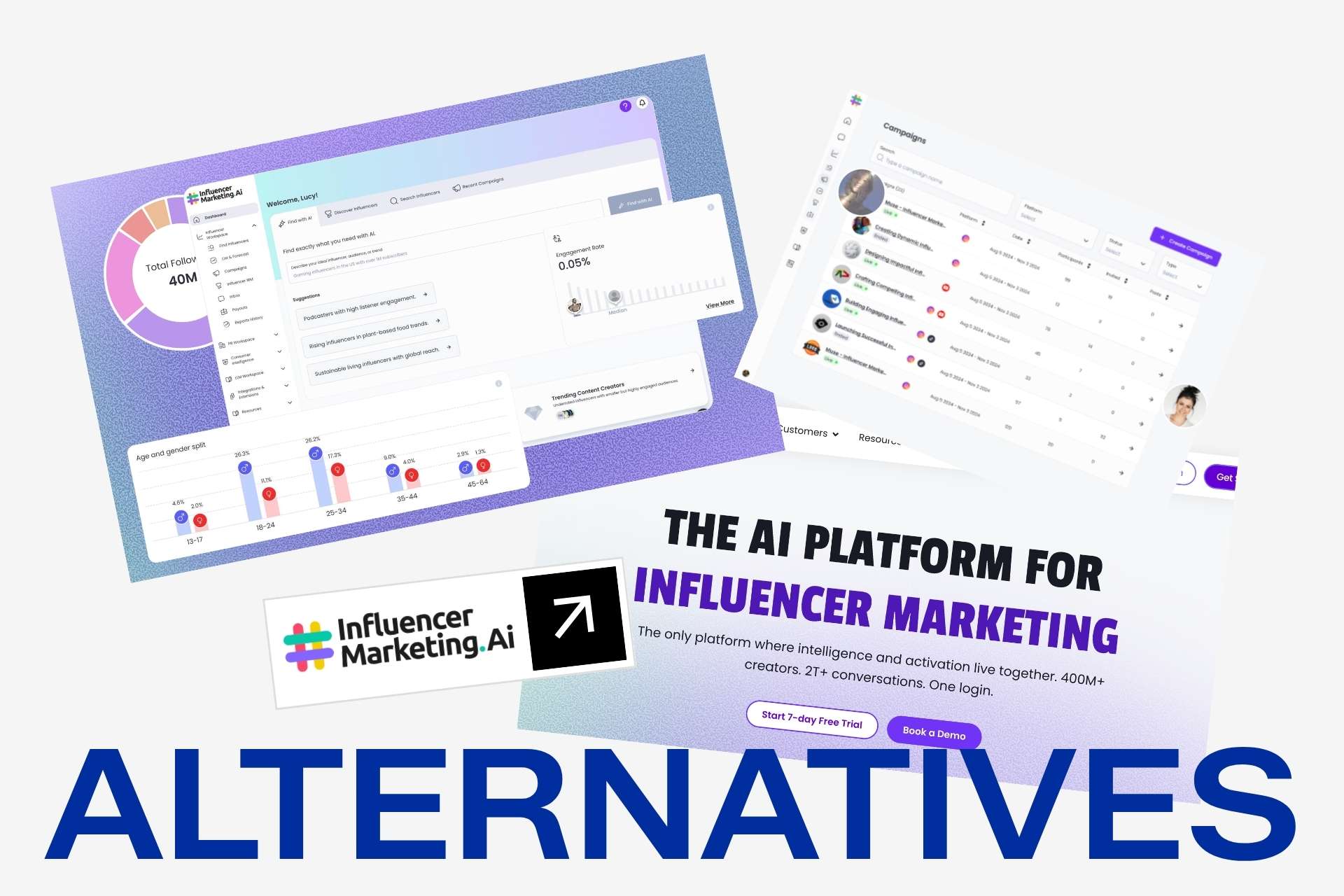
IMAI, short for Influencer Marketing AI, is an AI-driven influencer marketing platform built for brands, agencies, eCommerce teams, and enterprise marketers that want to manage creator discovery, campaign execution, reporting, and performance tracking in one system. The company now positions the product as more than a standalone influencer tool: its platform combines influencer marketing with connected workspaces for consumer intelligence, PR and media, UGC video ads, LLM visibility tracking, and AI voice/chat agents, while its core influencer workspace centers on creator search, campaign management, ROI tracking, and payouts.
Key Features
- Large creator database with AI-powered discovery: IMAI says its influencer workspace gives teams access to 400M+ creator profiles across major channels, with AI search, keyword targeting, and sentiment analysis to help narrow down relevant creators faster.
- Influencer search and filtering: The platform is built around creator discovery, including profile analysis, audience matching, and campaign fit evaluation. Review aggregators also highlight faceted search, filtering, influencer discovery, and influencer tracking as core capabilities.
- Campaign management workflows: IMAI is designed to help teams move from discovery to live campaign execution without switching tools, with campaign management and reporting called out across both the official site and software listings.
- ROI and performance tracking: The influencer workspace is positioned around ROI tracking, creator performance monitoring, and campaign measurement, while third-party listings also note campaign analytics, reporting, and ROI tracking among its strongest functions.
- Relationship management / CRM-style organization: IMAI highlights relationship management as one of its main solution areas, aimed at organizing outreach, briefs, and creator collaboration in one place.
- Creator payouts: The official product pages describe built-in creator payout handling, making it easier to connect campaign execution with payment workflows.
- Competitive analysis and social intelligence: Beyond campaign execution, IMAI also includes competitive analysis and connected consumer intelligence capabilities, which can help teams compare brand presence, monitor conversations, and use audience insights to shape creator strategy.
- Agency reporting and white-label support: For agencies and multi-brand teams, IMAI offers a dedicated reporting layer and white-label/reselling support on higher tiers.
- API and workflow extensibility: The platform supports API access and positions itself as compatible with broader martech stacks for automation and data syncing.
- Free trial availability: IMAI’s current pricing page includes a 7-day free trial, which lowers the barrier for teams that want to test the platform before committing.
Pricing
IMAI currently shows four plan tiers on its official pricing page, with both annual and monthly billing options.
- Starter
- $499/month when billed annually ($5,988/year) or $599/month billed monthly
- Includes 1 workspace, 1 team member, 1 market & 1 brand, 200 CRM records, and 50 profile reports.
- Growth
- $999/month when billed annually ($11,988/year) or $1,199/month billed monthly
- Includes 2 workspaces, 3 team members, 3 markets & 1 brand, 500 CRM records, 250 profile reports, and 15 intelligence / LLM reports.
- Teams
- $2,999/month when billed annually ($35,988/year) or $3,599/month billed monthly
- Includes 3 workspaces, unlimited team members, global markets & 3 brands, 1,800 CRM records / 500 reports, 25 intelligence / LLM reports, plus white-label and reselling support.
- Enterprise
- Custom pricing
- Includes custom limits, dedicated team support, AI voice and API credits, and custom SLAs.
Reviews
4.5 / 5.0 (G2)
Integrations
- Shopify: Connect influencer campaigns to your Shopify store to automate creator-driven campaigns, attribute sales, and tie influencer activity more closely to eCommerce performance.
- WooCommerce: Sync WooCommerce with IMAI for product integration, deep-linking, and sales attribution from influencer campaigns.
- Klaviyo: Use influencer data inside Klaviyo email flows to personalize campaigns and track affiliate-driven sales and link performance from email
- Hootsuite: Combine influencer marketing activity with broader social publishing and analytics workflows to monitor engagement and performance across social channels.
Pros
- Broader platform scope than many influencer tools: IMAI is no longer just positioning itself as a creator database and campaign tracker; it now bundles influencer marketing with consumer intelligence, PR/media, UGC ads, LLM visibility tracking, and AI voice/chat tools inside one platform, which is a notable differentiator for teams trying to consolidate multiple subscriptions.
- Strong workflow for agencies and multi-brand teams: Higher-tier plans include white-label reporting, reselling support, multiple workspaces, and multi-market coverage, making IMAI especially attractive for agencies or regional teams that need client-facing dashboards and more than one brand environment.
- Good balance of creator discovery and commerce connectivity: IMAI combines large-scale influencer discovery with direct integrations for Shopify, WooCommerce, Klaviyo, Zapier, and Hootsuite, which makes it easier to connect creator campaigns to revenue tracking, lifecycle marketing, and internal reporting.
Common Drawbacks of IMAI (InfluencerMarketing.AI)
Reporting can feel lighter than some teams want
Some users praise the analytics overall, but there is also feedback that reports could be more detailed, which may matter for teams that need deeper custom reporting or stakeholder-ready breakdowns.
Search and platform performance are not always perfect
While discovery is one of the product’s strongest areas, some users report that search can be slow at times, which can become frustrating during heavy prospecting workflows.
Some buyers question data accuracy and coverage consistency
Feedback across review platforms shows that not every team is equally confident in the accuracy of stats, and there are also requests for broader tracking support in some channels.
Billing and value perception can be a concern
Although the product offers transparent plan pricing today, some reviews point to frustration around charges during trial-to-paid transitions, and third-party review data also shows value-for-money scores lower than feature scores.
Best IMAI Alternatives
| TOOL | REVIEWS | BEST FOR | TRIAL INFO | PRICING | ||
|---|---|---|---|---|---|---|
1 |

|
⭐ | DTC creator management | Book Demo | Pricing | Website |
2 |

|
⭐ | Influencer discovery | Book Demo | Pricing | Website |
3 |

|
⭐ | Enterprise influencer marketing | Book Demo | Pricing | Website |
4 |

|
⭐ | Influencer CRM & automation | Book Demo | Pricing | Website |
5 |
|
⭐ | Influencer campaigns & data analytics | Book Demo | Pricing | Website |
6 |

|
⭐ | Influencer analytics & discovery | Book Demo | Pricing | Website |
7 |

|
⭐ | UGC creators & paid social ads | Book Demo | Pricing | Website |
8 |

|
⭐ | Data-driven influencer discovery & campaign analytics | Book Demo | Pricing | Website |
9 |

|
⭐ | Influencer gifting & UGC campaigns with micro-influencers | Book Demo | Pricing | Website |
10 |

|
⭐ | Influencer campaigns & creator marketplace | Book Demo | Pricing | Website |
1. GRIN
GRIN is an influencer marketing platform built primarily for eCommerce brands that want to manage creator relationships, gifting, affiliate tracking, content collection, and reporting in one system. Its current positioning leans heavily into operational execution for DTC teams: connecting influencer workflows directly to store data, creator payments, and campaign performance, rather than focusing mainly on benchmarking and brand-level analytics.
Key Features
- Creator discovery and search: GRIN lets brands discover creators with AI-assisted search and manage them inside a creator CRM built for ongoing programs rather than one-off campaigns.
- Integrated outreach: Teams can send emails from inside GRIN, use templates, automate sequences, and track opens, clicks, and replies without moving communication into separate tools.
- Product seeding and gifting: GRIN connects creator gifting to store operations so brands can ship products, generate discount codes, and manage commissions from the same workflow.
- Affiliate and revenue tracking: The platform supports affiliate links, commission tracking, and revenue attribution, making it useful for programs where creators are expected to drive measurable sales.
- Creator payments and contracts: GRIN supports creator payouts through PayPal and contract workflows through DocuSign, which reduces manual back-and-forth for finance and legal tasks.
- Content library and approvals: Brands can centralize creator content, manage approvals, and keep assets organized for reuse across paid and owned channels.
- Commerce integrations: GRIN is especially strong for store-connected influencer programs, with integrations and workflows centered around ecommerce execution.
Pricing
- Official pricing model: GRIN’s current pricing page promotes a 30-day free trial and more flexible packaging than before, including self-serve access.
- Public starting price benchmark: Recent software directories list GRIN from $999/month, though enterprise pricing still appears to scale materially based on features and program size.
- Enterprise benchmark pricing: Recent sales benchmarks and product overviews still place GRIN commonly starts at $25,000/year (approx. $2,050/month), with no discounts for upfront payment. Contracts require a full-year commitment with monthly billing.
Reviews
4.5/5.0 (G2)
Pros
- Much more transparent pricing than many enterprise rivals: GRIN now publishes self-serve tiers, a free trial, and month-to-month billing, which is a notable shift for a platform historically associated with custom annual deals.
- Strong commerce-native workflow: Shopify integration, gifting, affiliate attribution, creator payments, and tax handling make GRIN especially strong for product-seeding and revenue-focused programs.
- Expanded AI and operational tooling: AI creator search, report builder, automated payments, and centralized content workflows make it more useful for mature teams running recurring creator programs.
Cons
- Still not a low-cost option once programs scale: Even with public pricing, higher tiers add up quickly for teams that need larger creator capacity and more users.
- Can feel complex for smaller teams: The breadth of workflow, reporting, and content features can make implementation heavier than lighter-weight discovery tools.
- Some users still report performance and support friction: Review signals continue to mention lag, reporting limitations, and uneven support experiences.
Integrations
- Shopify: Sync products, send gifts, create affiliate links, and track creator-attributed conversions inside GRIN.
- PayPal: Pay creators directly through the platform and reduce payout admin work.
- DocuSign: Manage creator contracts and approvals without leaving the workflow.
- Klaviyo: Connect creator communication and commerce activity with email marketing workflows.
- Slack: Trigger internal notifications when creators take important actions inside campaigns.
IMAI (InfluencerMarketing.AI) vs GRIN
IMAI is broader as a marketing intelligence platform, combining influencer marketing with adjacent products like consumer intelligence, PR/media, UGC ads, and LLM visibility tracking, while GRIN is more narrowly optimized around creator operations and eCommerce execution. GRIN is the stronger choice for brands that care most about gifting, affiliate attribution, creator payments, and Shopify-connected workflows, whereas IMAI leans more into influencer discovery, campaign tracking, and cross-functional intelligence.
Another major difference is pricing structure. IMAI publishes higher entry pricing than GRIN’s current public Lite tier, but GRIN’s costs can rise meaningfully as a program scales into larger tiers and higher creator capacity. For DTC brands running product seeding and affiliate-heavy programs, GRIN is more operationally specialized; for teams wanting influencer software plus adjacent intelligence products in one vendor, IMAI has the broader platform story.
2. Upfluence
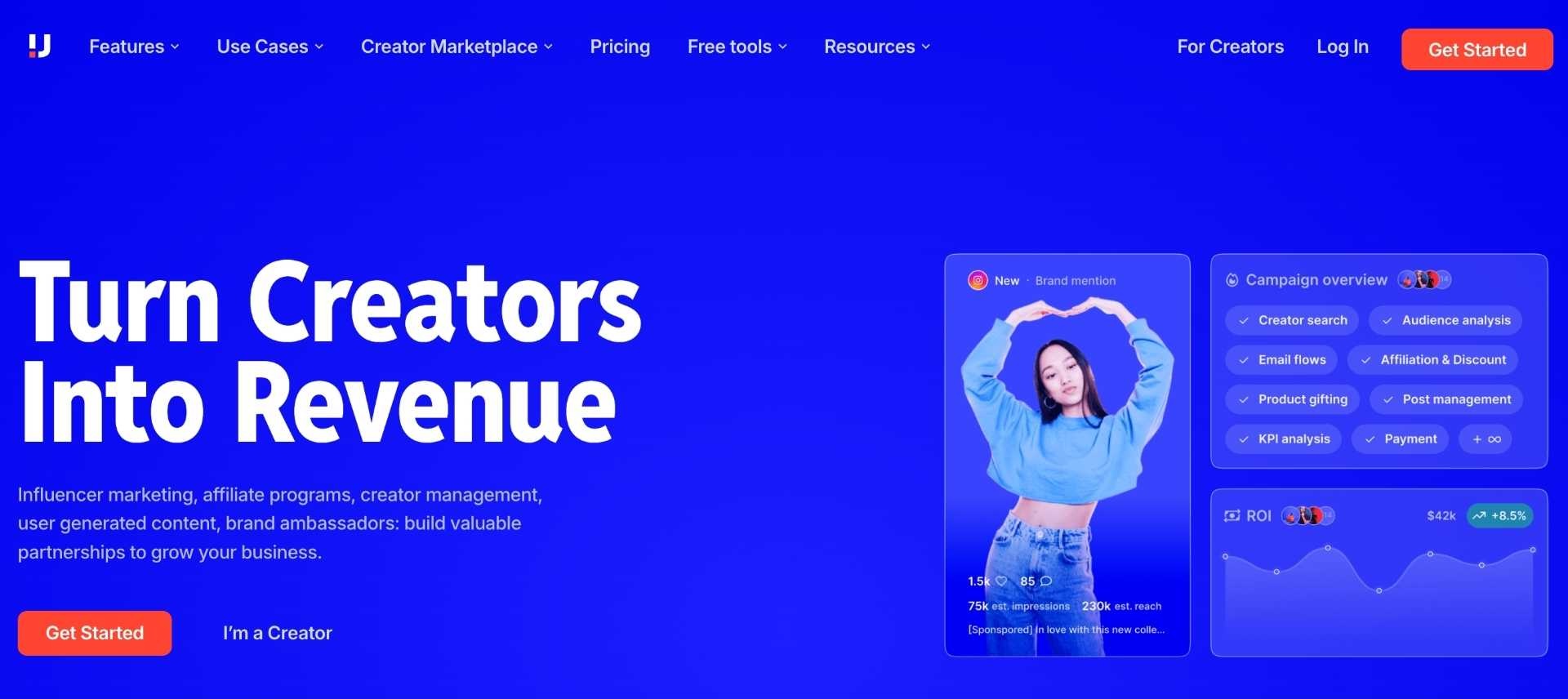
Upfluence is an influencer and affiliate marketing platform designed for brands that want to connect creator discovery, outreach, gifting, and ecommerce attribution in one system. Its official positioning is heavily ecommerce-centric, with particular strength for brands selling through Shopify, WooCommerce, Magento, BigCommerce, and Amazon.
Key Features
- Influencer discovery: Upfluence gives brands access to a large creator database with filters for audience, content, niche, and performance so teams can quickly shortlist relevant creators.
- Customer-to-creator matching: A standout capability is its ability to identify influencers already inside your customer or CRM lists, helping brands activate existing advocates.
- Bulk outreach and email automation: Upfluence supports mass outreach, templates, Gmail/Outlook syncing, and automated drip sequences for scaling communication.
- Jaice AI tools: The platform now emphasizes Jaice AI for creator search, campaign creation, and email personalization, which helps reduce manual setup work.
- Affiliate and discount-code workflows: Brands can generate promo codes, track sales, and run affiliate campaigns without fees on tracked sales.
- Product gifting and ecommerce analytics: Upfluence ties product sending and campaign execution to store data so brands can track clicks, conversions, and revenue instead of just engagement.
- Creator payments: Upfluence Pay adds creator payment, compliance, invoicing, and multi-currency payouts for teams that want a more end-to-end workflow.
Pricing
- Pricing model: Upfluence uses custom pricing rather than a public fixed plan table.
- All plans are custom made. There’s a minimum full year of service you have to commit to with monthly payments. On average plans start around $2,000/month ($24,000 yearly)
Reviews
4.3/5.0 (Capterra)
Pros
- Excellent fit for eCommerce brands: Upfluence’s strongest differentiator is how tightly it connects influencer campaigns with store data, customer lists, promo codes, gifting, and sales attribution.
- Jaice AI adds a more current AI layer: Jaice is one of the more visible recent AI positioning updates in the category, aimed at speeding campaign creation and execution.
- Wide native integration ecosystem: Upfluence supports major commerce, email, payments, and automation tools, which helps brands avoid stitching together as many external systems.
Cons
- Annual commitment limits flexibility: A 12-month minimum contract is a meaningful constraint for brands still testing influencer software.
- Price transparency is limited: Upfluence’s public site does not show standard package pricing, which can make early-stage evaluation slower.
- User feedback still points to workflow friction: Review patterns mention setup complexity, clunky campaign edits, and some support inconsistency.
Integrations
- Shopify: Identify customers who are creators, automate gifting, and tie campaign activity back to store sales.
- Amazon: Attribute influencer-driven sales and affiliate activity to Amazon storefront performance.
- Klaviyo: Connect influencer and affiliate activity with lifecycle email workflows.
- Stripe: Support payment-related campaign workflows alongside commerce attribution.
IMAI (InfluencerMarketing.AI) vs Upfluence
Upfluence is much more commerce-specific than IMAI. Where IMAI emphasizes a wider AI marketing ecosystem around influencer discovery, campaign tracking, consumer intelligence, and LLM visibility, Upfluence is more explicitly built to connect creators to store data, affiliate workflows, promo codes, gifting, and revenue attribution. That makes Upfluence the stronger option for brands whose influencer strategy is tightly linked to Shopify or Amazon performance.
IMAI is easier to evaluate on pricing because it publishes structured plans, while Upfluence currently routes buyers through custom pricing and a 12-month minimum contract. In practical terms, IMAI is better suited to teams wanting broader AI marketing functionality around influencer programs, while Upfluence is better for operators who want influencer marketing tightly fused with affiliate and eCommerce systems.
3. CreatorIQ

CreatorIQ is an enterprise creator marketing platform built for large brands and agencies running high-volume, cross-functional programs. Its current messaging centers on being an AI-native operating system for creator marketing, with heavy emphasis on governance, compliance, first-party platform partnerships, and unified measurement across paid, owned, earned, commerce, and community.
Key Features
- Creator discovery and intelligence: CreatorIQ uses its Creator Graph and content-first data model to help teams identify, evaluate, and organize creators at enterprise scale.
- AI-native workflows: The platform now explicitly positions itself as AI-native, which shows up in creator intelligence, workflow support, and data organization across the creator lifecycle.
- Enterprise reporting and governance: CreatorIQ is built for teams that need strong approvals, brand safety, permissions, and structured reporting rather than lightweight campaign management.
- Platform-partner data access: CreatorIQ highlights direct partnerships with TikTok, YouTube, Meta, Snapchat, and others, giving brands access to more reliable first-party data flows.
- Creator payments and compliance: CreatorIQ Pay automates creator onboarding, payments, tax collection, and audit-ready records for global teams.
- Cross-team collaboration: The platform is designed for organizations where marketing, legal, finance, and regional teams all need visibility into creator work.
- Integrations and API connectivity: CreatorIQ supports API-based integrations and external system connections for brands that need creator data to feed broader reporting and marketing stacks.
Pricing
There are different plans:
- Basic Plan: Starts at $35,000/year. Includes 1,000 contact creators per month
- Standard Plan: Starts at $50,000/year. Includes 2,500 contact creators per month
- Professional Plan: Starts at $90,000/year. Includes 5,000 contact creators per month
- Enterprise Plan: Starts at $200,000/year. Includes 7,500 contact creators per month
Reviews
4.4/5.0 (Capterra)
Pros
- SafeIQ is a meaningful newer differentiator: CreatorIQ’s AI-native brand safety layer is one of the clearest recent product updates among enterprise influencer platforms.
- Deep enterprise data infrastructure: ExchangeIQ and the platform’s API posture make CreatorIQ especially strong for organizations that need creator data inside internal BI and marketing systems.
- Strong official-platform positioning: CreatorIQ continues to differentiate on first-party access and official relationships, especially with TikTok and YouTube-related data initiatives.
Cons
- Pricing is enterprise-first and less transparent: CreatorIQ requires a sales process and is generally better aligned with large budgets than mid-market DTC teams.
- Complexity is part of the tradeoff: The platform is powerful, but user feedback consistently suggests a steeper learning curve than more operationally lightweight tools.
- Some users still flag analytics freshness and reporting friction: Review feedback mentions occasional outdated analytics and limitations in day-to-day reporting workflows.
Integrations
- Shopify: Used for creator gifting and product selection workflows tied to commerce programs.
- TikTok: CreatorIQ highlights direct TikTok creator data access through Creator Marketplace integration.
- Meta / Instagram / Facebook: Supports creator ad permissions and paid amplification from connected creator accounts.
- YouTube: CreatorIQ recently announced deeper YouTube partnership and audience-insight integration for smarter campaign planning.
- Internal BI systems via ExchangeIQ/API: ExchangeIQ lets brands move creator data into internal dashboards and enterprise systems for unified reporting.
IMAI (InfluencerMarketing.AI) vs CreatorIQ
CreatorIQ is much more enterprise-governed than IMAI. IMAI is broader in the sense that it bundles influencer marketing with adjacent AI marketing products, but CreatorIQ is more purpose-built for large organizations that need governance, compliance, brand safety, paid social permissions, and deep API-driven integration with internal systems. If a team is managing global programs across many stakeholders, CreatorIQ is the more enterprise-native option.
IMAI is likely the simpler fit for teams that want influencer software plus adjacent intelligence tools without going all the way into enterprise operating-system territory. CreatorIQ, by contrast, is stronger where internal control, platform partnerships, and high-confidence governance matter more than pricing transparency or quick setup.
4. Influencer Hero

Influencer Hero is an all-in-one influencer marketing platform aimed at DTC brands, ecommerce teams, and agencies that want discovery, outreach, CRM, gifting, affiliate tracking, content collection, and revenue attribution in one place. Its current positioning is especially strong for brands that want scalable automation without jumping to enterprise-only pricing.
Key Features
- Influencer discovery: Influencer Hero helps teams find creators with search filters, performance signals, lookalikes, and fake-follower checks.
- Bulk outreach and AI workflows: The platform supports personalized bulk outreach, automation rules, drip campaigns, and workflow triggers for scaling communication.
- Influencer CRM: Centralized pipeline to manage creators by campaign stage, track conversations, approvals, and deliverables without relying on spreadsheets
- Product seeding and gifting: Influencer Hero syncs with ecommerce systems so teams can create and track gifting orders and dispatch products without manual spreadsheets.
- Affiliate and revenue tracking: The platform supports affiliate links, discount codes, conversions, commissions, and storefront-style monetization.
- Campaign reporting & ROI tracking: Real-time dashboards showing engagement, clicks, conversions, and revenue attribution per influencer
- Content and UGC library: Captures creator content automatically and stores it for reuse and performance analysis.
- Wide integrations ecosystem: Influencer Hero positions integrations as a major differentiator across ecommerce, email, support, and workflow tools.
- Application pages & creator storefronts: Build branded pages for inbound creator applications and enable influencers to promote products via personalized storefronts
- API & integrations: Flexible API access plus integrations with tools like Klaviyo, Slack, Zapier, and email platforms for custom workflows and automation
Pricing
Influencer Hero offers flexible pricing based on outreach volume and you can have unlimited creators in your CRM:
- Standard — $649/month (up to 1,000 outreach messages per month)
- Pro — $1,049/month (up to 5,000 outreach messages per month)
- Business — $2,490/month (up to 10,000 outreach messages per month)
- Custom / Agency — Tailored pricing
Custom pricing is available for agencies and larger teams
Reviews
4.9/5.0 (Capterra)
Pros
- Strong workflow automation for lean teams: Influencer Hero’s biggest differentiator is how much of the day-to-day campaign operation it tries to automate, from outreach to attribution and payments.
- Creator storefront strategy is a newer growth lever: The Creator Hero integration gives brands a more persistent commerce layer than one-off influencer campaigns.
- Stronger creator-brand fit through data: Features like brand follower identification and AI-powered UGC search help teams find creators who already engage with the brand or produce relevant content, improving authenticity and campaign performance.
Cons
- Still requires setup discipline: Brands wanting advanced tracking, gifting, and automation may need more thoughtful initial implementation than with lighter discovery-only tools.
- No free trial: Makes it harder for teams to evaluate the platform before committing
Integrations
- Shopify: Connect store products, orders, codes, and sales attribution directly to creator campaigns.
- Klaviyo: Match creators against your audience and export influencer data into Klaviyo flows and segments.
- Gorgias: Surface influencer context inside support tickets so teams can prioritize high-impact creator issues.
- Slack: Send real-time campaign and creator activity alerts to internal teams.
- Creator Hero: Sync creator storefront performance and product catalogs with influencer campaign reporting.
IMAI (InfluencerMarketing.AI) vs Influencer Hero
IMAI positions itself as a broader AI-powered marketing suite, while Influencer Hero is more execution-focused for eCommerce and DTC brands. Influencer Hero brings discovery, outreach, CRM, gifting, affiliate tracking, payouts, UGC management, and storefront-driven revenue attribution into one tightly integrated workflow, making it feel like a system built for running creator campaigns end-to-end. In comparison, IMAI extends beyond influencer marketing into areas like consumer intelligence, PR, and AI-driven insights, so it operates more as a multi-product platform with influencer tools as one part of a larger ecosystem.
In terms of pricing, both platforms sit in a similar range, but the structure differs. Influencer Hero bases pricing on outreach volume while allowing unlimited creators in the CRM, which fits teams scaling outbound programs. IMAI, on the other hand, uses a more modular structure with limits on workspaces, CRM records, and access to its broader intelligence features. As a result, brands focused on execution, automation, and direct eCommerce attribution will typically find Influencer Hero more aligned, while those looking for a wider AI marketing stack may lean toward IMAI.
5. NeoReach
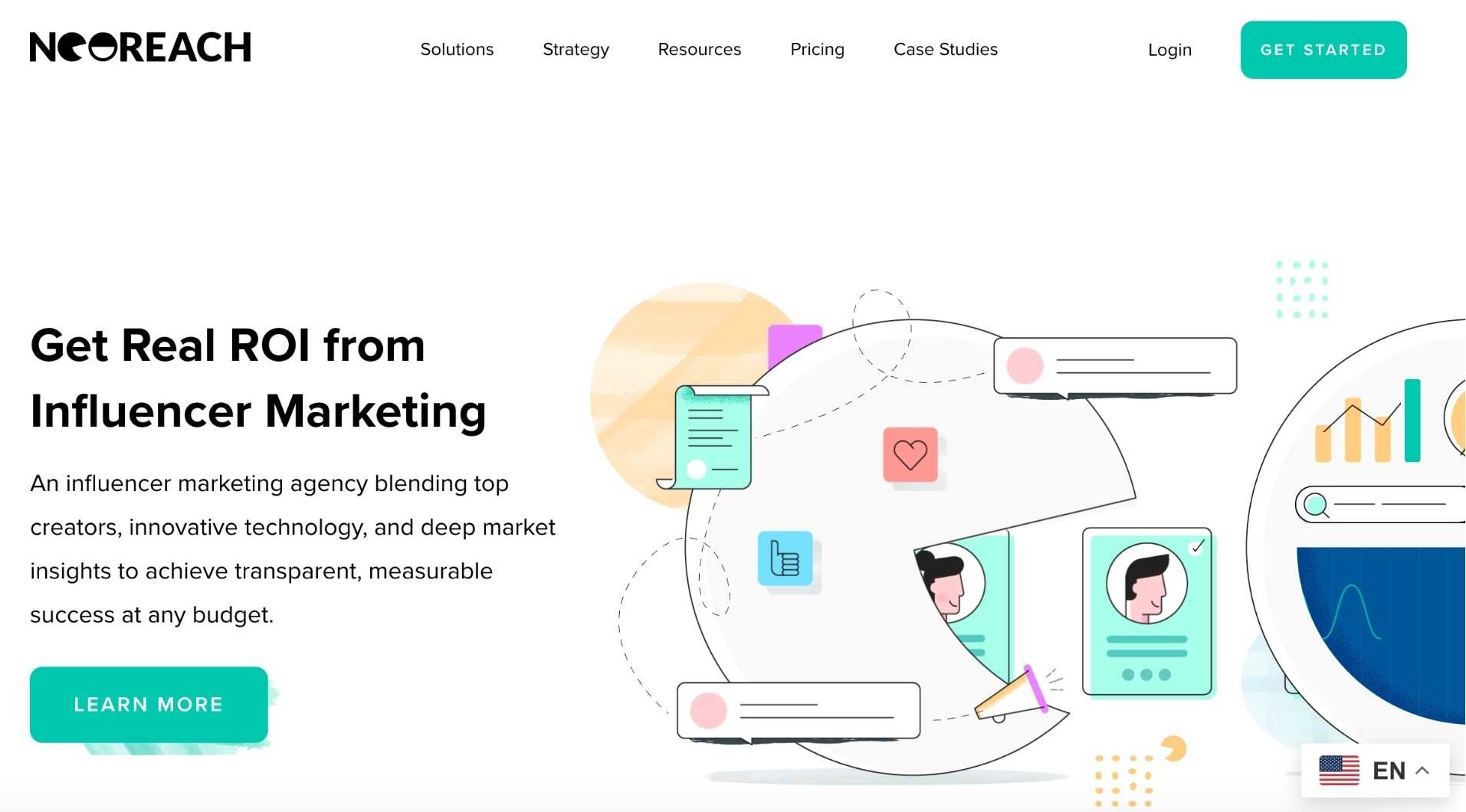
NeoReach is an enterprise influencer marketing platform that combines software, API access, fraud detection, and managed services. Unlike tools that focus mainly on self-serve discovery or CRM, NeoReach positions itself as both a technology platform and a hands-on campaign partner for larger brands that want strategy, paid media amplification, and data infrastructure in the same ecosystem.
Key Features
- Influencer discovery and campaign search: NeoReach provides creator search, campaign management, and tracking across influencer programs.
- API and data access: A major differentiator is NeoReach’s API layer, which exposes 400+ custom data points and 100+ custom endpoints for brands that want to feed creator data into internal dashboards and systems.
- Fraud detection: NeoReach strongly emphasizes fraud and authenticity analysis, including detection of fake followers, likes, and suspicious engagement patterns.
- Managed services: NeoReach offers full-service campaign support covering strategy, recruitment, activation, and performance, not just self-serve tooling.
- Paid media amplification: NeoReach also offers paid ad amplification, giving brands a way to scale creator content into performance media.
- Global automated payments: The platform highlights automated creator payments and enterprise-ready infrastructure for larger programs.
- Product seeding support: NeoReach also supports product seeding and distribution as part of its broader campaign offering.
Pricing
- Pricing model: NeoReach uses custom pricing and its official pricing page routes prospects to sales for both managed campaigns and platform/API access.
- Official public packaging: NeoReach publicly distinguishes Influencer Campaigns (managed service) and Platform & API offerings.
- Starting price (third-party listing): Capterra lists a starting price of $399/user/month, though NeoReach’s own site does not show a public rate card.
Reviews
4.5/5.0 (G2)
Pros
- Strong enterprise API story: NeoReach’s API depth is one of its clearest differentiators, especially for brands wanting creator data in internal dashboards and custom tooling.
- Combines software with managed services: Brands can use NeoReach as a platform, a service layer, or both, which gives it more flexibility than pure software vendors.
- Fraud detection remains a notable strength: NeoReach continues to emphasize fraud detection and audience-quality analysis as a core value proposition.
Cons
- No transparent public pricing tiers: Buyers need to go through sales for software and services, which slows quick comparison.
- Platform messaging is more enterprise-oriented than SMB-friendly: The product is clearly designed for scale, internal integrations, and larger programs rather than lightweight creator outreach.
- Less self-serve clarity than newer SaaS competitors: Compared with tools publishing detailed plans and onboarding flows, NeoReach’s site still leans more consultative.
Integrations
- REST API: Connect NeoReach data directly into internal apps, dashboards, and reporting systems using JSON-returning endpoints.
- Client Portal: Centralizes access for brand-side users managing campaigns and reporting.
- Creator Portal: Gives creators a dedicated environment for participation and account management.
- Internal BI / enterprise dashboards: NeoReach explicitly positions its API for integration into in-house workflows and dashboards.
- Paid social platforms: NeoReach supports paid amplification of influencer content across major social platforms as part of its broader managed solution.
IMAI (InfluencerMarketing.AI) vs NeoReach
IMAI and NeoReach overlap on influencer discovery, analytics, and campaign measurement, but NeoReach is more enterprise-services-oriented. NeoReach pairs software with managed execution, API access, fraud detection, and global payment infrastructure, while IMAI is more clearly packaged as an AI marketing platform with influencer software sitting alongside other intelligence products. For brands that want a hands-on partner and deeper API flexibility, NeoReach has the edge.
IMAI is the more accessible fit for teams that want a defined SaaS product with published pricing and broader adjacent AI-marketing features. NeoReach is better suited to larger organizations that want software plus service, stronger custom data access, and a more enterprise-style operating model.


6. Lefty
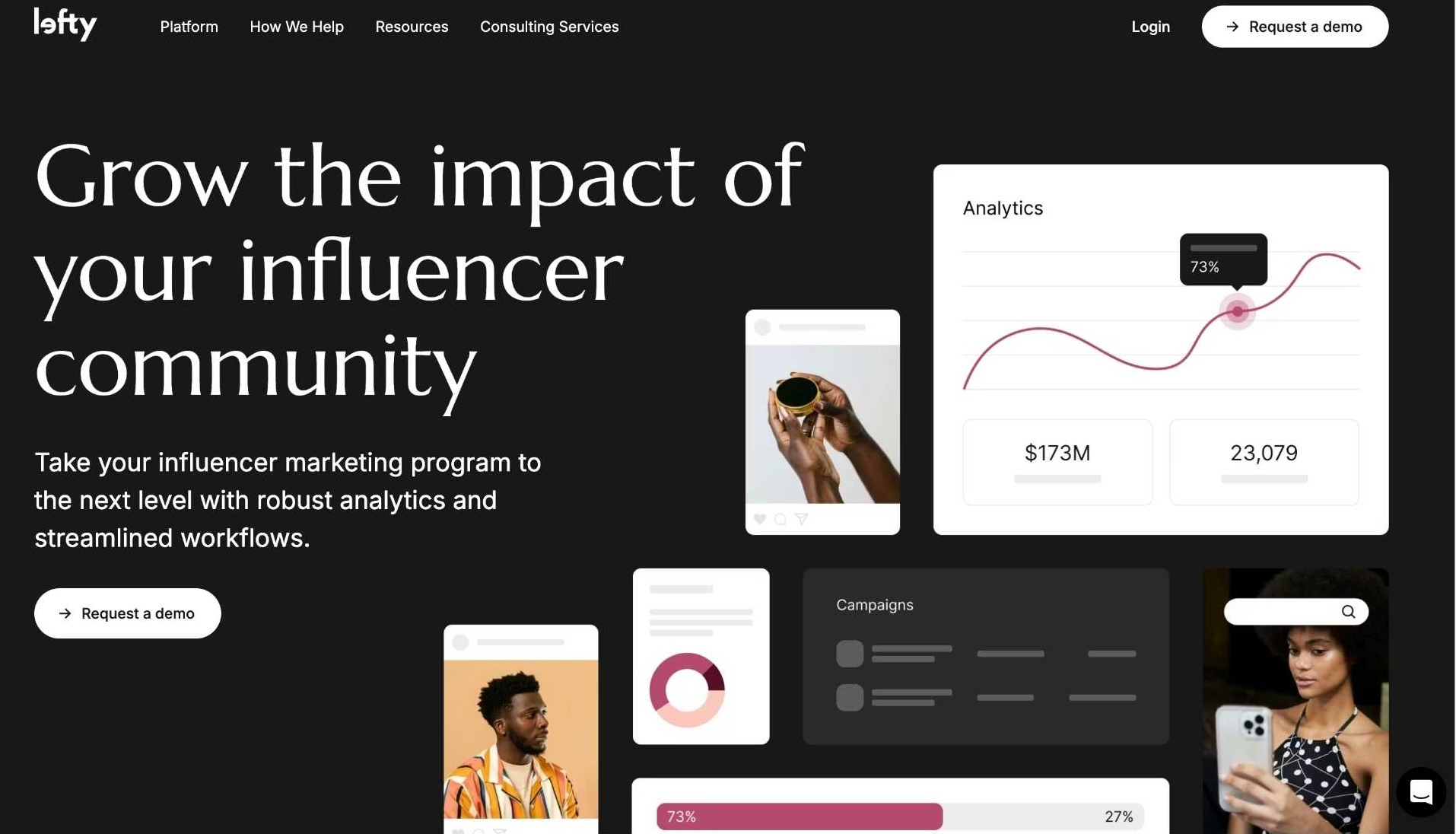
Lefty is an influencer marketing platform focused on helping brands discover creators, manage campaigns, and track performance across social media. It positions itself as a data-driven platform with a strong emphasis on influencer analytics, campaign reporting, and streamlined workflows for mid-sized to enterprise teams.
Key Features
- Influencer discovery: Lefty provides access to a large creator database with filters for demographics, audience quality, engagement, and content type to help brands find relevant influencers quickly.
- Campaign management: Teams can manage end-to-end campaigns including creator selection, outreach, deliverables, and approvals within a centralized dashboard.
- Performance analytics: Offers detailed reporting on engagement, reach, impressions, and ROI to evaluate campaign success and optimize future efforts.
- Audience insights: Provides deep insights into influencer audiences, including demographics, interests, and authenticity metrics to ensure better brand alignment.
- Content tracking: Tracks influencer posts and content performance in real time, helping brands monitor results as campaigns go live.
- Collaboration tools: Enables team collaboration through shared dashboards, notes, and workflow tracking for multi-user environments.
Pricing
- Starting Price: ~€590 per month.
- Pro Plan: ~€990/month, including 2 users, 5 campaigns, and unlimited reports.
- Premium Plan: ~€1,690/month, which adds a dedicated manager.
- Premium+ Plan: ~€3,490/month for 10 users and 25 campaigns.
Reviews
4.7/5.0 (G2)
Pros
- Best-in-class visual discovery: Lefty’s visual search capability stands out for brands that prioritize aesthetics and brand alignment over pure data filtering.
- Strong competitive intelligence tools: The ability to analyze competitor influencer campaigns is a major differentiator for strategy teams.
- Clean UI and usability: Users frequently highlight Lefty’s intuitive interface compared to more complex enterprise tools.
Cons
- Limited pricing transparency: No public pricing makes it harder for smaller teams to evaluate.
- Less focus on eCommerce workflows: Compared to tools like GRIN or Upfluence, it lacks deep Shopify or affiliate integrations.
- Primarily suited for lifestyle verticals: Stronger in fashion/beauty than in broader B2B or niche industries.
Integrations
- Instagram: Track influencer posts, engagement, and campaign performance directly.
- TikTok: Monitor creator performance and campaign reach across short-form content.
- Google Analytics: Connect campaign performance to website traffic and conversions.
- Slack: Share campaign updates and alerts with internal teams.
- Export tools (CSV/API): Export campaign data for deeper analysis or reporting.
IMAI (InfluencerMarketing.AI) vs Lefty
IMAI offers a broader AI-driven marketing suite with influencer discovery, campaign tracking, and additional tools like consumer intelligence and PR insights, whereas Lefty is more specialized in visual discovery and brand alignment. Lefty is particularly strong for brands that prioritize aesthetic fit and competitor benchmarking, while IMAI provides a more comprehensive platform for managing influencer marketing alongside other marketing intelligence functions.
Additionally, IMAI offers more transparent pricing tiers and a wider feature set beyond influencer marketing, while Lefty is more focused but less flexible in pricing visibility. Brands looking for a design-led discovery experience may prefer Lefty, whereas those seeking a more holistic marketing platform may lean toward IMAI.
7. Insense
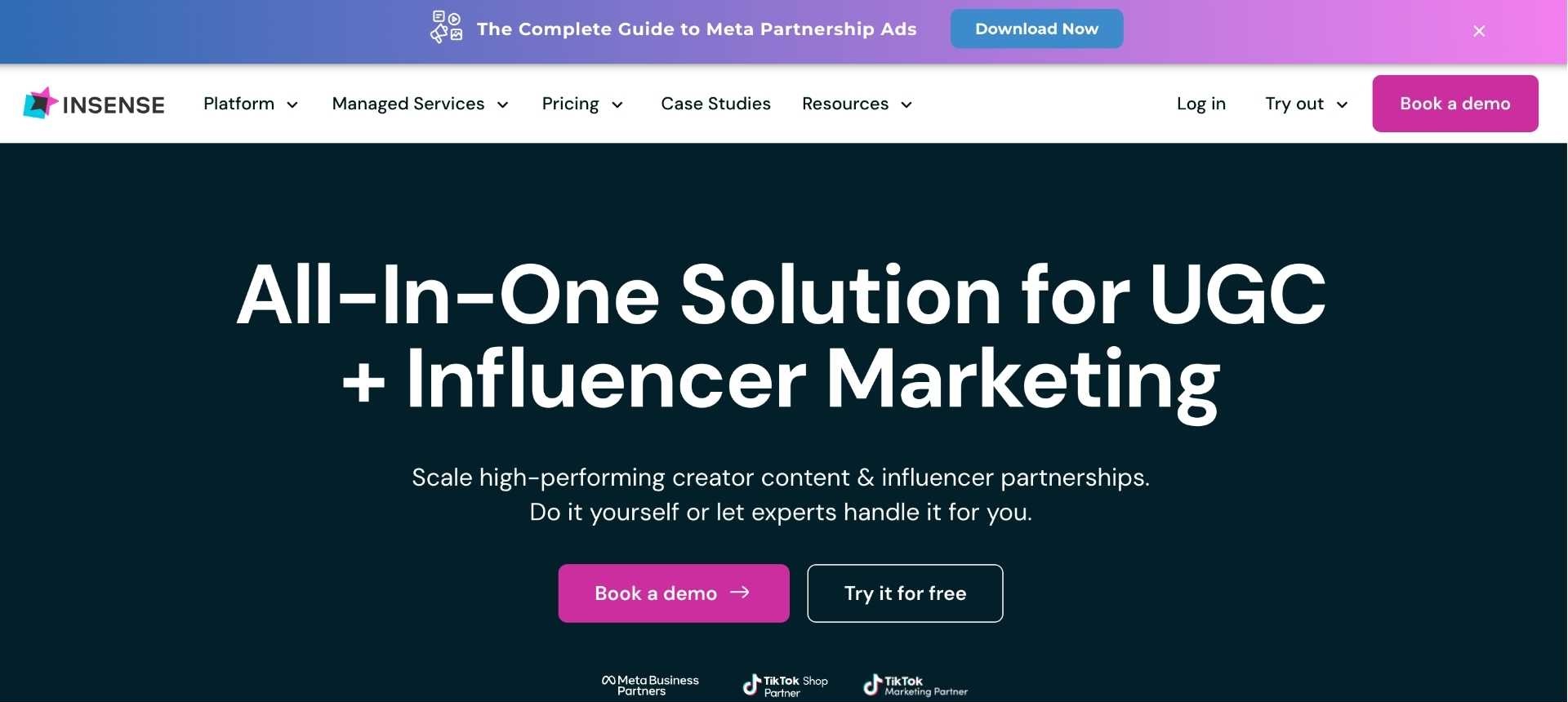
Insense is a creator marketing platform designed primarily for brands running UGC and paid social campaigns. It focuses heavily on connecting brands with vetted creators who produce ad-ready content, making it particularly popular among ecommerce and performance marketing teams.
Key Features
- UGC marketplace: Brands can post campaign briefs and receive applications from creators, streamlining the hiring process.
- Creator sourcing: Access to a curated network of creators specializing in producing ad-ready content.
- Content production workflows: Manage briefs, approvals, revisions, and delivery of creative assets within the platform.
- Paid media integration: Supports running influencer-generated content directly as ads on platforms like Meta and TikTok.
- Performance tracking: Tracks engagement and ad performance metrics for content created through campaigns.
- Whitelisting support: Enables brands to run ads from creator accounts for better performance and authenticity.
Pricing
- Trial: from $650/month, with an option to upgrade to a quarterly plan.
- Brand plan: from $500/month billed quarterly or $400/month billed annually.
- Agency plan: from $800/month billed quarterly or $640/month billed annually.
- Self-serve plans auto-renew every 3 months on quarterly billing, and creator payments are budgeted separately through a marketplace fee model.
Reviews
4.5/5.0 (G2)
Pros
- Strong UGC + paid ads workflow: One of the best platforms for turning influencer content into ad creatives.
- Marketplace model simplifies sourcing: Brands can receive inbound creator applications quickly.
- Fast campaign execution: Streamlined workflows make it easy to launch campaigns quickly.
Cons
- Limited influencer discovery depth: Less robust search compared to large databases like IMAI or Modash.
- Focused on content rather than relationships: Not ideal for long-term influencer CRM strategies.
- Reporting depth can be limited for advanced users
Integrations
- Meta Ads (Facebook/Instagram): Launch and optimize ads using influencer-generated content.
- TikTok Ads: Use creator content directly in TikTok ad campaigns.
- Shopify: Connect campaigns with product catalog and track performance.
- Google Drive: Store and manage content assets.
- Slack: Receive campaign notifications and updates.
IMAI (InfluencerMarketing.AI) vs Insense
IMAI is a full-scale influencer marketing platform with discovery, CRM, and analytics, while Insense is more focused on UGC production and paid social execution. Insense excels in helping brands quickly generate ad-ready content, whereas IMAI is better suited for managing long-term influencer relationships and large-scale discovery.
For brands prioritizing content creation and ad performance, Insense is more specialized. However, for broader influencer marketing strategy, campaign tracking, and AI-driven insights, IMAI offers a more complete solution.
8. Kolsquare

Kolsquare is a European influencer marketing platform designed for brands and agencies looking to manage campaigns with a strong emphasis on data transparency, compliance, and audience quality.
Key Features
- Influencer discovery: Access to millions of influencer profiles with advanced filters for audience demographics, engagement, and niche.
- Audience credibility scoring: Helps brands evaluate influencer authenticity and detect fake followers.
- Campaign management: Manage outreach, collaboration, and performance tracking in one platform.
- Performance analytics: Tracks campaign metrics including engagement, reach, and ROI.
- Compliance tools: Supports regulatory compliance, particularly for European markets.
- Content tracking: Monitors influencer posts and performance across campaigns.
Pricing
- Pricing is custom and quote-based
- Typically structured as annual contracts depending on usage and features
Reviews
- 4.5/5.0 (G2)
Pros
- Strong compliance focus: Particularly valuable for brands operating in regulated markets.
- Detailed analytics: Offers strong reporting capabilities for campaign performance.
- Good multi-market support: Designed for brands managing campaigns across different regions.
Cons
- Limited pricing transparency
- Less focus on eCommerce integrations compared to competitors
- Interface can feel complex for new users
Integrations
- Instagram: Track campaign performance and influencer activity.
- TikTok: Monitor engagement and reach across campaigns.
- Google Analytics: Connect influencer campaigns to site performance.
- CRM tools: Export influencer data into external systems.
- Reporting tools (CSV/API): Export campaign data for analysis.
IMAI (InfluencerMarketing.AI) vs Kolsquare
Kolsquare focuses heavily on analytics, compliance, and multi-market campaign management, while IMAI provides a broader AI-driven platform that includes influencer marketing alongside consumer intelligence and other tools. Kolsquare is particularly strong for European brands that need regulatory alignment, while IMAI offers a more flexible and globally oriented platform.
IMAI also provides more visible pricing tiers and a wider range of integrated marketing tools, whereas Kolsquare is more specialized but less transparent in its pricing and onboarding process.
9. Skeepers
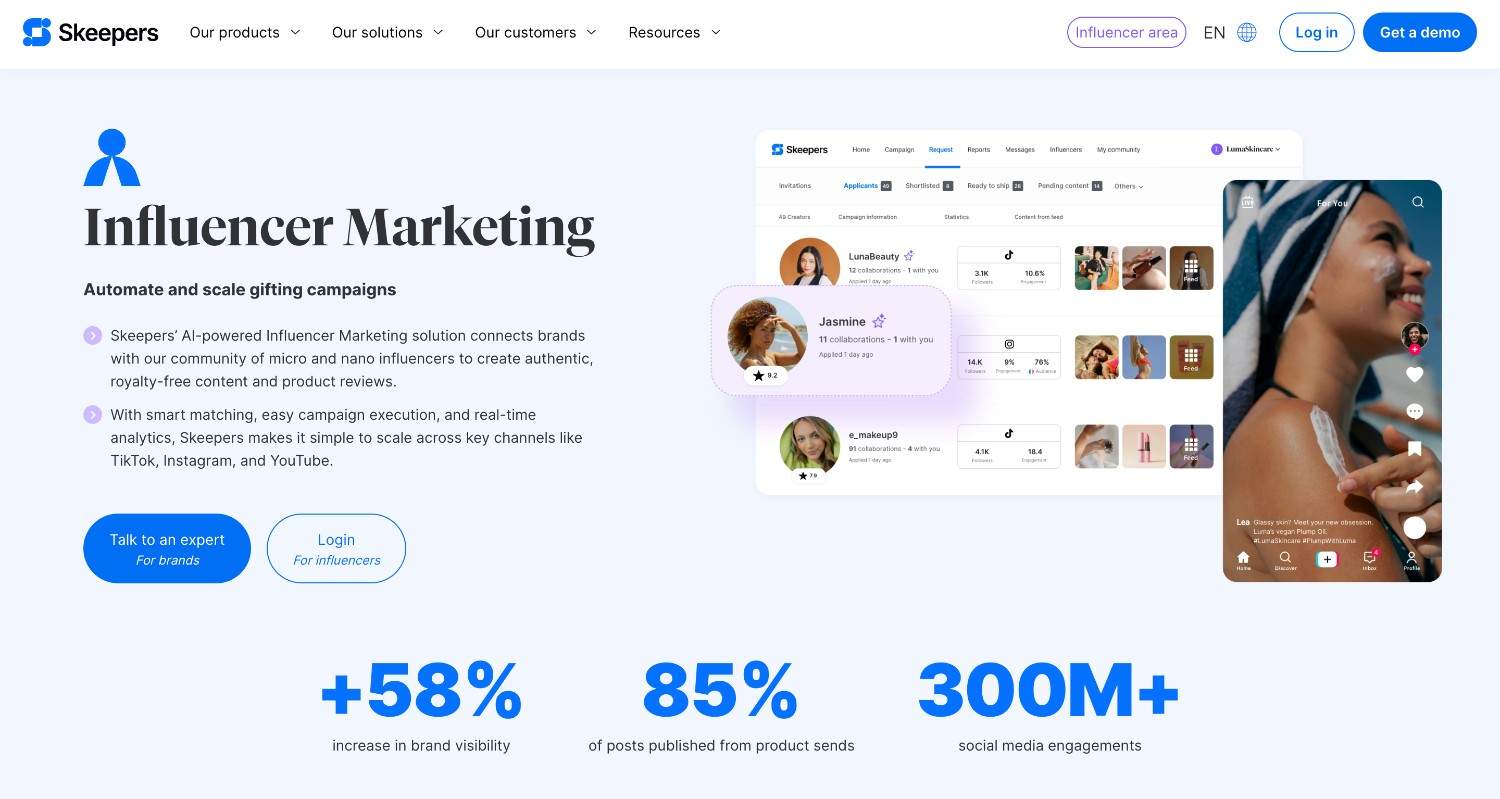
Skeepers is a broader user-generated content and customer engagement platform that includes influencer marketing as one of its modules. It focuses on turning customers and creators into brand advocates while integrating UGC into marketing strategies.
Key Features
- Influencer marketing module: Connect brands with micro and nano influencers for authentic content creation.
- UGC management: Collect, manage, and distribute user-generated content across channels.
- Ratings and reviews integration: Combines influencer marketing with customer reviews and social proof.
- Campaign management: Manage influencer collaborations and track performance.
- Content distribution: Repurpose influencer and customer content across ads, websites, and social media.
- Customer advocacy tools: Turn loyal customers into brand ambassadors.
Pricing
- Skeepers does not publicly list a detailed pricing table for Influencer Marketing on its main site.
- Capterra lists a starting price of €1,250/month and says no free trial is available.
Reviews
4.3/5.0 (Capterra)
Pros
- Strong UGC ecosystem: Combines influencer marketing with reviews and customer content.
- Multi-channel content activation: Enables brands to reuse content across multiple channels.
- Focus on conversion and trust-building
Cons
- Less focused on influencer discovery depth
- Pricing not transparent
- More suited to content/UGC strategy than full influencer lifecycle management
Integrations
- Shopify: Use UGC and influencer content directly on product pages.
- Magento: Integrate content into eCommerce workflows.
- Meta Ads: Use UGC in paid campaigns.
- Google Analytics: Track performance impact.
- CRM systems: Sync customer and influencer data.
IMAI (InfluencerMarketing.AI) vs Skeepers
Skeepers is primarily a UGC and reviews platform with influencer capabilities, while IMAI is a dedicated influencer marketing platform with broader AI-driven features. Skeepers excels at content activation and trust-building across the customer journey, whereas IMAI is better for discovery, campaign management, and analytics.
Brands focused on conversion and content reuse may prefer Skeepers, while those looking for a full influencer marketing solution will find IMAI more comprehensive.
10. Creator.co
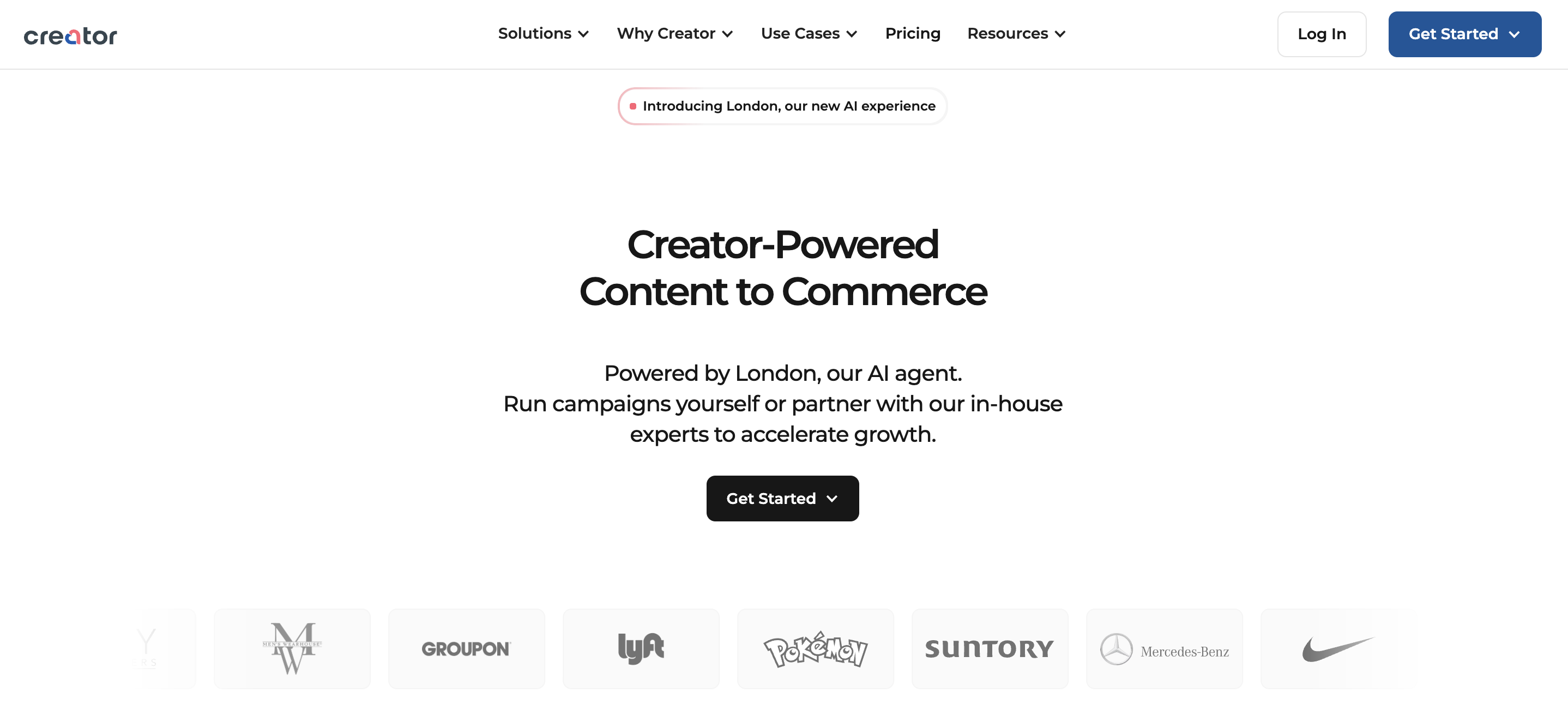
Creator.co is an influencer marketing platform and marketplace that connects brands with creators through both self-serve tools and managed campaign services. It is designed to simplify influencer marketing for brands of all sizes, particularly those looking for flexible and scalable solutions.
Key Features
- Creator marketplace: Brands can browse and connect with influencers directly or receive applications for campaigns.
- Campaign management: Manage outreach, collaboration, and performance tracking within the platform.
- Managed services: Offers full-service campaign execution for brands that want hands-off support.
- Content creation workflows: Handle briefs, approvals, and deliverables in one place.
- Performance tracking: Tracks engagement and campaign performance metrics.
- Subscription-based access: Allows brands to scale influencer efforts with predictable costs.
Pricing
- Self-Serve: $299/month, with a 3-month minimum commitment.
- Managed: $2,199/month, with a 3-month minimum commitment.
- Enterprise: Custom pricing, with an annual commitment.
- The pricing page also notes that after the initial term, monthly subscriptions move to month-to-month billing, while annual plans renew yearly at a discounted rate.
- Creator.co offers a free trial for Self-Serve.
Reviews
4.6 / 5.0 (G2)
Pros
- Hybrid model (software + services): Offers flexibility for brands that want support.
- Easy creator sourcing via marketplace: Reduces time spent on outreach.
- Good for scaling campaigns quickly
Cons
- Less advanced analytics compared to enterprise tools
- Marketplace quality can vary
- Limited deep integrations compared to eCommerce-focused platforms
Integrations
- Shopify: Track influencer-driven sales and campaigns.
- Instagram: Manage influencer collaborations and track posts.
- TikTok: Monitor campaign performance.
- Google Analytics: Connect campaigns to website metrics.
- Stripe: Manage payments and transactions.
IMAI (InfluencerMarketing.AI) vs Creator.co
Creator.co combines a marketplace with managed services, making it easier for brands to launch campaigns quickly, while IMAI is more focused on providing a robust SaaS platform with AI-driven insights and campaign management tools. Creator.co is better suited for teams that want hands-on support or faster campaign execution, while IMAI is more appropriate for teams that want full control over strategy and analytics.
IMAI also offers a broader set of features beyond influencer marketing, while Creator.co focuses more narrowly on campaign execution and creator sourcing.
Final Thoughts
Choosing the right alternative to IMAI ultimately depends on your team’s priorities and maturity in influencer marketing. Platforms like GRIN, Upfluence, and Influencer Hero stand out for their strong eCommerce and revenue attribution capabilities, while CreatorIQ and NeoReach cater more to enterprise teams needing advanced data infrastructure and scalability. On the other hand, tools like Insense, Skeepers, and Creator.co are better suited for brands focused on UGC production and fast campaign execution. IMAI differentiates itself with a broader AI-driven ecosystem beyond influencer marketing, but many alternatives offer deeper specialization in areas like affiliate tracking, creator workflows, or content-driven growth.

.png)


.jpg)