

10 meilleures alternatives à TRIBE • Critères clés • Aperçu de TRIBE • Meilleures alternatives à TRIBE • Influencer Hero • Upfluence • Aspire • CreatorIQ • Later • IZEA • Traackr • Influencity • Heepsy • Lefty • Réflexions finales • FAQ
```10 meilleures alternatives à TRIBE pour le marketing d'influence
La gestion des campagnes d'influence est devenue un canal de croissance essentiel pour les marques D2C, mais la faire manuellement—de la découverte de créateurs et la prospection au suivi des performances et du ROI—devient rapidement inefficace à grande échelle. Les logiciels de marketing d'influence aident à rationaliser ces workflows, centraliser les relations avec les créateurs et lier les campagnes directement aux revenus. TRIBE est l'une des plateformes bien connues dans ce domaine, notamment pour son modèle de marché basé sur les propositions et son approche axée sur le contenu, mais de nombreuses équipes rencontrent des défis autour de la transparence des prix, des budgets minimums plus élevés, des pools de créateurs limités et des workflows moins flexibles pour la mise à l'échelle des campagnes. Le système basé sur les propositions peut également ralentir l'exécution pour les marques qui préfèrent la prospection directe et des délais d'exécution plus rapides. Pour les équipes évaluant des alternatives à Tribe ou explorant les logiciels de marketing d'influence pour la première fois, il est important de comprendre comment les autres plateformes se comparent en termes de fonctionnalités, de tarification et de cas d'usage.
Dans cet article, nous vous présenterons 10 des meilleures alternatives à TRIBE—notamment Influencer Hero, Upfluence, Aspire, CreatorIQ, Later, IZEA, Traackr, Influencity, Heepsy et Lefty—pour vous aider à trouver la solution adaptée à votre stratégie de croissance.
Critères clés pour évaluer les plateformes de marketing d'influence
Fonctionnalités essentielles
Évaluation des capacités essentielles de marketing d'influence, notamment la découverte de créateurs, la prospection, la gestion de la relation client, la gestion de campagnes, les rapports et les workflows de contenu.
Tarification et flexibilité
Comparaison des modèles de tarification, des plans d'abonnement et des conditions contractuelles pour répondre aux différents budgets et stades de croissance.
Avis des clients et satisfaction
Analyse des commentaires des utilisateurs provenant de plateformes d'évaluation de confiance, en mettant l'accent sur la facilité d'utilisation, la fiabilité, l'assistance client et les performances globales.
Avantages et inconvénients
Examen des forces et des limitations de chaque plateforme pour mettre en évidence où elle fonctionne bien et où elle peut être insuffisante en fonction de différents cas d'usage.
Intégrations
Examen des intégrations les plus importantes (par exemple, Shopify et autres outils technologiques), en mettant en évidence ce que chaque intégration permet en une phrase.
Présentation générale de TRIBE

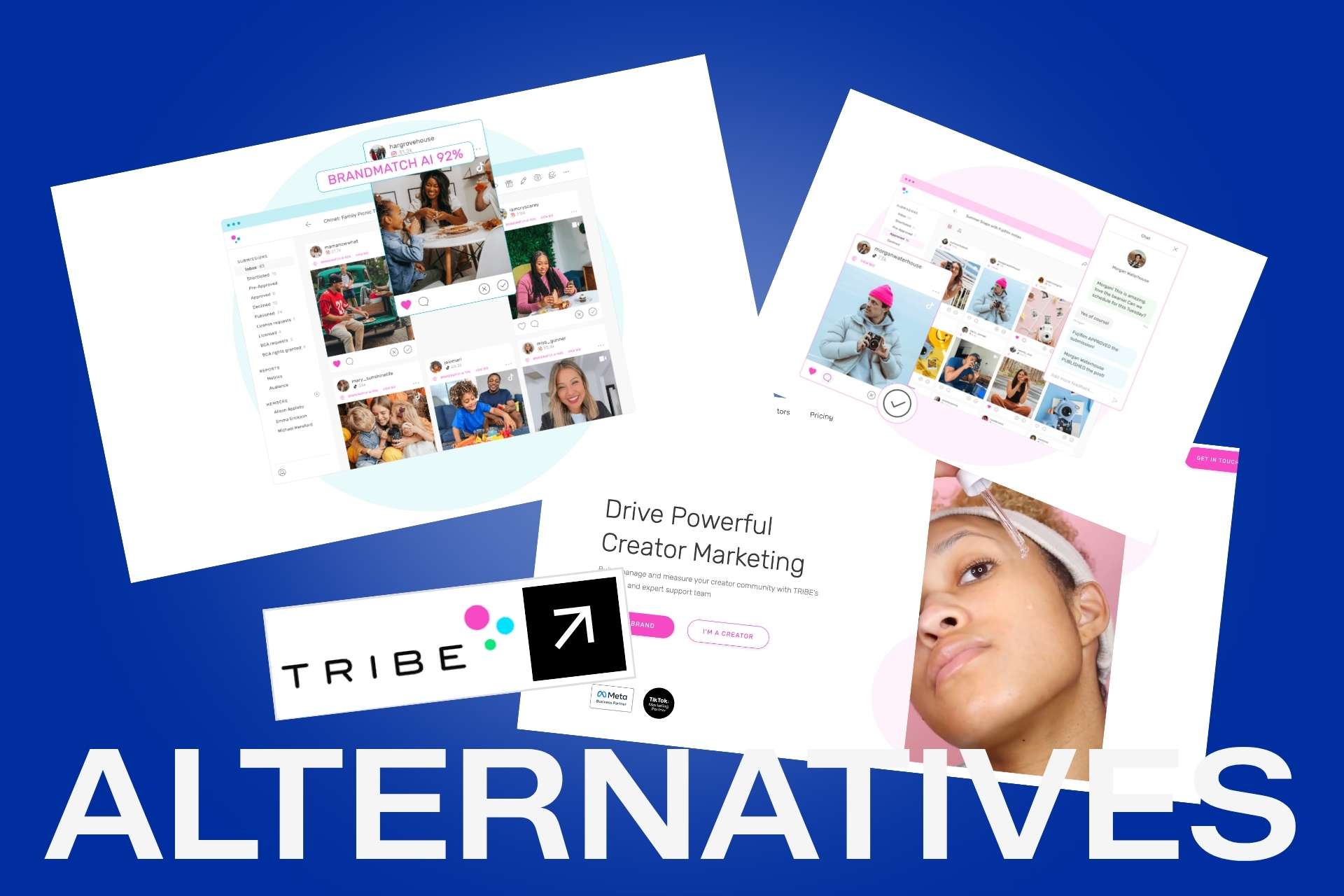
TRIBE est une plateforme de marché de créateurs et de marketing d'influence conçue pour aider les marques à sourcer, gérer et mettre à l'échelle les campagnes dirigées par des créateurs. Contrairement aux outils d'influence traditionnels qui s'appuient fortement sur la découverte sortante, TRIBE fonctionne sur un modèle opt-in où les créateurs proposent des idées de contenu directement aux marques. Cette approche « basée sur les propositions » permet aux spécialistes du marketing d'évaluer les concepts créatifs avant de s'engager sur le budget, ce qui la rend particulièrement efficace pour les campagnes axées sur le contenu.
La plateforme combine le sourcing de créateurs, la gestion de campagnes, la concession de licences de contenu et le suivi des performances dans un workflow unique. Elle offre également à la fois des services en libre-service et des services gérés, ce qui la rend adaptée aux marques qui souhaitent soit un contrôle pratique, soit un soutien stratégique supplémentaire.
Fonctionnalités clés
- Marché de créateurs opt-in
Les marques lancent des appels d'offres de campagnes et reçoivent des propositions de contenu de la part de créateurs, réduisant le besoin de prospection à froid et améliorant l'alignement créateur-marque dès le départ. - Approbation de contenu basée sur les propositions
Examinez les idées préalables et les concepts créatifs avant d'approuver les créateurs, ce qui contribue à assurer l'adéquation avec la marque et la qualité du contenu avant l'engagement des dépenses. - BrandMatch AI
Système de notation alimenté par l'IA qui classe les créateurs en fonction de l'adéquation avec la marque, en utilisant les données démographiques de l'audience et les exigences de la campagne pour prioriser les meilleures correspondances. - Données d'audience de première partie
Accédez à des insights d'audience fiables (âge, sexe, localisation) extraits directement de plateformes comme Instagram et TikTok, améliorant la précision du ciblage. - Workflow de gestion de campagnes
Gérez la communication avec les créateurs, les approbations, les contrats et les paiements dans un tableau de bord centralisé. - Concession de licences de contenu et bibliothèque d'actifs
Sécurisez les droits d'utilisation du contenu des créateurs et stockez les actifs approuvés dans une bibliothèque pour réutilisation dans les annonces payantes, les réseaux sociaux et les canaux détenus. - Amplification des médias payants
```Transformer les publications des créateurs en publicités via TikTok Spark Ads et Meta Partnership Ads, en étendant la portée du contenu performant. - Sécurité des marques et détection des fraudes
Vérifications d'authenticité intégrées et surveillance continue pour identifier les activités suspectes et maintenir la qualité des campagnes. - Services gérés (TRIBE Plus)
Option pour accéder à un service plus complet et entièrement géré pour l'exécution et la stratégie des campagnes.
Tarification
TRIBE suit un modèle de tarification hybride qui varie selon la région et l'utilisation :
- Modèle à l'usage
- Frais d'activation par campagne
- Marge de plateforme appliquée aux dépenses de campagne
- Généralement utilisé en dehors des États-Unis et du Canada
- Modèle par abonnement (contrat annuel)
- Frais annuels de plateforme (payés d'avance ou mensuellement)
- Marge de plateforme supplémentaire sur les dépenses de campagne
- TRIBE Plus (service géré)
- Tarification personnalisée basée sur l'envergure de la campagne ou accord annuel
- Inclut le soutien stratégique et opérationnel
Dépense minimale :
- ~10 000 $ pour les campagnes à l'usage
- ~2 000 $ pour les campagnes selon les plans d'abonnement
Avis
4,3 / 5,0 (G2)
Intégrations
- Instagram / Meta
Accédez aux informations d'audience propriétaires et diffusez des Partnership Ads en utilisant le contenu des créateurs. - TikTok
Suivez les performances des créateurs et amplifiez le contenu via Spark Ads. - Pinterest
Gérez les collaborations avec les créateurs et accédez aux informations d'audience pour vos campagnes. - Facebook (Account Linking)
Active l'authentification et la synchronisation des données pour les campagnes basées sur Instagram. - TikTok Ads Manager
Utilisez des codes d'autorisation pour promouvoir directement le contenu des créateurs en tant que publicités payantes.
Avantages
- La marketplace basée sur les propositions améliore la qualité du contenu
Le plus grand avantage distinctif de TRIBE est son flux de travail : les marques examinent les idées de contenu réelles avant d'approuver les créateurs. Cela réduit considérablement le risque de livrables de faible qualité et de partenariats mal alignés. - Accent fort sur la réutilisation du contenu et l'amplification payante
La plateforme est conçue non seulement pour la sensibilisation des influenceurs, mais aussi pour transformer le contenu des créateurs en actifs médias payants performants sur TikTok et Meta. - Appairage des créateurs alimenté par l'IA (BrandMatch)
BrandMatch aide les équipes à identifier rapidement les créateurs très compatibles en utilisant les données d'audience et de campagne, réduisant le temps de validation manuel et améliorant l'efficacité des campagnes.
Inconvénients courants de TRIBE
Manque de transparence tarifaire
Les coûts varient considérablement selon la géographie, le type de contrat et la structure de la campagne, ce qui rend plus difficile pour les équipes de comparer avec les concurrents.
Coût élevé pour les petites marques
Les budgets de campagne minimums et les marges de plateforme peuvent rendre TRIBE moins accessible pour les startups ou les équipes exécutant des programmes d'influenceurs plus petits.
Bassin de créateurs limité par rapport aux bases de données ouvertes
Parce que TRIBE repose sur une marketplace opt-in, elle n'offre peut-être pas la même diversité que les plateformes qui indexent des centaines de millions de profils publics.
Flexibilité limitée dans les flux de travail des campagnes
Certaines équipes trouvent le système structuré et basé sur les propositions restrictif, en particulier pour les collaborations répétées ou les campagnes à grand volume.
Le modèle basé sur les propositions peut ralentir l'exécution
Bien que précieux pour le contrôle de la qualité, la nécessité pour les créateurs de soumettre des propositions peut ajouter du temps à la configuration de la campagne par rapport aux plateformes d'outreach directe.
Meilleures alternatives à TRIBE
| OUTIL | AVIS | IDÉAL POUR | INFOS ESSAI | TARIFICATION | ||
|---|---|---|---|---|---|---|
1 |

|
⭐ | Influencer CRM & automatisation | Réserver une démo | Tarification | Site web |
2 |
```html

|
⭐ | Découverte d'influenceurs | Demander une démo | Tarification | Site web |
3 |

|
⭐ | Partenariats avec des influenceurs | Demander une démo | Tarification | Site web |
4 |

|
⭐ | Marketing d'influenceurs d'entreprise | Demander une démo | Tarification | Site web |
5 |

|
⭐ | Campagnes de médias sociaux et d'influenceurs | Demander une démo | Tarification | Site web |
6 |
|
⭐ | Marketplace d'influenceurs | Demander une démo | Tarification | Site web |
7 |

|
⭐ | Analytics d'influenceurs d'entreprise | Demander une démo | Tarification | Site web |
8 |

|
⭐ | Gestion de campagnes | Demander une démo | Tarification | Site web |
9 |

|
⭐ | Découverte d'influenceurs | ``````html Réserver une démo | Tarification | Site web |
10 |

|
⭐ | Analytics influenceur & découverte | Réserver une démo | Tarification | Site web |

Influencer Hero
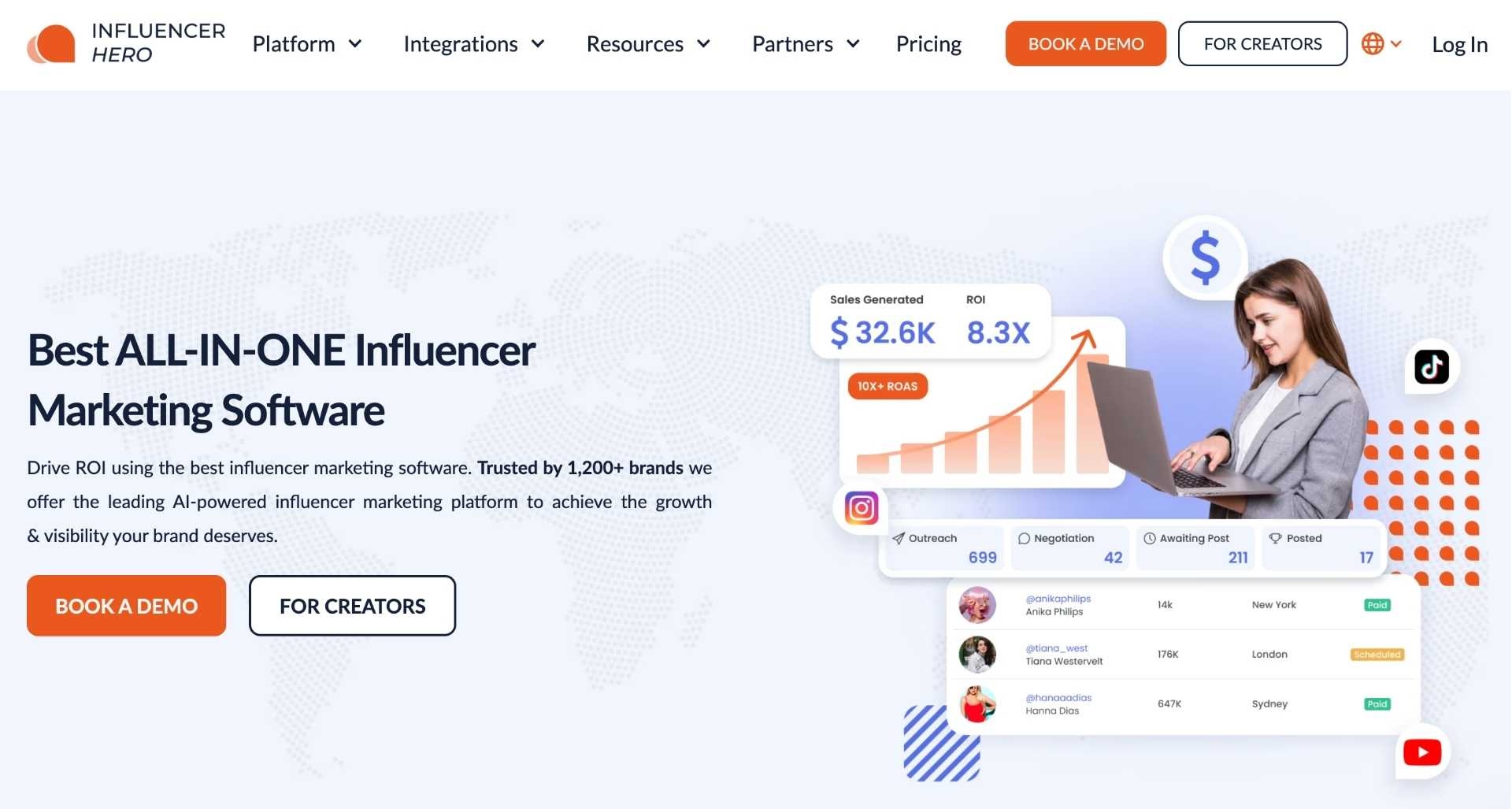
Influencer Hero est une plateforme de marketing d'influence tout-en-un conçue pour les marques DTC et e-commerce qui souhaitent la découverte de créateurs, la prospection, l'envoi de produits, le suivi des affiliés, la collecte UGC, et l'attribution des revenus dans un seul système. Comparée aux outils plus orientés vers l'entreprise, son positionnement est plus opérationnel et axé sur le ROI, avec des plans flexibles et une structure d'engagement plus courte qui fonctionne bien pour les marques en croissance.
Fonctionnalités clés
- Découverte de créateurs avec CRM intégré — Trouvez des créateurs avec des filtres pour la démographie du public, la géographie, l'engagement et les lookalikes, puis déplacez-les directement dans les pipelines de campagne sans exporter de données entre les outils.
- Prospection en masse et automatisation du flux de travail — Lancez une prospection un-à-un ou en masse avec des modèles, des suivis au goutte-à-goutte et des automations basées sur des règles qui font progresser les créateurs dans les étapes de la campagne automatiquement.
- CRM centré sur la campagne — Suivez la prospection, les négociations, l'envoi de produits, les livrables et le ROI dans des tableaux structurés conçus pour les programmes de créateurs à haut volume.
- Envoi de produits et seeding — Connectez votre boutique, envoyez des produits directement depuis la plateforme, et gardez l'exécution des commandes liée aux campagnes d'influenceurs au lieu de la gérer dans des feuilles de calcul.
- Suivi des affiliés et paiements automatisés — Générez des liens et des codes de réduction, attribuez les clics et les ventes à des créateurs individuels, et gérez les commissions des créateurs dans un seul flux de travail.
- Bibliothèque UGC et vitrines — Collectez automatiquement le contenu des créateurs pour réutilisation, et soutenez les flux de travail de vitrine des créateurs qui gardent les produits en vie au-delà des campagnes ponctuelles.
- Pages d'application — Lancez des pages d'inscription de créateurs de marque sur votre site ou sous-domaine et alimentez les candidats directement dans le CRM pour examen et approbation.
Tarification
Influencer Hero offre une tarification flexible basée sur le volume de prospection et vous pouvez avoir un nombre illimité de créateurs dans votre CRM :
- Standard — 649 $/mois (jusqu'à 1 000 messages de prospection par mois)
- Pro — 1 049 $/mois (jusqu'à 5 000 messages de prospection par mois)
- Business — 2 490 $/mois (jusqu'à 10 000 messages de prospection par mois)
- Personnalisé / Agence — Tarification sur mesure
Une tarification personnalisée est disponible pour les agences et les équipes plus grandes
Avis
4,9/5,0 (Capterra)
Avantages
- Flux de travail alimentés par l'IA conçus pour la mise à l'échelle — Influencer Hero rationalise l'ensemble du cycle de vie de la campagne—de la découverte à la prospection—avec l'automatisation, la notation prédictive et les suggestions intelligentes de campagnes, aidant les équipes à réduire le travail manuel sans perdre le contrôle.
- Prospection hautement personnalisée à grande échelle — Les flux de courrier électronique améliorés par l'IA et les suivis automatisés génèrent des messages qui semblent adaptés et pertinents, améliorant les taux de réponse, les conversions et les relations à long terme avec les créateurs.
- Couche d'intégration large pour les équipes orientées vers l'e-commerce — L'expansion récente de l'intégration a ajouté 45+ connexions entre les plateformes de magasin, les contrats, le support, le courrier électronique et les outils d'automatisation, ce qui facilite l'intégration dans une pile DTC existante.
Inconvénients
- La configuration initiale peut demander du travail — Parce que la plateforme couvre la découverte, la prospection d'influenceurs, l'envoi de produits, le suivi des affiliés et l'automatisation, les équipes ont souvent besoin d'aide à l'intégration pour configurer correctement les flux de travail au démarrage.
- Pas d'essai gratuit — Rend plus difficile l'évaluation de la plateforme par les équipes avant de s'engager
Intégrations
- Shopify — Synchronisez les produits, créez des codes de réduction, passez des commandes de produits et liez directement l'activité des créateurs aux revenus de la boutique.
- Amazon — Suivez les clics et les achats Amazon Attribution à partir des liens d'influenceurs dans Influencer Hero.
- WooCommerce — Connectez les données de la vitrine afin que l'envoi de produits, le suivi des affiliés et les rapports de conversion restent dans un seul flux de travail.
- ``````html Klaviyo — Connectez les données et les workflows de marketing par email pour rapprocher la communication avec les influenceurs et les clients.
- Zapier — Poussez les données de campagne et de créateur dans le reste de votre stack et automatisez les workflows personnalisés sans exports manuels.
TRIBE vs Influencer Hero
TRIBE et Influencer Hero résolvent des problèmes différents. TRIBE est plus fort en tant que marketplace de créateurs orientée vers les pitches, où les créateurs soumettent des idées pour des briefs et les marques examinent les concepts avant d'acheter. Influencer Hero est plus fort en tant que système d'exploitation pour les équipes qui souhaitent gérer la prospection, le CRM, le gifting, le suivi des affiliés et l'attribution des ventes en un seul endroit. TRIBE se concentre davantage sur les soumissions de campagnes opt-in et la concession de licences de contenu, tandis qu'Influencer Hero se concentre davantage sur les intégrations de magasins, l'automatisation des workflows et la création de rapports sur les revenus.
Pour les marques axées sur le marketing de performance et l'exécution du commerce électronique, Influencer Hero est généralement l'alternative la plus complète. Il offre une tarification publique plus claire, des options d'engagement plus courtes, des intégrations commerciales plus larges et des outils opérationnels plus robustes pour mettre à l'échelle les programmes de créateurs. TRIBE reste le meilleur choix pour les marques qui préfèrent un modèle de brief et pitch organisé et qui souhaitent que les créateurs les contactent d'abord avec des concepts.
Upfluence

Upfluence est une plateforme de marketing d'influenceurs et d'affiliation créée autour de la découverte de créateurs, de la prospection, du CRM et de l'intégration des données de commerce électronique. Son principal différenciateur réside dans la manière dont il connecte étroitement les campagnes d'influenceurs aux données des magasins et des places de marché, en particulier pour les marques vendant sur Shopify et Amazon qui souhaitent identifier les créateurs parmi leur base de clients existante.
Fonctionnalités clés
- Large base de données de créateurs avec découverte assistée par IA — Recherchez des millions de créateurs par niche, données démographiques d'audience, localisation, engagement, intérêts et tarification estimée, puis affinez les listes avec des filtres avancés.
- Identification client-créateur — Upfluence peut identifier quels clients de votre magasin sont également des créateurs, ce qui est particulièrement utile pour trouver des défenseurs de marque authentiques qui achètent déjà chez vous.
- Prospection et CRM intégrés — Gérez les conversations, le statut des campagnes, les configurations d'affiliation et les enregistrements d'influenceurs sans quitter la plateforme.
- Suivi des affiliés et des codes de réduction — Créez des liens et des codes promo, puis reliez les performances aux ventes et conversions via les intégrations de magasins.
- Intégration Shopify et Amazon — Extrayez les données commerciales dans les campagnes, attribuez les ventes, gérez le gifting et exécutez les workflows d'affiliation à partir du même système.
- Jaice AI — Upfluence positionne maintenant Jaice AI comme faisant partie de son produit principal, aidant à l'appariement des influenceurs et à l'assistance des workflows.
- Paiements en masse — Supportez les versements sécurisés en masse pour les créateurs, réduisant les tâches de finance manuelle.
Tarification
- Modèle de tarification : Upfluence utilise une tarification personnalisée plutôt qu'un tableau de plans fixes publics.
- Tous les plans sont personnalisés. Il y a une année complète minimum de service à laquelle vous devez vous engager avec des paiements mensuels. En moyenne, les plans commencent autour de 2 000 $/mois (24 000 $ par an)
Avis
4.3/5.0 (Capterra)
Avantages
- Excellent intégration du commerce électronique, en particulier pour Shopify et Amazon — Upfluence est l'un des meilleurs choix pour les marques qui souhaitent lier les données de magasin, les listes de clients, le gifting, les affiliés et l'attribution des influenceurs.
- Le workflow d'advocacy client est un vrai différenciateur — La possibilité de mettre en avant les créateurs de votre propre base de clients facilite le recrutement des fans existants plutôt que de commencer chaque campagne à partir de la découverte à froid.
- Jaice AI ajoute plus d'automatisation à une plateforme historiquement riche en données — Upfluence commercialise maintenant activement l'IA dans l'appariement des influenceurs et le support de la prospection, ce qui aide à moderniser une plateforme auparavant connue plutôt pour la profondeur des données que pour la convivialité.
Inconvénients
- La tarification peut augmenter rapidement — Upfluence est fréquemment considérée comme chère une fois que la taille du CRM, les modules et la portée du contrat se développent
- L'engagement annuel limite la flexibilité — Il est généralement vendu sur des contrats annuels plutôt que des plans mensuels plus légers.
- ```Workflow complexity remains a pain point — Common complaints include a learning curve, clunky organization, and limited editability in some campaign setups.
Intégrations
- Shopify — Identify customer-influencers, run gifting, generate codes, and attribute revenue to creators.
- Amazon Attribution — Track influencer-driven Amazon sales and affiliate performance.
- WooCommerce — Connect store data to influencer workflows for sales tracking and campaign attribution.
- PayPal — Manage creator payouts from within the Upfluence ecosystem.
- Gmail / Outlook — Sync mailbox activity so outreach and creator communication stay centralized.
TRIBE vs Upfluence
TRIBE is more creator-marketplace-driven, while Upfluence is more data-and-commerce-driven. TRIBE works best when a brand wants creators to pitch ideas against a brief and then repurpose top content. Upfluence works better when a brand wants to search proactively, import creators, manage CRM pipelines, connect store data, and attribute sales to influencer activity.
Upfluence is usually the stronger alternative for DTC brands that care about Shopify, Amazon, affiliate programs, and customer-to-creator discovery. TRIBE is usually the stronger choice for brands that prefer opt-in campaign submissions, concept-first approvals, and a more marketplace-led workflow. The tradeoff is that Upfluence offers more operational depth, while TRIBE typically feels more campaign-curated.
Aspire

Aspire is an influencer marketing platform built for brands that want to manage discovery, creator recruitment, gifting, content approvals, affiliate tracking, and campaign reporting in one place. It stands out for combining outbound discovery with a large inbound creator marketplace, which makes it particularly attractive for brands scaling ambassador, seeding, and affiliate-style programs.
Fonctionnalités clés
- Découverte de créateurs entrants et sortants — Aspire lets brands search creators directly or attract applicants through marketplace listings and custom landing pages, reducing reliance on cold outreach.
- Accès aux données sociales de première partie — The platform emphasizes direct partnerships with major social platforms, improving confidence in audience and performance data.
- Pages de candidature et place de marché de créateurs — Brands can publish collaboration opportunities and receive applications from active creators, with your research noting roughly 1M+ applicants in the marketplace.
- Automatisation du flux de travail — Manage invites, contracts, briefs, content approvals, and follow-ups through a structured pipeline with bulk actions and automated reminders.
- Envoi de produits et exécution — Connect Shopify, let creators select products within brand-defined rules, and track fulfillment status without toggling between systems.
- Suivi des affiliés et des ventes — Track links, discount codes, creator stores, clicks, conversions, sales, and commissions in campaign reports.
- Bibliothèque de contenu et droits d'utilisation — Store influencer assets and keep approvals organized for reuse in paid and organic channels.
Tarification
Aspire does not publish full public package pricing on its website. Public and recent market sources indicate:
- Tarification personnalisée
- Often reported at about $2,000+/month
- Recent quoting indicated around $2,300/month for a mid-tier setup
- Typically sold with a 12-month commitment rather than month-to-month self-serve plans
Avis
4.0/5.0 (Capterra)
Avantages
- L'un des plus forts pipelines de créateurs entrants de la catégorie — Aspire's marketplace and application pages make it easier to recruit interested creators at scale instead of relying only on outbound prospecting.
- Les partenariats de données de première partie sont un avantage significatif
- Aspire repeatedly emphasizes direct partnerships with Meta, TikTok, and Pinterest, which improves data reliability and campaign confidence.
- Well-developed seeding and workflow automation — Product selection, gifting rules, approval flows, and automated follow-ups are especially useful for brands running recurring influencer and affiliate programs.
Inconvénients
- Pricing can be high for smaller teams — Aspire is powerful, but it tends to fit mid-market and larger brands more comfortably than early-stage programs.
- Feature breadth brings some learning curve — Teams often need onboarding to fully take advantage of the workflow depth and marketplace features.
- Direct payout handling is less central than some competitors — It is strong on gifting, workflows, and attribution, but less differentiated on embedded creator payment infrastructure.
Intégrations
- Shopify — Sync product catalogs, handle gifting, identify customers, and report on direct sales from creators.
- Meta — Use direct platform partnership data and support branded content workflows for paid amplification.
- TikTok — Access first-party performance data and support influencer campaign measurement through direct partnership infrastructure.
- Pinterest — Use Pinterest partnership data as part of creator discovery and performance analysis.
- Gmail — Sync creator conversations into Aspire so outreach history lives inside the campaign workflow.
TRIBE vs Aspire
TRIBE and Aspire both reduce manual influencer operations, but they do it differently. TRIBE is more marketplace-first and concept-led: brands post briefs and review creator pitches. Aspire is more workflow-first and program-led: brands can recruit inbound applicants, search outbound, automate approvals, manage seeding, and track affiliate revenue in one system.
Aspire is usually the stronger alternative for brands building repeatable ambassador, gifting, and affiliate engines with ongoing creator intake. TRIBE is usually better for brands that prioritize reviewing creative pitches before committing budget and want a lighter marketplace-style collaboration model. In practice, Aspire offers broader operational depth, while TRIBE offers a more curated campaign flow.
CreatorIQ

CreatorIQ is an enterprise creator marketing platform built for global brands that need discovery, governance, payments, reporting, and cross-team collaboration at scale. It is less about lightweight campaign execution and more about giving large organizations a system of record for creator programs, performance measurement, and compliance-heavy workflows.Fonctionnalités clés
- Enterprise-grade creator discovery — Search public creators with granular filters across audience demographics, content topics, prior brand work, and platform-specific performance indicators.
- AI-native infrastructure — CreatorIQ now positions itself as an AI-native platform built on its Creator Graph, bringing together discovery, intelligence, governance, content, commerce, and reporting into one system.
- Structured CRM and approvals — Use tags, notes, one-sheets, approval workflows, and campaign records to manage creator relationships across departments.
- Custom reporting and live dashboards — Build branded reporting with shareable live links and executive-ready views for campaign, creator, and business KPI performance.
- Global payments and tax handling — CreatorIQ Pay supports creator onboarding, payment collection, tracking, and compliant payouts across multiple countries and currencies.
- Commerce and API integrations — Connect influencer data into broader internal systems through ExchangeIQ and ready-made integrations designed for enterprise stacks.
- Strong direct platform relationships — CreatorIQ highlights integrations with Meta, TikTok, YouTube, Snapchat, and more, which improves access to first-party data and newer social capabilities.
Tarification
There are different plans:
- Plan Basic : À partir de 35 000 $/an. Inclut 1 000 créateurs à contacter par mois
- Plan Standard : À partir de 50 000 $/an. Inclut 2 500 créateurs à contacter par mois
- Plan Professional : À partir de 90 000 $/an. Inclut 5 000 créateurs à contacter par mois
- Plan Enterprise : À partir de 200 000 $/an. Inclut 7 500 créateurs à contacter par mois
Avis
4.4/5.0 (Capterra)
Avantages
- Meilleur ajustement pour la gouvernance et les rapports d'entreprise — CreatorIQ est l'un des meilleurs choix pour les équipes multinationales qui ont besoin de conformité, d'approbations, de flux de travail financiers et de rapports au niveau exécutif dans une seule plateforme.
- CreatorIQ Pay s'est considérablement développé — Les mises à jour récentes ont étendu les capacités de paiement et de mesure, ce qui le rend plus attrayant pour les programmes mondiaux gérant les paiements importants aux créateurs.
- Les partenariats directs avec les plateformes restent un avantage majeur — Son statut de partenaire marketing TikTok et ses intégrations de plateforme de première partie plus larges aident à soutenir des données d'intelligence créatrice plus fiables et un accès aux données.
Inconvénients
- Les tarifs Enterprise sont élevés — CreatorIQ est généralement inaccessible pour les marques DTC plus petites ou les équipes exécutant des programmes légers.
- La plateforme peut sembler complexe — De nombreuses équipes apprécient la profondeur, mais la courbe d'apprentissage est réelle, en particulier pour les nouveaux utilisateurs ou les équipes plus petites et plus agiles.
- Le suivi des affiliés est moins automatisé que certains concurrents axés sur le commerce — Il est excellent pour la gouvernance et les rapports, mais ne l'est pas toujours pour l'exécution DTC la plus légère ou la plus flexible pour les performances.
Intégrations
- TikTok — Accédez aux performances des créateurs de première partie et aux métriques d'audience via la relation officielle de partenaire de CreatorIQ.
- Meta — Tirez les données et gérez les rapports via les intégrations directes des plateformes qui soutiennent une mesure plus fiable.
- YouTube — Utilisez les partenariats de plateforme de CreatorIQ pour une intelligence créatrice plus complète et des rapports de campagne.
- Shopify — Connectez les données de commerce aux tableaux de bord de rapports des créateurs afin que les équipes puissent lier l'activité des créateurs aux résultats de chiffre d'affaires.
- PayPal / rails de paiement mondiaux — Utilisez CreatorIQ Pay pour gérer les paiements aux créateurs, la collecte de paiements, les flux de travail fiscaux et les débours multi-devises.
TRIBE vs CreatorIQ
TRIBE et CreatorIQ servent des acheteurs très différents. TRIBE est plus accessible pour les équipes axées sur les campagnes qui souhaitent une place de marché pour créateurs, des soumissions de pitchs et des licences de contenu. CreatorIQ est conçu pour les organisations d'entreprise qui ont besoin d'approbations strictes, de paiements mondiaux, de rapports structurés et d'une gouvernance centralisée des créateurs sur les marchés et départements.
Pour la plupart des marques DTC du marché intermédiaire, CreatorIQ semblera plus lourd, plus complexe et plus coûteux que TRIBE. Mais pour les marques multinationales ayant des exigences de conformité, des contrôles financiers et des besoins de rapports multi-fonctionnels, CreatorIQ est une bien meilleure alternative. TRIBE est meilleur pour l'exécution de campagnes de type place de marché ; CreatorIQ est meilleur pour les opérations créatrice à l'échelle de l'entreprise.
Later
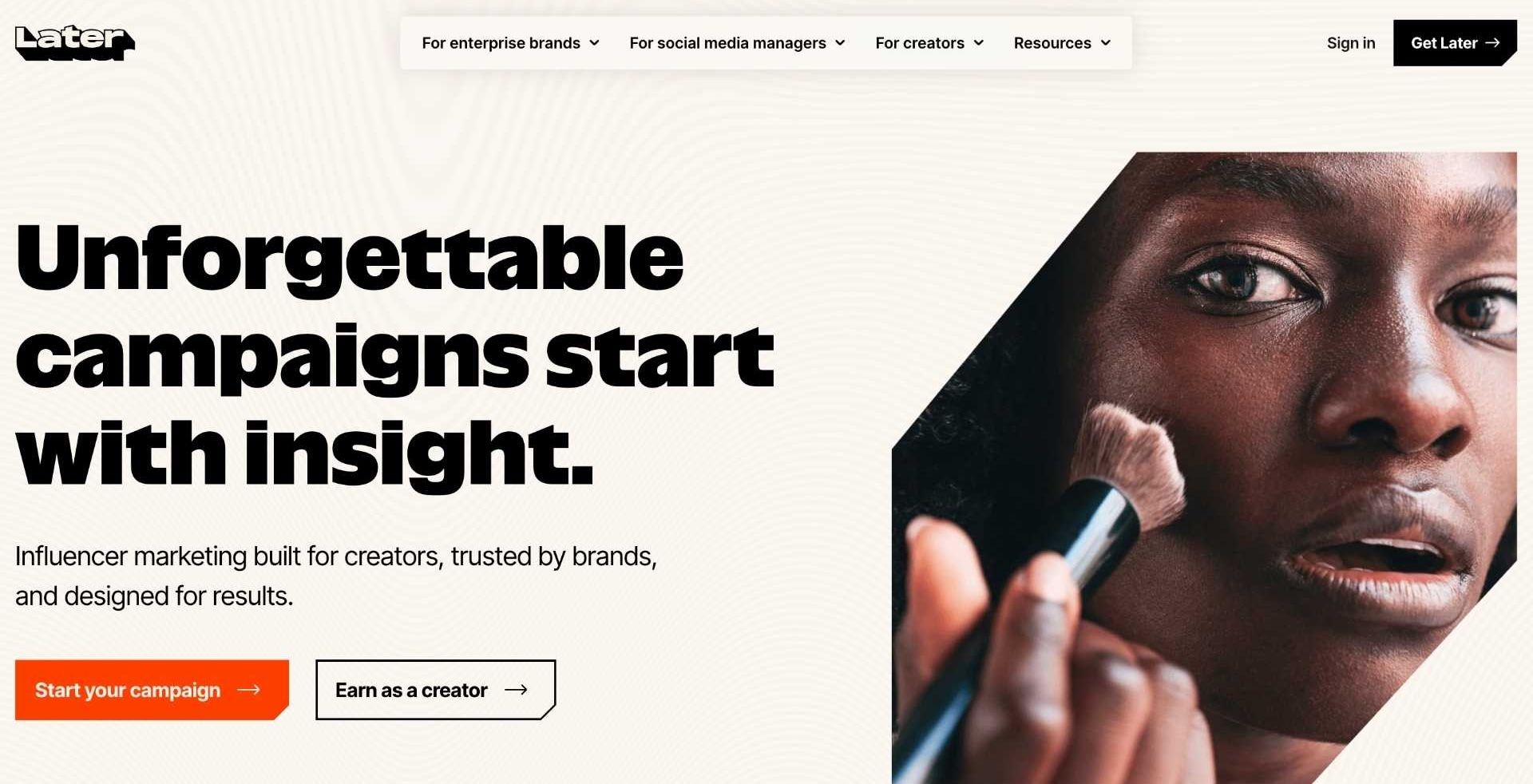
Later Influence est la plateforme de influencer marketing d'entreprise de Later, conçue pour aider les marques à découvrir des créateurs, gérer les campagnes, suivre les performances et connecter l'activité des créateurs aux résultats de ventes. Depuis le changement de marque Mavrck et l'ajout de Later EdgeAI et Mavely, Later s'est positionnée comme un écosystème complet de influencer marketing, d'affiliation et de commerce social plutôt que simplement un outil de campagne.
Fonctionnalités clés
- Découverte de créateurs avec signaux de risque et d'ajustement — Later utilise les signaux de marque et l'intelligence de campagne pour mettre en surface les créateurs les mieux adaptés tout en signalant les risques potentiels plus tôt dans le processus de sélection.
- Later EdgeAI — Sa couche IA plus récente utilise l'historique réel des campagnes, le comportement des créateurs, les données de tendances et les données d'achat pour aider les équipes à prendre de meilleures décisions de campagne avant le lancement.
- Conseiller en incitatifs — Later montre ce que les créateurs sont réellement payés sur tous les canaux, aidant les marques à fixer des tarifs plus équitables et à négocier en toute confiance.
- Gestion des campagnes et rapports — Gérez la prospection, la collaboration et les rapports d'entonnage complet à partir d'une seule plateforme, y compris les vues de performance payante, organique et commerciale.
- Marketing d'affiliation avec Mavely — Later s'intègre désormais à Mavely afin que les marques puissent créer des livrables d'affiliation, distribuer des liens et suivre les conversions et les commissions dans la plateforme.
- Gifting Shopify et codes — Connectez Shopify pour générer des codes produits, automatiser les flux de travail de gifting et surveiller les résultats des campagnes créateurs.
- Campagnes de notation, d'avis et de style communautaire — Later supporte les programmes d'ambassadeur, de notation et d'avis, d'ensemencement de produits, d'affiliation et de sondage dans le cadre d'un moteur créateur plus large.
Tarification
La plateforme de marketing d'influenceurs de Later (Later Influence) utilise une tarification personnalisée, et les marques doivent demander une démonstration pour connaître les coûts exacts.
En fonction de nos recherches, il existe différents plans :
- Plan Essentials : à partir de 28 500 $/an. Idéal pour les marques qui débutent dans le marketing d'influenceurs.
- Plan Pro : à partir de 42 000 $/an. Idéal pour les données et l'automatisation afin d'accélérer vos campagnes et d'obtenir un meilleur retour sur investissement.
- Plan Premier : à partir de 60 000 $/an. Tout ce dont vous avez besoin pour un programme d'influenceurs à grande échelle.
- Tous les plans incluent des frais d'intégration uniques supplémentaires de 5 000 $ pour tous les nouveaux clients.
Avis
4.4 / 5.0 (Capterra)
Avantages
- Later EdgeAI est l'une des additions les plus notables de la catégorie — Elle utilise les données historiques des campagnes, les modèles de tendances et les signaux d'achat pour améliorer la sélection des créateurs et la planification des campagnes.
- Mavely renforce son histoire d'affiliation et de commerce social — L'intégration Mavely donne à Later une attribution commerciale plus solide, des liens d'affiliation et des capacités de monétisation des créateurs qu'il n'avait pas auparavant.
- Flexibilité de programme plus large que de nombreux outils de marketplace — Later supporte les campagnes d'influenceurs, l'ensemencement de produits, les évaluations et avis, la recherche, les ambassadeurs et les programmes d'affiliation au sein d'un seul écosystème.
Inconvénients
- Aucune tarification publique pour la plateforme d'influenceurs — Les acheteurs doivent toujours passer par le service des ventes pour comprendre le coût réel de la plateforme.
- Peut sembler complexe pour les nouvelles équipes — Les commentaires d'avis indiquent une courbe d'apprentissage, en particulier pour les premiers utilisateurs du produit d'entreprise.
- Certaines plaintes récurrentes portent sur des problèmes techniques et des frictions dans la gestion des créateurs — Les résumés d'avis publics mentionnent des dysfonctionnements, des problèmes de communication avec les créateurs et des difficultés à trouver les bons créateurs dans certains flux de travail.
Intégrations
- Shopify — Automatisez le gifting, la sélection des créateurs, la génération de codes de réduction et le suivi des résultats des campagnes avec votre magasin connecté.
- Instagram API — Extrayez les données de performance et d'audience internes pour les comptes créateurs connectés.
- Facebook Graph API — Supportez les données de compte Facebook et Instagram, les rapports de contenu et la mesure des campagnes.
- TikTok One API — Intégrez les données des créateurs TikTok dans la plateforme pour les rapports et les opérations de campagne.
- Mavely — Créez des liens d'affiliation, suivez les ventes et les commissions, et connectez les campagnes d'influenceurs à la performance du commerce social.
TRIBE vs Later
TRIBE et Later aident tous deux les marques à se connecter avec les créateurs, mais leurs modèles sont différents. TRIBE est construit autour des présentations des créateurs et des campagnes de marketplace basées sur des appels d'offres. Later est plus large et plus programmatique : il supporte les campagnes d'influenceurs, les programmes d'affiliation, les avis, l'ensemencement, les programmes d'ambassadeurs et le commerce social sous un seul parapluie d'entreprise.
Later est généralement l'alternative la plus forte pour les marques qui souhaitent un programme créateur plus piloté par les données et d'entonnage complet avec des couches d'affiliation et de commerce intégrées. TRIBE est généralement mieux pour les marques qui souhaitent un flux de travail plus simple centré sur les appels d'offres et les présentations et la soumission de contenu et la concession de licence créateurs. En d'autres termes, Later est le système d'exploitation plus expansif ; TRIBE est le marketplace de campagne plus ciblé.

IZEA
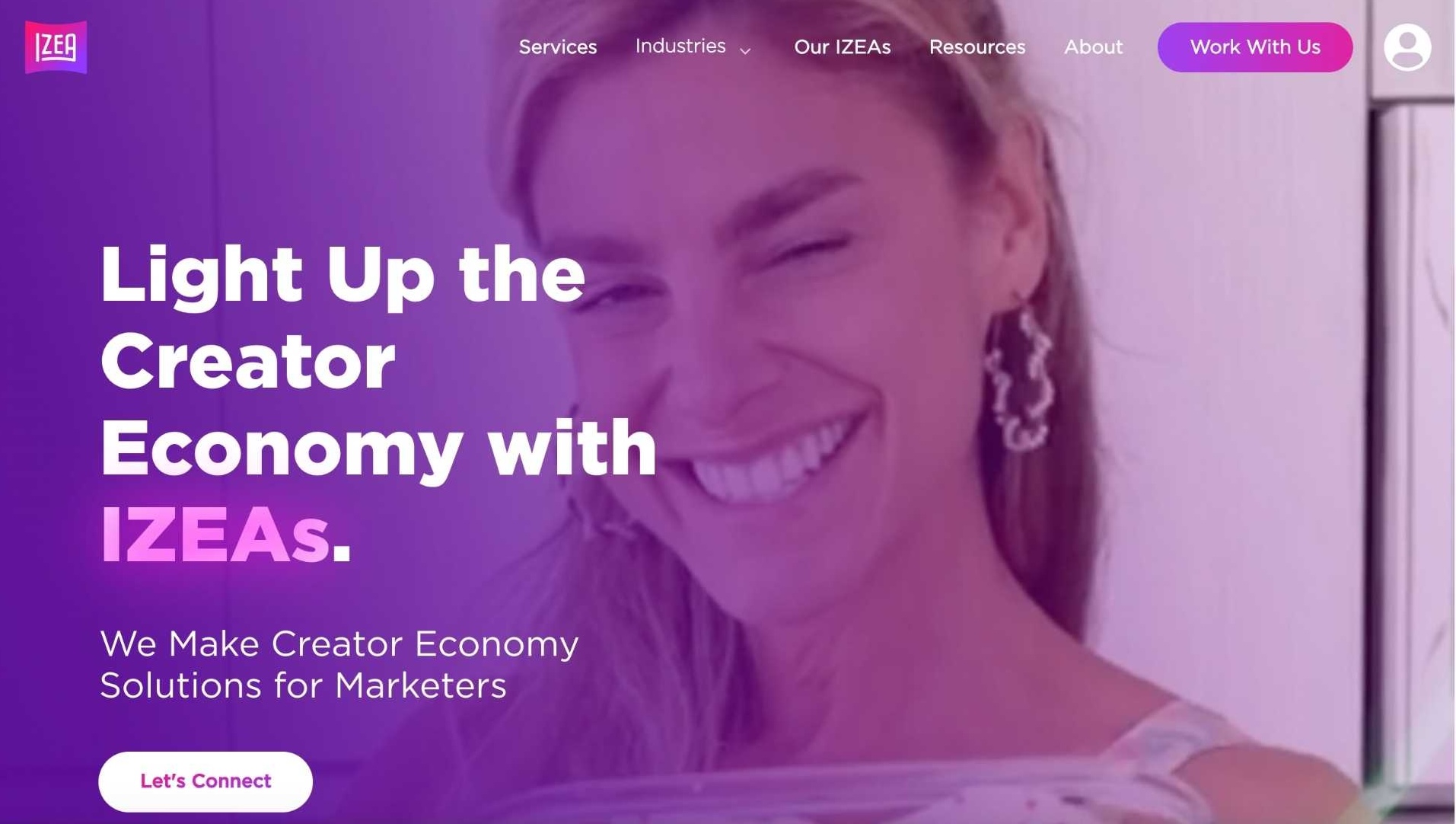
IZEA est une plateforme de marketing d'influenceurs et d'économie créative qui combine la découverte d'influenceurs, la gestion de campagnes et la collaboration de contenu avec un accent fort sur la monétisation des créateurs. Elle se distingue par son approche de style marché et sa suite croissante d'outils alimentés par l'IA pour la création de contenu et les flux de travail des influenceurs.
Fonctionnalités clés
- Plateforme IZEA Flex
Système complet de gestion de campagnes couvrant la découverte, la prospection, la conclusion de contrats, l'approbation de contenu et les rapports dans un seul tableau de bord. - Marché des créateurs (IZEA Marketplace)
Les marques peuvent publier des opportunités et recevoir des candidatures de créateurs, similaire à un modèle de tableau d'affichage pour les collaborations avec des influenceurs. - Outils alimentés par l'IA (FormAI & Shake AI)
Générez des briefs de campagne, du contenu social et des idées d'influenceurs en utilisant l'IA générative intégrée aux flux de travail. - Flux de travail de collaboration de contenu
Gérez les briefs, les brouillons, les approbations et les révisions directement dans la plateforme avec des outils de communication structurés. - Découverte d'influenceurs et analytics
Filtrez les créateurs par démographie d'audience, engagement, localisation et données de performance historiques. - Paiements et conclusion de contrats
Gestion intégrée des contrats et flux de travail de paiement pour rationaliser la rémunération des créateurs.
- les équipes centralisent la communication avec les créateurs de manière plus nette dans la plateforme.
Tarification
- Plan Starter : commence à 130 $/mois.
- Plan Power : commence à 500 $/mois.
- Essai gratuit : 10 jours.
- Services gérés : tarification personnalisée basée sur devis pour les campagnes entièrement gérées.
Avis
3,9 / 5,0 (G2)
Avantages
- Outils IA robustes (FormAI & Shake AI)
IZEA a fortement misé sur l'IA générative, aidant les marques à automatiser la création de contenu, les briefs de campagne et les flux de travail d'idéation. - Marché flexible + hybride de flux de travail gérés
Combine les candidatures volontaires de créateurs avec la gestion complète de campagnes, offrant aux marques une flexibilité dans les stratégies d'approvisionnement. - Paiements et contrats intégrés
Les flux de travail financiers intégrés réduisent la dépendance aux outils externes pour les processus juridiques et de paiement.
Inconvénients
- L'interface peut sembler datée et moins intuitive
Certains utilisateurs rapportent que l'expérience utilisateur traîne par rapport aux plateformes d'influenceurs plus récentes. - La transparence tarifaire est limitée
Les tarifs personnalisés rendent plus difficile l'évaluation comparative par rapport aux concurrents. - La profondeur de la découverte peut varier selon le créneau
Bien que large, la base de données ne fait pas toujours surface des créateurs hautement spécialisés efficacement.
Intégrations
- Instagram / Meta — Accédez aux données des créateurs et gérez la performance de la campagne en utilisant les informations de la plateforme.
- TikTok — Suivez la performance du contenu et les métriques des créateurs pour les campagnes.
- YouTube — Analysez la performance des créateurs en format long et les données d'audience.
- Google Analytics — Mesurez le trafic et les conversions générés par les campagnes d'influenceurs.
- Salesforce — Synchronisez les données de campagne et d'influenceurs dans les flux de travail CRM.
TRIBE vs IZEA
TRIBE et IZEA proposent tous deux un approvisionnement en créateurs de style marché, mais leurs approches diffèrent. TRIBE se concentre sur les soumissions de contenu basées sur des propositions, tandis que IZEA combine un marché avec des flux de travail plus approfondis de gestion de campagnes et de collaboration de contenu. IZEA s'appuie également davantage sur la génération de contenu assistée par l'IA et l'infrastructure de contrats intégrée, tandis que TRIBE se concentre davantage sur l'approbation et la concession de licences de contenu. Pour les marques ayant besoin de flux de travail assistés par l'IA et d'infrastructure de paiement, IZEA est plus puissant ; pour les propositions de campagnes orientées contenu, TRIBE est plus simple.
Traackr
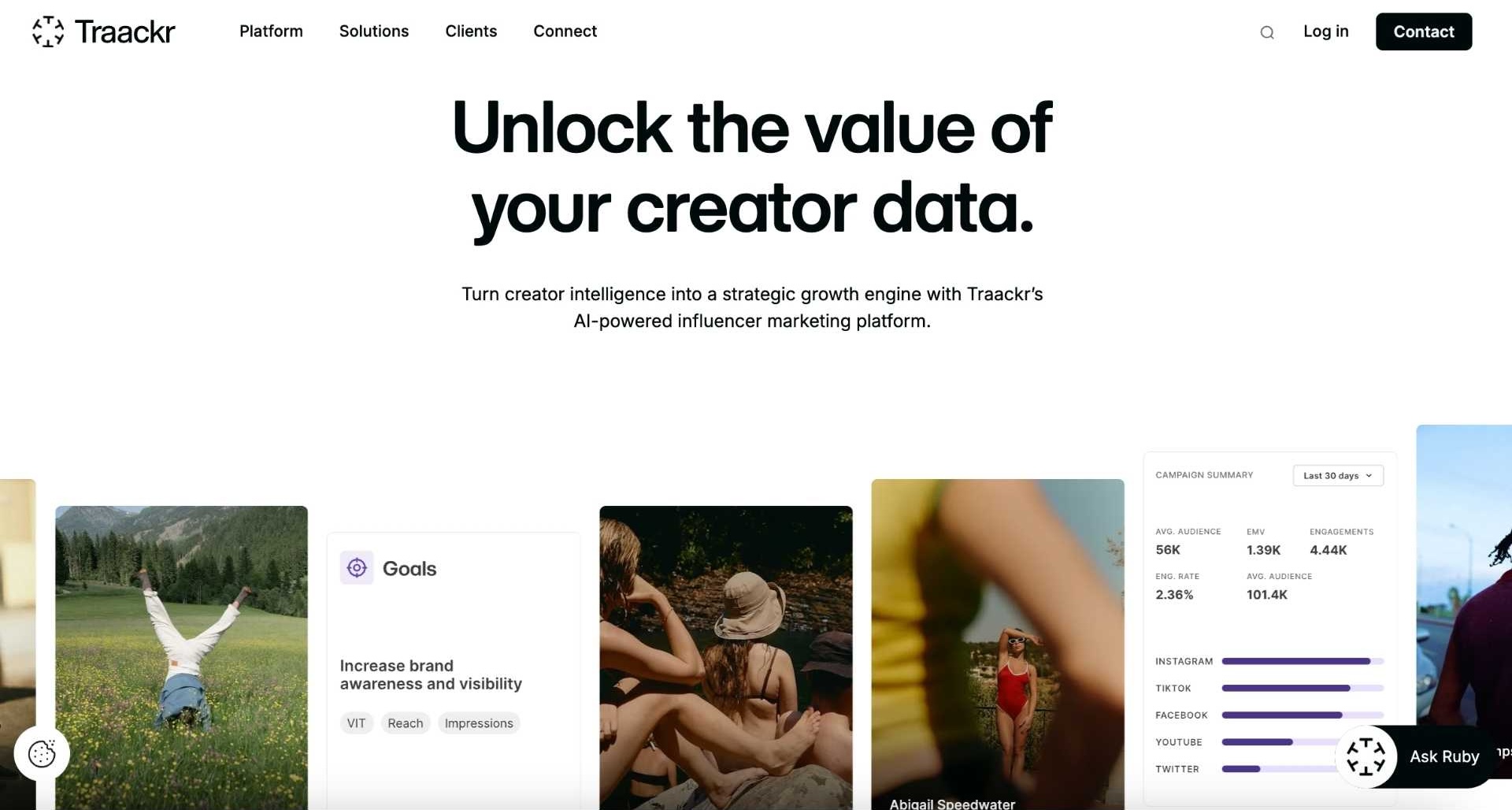
Traackr est une plateforme influencer marketing d'entreprise axée sur la prise de décision fondée sur les données, la gestion des relations avec les influenceurs et l'analyse comparative des performances. Elle est largement utilisée par les grandes marques pour gérer les programmes créateurs à long terme et mesurer le ROI sur les marchés.
Fonctionnalités clés
- Découverte avancée d'influenceurs
Recherchez des créateurs en utilisant des filtres approfondis incluant les données démographiques du public, l'affinité avec la marque et les partenariats antérieurs. - Gestion des relations (IRM)
Construisez des relations à long terme avec les influenceurs grâce au suivi de style CRM, aux notes et à l'historique des collaborations. - Suivi des performances de campagne
Mesurez l'engagement, la portée, le ROI et l'impact sur la marque dans les campagnes grâce à des analytics détaillés. - Analyse comparative et insights concurrentiels
Comparez les performances des influenceurs par rapport aux concurrents et aux points de référence de l'industrie. - Suivi des dépenses et du ROI
Suivez les dépenses consacrées aux influenceurs et reliez-les aux mesures de performance pour une meilleure allocation budgétaire. - Gestion des campagnes mondiales
Conçu pour les équipes multi-marchés gérant des campagnes dans différentes régions et langues.
Tarification
- Tarification officielle : sur mesure / demander un devis.
- Point de référence public : la tarification commence autour de 32 500 $/an pour un forfait standard, avec des modules supplémentaires disponibles sur demande.
- Type de contrat : généralement des contrats d'entreprise annuels.
Avis
4,3 / 5,0 (G2)
Avantages
- Analyse comparative et analytics de classe mondiale
Traackr excelle dans la comparaison des performances des influenceurs entre les campagnes et les concurrents, ce qui la rend très axée sur les données. - Gestion forte des relations avec les influenceurs
L'accent est mis sur les partenariats à long terme plutôt que sur les campagnes ponctuelles. - Capacités de campagnes mondiales
Construite pour les marques multinationales exécutant des programmes influencer dans plusieurs régions.
Inconvénients
- Coût élevé et orientation entreprise
Non idéal pour les petites ou moyennes marques. - Automatisation de prospection limitée
Comparé aux outils plus récents, les flux de travail de prospection peuvent sembler moins automatisés. - Courbe d'apprentissage plus abrupte
L'interface riche en données nécessite un onboarding et une formation.
Intégrations
- Instagram / Meta — Tirez les données de performance pour la mesure des campagnes.
- TikTok — Analysez les performances des créateurs et les tendances d'engagement.
- YouTube — Suivez les métriques de contenu long format et les insights d'audience.
- Google Analytics — Connectez les campagnes influencer au trafic du site Web et aux conversions.
- Tableau / Outils BI — Exportez les données pour des rapports et dashboards avancés.
TRIBE vs Traackr
TRIBE est axée sur les campagnes et orientée marketplace, tandis que Traackr est axée sur les analytics et les relations. TRIBE fonctionne bien pour lancer rapidement des campagnes avec des présentations de créateurs, tandis que Traackr est construite pour la stratégie influencer à long terme, l'analyse comparative et l'analyse du ROI. Pour les équipes d'entreprise axées sur la mesure et les programmes mondiaux, Traackr est plus puissante ; pour l'exécution de campagnes axées sur le contenu, TRIBE est plus simple.
Influencity
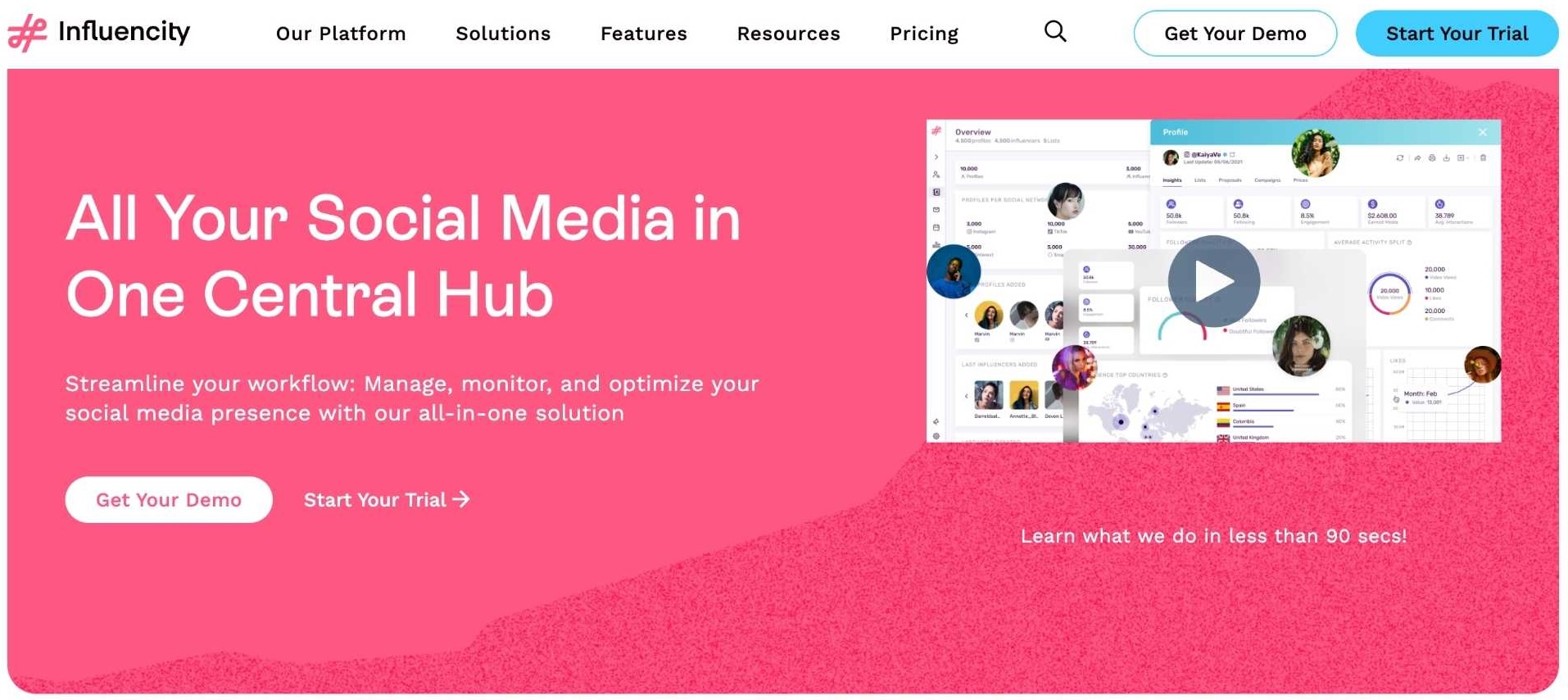
Influencity est une plateforme influencer marketing axée sur les données, conçue pour aider les marques à découvrir des créateurs, gérer des campagnes et analyser les performances en mettant l'accent sur les insights d'audience et la segmentation.
Fonctionnalités clés
- Massive base de données d'influenceurs
Accédez à des millions de créateurs sur Instagram, TikTok et YouTube avec des filtres détaillés. - Analytics d'audience
Insights approfondis sur les données démographiques du public, l'authenticité, les intérêts et la qualité de l'engagement. - Outils de gestion de campagne
Gérez la prospection, suivez les livrables et surveillez les performances dans un dashboard centralisé. - Outils de lookalike et de segmentation
Trouvez des créateurs similaires à vos influenceurs les plus performants. - Reporting de performance
```Suivre le ROI de la campagne, l'engagement, la portée et les mesures de qualité d'audience. - Détection des faux followers
Identifier les comptes suspects et assurer l'authenticité de la campagne.
Tarification
Influencity propose trois principaux niveaux de tarification, ainsi que des modules complémentaires :
- Plan Professionnel : $318/mois ou $3 816/an
- Plan Métier : $798/mois ou $9 576/an
- Plan Entreprise : Tarification personnalisée
- Module Auto-Tracker : $660/an (pour 50 influenceurs)
Avis
4,3 / 5,0 (G2)
Points forts
- Analytique d'audience et segmentation puissantes
Influencity excelle particulièrement à aider les marques à comprendre la qualité et les données démographiques de l'audience. - Tarification flexible par rapport aux outils d'entreprise
Propose des forfaits mensuels accessibles pour les petites équipes. - Bon équilibre entre découverte et analytique
Combine efficacement la recherche de créateurs avec les insights de performance.
Points faibles
- Automatisation d'outreach limitée par rapport aux concurrents
Les workflows de campagne sont moins robustes que les outils axés sur la gestion de la relation client. - L'interface peut sembler moins aboutie
Certains utilisateurs rapportent des problèmes d'utilisabilité dans la navigation. - Moins d'intégrations natives
Comparé aux plus grandes plateformes, l'écosystème d'intégration est plus petit.
Intégrations
- Instagram — Analyser les profils de créateurs et les insights d'audience.
- TikTok — Suivre l'engagement et les mesures de performance.
- YouTube — Évaluer la performance du contenu de longue durée.
- Google Analytics — Connecter les campagnes d'influenceurs au trafic du site web.
- Exportations CSV — Exporter les données pour les rapports et analyses externes.
TRIBE vs Influencity
TRIBE est davantage axé sur les campagnes avec une marketplace de créateurs, tandis qu'Influencity est davantage axé sur l'analytique avec des insights d'audience puissants. TRIBE simplifie l'approvisionnement en créateurs via des propositions, tandis qu'Influencity donne aux marques plus de contrôle par la recherche et la segmentation. Pour la prise de décision basée sur les données, Influencity est plus puissant ; pour l'exécution des campagnes rationalisée, TRIBE est plus facile à utiliser.
Heepsy

Heepsy est une plateforme de marketing d'influenceurs axée sur la découverte, l'outreach et le suivi des campagnes, particulièrement populaire auprès des marques de commerce électronique et des petites à moyennes équipes à la recherche d'une solution économique.
Fonctionnalités clés
- Grande base de données d'influenceurs (~50M créateurs)
Rechercher des influenceurs à l'échelle mondiale avec des filtres par niche, engagement, données démographiques de l'audience et authenticité. - Filtrage avancé et détection des faux followers
Identifier les créateurs de haute qualité en utilisant les taux d'engagement et les scores d'authenticité. - Pipeline d'outreach et de gestion de la relation client
Gérer les relations avec les influenceurs via un pipeline de style Kanban et l'outreach par email en masse. - Suivi et reporting des campagnes
Suivre les mesures d'engagement et les performances des campagnes dans tous les créateurs. - Intégration Shopify pour le suivi des ventes
Générer des liens et des codes de réduction pour suivre les revenus générés par les influenceurs (plan Avancé).
Tarification
- Gratuit — un accès gratuit limité est disponible.
- Starter — les références récentes du blog officiel Heepsy placent Starter à $89/mois.
- Plus — les références récentes du blog officiel Heepsy placent Plus à $249/mois.
- Avancé — les références récentes du blog officiel Heepsy placent Avancé à $369/mois.
- Heepsy dit également que les utilisateurs peuvent choisir une facturation mensuelle ou annuelle, les abonnements annuels bénéficiant d'une remise par rapport aux tarifs mensuels.
Avis
4,5 / 5,0 (G2)
Points forts
- Filtres de découverte puissants avec grande base de données
L'un des meilleurs outils pour trouver rapidement des influenceurs de niche à l'échelle mondiale. - Abordable par rapport aux plateformes d'entreprise
La tarification est accessible pour les petites équipes et les marques en croissance. - Suivi simple des campagnes de style gestion de la relation client
Le pipeline visuel facilite la gestion des workflows d'influenceurs.
Points faibles
```html- Suivi des ventes verrouillé derrière des plans supérieurs
Les fonctionnalités avancées nécessitent de passer à des niveaux tarifaires plus élevés. - Fonctionnalités d'IA et d'automatisation limitées
Comparé aux plateformes plus récentes, l'automatisation est basique. - La détection des faux abonnés n'est pas entièrement précise
La précision est estimée plutôt qu'exacte.
Intégrations
- Shopify — Suivez les ventes et conversions générées par les influenceurs.
- Instagram — Analysez la performance et l'engagement des influenceurs.
- TikTok — Évaluez le contenu des créateurs et les métriques d'audience.
- Outils de messagerie électronique — Envoyez des campagnes de prospection en masse.
- Export CSV — Exportez les données d'influenceurs pour une utilisation externe.
TRIBE vs Heepsy
TRIBE se concentre sur les propositions de créateurs et les campagnes gérées, tandis que Heepsy se concentre sur la découverte et la prospection. Heepsy vous donne plus de contrôle sur la recherche et le contact avec les influenceurs, tandis que TRIBE simplifie la recherche grâce à son modèle de marché. Pour les équipes soucieuses du budget, Heepsy est plus accessible ; pour les campagnes axées sur le contenu, TRIBE est plus structuré.
Lefty
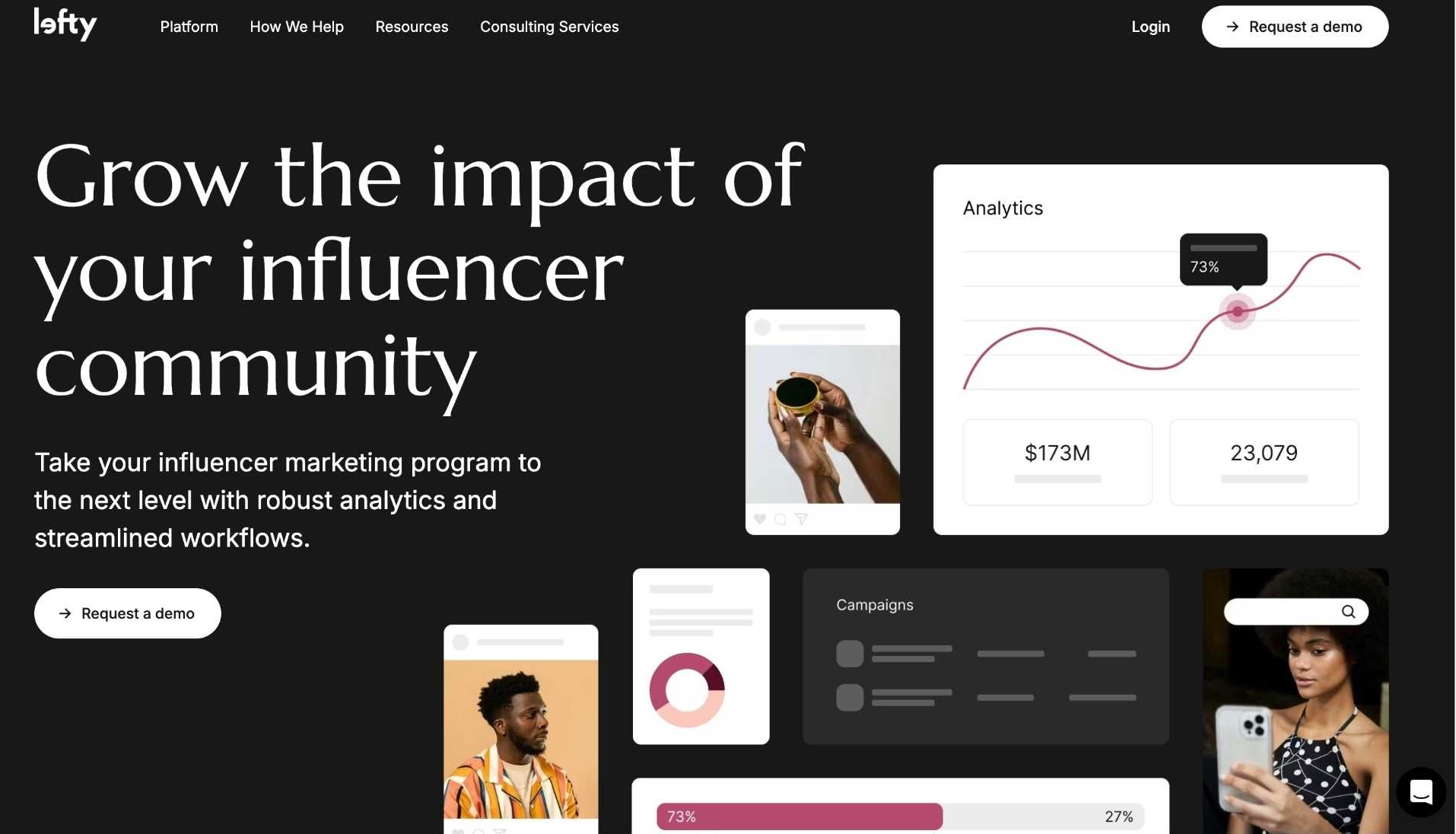
Lefty est une plateforme de marketing d'influenceurs conçue pour les marques qui souhaitent gérer la découverte de créateurs, l'exécution de campagnes et l'analyse de performance avec un accent fort sur la visualisation des données et les rapports.
Fonctionnalités principales
- Découverte et recherche d'influenceurs
Trouvez des créateurs en utilisant des filtres pour les données démographiques d'audience, l'engagement et la niche. - Flux de travail de gestion de campagne
Gérez les collaborations avec les influenceurs, les approbations et les livrables au même endroit. - Tableaux de bord analytiques avancés
Visualisez la performance des campagnes avec un reporting détaillé sur l'engagement, la portée et le ROI. - Insights d'audience et segmentation
Comprenez les données démographiques et le comportement de l'audience pour un meilleur ciblage. - Benchmarking concurrentiel
Analysez les campagnes des concurrents et les stratégies des influenceurs. - Suivi du contenu et analyse de performance
Suivez les publications des influenceurs et les résultats des campagnes en temps réel.
Tarification
- Prix de départ : ~590 € par mois.
- Plan Pro : ~990 €/mois, incluant 2 utilisateurs, 5 campagnes et rapports illimités.
- Plan Premium : ~1 690 €/mois, qui ajoute un gestionnaire dédié.
- Plan Premium+ : ~3 490 €/mois pour 10 utilisateurs et 25 campagnes.
Avis
4.7/5.0 (G2)
Avantages
- Outils d'analytique et de visualisation robustes
Lefty se distingue par ses tableaux de bord et la clarté du reporting. - Bon équilibre entre découverte et reporting
Combine la recherche de créateurs avec un suivi de performance détaillé. - Fonctionnalités de benchmarking concurrentiel
Aide les marques à comprendre comment elles se comparent dans leur industrie.
Inconvénients
- Transparence tarifaire limitée
Nécessite un engagement avec la vente pour comprendre les coûts. - Moins d'accent sur l'automatisation de la prospection
L'exécution des campagnes peut nécessiter des outils supplémentaires. - Écosystème plus petit comparé aux plateformes plus grandes
Moins d'intégrations et de fonctionnalités de marché.
Intégrations
- Instagram — Suivez les publications des influenceurs et les métriques d'engagement.
- TikTok — Surveillez la performance des créateurs et les résultats des campagnes.
- YouTube — Analysez le contenu long format des influenceurs.
- Google Analytics — Connectez les campagnes à la performance du site web.
- Outils d'export de données — Exportez les données de campagne pour le reporting.
TRIBE vs Lefty
TRIBE est plus axé sur le marché et les campagnes, tandis que Lefty se concentre sur l'analytique et le reporting. TRIBE simplifie la recherche d'influenceurs par le biais de propositions de créateurs, tandis que Lefty fournit des insights de performance plus profonds et un benchmarking. Pour les équipes riches en données, Lefty est plus puissant ; pour une exécution de campagne rationalisée, TRIBE est plus intuitif.
Réflexions finales
```
Le choix de la bonne alternative à TRIBE dépend en fin de compte des priorités de votre équipe—qu'il s'agisse de campagnes axées sur le contenu, d'analyses approfondies ou d'une intégration e-commerce de bout en bout. Des plateformes comme Influencer Hero, Upfluence et Aspire offrent des flux de travail opérationnels plus solides et un suivi des revenus pour les marques DTC, tandis que des outils comme Traackr, CreatorIQ et Lefty excellent dans les analytics, l'analyse comparative et la gestion à l'échelle de l'entreprise. Pendant ce temps, des options plus accessibles comme Heepsy et Influencity offrent une bonne découverte et une tarification abordable pour les petites équipes. Dans l'ensemble, TRIBE reste un excellent choix pour les campagnes basées sur les pitches, mais les marques à la recherche d'une plus grande flexibilité, d'une profondeur de données ou d'une attribution de performance trouveront plusieurs alternatives intéressantes dans différents cas d'usage.

.png)


.jpg)