

10 meilleures alternatives à Later • Critères clés • Aperçu de Later • Meilleures alternatives à Later • GRIN • Upfluence • CreatorIQ • Influencer Hero • NeoReach • Lefty • Insense • Kolsquare • Skeepers • Creator.co • Réflexions finales • FAQs
```10 meilleures alternatives à Later pour le influencer marketing
Les marques D2C s'appuient de plus en plus sur des logiciels de influencer marketing pour rationaliser la découverte des créateurs, gérer la prospection à grande échelle et suivre les performances des campagnes en fonction du chiffre d'affaires. Later est une option populaire dans ce domaine, offrant un mélange d'outils de campagnes d'influenceurs et de gestion des réseaux sociaux, mais elle s'accompagne souvent de limitations telles que la tarification personnalisée, une courbe d'apprentissage plus abrupte et des workflows qui ne conviennent pas à tous les équipes, en particulier celles axées sur le commerce électronique ou les campagnes basées sur les performances. En conséquence, de nombreuses marques commencent à explorer des alternatives à Later qui offrent une meilleure découverte des créateurs, un meilleur suivi du ROI ou des modèles de tarification plus flexibles. Que vous évaluiez un logiciel de influencer marketing pour la première fois ou que vous envisagiez de changer de plateforme, il est essentiel de comprendre comment ces outils se comparent.
Dans ce guide, nous détaillons les 10 meilleures alternatives à Later, notamment GRIN, Upfluence, CreatorIQ, Influencer Hero, NeoReach, Lefty, Insense, Kolsquare, Skeepers et Creator.co, pour vous aider à trouver la solution idéale pour votre stratégie de croissance.
Critères clés pour évaluer les plateformes de influencer marketing
Fonctionnalités essentielles
Évaluation des capacités essentielles en matière de influencer marketing, y compris la découverte des influenceurs, la prospection, la gestion de la relation client, la gestion des campagnes, la création de rapports et les workflows de contenu.
Tarification et flexibilité
Comparaison des modèles de tarification, des plans d'abonnement et des conditions contractuelles pour correspondre à différents budgets et étapes de croissance.
Avis des clients et satisfaction
Analyse des commentaires des utilisateurs provenant de plateformes d'examen de confiance, en mettant l'accent sur la convivialité, la fiabilité, le support client et les performances globales.
Avantages et inconvénients
Examen des forces et des limitations de chaque plateforme pour mettre en évidence les domaines où elle excelle et ceux où elle pourrait faire défaut en fonction des différents cas d'usage.
Intégrations
Examen des intégrations les plus importantes (par exemple, Shopify et autres outils technologiques), en mettant en évidence ce que chaque intégration permet en une phrase.
Présentation générale de Later
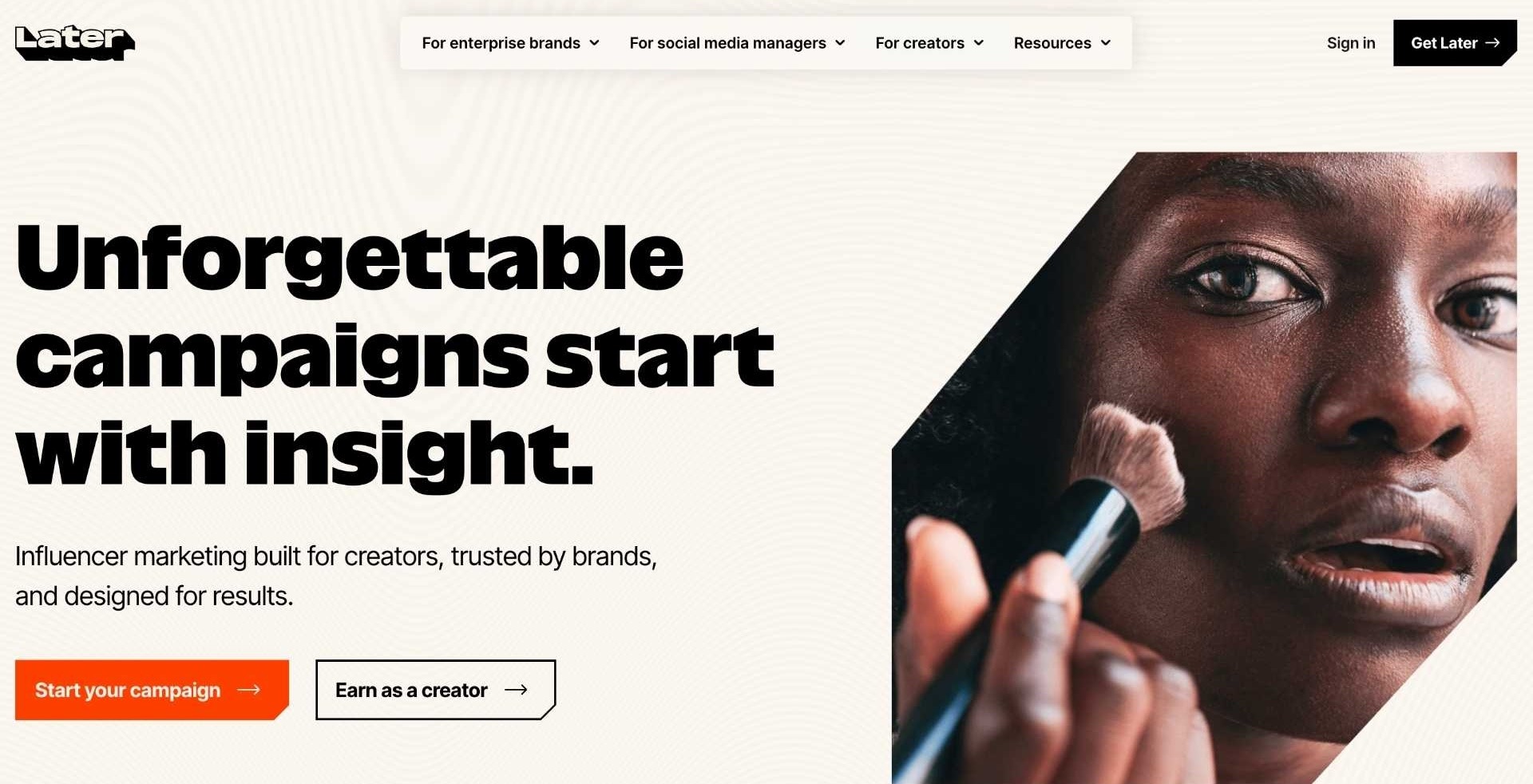
Later est une plateforme de réseaux sociaux et de influencer marketing qui aide les marques à découvrir des créateurs, à gérer les campagnes d'influenceurs et à suivre les performances sur l'ensemble du parcours client. Initialement connue pour la planification des réseaux sociaux, Later s'est étendue au influencer marketing grâce à sa plateforme Later Influence, offrant des outils pour la découverte des créateurs, la prospection, la gestion des campagnes et le suivi du ROI.
La plateforme est particulièrement forte pour les marques qui souhaitent combiner le influencer marketing avec la gestion des réseaux sociaux et le suivi du commerce électronique, ce qui en fait un choix populaire pour les entreprises DTC et de vente au détail.
Fonctionnalités clés
- Découverte des influenceurs avec filtres IA
Accédez à une base de données de millions de créateurs et utilisez des filtres avancés (données démographiques de l'audience, taux d'engagement, créneau, etc.) pour trouver rapidement les bons influenceurs. - Prospection automatisée et workflows de campagnes
Créez des modèles de prospection, automatisez la communication avec les créateurs et rationalisez la configuration des campagnes grâce à des workflows reproductibles. - CRM des influenceurs et gestion des relations
Gérez les relations avec les créateurs, suivez l'historique des communications et organisez les listes d'influenceurs dans un tableau de bord centralisé. - Approbation du contenu et gestion des campagnes
Examinez le contenu des influenceurs avant publication, gérez les livrables et suivez la progression des campagnes par le biais de workflows structurés. - Suivi des performances et reporting du ROI
Mesurez le succès des campagnes avec des analytics sur l'engagement, la portée, les conversions et le ROI des campagnes d'influenceurs. - Intégration Shopify pour les envois de produits et les codes
Générez des codes de réduction, envoyez-les automatiquement aux créateurs et suivez les commandes, les rachats et les ventes directement dans la plateforme. - Intégration des avis et critiques
Collectez les avis sur les produits générés par les influenceurs et distribuez-les sur les canaux de commerce électronique et de marketing. - Gestion des incitations et des paiements
Envoyez des paiements ou des récompenses (en espèces ou en cartes cadeaux) aux créateurs par le biais de systèmes de paiement intégrés.
``````html Tarification
La plateforme de marketing d'influenceurs de Later (Later Influence) utilise une tarification personnalisée, et les marques doivent demander une démo pour connaître les coûts exacts.
Selon nos recherches, il existe différents plans :
- Plan Essentials : À partir de 28 500 $/an. Idéal pour les marques qui débutent en marketing d'influenceurs.
- Plan Pro : À partir de 42 000 $/an. Idéal pour les données et l'automatisation afin d'accélérer vos campagnes et d'améliorer votre ROI.
- Plan Premier : À partir de 60 000 $/an. Tout ce dont vous avez besoin pour un programme d'influenceurs à grande échelle.
- Tous les plans incluent des frais d'intégration ponctuels supplémentaires de 5 000 $ pour tous les nouveaux clients.
Avis
4.4 / 5.0 (Capterra)
Intégrations
- Shopify — Créez des codes de réduction, gérez le gifting de produits et suivez les ventes générées par les influenceurs directement dans votre boutique.
- Stripe — Envoyez des paiements ou des incitations aux créateurs de manière sécurisée dans la plateforme.
- Tango Card — Distribuez des cartes-cadeaux et des récompenses aux influenceurs comme incitations de campagne.
- Yotpo — Collectez et syndiquiez les avis de produits générés par les influenceurs sur les canaux marketing.
- Bazaarvoice — Synchronisez les catalogues de produits et distribuez les évaluations et avis des campagnes d'influenceurs.
Avantages
- IA Avancée & Insights Prédictifs : Les nouvelles capacités d'IA de Later (par exemple, EdgeAI) aident à prédire les performances des créateurs et les résultats des campagnes, ce qui rend la sélection des influenceurs plus basée sur les données que les outils manuels.
- Rapports Full-Funnel avec Later 360 : Later combine les données des influenceurs, des médias payants et du commerce électronique dans des tableaux de bord unifiés, permettant aux marques de suivre les performances au-delà des métriques d'engagement jusqu'à l'impact réel sur les revenus.
- Intégrations Solides pour l'E-Commerce & Retail : Avec les intégrations Shopify et des plateformes d'avis, Later est particulièrement bien adapté aux marques axées sur l'ensemencement de produits, les ventes d'affiliation et le commerce basé sur l'UGC.
Inconvénients Courants de Later
Absence de Tarification Transparente
La tarification n'est pas disponible publiquement, ce qui rend difficile pour les petites marques d'évaluer ou de comparer les coûts à l'avance.
Mieux Adapté aux Équipes Mid-Market & Enterprise
La complexité de la plateforme et le processus d'intégration peuvent être accablants pour les petites équipes ou les marques qui débutent en marketing d'influenceurs.
Courbe d'Apprentissage Plus Abrupte
Les utilisateurs ont souvent besoin de temps pour comprendre pleinement les flux de travail, notamment par rapport aux outils d'influenceurs plus simples.
Flexibilité Limitée dans la Personnalisation de la Prospection
Bien que l'automatisation soit utile, la prospection peut parfois sembler trop basée sur des modèles, ce qui peut réduire les taux de réponse des influenceurs.
Limitations Occasionnelles des Rapports & Flux de Travail
Certains utilisateurs éprouvent des difficultés avec la profondeur des rapports, les mises en ligne de contenu et les flux de travail des campagnes, nécessitant des solutions manuelles.
Meilleures Alternatives à Later
| TOOL | REVIEWS | BEST FOR | TRIAL INFO | PRICING | ||
|---|---|---|---|---|---|---|
1 |

|
⭐ | Gestion des créateurs DTC | Réserver une démo | Tarification | Site web |
2 |

|
⭐ | Découverte d'influenceurs | Réserver une démo | Tarification | Site web |
3 |

|
``````html
⭐ | Marketing d'influence en entreprise | Demander une démo | Tarification | Site Web |
4 |

|
⭐ | CRM influenceurs et automatisation | Demander une démo | Tarification | Site Web |
5 |

|
⭐ | Campagnes d'influence et analyses de données | Demander une démo | Tarification | Site Web |
6 |

|
⭐ | Analyses influenceurs et découverte | Demander une démo | Tarification | Site Web |
7 |

|
⭐ | Créateurs UGC et publicités sociales payantes | Demander une démo | Tarification | Site Web |
8 |

|
⭐ | Découverte d'influenceurs basée sur les données et analyses de campagnes | Demander une démo | Tarification | Site Web |
9 |

|
⭐ | Gifting influenceurs et campagnes UGC avec micro-influenceurs | Demander une démo | Tarification | Site Web |
10 |

|
⭐ | Campagnes d'influence et marketplace de créateurs | ``````html Réserver une démo | Tarification | Site web |
1. GRIN
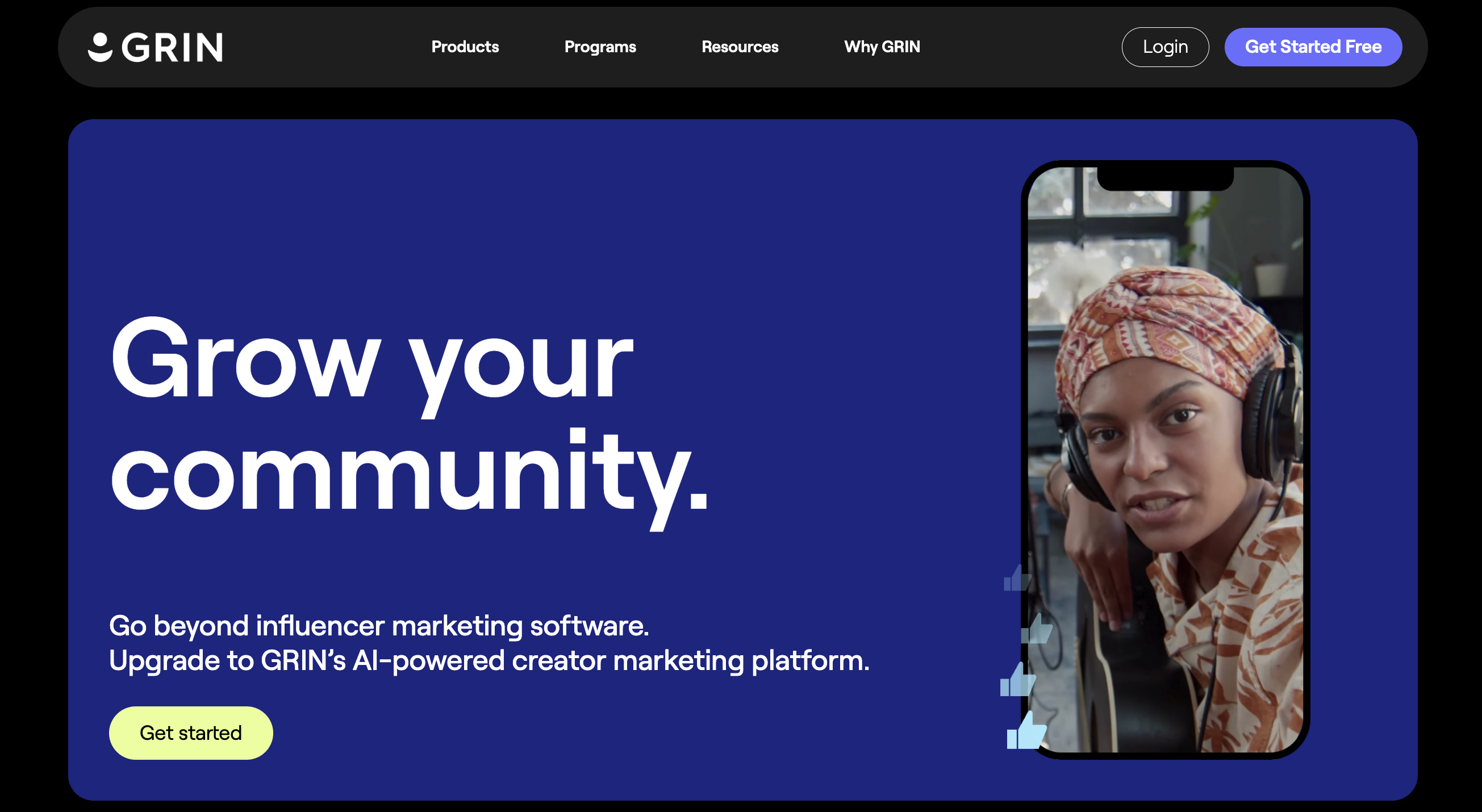
GRIN est une plateforme de gestion de créateurs conçue principalement pour les marques D2C et e-commerce qui souhaitent exécuter des programmes d'influenceurs, d'affiliés, d'ambassadeurs et de défense des clients à partir d'un seul système. Elle se concentre particulièrement sur la transformation des relations de créateurs en revenus mesurables grâce à l'envoi de produits, aux liens d'affiliation, à la gestion de contenu et aux rapports intégrés.
Fonctionnalités principales
- Découverte de créateurs et gestion des relations — GRIN aide les marques à trouver des créateurs, à organiser tout l'historique de communication et à gérer les partenariats à long terme au sein d'un CRM centralisé de créateurs.
- Prospection intégrée et suivi des e-mails — les équipes peuvent envoyer des prospections depuis GRIN en utilisant des modèles, des automatisations et le suivi de l'engagement au lieu de s'appuyer sur des boîtes de réception dispersées.
- Workflows d'envoi de produits et d'affiliation — la plateforme prend en charge l'ensemencement de produits, les liens d'affiliation, les codes de réduction et le suivi des conversions pour les campagnes axées sur le commerce.
- Collecte et réutilisation de contenu — GRIN stocke le contenu des créateurs dans une bibliothèque centralisée afin que les équipes marketing puissent trouver, baliser et réutiliser les actifs sur tous les canaux.
- Paiements des créateurs et opérations contractuelles — les marques peuvent gérer les contrats et payer les créateurs via des outils connectés comme DocuSign et PayPal, ce qui réduit les frictions opérationnelles.
- Support IA via Gia — GRIN positionne désormais Gia comme une couche alimentée par l'IA pour la correspondance des créateurs, la prospection, l'envoi de produits et le support de performance, tandis que la plateforme principale reste disponible pour un contrôle pratique.
Tarification
- Modèle de tarification officiel : La page de tarification actuelle de GRIN promeut un essai gratuit de 30 jours et un emballage plus flexible qu'auparavant, y compris l'accès en libre-service.
- Conditions contractuelles : GRIN met désormais l'accent sur la facturation mensuelle, l'absence de blocage à long terme et la possibilité de suspendre ou d'adapter les besoins en fonction des circonstances.
- Point de repère du prix de départ public : Les récents répertoires de logiciels listent GRIN à partir de 999 $/mois, bien que la tarification enterprise semble toujours augmenter considérablement en fonction des fonctionnalités et de la taille du programme.
- Point de repère de la tarification enterprise : Les récents points de repère des ventes et les aperçus des produits placent toujours couramment GRIN à partir de 25 000 $/an (environ 2 050 $/mois), sans réductions pour paiement anticipé. Les contrats nécessitent un engagement d'une année complète avec facturation mensuelle.
Avis
4,5/5,0 (G2)
Avantages
- La tarification en libre-service et mensuelle est une amélioration majeure récente — par rapport aux anciennes modalités d'achat de style enterprise, GRIN offre désormais une inscription instantanée, un essai gratuit de 30 jours et une facturation mensuelle flexible.
- Gia donne à GRIN un angle plus natif à l'IA que de nombreux CRM d'influenceurs traditionnels — GRIN met désormais en avant la découverte de créateurs assistée par l'IA, la prospection, l'envoi de produits et l'optimisation au lieu de simplement la gestion des workflows.
- ```Les workflows de commerce profond restent son différenciateur le plus clair — GRIN est particulièrement puissant pour les marques qui ont besoin de gifting, de suivi des affiliés, de paiements de créateurs et de réutilisation de contenu directement liés aux revenus.
Inconvénients
- La plateforme peut encore sembler complexe à naviguer pour les équipes qui souhaitent quelque chose de plus léger et simple.
- La gestion des livrables peut nécessiter une coordination supplémentaire lorsque les créateurs ne téléchargent pas régulièrement les actifs ou ne mettent pas à jour les statuts correctement.
- Les prix peuvent augmenter rapidement à mesure que la capacité et les fonctionnalités avancées s'étendent, même si le modèle de contrat est désormais plus flexible.
Intégrations
- Shopify — connectez votre magasin pour rationaliser les produits de semence, l'exécution et les workflows de commerce créateur.
- PayPal — payez les créateurs directement via GRIN et gardez les paiements liés aux opérations de campagne.
- Klaviyo — créez des communications de créateur plus personnalisées et de marque via des workflows de courrier électronique connectés.
- DocuSign — envoyez et gérez les contrats d'influenceurs sans quitter votre workflow créateur.
- Slack — recevez des notifications d'activité des créateurs et tenez les équipes alignées sur les mises à jour des campagnes.
Later vs GRIN
Later est plus puissant pour les marques qui souhaitent le marketing d'influenceurs associé à une pile de publication et de reporting sur les réseaux sociaux plus large, tandis que GRIN est plus commerce-native et opérationnellement axé. GRIN met davantage l'accent sur le gifting, les liens d'affiliation, les paiements des créateurs et les workflows de revenus DTC; Later convient généralement mieux aux équipes qui souhaitent un mélange plus équilibré de gestion des influenceurs, de planification des réseaux sociaux et de reporting de campagnes. GRIN propose également désormais un accès en libre-service, mois après mois, tandis que Later Influence reste sur devis et plus axé sur la vente. Si l'objectif principal d'une marque est d'exécuter des programmes créateurs directement liés à l'ensemencement des produits et à l'attribution des ventes, GRIN est généralement le choix le plus spécialisé.
2. Upfluence
Upfluence est une plateforme de marketing d'influenceurs et d'affiliation conçue autour de la découverte des créateurs, de la prospection, du gifting, du suivi des affiliés et de l'attribution du commerce électronique. Son positionnement central est que les marques ne doivent pas seulement trouver des créateurs externes, mais aussi identifier les clients et abonnés influents déjà présents dans leurs données de commerce et de CRM.
Fonctionnalités clés
- Grande base de données de recherche de créateurs — la page de tarification d'Upfluence met en évidence une base de données de créateurs 14M+ avec recherche avancée illimitée et données de performance.
- Découverte et prospection assistées par l'IA — Upfluence promeut Jaice AI pour la recherche de créateurs, le lancement de campagnes et la personnalisation des e-mails à grande échelle.
- Correspondance client-créateur — l'une de ses fonctionnalités les plus distinctives est l'appariement des opportunités d'influenceurs par rapport à vos données CRM ou de commerce électronique existantes pour identifier les clients et abonnés influents.
- Prospection en masse et séquences automatisées — les marques peuvent exécuter une prospection en masse illimitée, des champs personnalisés, des modèles de courrier électronique et des séquences de goutte-à-goutte avec intégration Gmail et Outlook.
- Gestion des campagnes et outils d'affiliation — Upfluence prend en charge l'organisation du CRM, la création de campagnes, le filtrage des affiliés, la génération de codes promotionnels, l'expédition de produits, l'écoute sociale et les analyses de ventes.
- Paiements des créateurs — son plan haut de gamme ajoute Upfluence Pay, les paiements multi-devises et les workflows fiscaux/de facturation.
Tarification
- Modèle de prix : Upfluence utilise une tarification personnalisée plutôt qu'une table de plans fixes publics.
- Tous les plans sont personnalisés. Il y a un engagement minimum d'une année entière de service que vous devez respecter avec des paiements mensuels. En moyenne, les plans commencent autour de 2 000 $/mois (24 000 $/an)
Avis
4,3/5,0 (Capterra)
Avantages
- La correspondance client-créateur est l'un des différenciateurs les plus utiles de la catégorie — Upfluence peut identifier les clients influents de Shopify, CRM et des listes de courrier électronique, ce qui est précieux pour les marques DTC qui possèdent déjà des défenseurs inexploités.
- Jaice AI donne maintenant à Upfluence plus d'automatisation sur la recherche, les campagnes et la prospection— particulièrement pour les équipes cherchant à réduire le travail manuel de sourcing et de recrutement de créateurs.
- Son écosystème de commerce électronique est inhabituellement large — Upfluence supporte Shopify, WooCommerce, Magento, BigCommerce et Amazon, ce qui le rend plus robuste que de nombreux outils qui se concentrent sur un seul écosystème de magasin.
Inconvénients
- La tarification reste peu transparente, ce qui peut ralentir l'évaluation pour les équipes plus petites ou sensibles au budget.
- La plateforme peut sembler lourde pour les nouveaux utilisateurs, particulièrement si une équipe n'a pas besoin de l'ensemble complet du CRM, de l'affiliate et du stack de paiement
- Certains utilisateurs décrivent toujours certaines parties du flux de travail comme maladroites ou moins flexibles que prévu, particulièrement en comparaison avec les outils plus légers axés sur la découverte.
Intégrations
- Shopify — identifiez les clients influents, envoyez des produits, générez des codes et suivez les ventes générées par les créateurs directement depuis votre magasin.
- Amazon — connectez l'activité des influenceurs et des affiliés aux campagnes de commerce axées sur Amazon et aux flux de travail d'attribution.
- Klaviyo — enrichissez les données de courrier électronique avec des insights sociaux et activez les créateurs déjà présents dans votre base d'abonnés.
- Gmail / Outlook — synchronisez votre prospection avec les plateformes de courrier électronique que votre équipe utilise déjà pour communiquer avec les créateurs.
- Stripe — alimentez les paiements aux créateurs via Upfluence Pay et suivez les transactions associées.
Later vs Upfluence
Later est surtout connu pour combiner le marketing d'influenceurs avec la publication sur les réseaux sociaux et les flux de travail de contenu plus larges, tandis qu'Upfluence se concentre davantage sur l'attribution du commerce électronique, l'infrastructure d'affiliation et la découverte de créateurs auprès de clients. Upfluence est généralement le meilleur choix pour les marques qui souhaitent identifier des créateurs à partir de leurs propres listes de clients, se connecter directement à plusieurs plateformes de commerce et exécuter des programmes basés sur des codes de remise ou des affiliations. Later, en revanche, est souvent plus attrayant pour les équipes qui se soucient des partenariats avec les créateurs mais qui souhaitent aussi la planification des réseaux sociaux et les rapports de campagne multi-canaux dans un écosystème plus large.
3. CreatorIQ

CreatorIQ est une plateforme de marketing de créateurs d'entreprise conçue pour les marques mondiales qui ont besoin d'une découverte structurée, de gouvernance, de contrôle des flux de travail, de sécurité des marques et de rapports à grande échelle. Elle se positionne moins comme un CRM de créateurs léger et plutôt comme un système d'exploitation pour la croissance menée par les créateurs sur plusieurs équipes, régions et exigences de conformité.
Principales fonctionnalités
- Découverte de créateurs alimentée par l'IA — CreatorIQ affirme que les marques peuvent identifier les bons créateurs et contenu plus rapidement grâce à la découverte et aux recommandations alimentées par l'IA.
- Flux de travail et gouvernance d'entreprise — la plateforme met l'accent sur la gouvernance mondiale, les flux de travail structurés, les permissions et la sécurité des marques pour les grandes organisations.
- Benchmarking et rapports d'entreprise — ses outils de rapport sont conçus pour la visibilité multi-marques et multi-marchés, le benchmarking compétitif et les tableaux de bord exécutifs.
- Couche API ExchangeIQ — CreatorIQ offre ExchangeIQ pour connecter les données des créateurs à des systèmes internes et à des outils commerciaux externes.
- Suivi du commerce et des codes — CreatorIQ supporte les codes promotionnels liés à Shopify et le suivi des revenus pour les campagnes de créateurs de commerce électronique.
- Infrastructure de sécurité et de conformité des marques — CreatorIQ a continué à investir dans les outils de sécurité et de gouvernance d'entreprise, y compris SafeIQ et les intégrations de partenaires élargies.
Tarification
Il existe différents plans :
- Plan Basic : À partir de 35 000 $/an. Comprend 1 000 créateurs à contacter par mois
- Plan Standard : À partir de 50 000 $/an. Comprend 2 500 créateurs à contacter par mois
- Plan Professional : À partir de 90 000 $/an. Comprend 5 000 créateurs à contacter par mois
- Plan Enterprise : À partir de 200 000 $/an. Comprend 7 500 créateurs à contacter par mois
Avis
4,4/5,0 (Capterra)
Avantages
- La nouvelle intégration de l'API de créateurs YouTube est une mise à jour récente significative — elle ajoute des données d'audience propriétaires plus fortes et des flux de travail de campagne plus clairs pour les programmes YouTube.
- Le nouveau partenariat Sprinklr renforce la mesure unifiée des réseaux sociaux — cela rend CreatorIQ plus attrayant pour les entreprises qui souhaitent obtenir les performances des créateurs, du contenu organique et de la publicité sociale dans des rapports connectés.
- CreatorIQ reste l'une des meilleures options pour la gouvernance et la sécurité en entreprise — son orientation produit récente continue d'insister sur la conformité, la sécurité de la marque et la surveillance mondiale.
Inconvénients
- C'est l'un des outils les plus orientés vers l'entreprise de la catégorie, ce qui peut le rendre coûteux et moins pratique pour les petites équipes DTC.
- Il y a une courbe d'apprentissage notable, particulièrement pour les utilisateurs qui ont besoin d'une exécution rapide plutôt que d'une structure et d'un reporting profonds.
- La tarification publique est limitée, il est donc plus difficile de budgétiser et de comparer que avec des concurrents plus transparents.
Intégrations
- YouTube Creator API — donne aux marques des insights d'audience propriétaires améliorés et des flux de travail de campagne YouTube plus efficaces.
- Sprinklr — unifie la mesure des créateurs, du contenu organique et de la publicité sociale dans un environnement de reporting.
- Shopify — génère automatiquement des liens et des codes spécifiques aux créateurs et suit leur performance.
- Meta — CreatorIQ met en évidence une collaboration étroite avec les API Meta et les flux de travail de contenu de marque pour les campagnes menées par des créateurs.
- ExchangeIQ / intégrations API personnalisées — connecte les données des créateurs aux systèmes métier internes, aux environnements BI et à d'autres outils d'entreprise.
Later vs CreatorIQ
Later est généralement plus accessible pour les équipes de mid-market qui souhaitent un logiciel d'influenceurs sans un modèle opérationnel d'entreprise lourd. CreatorIQ est plus puissant quand une entreprise a besoin d'une gouvernance stricte, d'un reporting à grande échelle, d'une extensibilité API et d'une surveillance interfonctionnelle entre les régions ou les marques. Later est plus facile à envisager pour les programmes d'influenceurs étroitement liés à l'exécution marketing et aux opérations sociales ; CreatorIQ convient mieux aux organisations qui traitent le marketing de créateurs comme un système d'entreprise formel avec des exigences de conformité, d'analyse comparative et d'infrastructure de données.
4. Influencer Hero

Influencer Hero est une plateforme d'influencer marketing tout-en-un conçue pour les marques DTC et les agences qui souhaitent obtenir la découverte, la prospection, un CRM, l'envoi de produits d'influenceurs, le suivi des affiliés, la collecte d'UGC et l'attribution des revenus dans un flux de travail unique. Son positionnement est particulièrement axé sur la performance, avec un accent particulier sur l'automatisation de la prospection et les intégrations de commerce électronique plutôt que seulement sur la recherche de créateurs.
Fonctionnalités clés
- Découverte d'influenceurs — Recherchez des créateurs sur les principales plateformes avec des filtres avancés d'audience, d'engagement, de localisation et de niche, ainsi que la détection de fraude et des recommandations de lookalike
- Prospection et automatisation — Menez une prospection personnalisée à grande échelle avec messagerie assistée par l'IA, suivi automatique et séquences d'e-mail multi-étapes
- CRM d'influenceurs — Centralisez les relations avec les créateurs grâce à une gestion de pipeline pour les conversations, les étapes de campagne et les livrables
- Flux de travail d'envoi de produits — Gérez la promotion des produits de bout en bout avec création de commande automatisée, suivi des expéditions et surveillance des livraisons
- Suivi des affiliés et paiements — Créez des liens traçables et des codes de réduction, mesurez la performance et gérez les commissions et les paiements dans un flux de travail unique
- Analyses de campagne et suivi du ROI — Suivez l'engagement, les clics, les conversions et les revenus via des tableaux de bord en temps réel liés à la performance des campagnes
- Bibliothèque d'UGC — Capturez et organisez automatiquement le contenu des créateurs pour une réutilisation dans les annonces payantes, les réseaux sociaux et les canaux de commerce électronique
- Pages d'application et vitrines — Créez des pages d'application de créateurs de marque et permettez aux influenceurs de promouvoir des produits via des vitrines personnalisées
- Intégrations de commerce électronique — Connectez-vous directement à des plateformes comme Shopify et WooCommerce pour lier l'activité des influenceurs aux ventes et à l'attribution
- API & integrations — Développez vos capacités grâce à l'accès API et aux intégrations telles que Klaviyo, Slack, Zapier et les plateformes de messagerie
Tarification
Influencer Hero propose une tarification flexible basée sur le volume de prospection et vous pouvez avoir un nombre illimité de créateurs dans votre CRM :
- Standard — 649 $/mois (jusqu'à 1 000 messages de prospection par mois)
- Pro — 1 049 $/mois (jusqu'à 5 000 messages de prospection par mois)
- Business — 2 490 $/mois (jusqu'à 10 000 messages de prospection par mois)
- Custom / Agency — Tarification personnalisée
Une tarification personnalisée est disponible pour les agences et les grandes équipes
Avis
4.9/5.0 (Capterra)
Avantages
- Flux de travail alimentés par l'IA conçus pour la scalabilité — Influencer Hero rationalise l'intégralité du cycle de campagne — de la découverte à la prospection — avec l'automatisation, l'analyse prédictive et les suggestions de campagne intelligentes, aidant les équipes à réduire le travail manuel sans perdre le contrôle.
- Prospection hautement personnalisée à grande échelle — Les flux de courriels améliorés par l'IA et les suivis automatisés génèrent des messages qui semblent sur mesure et pertinents, améliorant les taux de réponse, les conversions et les relations à long terme avec les créateurs.
- Son écosystème d'intégrations s'est considérablement étendu — la plateforme a récemment mis en avant 30+ nouvelles intégrations, la rendant plus flexible pour les marques disposant de piles commerciales et opérationnelles variées.
Inconvénients
- Pas d'essai gratuit — Rend plus difficile l'évaluation de la plateforme par les équipes avant de s'engager
- Tarification plus élevée pour les petites équipes — Peut être moins accessible pour les marques en démarrage ou celles disposant de budgets limités
- Courbe d'apprentissage abrupte — La profondeur des fonctionnalités signifie que l'intégration et la configuration peuvent prendre du temps
Intégrations
- Shopify — connectez les données de votre boutique à la prospection influenceur, aux envois de produits, aux liens et à l'attribution des ventes.
- WooCommerce — générez des codes et des liens, synchronisez les commandes et créez des rapports sur les ventes générées par les créateurs directement dans le CRM.
- Klaviyo — identifiez les créateurs déjà dans votre audience et synchronisez les données d'influenceurs dans les flux de marketing du cycle de vie.
- Slack — recevez des notifications en temps réel pour les réponses, les publications, les ventes et les paiements sans consulter la plateforme constamment.
- DocuSign — gérez les contrats et les approbations dans le cadre du flux de travail de campagne.
Later vs Influencer Hero
Later est le choix plus sûr pour les marques qui souhaitent le marketing d'influenceurs au sein d'une plateforme de médias sociaux plus large, tandis qu'Influencer Hero est plus étroitement optimisé pour les opérations DTC et le ROI. Influencer Hero met davantage l'accent sur le séquençage de la prospection, la gestion des pipelines, l'attribution des affiliés et les intégrations commerciales directes ; Later est plus équilibré entre les flux de travail d'influenceurs et la publication/rapports sociaux. La tarification est également plus transparente avec Influencer Hero, tandis que Later Influence nécessite toujours un contact commercial pour la tarification de la plateforme. Pour les marques exécutant des programmes de créateurs intensifs en matière d'envois de produits et orientés vers la conversion, Influencer Hero est généralement l'alternative plus spécialisée.
5. NeoReach
NeoReach est une plateforme de marketing d'influenceurs et un prestataire de services technologiquement activé axés sur l'exécution de campagnes à grande échelle, l'analyse, la détection de la fraude, l'amplification des médias payants et l'accès aux données d'influenceurs basé sur l'API. Elle combine les logiciels, les services gérés et les offres d'API, ce qui la rend plus orientée vers l'entreprise que de nombreux outils d'influenceurs du marché intermédiaire.
Fonctionnalités clés
- Recherche et analyse d'influenceurs — NeoReach affirme que les marques peuvent rechercher plus de 5M influenceurs en utilisant 40+ filtres couvrant les données démographiques de l'audience, la performance et l'adéquation aux plateformes.
- Gestion de campagnes à grande échelle — le logiciel est conçu pour rechercher, gérer et suivre les campagnes d'influenceurs et le contenu généré par les utilisateurs à partir d'un seul système.
- Analyse de niveau entreprise — NeoReach met l'accent sur le ciblage de l'audience, l'analyse et les rapports évolutifs pour les grands programmes.
- API de détection de la fraude— NeoReach offre une API spécifiquement conçue pour identifier les audiences fausses ou suspectes en analysant les modèles d'engagement et le comportement des followers.
- Accès à l'API et infrastructure de données personnalisée — son API supporte plus de 400 points de données pour les marques qui construisent des outils internes, des couches de reporting ou des workflows personnalisés.
- Services gérés et support des médias payants — NeoReach offre également une stratégie de campagne, une sélection d'influenceurs, une logistique de produits, une amplification des médias sociaux payants et des paiements aux créateurs en tant que services gérés.
Tarification
- Modèle de tarification : NeoReach utilise une tarification personnalisée et sa page de tarification officielle oriente les prospects vers les ventes pour les campagnes gérées et l'accès à la plateforme/API.
- Emballage public officiel : NeoReach distingue publiquement les Campagnes d'Influenceurs (service géré) et les offres de Plateforme et API.
- Prix de départ (listing tiers) : Capterra liste un prix de départ de 399 $/utilisateur/mois, bien que le site de NeoReach lui-même n'affiche pas de tarif public.
Avis
4,5/5,0 (G2)
Avantages
- L'API de Détection de Fraude est un différenciateur puissant — elle offre aux marques une couche d'authenticité dédiée plutôt que de se fier uniquement aux statistiques de base des créateurs.
- NeoReach est inhabituellement flexible pour les équipes enterprise qui ont besoin à la fois de logiciels et de services — les marques peuvent utiliser la plateforme, l'API, les services gérés, le support des médias payants, ou une combinaison.
- Son API et son infrastructure de données sont plus robustes que de nombreux outils du marché intermédiaire — la plateforme expose plus de 400 points de données personnalisés pour les systèmes internes et les cas d'usage avancés de reporting.
Inconvénients
- La tarification n'est pas publique, il est donc plus difficile de comparer avec des alternatives plus transparentes.
- La plateforme semble mieux adaptée aux équipes plus grandes ou plus techniques qu'aux marques allégées à la recherche d'un CRM de créateurs en libre-service rapide.
- Certains utilisateurs décrivent l'interface comme maladroite ou plus lente que prévu, ce qui peut être un inconvénient pour les équipes privilégiant la rapidité et la facilité d'utilisation.
Intégrations
- API NeoReach — connectez plus de 400 points de données de créateurs dans des outils internes et des environnements de reporting.
- API de Détection de Fraude — évaluez l'authenticité de l'audience avant d'activer les créateurs.
- Paiements aux Créateurs / workflows de virements bancaires — NeoReach supporte les paiements aux créateurs via PayPal ou virement bancaire.
- Amplification des médias sociaux payants — étendez le contenu des créateurs dans les campagnes payantes sur Facebook, Instagram, TikTok, Snapchat et bien d'autres.
- Service de livraison de produits et de logistique — gérez l'exécution des produits et la coordination des expéditions pour les créateurs au cours des campagnes.
Later vs NeoReach
Later est un choix plus simple pour les marques qui veulent intégrer le marketing d'influenceurs avec la gestion des médias sociaux et le reporting de campagnes dans un flux de travail SaaS familier. NeoReach convient mieux aux équipes qui ont besoin d'un hybride de logiciels, d'infrastructure API, de détection de fraude, de support des médias payants et de services gérés. Later est généralement plus facile à mapper à l'exécution du marché intermédiaire ; NeoReach semble plus entreprise et personnalisé, en particulier lorsque l'accès aux données, l'analyse d'authenticité ou l'exécution gérée à grande échelle comptent le plus.


6. Lefty
Lefty est une plateforme de marketing d'influenceurs conçue pour aider les marques à découvrir des créateurs, gérer des campagnes et mesurer les performances à l'aide d'insights basés sur les données. Elle est particulièrement populaire auprès des marques de mode, de beauté et de mode de vie en raison de son accent fort sur le contenu visuel, l'analyse des influenceurs et l'évaluation comparative des campagnes.
Fonctionnalités clés
- Moteur de découverte d'influenceurs avancé — Lefty permet aux marques de rechercher des créateurs à l'aide de filtres tels que la démographie du public, le taux d'engagement et la pertinence du contenu.
- Insights sur le public et l'authenticité — fournit des ventilations détaillées du public, notamment la détection de faux followers et la notation de la qualité du public.
- Tableau de bord de gestion des campagnes — gérez les collaborations d'influenceurs, suivez les livrables et surveillez la progression des campagnes au même endroit.
- Suivi du contenu et analytics de performances — suit automatiquement les publications, les mentions et les performances des campagnes sur les différentes plateformes.
- Outils d'évaluation comparative — comparez les performances des campagnes par rapport aux concurrents ou aux points de référence du secteur.
- Gestion des relations avec les influenceurs — maintenez des listes organisées d'influenceurs et gérez les partenariats à long terme.
Tarification
- Prix de départ : ~590 € par mois.
- Plan Pro : ~990 €/mois, incluant 2 utilisateurs, 5 campagnes et des rapports illimités.
- Plan Premium : ~1 690 €/mois, qui ajoute un gestionnaire dédié.
- Plan Premium+ : ~3 490 €/mois pour 10 utilisateurs et 25 campagnes.
Avis
4,7/5,0 (G2)
Avantages
- Analytics visuels forts et outils d'évaluation comparative — particulièrement précieux pour les marques de mode et de mode de vie qui s'appuient fortement sur les comparaisons de performances de contenu.
- Insights fiables sur la qualité du public et la détection de la fraude — aide les marques à éviter les influenceurs de faible qualité et à améliorer le ROI des campagnes.
- Interface propre et intuitive — les utilisateurs soulignent souvent la facilité de navigation par rapport aux outils d'entreprise plus complexes.
Inconvénients
- Transparence limitée en matière de tarification, nécessitant des conversations de vente avant l'évaluation
- Moins d'accent sur le suivi du commerce électronique et des filiales par rapport aux plateformes axées sur le D2C
- Moins de fonctionnalités d'automatisation des workflows que les CRM d'influenceurs plus modernes
Intégrations
- API Instagram — suivez le contenu des influenceurs, l'engagement et les performances des campagnes directement.
- API TikTok — surveillez les publications de campagnes et les performances des créateurs sur TikTok.
- Google Analytics — connectez les performances des campagnes aux insights du trafic du site Web.
- Shopify (limité) — suivez le trafic et les conversions de base dirigés par les influenceurs.
- Outils d'export (CSV/API) — exportez les données des influenceurs et des campagnes pour une analyse externe.
Later vs Lefty
Later est plus complet avec la planification des réseaux sociaux, les workflows d'influenceurs et les intégrations du commerce électronique, tandis que Lefty est plus focalisé sur la découverte d'influenceurs basée sur les données et l'évaluation comparative. Lefty est souvent mieux pour les marques qui priorisent les insights d'analytics et de qualité du public, tandis que Later offre des workflows de campagne plus solides et des intégrations pour le contenu, le commerce et les rapports. Pour les équipes axées sur l'évaluation comparative des performances et l'examen des influenceurs, Lefty se démarque, mais pour l'exécution des campagnes de bout en bout, Later est généralement plus complet.
7. Insense
Insense est une plateforme de marché de créateurs et de marketing d'influenceurs conçue pour les marques qui souhaitent collaborer avec des créateurs à grande échelle, en particulier pour les campagnes UGC et de publicité sociale payante. Elle est largement utilisée par les marques D2C pour trouver des créateurs, produire du contenu et diffuser des annonces à l'aide d'assets générés par des créateurs.
Fonctionnalités clés
-
```
- Marketplace de créateurs — accédez à un grand bassin de créateurs vérifiés qui postulent directement aux campagnes de marques.
- Flux de travail de campagne axés sur l'UGC — les marques peuvent demander des livrables de contenu spécifiques pour les annonces, les réseaux sociaux ou les pages produits.
- Autorisation des annonces et amplification payante — diffusez des annonces directement à partir des comptes de créateurs pour améliorer les performances et l'authenticité.
- Flux de travail d'approbation du contenu — examinez et approuvez le contenu avant sa publication ou sa promotion.
- Suivi des performances — suivez l'engagement, les clics et les performances des annonces liées au contenu du créateur.
- Modèles de brefs et de campagnes — rationalisez la configuration de la campagne et la communication avec les créateurs.
Tarification
- Essai : à partir de 650 $/mois, avec la possibilité de passer à un plan trimestriel.
- Plan de marque : à partir de 500 $/mois facturés trimestriellement ou 400 $/mois facturés annuellement.
- Plan d'agence : à partir de 800 $/mois facturés trimestriellement ou 640 $/mois facturés annuellement.
- Les plans en libre-service se renouvellent automatiquement tous les 3 mois avec la facturation trimestrielle, et les paiements aux créateurs sont budgétisés séparément via un modèle de frais de place de marché.
Avis
4.5/5.0 (G2)
Avantages
- Flux de travail UGC + annonces payantes robustes — Insense excelle dans la transformation du contenu de créateurs en annonces payantes haute performance.
- Le modèle de place de marché réduit les efforts de prospection — les créateurs postulent aux campagnes, ce qui économise du temps sur la recherche manuelle.
- Exécution rapide des campagnes — idéal pour les marques exécutant fréquemment des campagnes orientées contenu.
Inconvénients
- Moins de focus sur la gestion des relations d'influenceurs à long terme
- Capacités CRM limitées par rapport aux plateformes complètes
- La découverte est basée sur le marché plutôt que sur une recherche approfondie de base de données
Intégrations
- Meta Ads Manager — diffusez des annonces en utilisant le contenu d'influenceurs directement à partir des comptes de créateurs.
- TikTok Ads — amplifiez le contenu de créateurs en tant que campagnes payantes sur TikTok.
- Shopify — connectez les campagnes aux données produits et suivez les performances.
- Google Analytics — suivez le trafic et l'impact des conversions.
- Slack — recevez des mises à jour et des notifications de campagne.
Later vs Insense
Later est mieux adapté aux marques à la recherche d'une plateforme complète de marketing d'influenceurs avec CRM et rapports, tandis qu'Insense est hautement spécialisé dans la production d'UGC et l'amplification des réseaux sociaux payants. Insense brille lorsque les marques veulent une création de contenu rapide et scalable ainsi que des performances publicitaires, tandis que Later est davantage structuré autour des relations d'influenceurs, des flux de travail et du suivi des campagnes à long terme. Si votre focus est la créativité de performance et les annonces, Insense est plus fort ; si vous avez besoin d'une gestion plus large d'influenceurs, Later est le meilleur choix.
8. Kolsquare

Kolsquare est une plateforme de marketing d'influenceurs conçue pour les marques et les agences qui souhaitent une analyse détaillée des influenceurs, une gestion de campagnes et un suivi des performances dans plusieurs régions. Elle est particulièrement forte en Europe et est connue pour son approche basée sur les données du marketing d'influenceurs.
Fonctionnalités clés
- Découverte d'influenceurs avec filtres détaillés — recherchez des créateurs par niche, données démographiques d'audience, engagement et données géographiques.
- Notation de crédibilité d'audience — analysez l'authenticité de l'influenceur et la qualité de l'audience pour réduire le risque de fraude.
- Outils de gestion de campagnes — suivez les campagnes, supervisez les livrables et gérez les collaborations d'influenceurs.
- Analytics et rapports de performance — mesurez le ROI des campagnes, l'engagement et l'impact sur l'audience.
- Benchmarking compétitif — comparez les campagnes d'influenceurs par rapport aux concurrents ou aux normes du secteur.
- Support multi-marché — gérez les campagnes dans plusieurs pays et régions.
Tarification
- Découverte : à partir de 500 €/mois.
- Écoute : tarification personnalisée.
- Entreprise : tarification personnalisée.
- Kolsquare propose une tarification décrite comme flexible et personnalisée, avec des tarifs spéciaux pour certaines organisations à but non lucratif, B Corps et entreprises en phase de démarrage.
Avis
4,5/5,0 (G2)
Avantages
- Notation de crédibilité d'audience forte — aide les marques à identifier les influenceurs de haute qualité avec des audiences réelles.
- Excellente prise en charge des campagnes multi-marchés — idéale pour les campagnes mondiales ou régionales.
- Analyses et rapports détaillés — accent fort sur la prise de décision basée sur les données.
Inconvénients
- Transparence limitée sur la tarification
- Moins de focus sur les intégrations de commerce électronique par rapport aux outils D2C
- L'interface utilisateur et les flux de travail peuvent sembler complexes pour les nouveaux utilisateurs
Intégrations
- API Instagram — suivre les publications des influenceurs et les métriques d'engagement.
- API TikTok — analyser la performance des créateurs et le contenu des campagnes.
- YouTube — surveiller la performance vidéo et la portée des influenceurs.
- Google Analytics — connecter les campagnes d'influenceurs à la performance du site Web.
- Outils API / export — exporter les données de campagne pour les rapports externes.
Later vs Kolsquare
Later est davantage axée sur l'automatisation des flux de travail, l'intégration des médias sociaux et le suivi du commerce électronique, tandis que Kolsquare est davantage orientée vers l'analyse avec un accent fort sur la crédibilité de l'audience et les perspectives multi-marchés. Kolsquare est souvent meilleure pour les marques priorisant les données et les campagnes internationales, tandis que Later propose une solution plus équilibrée pour gérer les campagnes d'influenceurs aux côtés des médias sociaux et du commerce.
9. Skeepers
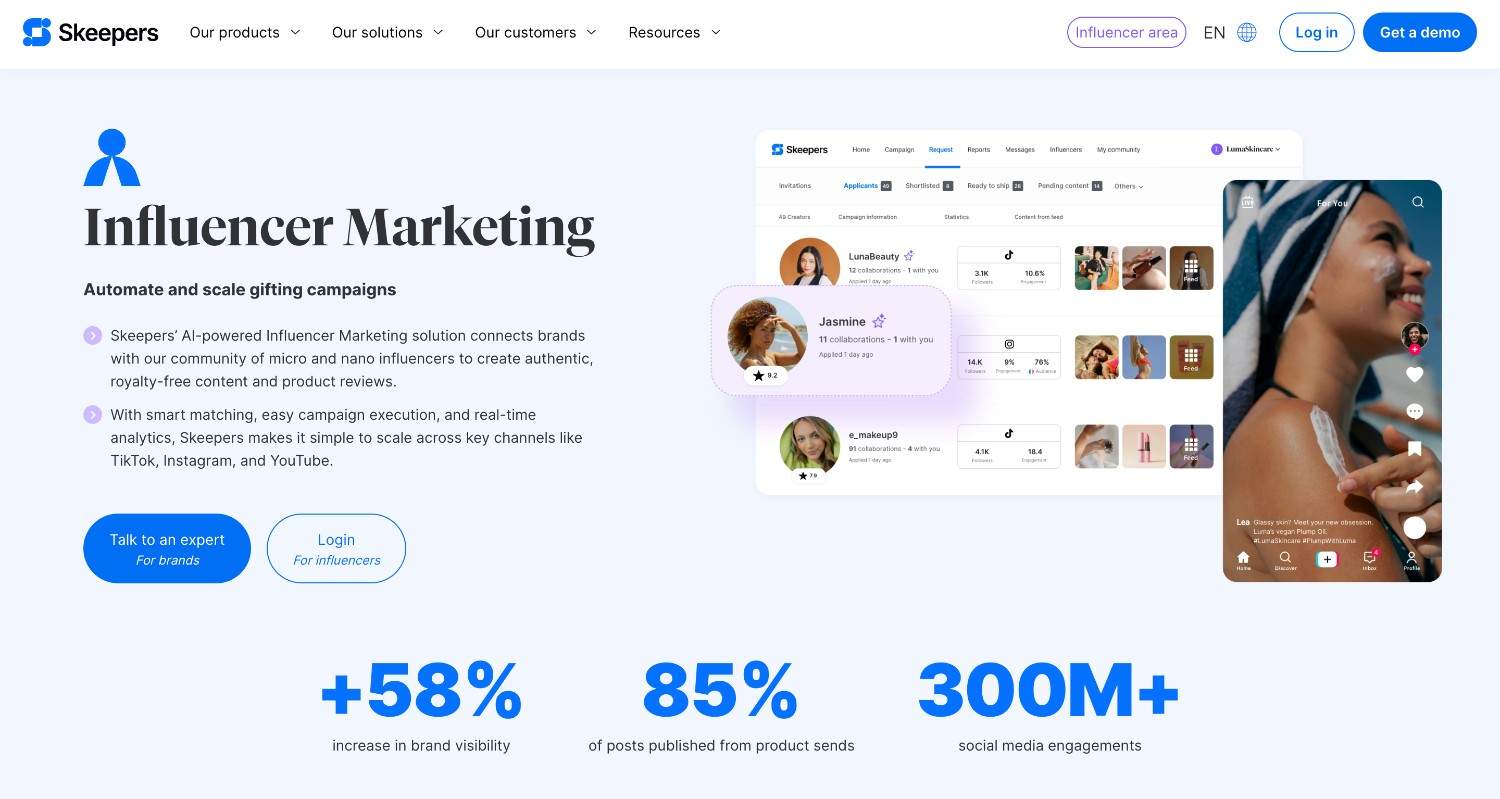
Skeepers est une plateforme unifiée axée sur le contenu généré par les utilisateurs, le marketing d'influence et les avis clients, aidant les marques à transformer les clients et les créateurs en moteurs de contenu et de conversion. Elle est particulièrement puissante en Europe et met l'accent sur la combinaison des campagnes d'influenceurs avec l'UGC et la preuve sociale.
Fonctionnalités principales
- Gestion de campagnes UGC et d'influenceurs — menez des campagnes avec des créateurs et des clients pour générer du contenu authentique.
- Intégration des évaluations et avis — collectez et affichez les avis des clients et des influenceurs sur tous les canaux.
- Recrutement de créateurs et création de communautés — construisez et gérez un réseau de défenseurs de la marque.
- Outils de distribution de contenu — réutilisez et distribuez l'UGC sur les canaux marketing.
- Suivi des performances et analyses — suivre l'engagement, la portée et les résultats des campagnes.
- Prise en charge de la stratégie de contenu omnicanale — unifiez le contenu des influenceurs, de l'UGC et des avis.
Tarification
- Skeepers ne répertorie pas publiquement de tableau de tarification détaillé pour le Marketing d'influence sur son site principal.
- Capterra répertorie un prix de départ de 1 250 €/mois et indique qu'aucun essai gratuit n'est disponible.
Avis
4,3/5,0 (Capterra)
Avantages
- Écosystème UGC + avis robuste — combine le marketing d'influence avec les avis clients et la preuve sociale.
- Excellent pour les campagnes pilotées par la communauté — aide les marques à activer les clients en tant que créateurs.
- Capacités de réutilisation de contenu — facilite la réutilisation de l'UGC sur tous les canaux.
Inconvénients
- Moins axée sur la profondeur de la découverte d'influenceurs
- Fonctionnalités CRM avancées limitées par rapport aux plateformes complètes
- La transparence des prix est faible
Intégrations
- Shopify — synchronisez les avis, l'UGC et les campagnes d'influenceurs avec votre boutique.
- Magento — intégrez les données de produits et les informations clients aux campagnes.
- Salesforce — connectez les données d'influenceurs et de clients aux flux de travail CRM.
- Google Analytics — suivez l'impact de la campagne sur la performance du site.
- Plateformes d'avis — distribuez les évaluations et les avis sur tous les canaux.
Later vs Skeepers
Later est un choix plus solide pour les flux de travail traditionnels de marketing d'influenceurs et la gestion de campagnes, tandis que Skeepers se concentre davantage sur l'UGC, les avis et le contenu piloté par la communauté. Skeepers est idéal pour les marques qui privilégient la preuve sociale et la réutilisation de contenu, tandis que Later convient mieux aux campagnes d'influenceurs structurées avec prospection, analytics et intégration des réseaux sociaux.
10. Creator.co
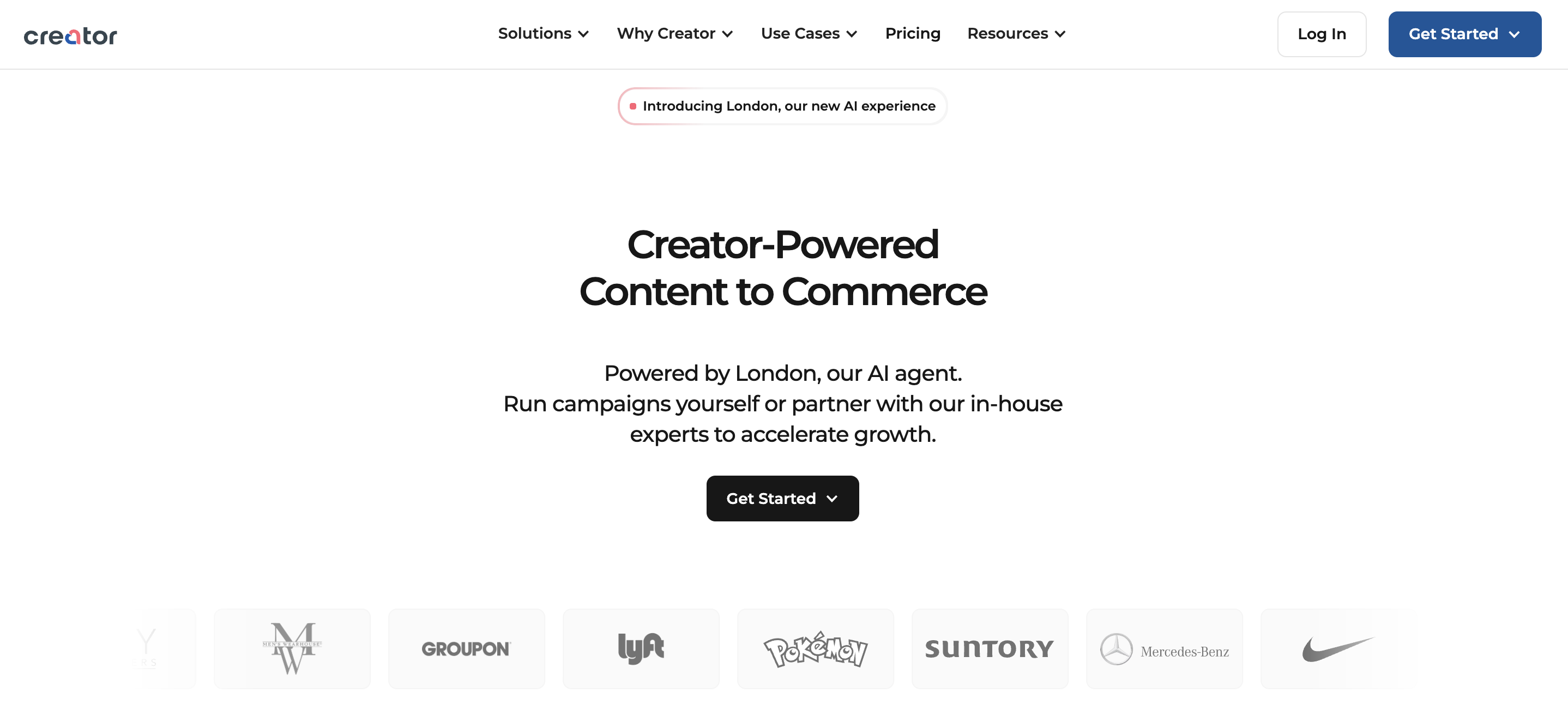
Creator.co est une plateforme de marketing d'influenceurs qui combine un marché de créateurs avec des outils de gestion de campagnes, permettant aux marques de collaborer avec des influenceurs via des campagnes en libre-service et des services gérés. Elle est particulièrement populaire parmi les petites et moyennes marques à la recherche de campagnes d'influenceurs abordables.
Fonctionnalités clés
- Marché des créateurs — les marques peuvent publier des campagnes et recevoir des candidatures d'influenceurs.
- Outils de découverte d'influenceurs — rechercher des créateurs par niche, audience et engagement.
- Flux de travail de gestion de campagnes — gérer les livrables, la communication et les approbations.
- Création de contenu et campagnes UGC — générer du contenu de réseaux sociaux via des collaborations avec des influenceurs.
- Services de campagnes gérées — service optionnel où Creator.co gère l'exécution de la campagne.
- Suivi des performances — surveiller l'engagement et les résultats des campagnes.
Tarification
- Self-Serve : 299 $/mois, avec un engagement minimum de 3 mois.
- Managed : 2 199 $/mois, avec un engagement minimum de 3 mois.
- Enterprise : tarification personnalisée, avec un engagement annuel.
- La page de tarification note également qu'après la période initiale, les abonnements mensuels passent à la facturation mois par mois, tandis que les plans annuels se renouvellent chaque année à un tarif réduit.
- Creator.co propose une essai gratuit pour Self-Serve.
Avis
4.6 / 5.0 (G2)
Avantages
- Point d'entrée abordable comparé à de nombreuses plateformes — convient aux petites marques.
- Le modèle de marché simplifie le sourcing d'influenceurs — les créateurs postulent directement aux campagnes.
- Options de campagnes flexibles — supporte à la fois les campagnes en libre-service et gérées.
Inconvénients
- Analytics et rapports avancés limités
- Fonctionnalités de CRM et de flux de travail moins robustes
- Base de données de créateurs plus petite comparée aux outils d'entreprise
Intégrations
- Shopify — connecter les campagnes d'influenceurs aux ventes de produits et aux performances.
- Stripe — gérer les paiements des collaborations avec les influenceurs.
- Google Analytics — suivre le trafic et les conversions des campagnes.
- Plateformes sociales (Instagram, TikTok) — gérer et suivre le contenu des influenceurs.
- Outils de messagerie — communiquer avec les créateurs et gérer la prospection.
Later vs Creator.co
Later est plus robuste pour les marques ayant besoin de flux de travail d'influenceurs avancés, d'analytics et d'intégrations, tandis que Creator.co convient mieux aux petites équipes ou à celles qui commencent tout juste avec le marketing d'influenceurs. Creator.co se concentre sur l'accessibilité et la facilité d'utilisation, tandis que Later offre une gestion de campagnes plus structurée et des rapports plus détaillés. Pour les marques soucieuses de leur budget, Creator.co est une alternative plus simple ; pour développer les programmes d'influenceurs, Later est l'option la plus puissante.
Réflexions finales
Later est une plateforme solide pour les marques cherchant à combiner le marketing d'influenceurs avec la gestion des réseaux sociaux et les flux de travail de campagnes structurés, mais les alternatives mises en avant offrent des forces plus spécialisées selon les besoins spécifiques. Des plateformes comme GRIN, Upfluence et Influencer Hero se distinguent par l'e-commerce et les campagnes axées sur les revenus, tandis que CreatorIQ et NeoReach s'adressent davantage aux programmes à l'échelle de l'entreprise avec des données avancées et la gouvernance. D'autres comme Insense, Skeepers et Creator.co se concentrent sur l'UGC, les marchés ou l'accessibilité. En fin de compte, le meilleur choix dépend de whether une marque privilégie l'évolutivité, la profondeur des analytics, les relations avec les créateurs ou les résultats axés sur la performance.

.png)


.jpg)