10 meilleures alternatives à Humanz pour le marketing d'influence
Explorez les meilleures alternatives à Humanz pour le marketing d'influenceurs, notamment Influencer Hero, Upfluence, Aspire, CreatorIQ, Later et Traackr. Comparez les fonctionnalités telles que la découverte de créateurs, l'UGC, le suivi des affiliés, les intégrations Shopify, la tarification et l'analyse des campagnes pour trouver la plateforme idéale pour votre marque.
10 meilleures alternatives à Humanz pour le marketing d'influence
Les marques D2C s'appuient de plus en plus sur les logiciels de marketing d'influence pour rationaliser la découverte de créateurs, gérer les prospections à grande échelle et suivre l'impact réel des campagnes sur les revenus plutôt que seulement l'engagement. Des plateformes comme Humanz ont gagné en traction grâce à leurs données de créateurs vérifiées et leurs capacités de suivi des performances, notamment avec des outils comme leur pixel d'attribution et leurs fonctionnalités d'amplification payante. Cependant, les commentaires courants soulignent des limitations autour de la transparence des prix, des problèmes d'utilisabilité et du besoin d'intégrations plus fortes ou d'une flexibilité de flux de travail—incitant de nombreuses équipes à explorer des solutions mieux adaptées. Que vous évaluiez des outils pour la première fois ou que vous recherchiez activement des alternatives à Humanz, le choix de la bonne plateforme peut directement impacter l'efficacité avec laquelle vous développez les partenariats avec les créateurs et mesurez le ROI.
Dans cet article, nous comparons les 10 meilleures alternatives à Humanz—notamment Influencer Hero, Upfluence, Aspire, CreatorIQ, Later, IZEA, Traackr, Influencity, Heepsy et Lefty—pour vous aider à trouver la solution adaptée à votre marque.
Critères clés pour évaluer les plateformes de marketing d'influence
Fonctionnalités essentielles
Évaluation des capacités essentielles en matière de marketing d'influence, notamment la découverte d'influenceurs, la prospection, le CRM, la gestion des campagnes, les rapports et les flux de travail de contenu.
Tarification et flexibilité
Comparaison des modèles tarifaires, des plans d'abonnement et des conditions contractuelles pour correspondre à différents budgets et étapes de croissance.
Avis et satisfaction des clients
Analyse des commentaires des utilisateurs provenant de plateformes d'examen de confiance, en mettant l'accent sur l'utilisabilité, la fiabilité, le support client et les performances globales.
Avantages et inconvénients
Examen des forces et des limitations de chaque plateforme pour mettre en évidence ses performances et ses faiblesses potentielles en fonction de différents cas d'usage.
Intégrations
Examen des intégrations les plus importantes (par exemple, Shopify et autres outils technologiques), en mettant en évidence ce que chaque intégration offre en une phrase.
Aperçu de Humanz
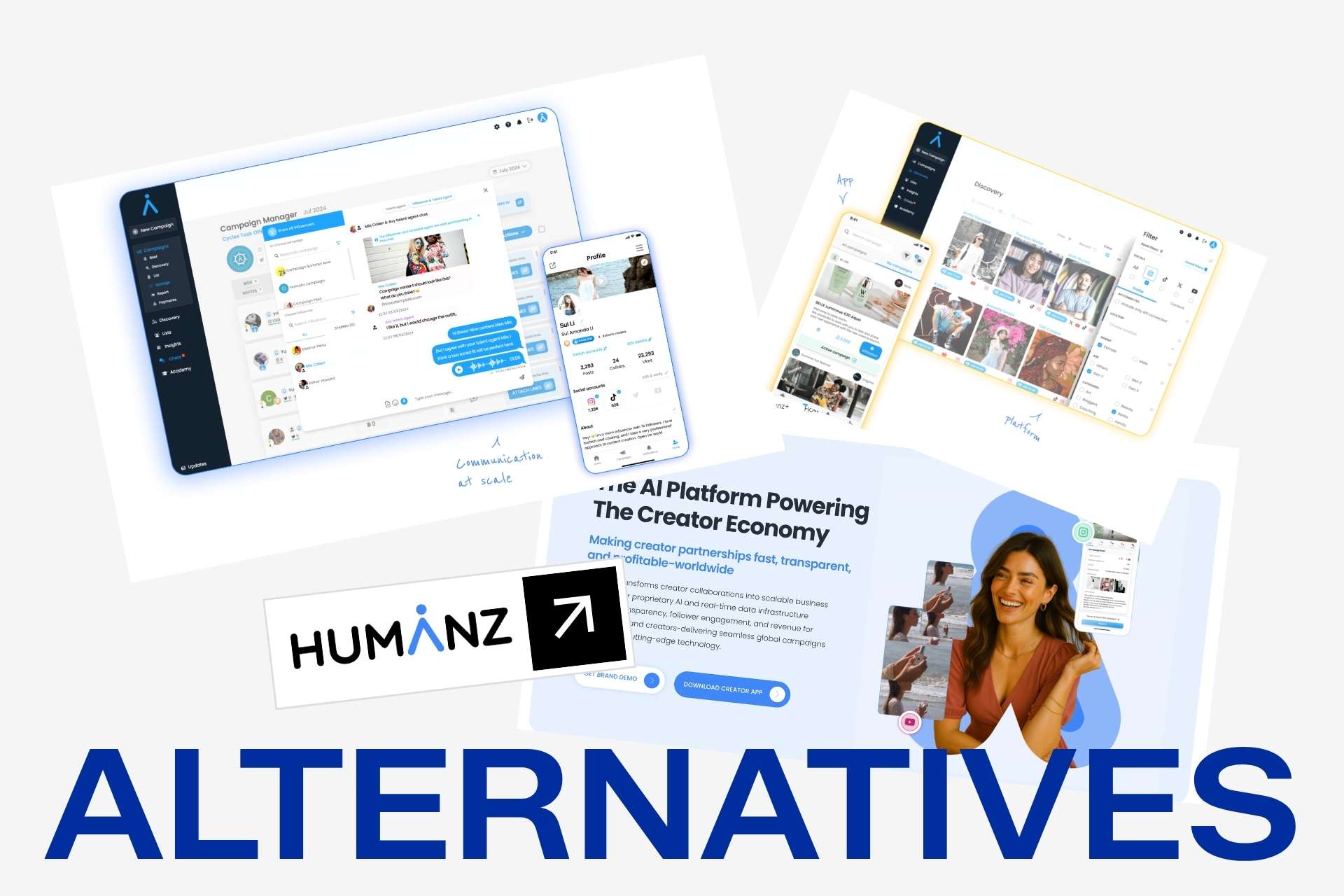
Humanz est une plateforme de marketing d'influence alimentée par l'IA, conçue pour aider les marques à gérer l'ensemble du cycle de vie du marketing de créateurs—de la découverte et la prospection à l'exécution de campagnes, au suivi et à l'amplification payante. Positionnée comme une solution axée sur la performance, Humanz va au-delà des plateformes d'influenceurs traditionnelles en combinant les données de créateurs vérifiées, les analyses en temps réel et les outils de suivi des conversions pour aider les marques à mesurer l'impact réel sur les affaires, et non seulement l'engagement.
Fonctionnalités clés
Découverte d'influenceurs alimentée par l'IA Humanz permet aux marques de trouver des créateurs en utilisant des filtres avancés tels que les données démographiques du public, la qualité de l'engagement, la pertinence des niches et les collaborations précédentes avec des marques—ce qui facilite l'identification des partenaires les plus pertinents.
Données de créateurs vérifiées (« Vérifiées par Humanz ») Une capacité remarquable où les créateurs connectent leurs comptes de réseaux sociaux via des API officielles, permettant aux marques d'accéder aux performances et aux données d'audience authentifiées au lieu de s'appuyer sur des métriques estimées.
Marketplace d'influenceurs + CRM Les marques peuvent recruter des créateurs à partir de la marketplace de Humanz ou importer les leurs, puis gérer toutes les relations, les communications et les collaborations dans un CRM centralisé.
Gestion des campagnes de bout en bout De la création d'un brief et l'approbation du contenu aux paiements et aux rapports, Humanz fournit un flux de travail complet pour gérer les campagnes d'influence à grande échelle.
Pixel Humanz (suivi des conversions) Une solution de suivi propriétaire qui mesure le comportement sur place et les ventes générées par les influenceurs—même sans codes de réduction—ce qui la rend particulièrement précieuse pour les marques DTC et de commerce électronique.
Analytics en temps réel et rapports de performance Suivez les métriques de campagne telles que la portée, l'engagement, les conversions et les revenus en temps réel, permettant une optimisation plus rapide et de meilleures décisions en matière de ROI.
Whitelisting des créateurs et amplification payante (Humanz Ads) Les marques peuvent transformer le contenu de créateurs performants en annonces payantes directement à partir de comptes d'influenceurs, ce qui contribue à étendre la portée et à améliorer la performance de la campagne.
```
Informations sur les créateurs générées par l'IA
Les récentes mises à jour incluent des résumés alimentés par l'IA des profils d'influenceurs, aidant les équipes à évaluer rapidement l'adéquation en fonction des thèmes de contenu, de la composition du public et des performances historiques.
Tarification
Humanz suit un modèle de tarification personnalisée, avec une transparence publique limitée concernant la structure des plans.
Avis
4,7/5,0 (G2)
Intégrations
Shopify — Suivez les ventes, conversions et performances de produits générées par les influenceurs directement via le pixel Humanz.
WooCommerce — Active le suivi des conversions et l'attribution pour les campagnes exécutées sur les magasins WooCommerce.
Wix — Permet aux petites marques de mesurer le trafic et les ventes générés par les influenceurs sur les sites basés sur Wix.
Meta (APIs Facebook et Instagram) — Fournit des données authentifiées d'audience et de performance pour une évaluation plus précise des influenceurs.
TikTok — Active l'accès aux métriques créateurs authentifiées et aux informations de performance des campagnes.
Avantages
Couche de données vérifiées avancée pour une meilleure prise de décision : La fonctionnalité « Verified by Humanz » de Humanz garantit que les marques travaillent avec des données réelles, soutenues par l'API, réduisant le risque de fraude et améliorant la précision de la sélection des influenceurs.
Accent fort sur le suivi des performances et des revenus : Contrairement à de nombreuses plateformes qui se concentrent sur les métriques de notoriété, Humanz met l'accent sur le suivi des conversions via son pixel, ce qui la rend très précieuse pour les marques DTC axées sur le ROI.
Amplification payante intégrée (Humanz Ads) : La capacité à convertir le contenu des influenceurs en publicités payantes au sein de la même plateforme aide les marques à générer des créations gagnantes sans changer d'outils.
Inconvénients courants de Humanz
Manque de transparence tarifaire
La tarification n'est pas accessible au public, ce qui rend difficile pour les équipes de comparer les coûts ou d'évaluer les alternatives au début du processus d'évaluation.
Problèmes de performance et d'utilisabilité de la plateforme
Certains utilisateurs signalent des temps de chargement lents, des plantages d'applications ou des notifications incohérentes, ce qui peut affecter l'efficacité du flux de travail quotidien.
Friction lors de l'intégration et de la configuration du compte
La connexion des profils sociaux et la configuration des comptes peuvent être difficiles, en particulier pour les créateurs, ce qui peut ralentir l'activation des campagnes.
Couverture de plateforme limitée dans certains cas
Bien que puissante sur les principales plateformes sociales, certains utilisateurs trouvent des lacunes dans le support des canaux supplémentaires ou de niche par rapport aux concurrents.
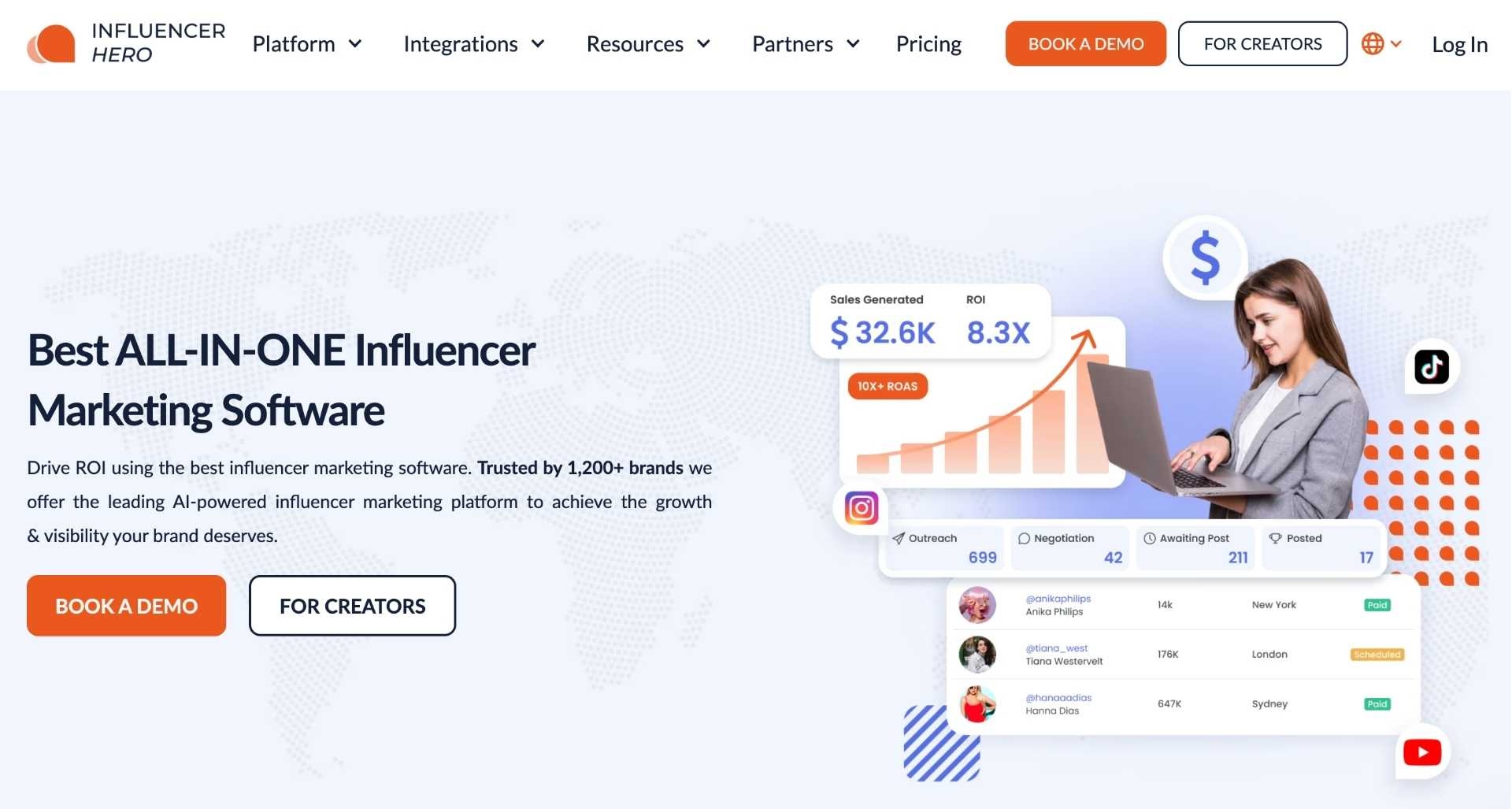
Influencer Hero est une plateforme de marketing d'influenceurs tout-en-un construite principalement pour les marques DTC et e-commerce qui souhaitent la découverte, la prospection, la gestion de la relation client, l'envoi de produits, le suivi des affiliés et les rapports ROI au même endroit. Son positionnement est remarquablement axé sur le commerce : plutôt que de traiter le marketing d'influenceurs comme un simple canal d'amorçage, il est conçu pour connecter l'activité des créateurs aux ventes en magasin, aux codes de réduction, aux revenus d'affiliation et à l'automatisation des campagnes.
Fonctionnalités clés
Découverte et évaluation des influenceurs — Influencer Hero offre une recherche de créateurs sur les principales plateformes sociales avec des filtres pour l'audience, la niche, la performance et l'adéquation, ce qui facilite la présélection des créateurs pour différents types de campagnes.
CRM centré sur les campagnes — La plateforme combine la gestion des relations avec les créateurs au suivi des flux de travail des campagnes, permettant aux équipes d'organiser les négociations, les livrables, les approbations et la performance dans un seul tableau de bord.
Flux de travail de prospection automatisés — La prospection en masse, les modèles et l'automatisation des flux de travail aident les marques à contacter et gérer de grands volumes de créateurs sans recourir à des feuilles de calcul ou des boîtes de réception fragmentées.
Suivi des affiliés et des codes de réduction — Influencer Hero est conçu pour générer et gérer les liens d'affiliation et les codes de réduction afin que les marques puissent attribuer les conversions et les revenus à des créateurs spécifiques.
Envoi de produits et ensemencement — La plateforme prend en charge les flux de travail d'ensemencement de produits liés aux campagnes, ce qui est particulièrement utile pour les marques Shopify et WooCommerce exécutant des programmes de créateurs basés sur l'envoi de produits.
Analytics de campagne et suivi du ROI — La plateforme est conçue pour suivre l'engagement, les clics, les conversions et les revenus via des tableaux de bord en temps réel liés à la performance des campagnes
Bibliothèque UGC — Capturez et organisez automatiquement le contenu créateur pour une réutilisation sur les annonces payantes, les réseaux sociaux et les canaux e-commerce
Pages d'application et vitrines — Créez des pages de candidature de créateurs de marque et permettez aux influenceurs de promouvoir les produits via des vitrines personnalisées
Tarification
Influencer Hero offre une tarification flexible basée sur le volume de prospection et vous pouvez avoir un nombre illimité de créateurs dans votre CRM :
Standard — 649 $/mois (jusqu'à 1 000 messages de prospection par mois)
Pro — 1 049 $/mois (jusqu'à 5 000 messages de prospection par mois)
Business — 2 490 $/mois (jusqu'à 10 000 messages de prospection par mois)
Personnalisé / Agence — Tarification sur mesure
Une tarification personnalisée est disponible pour les agences et les grandes équipes
Avis
4,9/5,0 (Capterra)
Avantages
Flux de travail alimentés par l'IA construits pour la mise à l'échelle — Influencer Hero rationalise l'ensemble du cycle de vie des campagnes—de la découverte à la prospection—grâce à l'automatisation, aux scores prédictifs et aux suggestions de campagnes intelligentes, aidant les équipes à réduire le travail manuel sans perdre le contrôle.
Prospection hautement personnalisée à grande échelle — Les flux de courriels améliorés par l'IA et les suivis automatisés génèrent des messages qui semblent adaptés et pertinents, améliorant les taux de réponse, les conversions et les relations à long terme avec les créateurs.
Support flexible d'e-commerce et d'attribution — Les intégrations natives avec Shopify, WooCommerce et les configurations personnalisées (via scripts) facilitent le suivi de l'envoi de produits, de la performance des affiliés et des revenus dans différentes vitrines dans un seul système.
Inconvénients
L'ampleur des fonctionnalités peut nécessiter un temps de configuration — Parce qu'elle combine le CRM d'influenceurs, la prospection, l'envoi de produits et l'attribution, les équipes peuvent avoir besoin d'aide à l'intégration pour configurer les flux de travail correctement au départ.
Tarification plus élevée pour les petites équipes — Peut être moins accessible pour les marques en phase de démarrage ou celles disposant de budgets limités
Intégrations
Shopify — Connectez votre magasin pour synchroniser les produits, les flux de travail d'envoi de produits, les codes de réduction et les revenus attribués dans les campagnes.
WooCommerce
```
Gestion des envois de produits et suivi des performances pour les programmes créateurs basés sur WooCommerce.
Klaviyo — Envoyez les données des créateurs et des campagnes vers les flux de marketing du cycle de vie et les listes d'audiences.
DocuSign — Envoyez et gérez les contrats des créateurs dans le cadre du flux de travail de la campagne.
Slack — Déclenchez des alertes d'équipe et des notifications de flux de travail à mesure que les créateurs progressent dans les étapes de la campagne.
Humanz vs Influencer Hero
Humanz est plus performant sur sa couche de données de créateurs vérifiés et son pixel Humanz pour mesurer l'activité des créateurs sur le site, tandis qu'Influencer Hero mise davantage sur les opérations DTC, en particulier l'automatisation de la prospection, l'envoi de produits, les liens d'affiliation et le suivi des revenus connectés au magasin. Humanz est également moins transparent sur la tarification publique, tandis qu'Influencer Hero offre aux acheteurs des points d'entrée plus clairs dès le départ.
Pour les marques qui souhaitent un flux de travail plus natif du commerce et une tarification plus claire pricing, Influencer Hero est généralement l'option la plus pratique. Pour les équipes qui accordent la priorité aux métriques de créateurs vérifiées par API et à l'écosystème d'amplification payante de Humanz, Humanz peut toujours sembler plus différencié en matière d'intégrité des données et de mise à l'échelle des publicités des créateurs.
Upfluence
Upfluence est une plateforme de marketing d'influenceurs et d'affiliation conçue autour de l'idée que le marketing des créateurs doit se connecter directement aux données des clients et du commerce. Elle est particulièrement bien connue pour aider les marques à découvrir des créateurs, recruter des influenceurs dans leur base de clients existante, gérer la prospection à grande échelle et suivre les revenus grâce aux intégrations du commerce électronique et des places de marché.
Fonctionnalités clés
Grande base de données de créateurs avec recherche avancée — Upfluence fournit un accès à une grande base de données d'influenceurs avec filtrage par niche, audience, engagement, plateforme et autres critères de découverte.
Correspondance entre clients et créateurs — L'une des capacités distinctives d'Upfluence est d'identifier les clients influents de votre boutique, CRM ou listes de messagerie afin que vous puissiez recruter les acheteurs existants comme créateurs.
Prospection en masse avec assistance IA — La plateforme prend en charge la prospection par courrier électronique, les modèles et les fonctionnalités Jaice AI pour aider les marques à lancer et personnaliser les campagnes plus rapidement.
Outils de campagne et CRM — Les marques peuvent gérer les listes de créateurs, les collaborations, les performances et l'historique des relations au sein de la même plateforme au lieu de répartir le travail entre plusieurs outils.
Suivi des affiliés, codes promotionnels et ventes — Upfluence peut générer des codes traçables et des liens d'affiliation et les connecter aux données de performance de la boutique et de la place de marché.
Paiements aux créateurs — Le niveau Autopilot ajoute Upfluence Pay pour les paiements multi-devises, les flux de conformité et la gestion des budgets.
Tarification
Modèle de tarification : Upfluence utilise une tarification personnalisée plutôt qu'un tableau de plans fixes publics.
Tous les plans sont personnalisés. Il y a une année complète minimale de service à laquelle vous devez vous engager avec des paiements mensuels. En moyenne, les plans commencent autour de 2 000 $/mois (24 000 $ par an)
Avis
4.3/5.0 (Capterra)
Avantages
Profondeur d'intégration au commerce électronique exceptionnelle — Upfluence se distingue par ses connexions solides à Shopify, Amazon, WooCommerce, Magento, BigCommerce et Klaviyo, ce qui en fait l'une des plateformes d'influenceurs les plus orientées vers le commerce.
La correspondance client est un véritable différenciant — La capacité à trouver des créateurs au sein de votre base de clients est l'une des capacités les plus distinctives d'Upfluence et peut réduire les coûts d'acquisition par rapport à la prospection à froid seule.
Conception modulaire flexible des plans — Sa structure de plan permet aux marques de passer de la découverte à l'automatisation complète et aux paiements des créateurs à mesure que les programmes mûrissent.
Inconvénients
Engagement annuel requis — Upfluence indique explicitement un contrat minimum de 12 mois, ce qui le rend moins flexible pour les équipes testant la catégorie.
La tarification peut être difficile à comparer rapidement — Parce que la tarification publique est en grande partie personnalisée, il est plus difficile de comparer le coût total au début du processus d'achat.
Les plaintes en matière d'utilisabilité ressurgissent encore
— Les avis publics et les commentaires des utilisateurs continuent de mentionner une courbe d'apprentissage, une rigidité des flux de travail et des frictions lors de la modification des campagnes.
Intégrations
Shopify — Identifiez les clients influents, synchronisez les données de votre boutique, envoyez des produits et suivez les ventes générées par les créateurs.
Amazon — Mesurez les performances d'affiliation et d'attribution pour les marques vendant sur Amazon.
Klaviyo — Enrichissez les listes d'e-mails avec les données des créateurs et identifiez les abonnés influents.
Gmail — Lancez la prospection et gérez la communication par e-mail avec les créateurs à partir de votre flux de travail de messagerie existant.
Outlook — Synchronisez la prospection et la communication avec les créateurs avec les flux de travail de messagerie Microsoft.
Humanz vs Upfluence
Humanz se concentre davantage sur les données des créateurs vérifiées, l'analyse des campagnes et l'amplification payante, tandis qu'Upfluence est plus manifestement conçue pour les opérations d'influencer marketing orientées vers le commerce, liées aux données clients, à l'envoi de produits, aux revenus d'affiliation et aux intégrations de marketplace. Upfluence est également l'option la plus solide lorsque l'identification des créateurs à partir de votre propre base de clients est une priorité.
Humanz peut séduire davantage les marques qui souhaitent un accent plus net sur la vérification des créateurs, le suivi en direct et les informations vérifiées par API, mais Upfluence est généralement un meilleur choix pour les marques qui souhaitent intégrer le influencer marketing étroitement dans Shopify, Amazon, Klaviyo et les flux de travail des données clients. Le compromis est qu'Upfluence s'accompagne généralement d'une structure de contrat plus lourde et d'une complexité opérationnelle plus importante.
Aspire
Aspire est une plateforme de influencer marketing pour les marques de commerce électronique qui combine la découverte de créateurs, les applications entrantes, la gestion des campagnes, le suivi d'affiliation, l'approvisionnement en UGC et les services gérés. Son positionnement est plus large qu'un outil de découverte typique : Aspire se positionne comme une plateforme de « commerce de bouche à oreille » conçue pour transformer les influenceurs, les affiliés, les ambassadeurs, les clients et les créateurs en canaux de revenus mesurables.
Fonctionnalités principales
Découverte de créateurs entrante et sortante — Aspire permet aux marques de rechercher directement des créateurs tout en permettant aux créateurs, clients, ambassadeurs et affiliés de postuler aux campagnes.
Flux de travail de campagne flexibles — La plateforme prend en charge l'envoi de produits, le contenu sponsorisé, la rédaction de contrats, les approbations et les flux de campagne personnalisés qui peuvent être adaptés à différents types de programmes.
CRM d'influenceur personnalisable — Aspire a mis l'accent sur la flexibilité du CRM, permettant aux équipes de gérer les relations avec les créateurs, les communications, les étiquettes et l'historique de manière plus personnalisée.
Liens d'affiliation, codes promotionnels et suivi du ROI — Les marques peuvent générer des liens et des codes uniques, mesurer les conversions et consulter les performances des campagnes au-delà des métriques de vanité.
Flux de travail d'approbation du contenu et UGC — Aspire prend en charge les révisions de brouillons, les approbations et les flux de réutilisation de contenu, ce qui est utile pour les marques utilisant les actifs des créateurs dans les canaux payants et possédés.
Plateforme en libre-service plus services gérés — Aspire vend à la fois l'accès aux logiciels et l'exécution des campagnes menées par les services, ce qui est utile pour les équipes qui souhaitent une aide stratégique ou opérationnelle.
Tarification
Aspire ne publie pas de tarification publique complète sur son site web. Les sources publiques et récentes du marché indiquent :
Tarification personnalisée
Souvent signalée à environ 2 000 $/mois
Le devis récent a indiqué environ 2 300 $/mois pour une configuration de niveau intermédiaire
Généralement vendue avec un engagement de 12 mois plutôt que des plans en libre-service mensuels
Avis
4,0/5,0 (Capterra)
Avantages
Modèle de marketplace entrant solide — La capacité d'Aspire à combiner l'approvisionnement sortant avec des créateurs qui postulent directement est un différenciateur majeur pour les marques construisant des programmes d'ambassadeurs et UGC à l'échelle.
Écosystème de partenaires propriétaires — Aspire souligne les partenariats avec Meta, TikTok et Pinterest, ce qui soutient une meilleure qualité des données et des informations de campagne plus fiables que les alternatives basées sur le scraping.
Mises à niveau récentes du CRM et du ROI— Aspire a investi dans des workflows CRM personnalisables et des outils ROI e-commerce plus complets, renforçant son attrait pour les marques qui passent de campagnes influenceurs ponctuelles à une gestion relationnelle à plus long terme.
Inconvénients
La tarification personnalisée peut devenir coûteuse pour les petites équipes — Aspire est rarement l'option la moins chère et tend à convenir aux marques disposant de budgets plus matures.
Moins transparent que les concurrents à coût inférieur — Les acheteurs ont généralement besoin d'une conversation avec un commercial pour comprendre le coût réel du forfait.
Certaines équipes décrivent encore une courbe d'apprentissage — Parce qu'Aspire couvre la découverte, le CRM, les affiliés, l'UGC et les workflows, l'intégration peut prendre du temps pour être complètement à l'aise.
Intégrations
Shopify — Intégrez les données d'acheteurs, enrichissez les profils clients, automatisez le gifting et suivez l'activité commerciale générée par les créateurs.
WooCommerce — Connectez les données du magasin et les workflows de campagne basés sur les produits pour les marques WooCommerce.
Meta — Accédez aux capacités de partenaire officiel qui soutiennent des données de campagne et de performance des créateurs plus fiables.
TikTok — Utilisez la connectivité partenaire TikTok pour les workflows de campagne et l'analyse de performance des créateurs.
Slack — Intégrez la coordination de campagne et la communication d'équipe dans la gestion quotidienne des workflows.
Humanz vs Aspire
Humanz et Aspire visent tous deux à couvrir la découverte, la gestion de campagne et la performance mesurable des créateurs, mais Aspire est généralement plus fort pour les marques qui souhaitent un mélange de logiciel et de services gérés, plus un accent plus important sur les candidatures de créateurs entrantes et les workflows de commerce de bouche à oreille. Humanz, en revanche, est davantage centré sur les données de créateurs vérifiées, l'accès à la place de marché et son propre pixel de conversion.
Si votre équipe souhaite opérationnaliser non seulement les influenceurs mais aussi les ambassadeurs, les affiliés, les clients et les contributeurs UGC, Aspire offre généralement le cadre le plus large. Si vous accordez plus d'importance aux données d'audience vérifiées, à l'évaluation des créateurs et à la couche d'amplification payante de Humanz, Humanz peut sembler plus spécialisé. Aspire est également plus susceptible de nécessiter un budget plus élevé et un processus d'évaluation plus long.
CreatorIQ
CreatorIQ est une plateforme de marketing d'influenceurs de niveau entreprise conçue pour les grandes marques mondiales qui ont besoin de rapports approfondis, de gouvernance, de collaboration et d'infrastructure de données. Plutôt que de se positionner comme un CRM de créateurs léger, CreatorIQ est conçu comme un système d'exploitation pour créateurs qui connecte la découverte de créateurs, la gestion des workflows, les paiements, les analyses comparatives et les rapports d'entreprise dans un seul environnement.
Fonctionnalités clés
Découverte de créateurs de qualité entreprise — La recherche de créateurs de CreatorIQ est alimentée par des intégrations API directes et une intelligence de créateurs large, avec filtrage par données démographiques d'audience, performance et adéquation.
Gestion unifiée des workflows — L'entreprise a récemment insisté sur l'apport de l'ensemble du parcours des créateurs sous un même toit, de l'exécution de campagne aux paiements en passant par les analyses comparatives compétitives.
Analyse concurrentielle BenchmarkIQ — L'add-on BenchmarkIQ de CreatorIQ aide les marques à comparer les performances des créateurs sur les marchés et les concurrents en utilisant un ensemble de données d'intelligence mondiale.
CreatorIQ Pay — La plateforme prend en charge les paiements aux créateurs de niveau entreprise avec des capacités de paiement mondiales, un soutien à la conformité et des opérations multi-devises.
Intégrations ExchangeIQ — CreatorIQ fournit une infrastructure API et d'intégration afin que les données des créateurs puissent circuler dans l'ensemble de la pile d'entreprise pour la mesure et les rapports.
Tableaux de bord de rapports d'entreprise — La couche de rapports est conçue pour les marques mondiales qui ont besoin d'une visibilité structurée au niveau de la campagne, régionale et exécutive.
Tarification
Il existe différents plans :
Plan Basic : À partir de 35 000 $ par an. Comprend 1 000 créateurs de contacts par mois
Plan Standard : À partir de 50 000 $ par an. Comprend 2 500 créateurs de contacts par mois
Plan Professional : À partir de 90 000 $ par an. Comprend 5 000 créateurs de contacts par mois
Plan Enterprise : À partir de 200 000 $ par an. Comprend 7 500 créateurs de contacts par mois
Avis
4.4/5.0 (Capterra)
Avantages
Rapports et gouvernance d'entreprise très solides — CreatorIQ est l'une des solutions les mieux adaptées aux équipes multinationales qui ont besoin d'une supervision structurée, de rapports exécutifs et de processus cohérents sur les marchés.
L'expansion récente des produits est significative — Les lancements et mises à jour récents tels que BenchmarkIQ, l'expansion de CreatorIQ Pay et la nouvelle expérience CreatorIQ montrent que la plateforme investit activement dans la mesure d'entreprise et la consolidation des flux de travail.
Direction des données internes et partenaires de haute qualité — Les intégrations récentes avec YouTube et les partenariats tels que Sprinklr renforcent l'orientation de CreatorIQ vers des données plus unifiées et fiables dans les domaines des créateurs, du contenu organique et de la publicité sociale payante.
Inconvénients
Coût d'entrée élevé — CreatorIQ se situe fermement dans la catégorie entreprise et est généralement hors de portée pour les équipes influenceurs plus petites ou en phase de démarrage.
Configuration plus complexe et courbe d'apprentissage plus prononcée — Sa profondeur est une force, mais elle peut aussi rendre la plateforme plus complexe que les alternatives du segment intermédiaire.
Transparence tarifaire moins importante — Les acheteurs doivent généralement passer par un processus de vente avant de comprendre le coût complet et la portée des offres.
Intégrations
Shopify — Automatisez la génération de codes promotionnels et de liens et collectez les données de performance du commerce des créateurs plus efficacement.
YouTube — La nouvelle intégration de l'API créateur YouTube offre aux marques des informations d'audience interne plus précises et des flux de travail de campagne plus fluides.
Sprinklr — Unifiez les performances des campagnes de créateurs avec les rapports de publicité payante et organique au sein d'une pile sociale d'entreprise plus large.
API ExchangeIQ — Connectez les données de CreatorIQ à vos systèmes métier internes pour des rapports plus complets et une intégration des flux de travail d'entreprise.
CreatorIQ Pay — Gérez les paiements mondiaux aux créateurs avec des devises locales et des contrôles de conformité au sein de la plateforme.
Humanz par rapport à CreatorIQ
Humanz est une plateforme de marketing de créateurs plus accessible pour les marques qui souhaitent des données de créateurs vérifiées, l'exécution de campagnes et le suivi des conversions sans nécessairement acheter un système d'exploitation d'entreprise complet. CreatorIQ est beaucoup plus orienté vers l'échelle mondiale, la gouvernance, l'analyse comparative et les intégrations d'entreprise.
En pratique, CreatorIQ est généralement la meilleure solution pour les grandes marques qui ont besoin de rapports multimarché, d'approbations structurées, d'intégrations étendues et de flux de travail de paiement exigeant la conformité. Humanz est plus attrayant pour les équipes qui souhaitent une plateforme plus ciblée centrée sur la découverte, la collaboration avec les créateurs, le suivi des performances et les données vérifiées sans la même surcharge d'entreprise ni probable étiquette de prix d'entreprise.
Later
Later Influence est la branche du marketing influenceur de la plateforme plus large de créateurs et de médias sociaux de Later. Elle combine la gestion des campagnes influenceurs avec un écosystème plus large de médias sociaux, et elle se positionne de plus en plus autour de l'intelligence de campagne alimentée par l'IA, des rapports sur l'ensemble du parcours, les relations avec les créateurs et les services gérés optionnels pour les marques qui ne souhaitent pas tout gérer en interne.
Fonctionnalités clés
Gestion complète des campagnes influenceurs — Later Influence prend en charge la découverte de créateurs, l'exécution de campagnes, l'automatisation des flux de travail, la mesure et les processus d'approbation pour les marques exécutant des programmes de créateurs structurés.
Utilisateurs, campagnes et partenariats de créateurs illimités — Sa page de tarification souligne l'échelle illimitée au sein des plans sous licence, ce qui est notable pour les programmes d'entreprise et multi-équipes.
Flux de travail de révision et d'approbation des projets — Les marques peuvent examiner le contenu avant sa mise en ligne, collaborer avec les parties prenantes internes et centraliser les commentaires au sein de la plateforme.
Rapports authentifiés quasi en temps réel — Later met en avant des métriques de performances vérifiées à partir des API de médias sociaux prises en charge afin que les équipes puissent rapporter sur les impressions, l'engagement, les mentions j'aime, les commentaires, les clics, les conversions, les ventes et l'EMV.
Later EdgeAI— Le système natif d'IA propriétaire de Later est construit sur un ensemble de données propriétaires important et vise à améliorer la planification, la prédiction et la performance des campagnes.
Reporting Later 360 — Une couche de reporting d'entreprise plus récente unifie les données organiques, payantes et commerciales dans un seul environnement de reporting, ce qui rend Later plus attrayant pour les marques qui ont besoin d'une visibilité complète de l'entonnoir.
Tarification
La plateforme de marketing d'influenceurs de Later (Later Influence) utilise une tarification personnalisée, et les marques doivent demander une démo pour connaître les coûts exacts.
Selon nos recherches, il existe différents plans :
Plan Essentials : À partir de 28 500 $/an. Idéal pour les marques qui débutent dans le marketing d'influenceurs.
Plan Pro : À partir de 42 000 $/an. Idéal pour les données et l'automatisation afin d'accélérer vos campagnes et d'obtenir un meilleur ROI.
Plan Premier : À partir de 60 000 $/an. Tout ce dont vous avez besoin pour un programme d'influenceurs à l'échelle.
Tous les plans incluent des frais d'intégration uniques supplémentaires de 5 000 $ pour tous les nouveaux clients.
Avis
4,4 / 5,0 (Capterra)
Points forts
Écosystème social et influenceur plus large — Later est plus puissant que la plupart des plateformes d'influenceurs pures si votre équipe valorise également la proximité avec la publication sociale, le commerce de créateurs et une pile de marketing social plus grande.
Les lancements récents d'IA et de reporting sont significatifs — Later EdgeAI et Later 360 sont des ajouts récents importants qui poussent la plateforme au-delà des logiciels de flux de travail d'influenceurs standard vers la prédiction et la reporting d'entreprise complète de l'entonnoir.
Modèle de service flexible — Les marques peuvent choisir des arrangements en libre-service, hybrides ou de service géré, ce qui donne à Later plus de flexibilité opérationnelle que de nombreuses plateformes logicielles uniquement.
Points faibles
Pas de tarification fixe publique pour les plans d'influenceurs — Les acheteurs doivent toujours entrer dans une conversation commerciale pour comprendre les coûts.
Non positionnée pour les équipes en libre-service conscientes du budget — L'emballage et l'accent sur le service suggèrent un meilleur ajustement pour les programmes plus grands ou plus matures.
Une certaine friction de liaison de compte de créateurs persiste au niveau de l'industrie — Les avis publics notent que les problèmes de connexion de compte peuvent toujours affecter le flux de travail, même si ces problèmes sont souvent liés aux contraintes de l'API sociale.
Intégrations
Shopify — Automatisez la livraison de produits, la sélection de créateurs et le suivi des résultats de campagne par le biais de flux de travail connectés à Shopify.
Yotpo Reviews — Connectez l'activité des influenceurs aux flux de travail de génération d'avis et de preuve sociale.
Bazaarvoice — Soutenez les programmes d'évaluations et d'avis liés aux campagnes de créateurs et de plaidoyer.
PowerReviews — Liez les programmes de créateurs à la collecte d'avis et aux initiatives de confiance des consommateurs.
Later Influence API / Reporting API — Exportez et intégrez les données de campagne dans les systèmes de reporting plus larges et internes.
Humanz vs Later
Humanz se concentre plus étroitement sur la découverte d'influenceurs, les données vérifiées de créateurs, l'exécution de campagnes, l'attribution et l'amplification des annonces de créateurs, tandis que Later offre un environnement social plus large avec influenceurs et services optionnels, l'intelligence des campagnes d'IA et la reporting d'entreprise complète et unifiée de l'entonnoir.
Pour les marques qui souhaitent une plateforme étroitement centrée sur les programmes d'influenceurs eux-mêmes, Humanz peut sembler plus direct. Pour les équipes qui souhaitent que le marketing d'influenceurs soit connecté à la publication sociale, aux services gérés, à la prévision d'IA et à la reporting unifiée des données organiques/payantes/commerciales, Later est le choix plus expansif. Le plus grand compromis est que le produit d'influenceurs de Later reste basé sur des devis et davantage orienté vers l'entreprise dans la façon dont il est présenté.
À grande échelle, le marketing d'influence est moins une question de créativité et davantage une question de systèmes et de données. Les marques qui gagnent sont celles qui construisent des cadres reproductibles soutenus par la bonne technologie.
Jordi Hendriks
D2C Expert & Founder of D2C Stack
IZEA
IZEA est l'une des plateformes les plus anciennes du secteur du marketing de créateurs, offrant à la fois une place de marché de créateurs en libre-service et une plateforme de campagne plus structurée, IZEA Flex, destinée aux marques et agences. Elle est surtout connue pour combiner la découverte de créateurs, l'approvisionnement en contenu de marque, la gestion des flux de travail et les paiements aux créateurs dans un parapluie plus large d'économie créative, plutôt que de fonctionner uniquement comme un CRM influenceur classique.
Fonctionnalités principales
Gestion de campagne IZEA Flex — IZEA Flex est conçu pour gérer les approbations, l'examen du contenu, le suivi des créateurs et les performances des campagnes à partir d'un hub unique, offrant aux marques un flux de travail plus structuré que la place de marché de base seule.
Place de marché des créateurs — Les marques peuvent parcourir les listes, créer des appels de casting et embaucher des créateurs directement via la place de marché d'IZEA, ce qui est utile pour les équipes qui souhaitent un point d'entrée plus léger avant de se lancer dans des programmes gérés plus importants.
Liens de suivi et attribution du commerce — IZEA Flex inclut des liens de suivi et prend en charge la mesure au niveau des commandes et des revenus par le biais d'intégrations commerciales, aidant les marques à connecter le travail des créateurs à l'activité du site et aux ventes.
Paiements et transactions des créateurs — IZEA prend en charge la rémunération des créateurs directement dans la plateforme, y compris les flux de travail de paiement forfaitaire dans Flex.
Outils de création et de flux de travail alimentés par l'IA — IZEA a étendu sa couche IA via FormAI et les nouvelles fonctionnalités de Flex AI telles qu'IZZY, offrant aux équipes des outils pour l'idéation, le soutien créatif et l'assistance aux flux de travail des campagnes.
Prospection connectée à Gmail — IZEA a ajouté une intégration Gmail vérifiée dans Flex, aidant les équipes à centraliser plus proprement la communication avec les créateurs dans la plateforme.
Tarification
Plan Starter : à partir de 130 $/mois.
Plan Power : à partir de 500 $/mois.
Essai gratuit :10 jours.
Services gérés : tarification personnalisée basée sur les devis pour les campagnes entièrement gérées.
Avis
3,9/5,0 (G2)
Avantages
Point d'entrée très flexible — IZEA est l'une des rares options qui offre aux marques à la fois une place de marché d'accès gratuit et un environnement Flex plus structuré, ce qui facilite le démarrage en petit et l'évolution ultérieure.
Couche IA utile pour le soutien au contenu et aux flux de travail — FormAI, IZZY et d'autres mises à jour récentes de l'IA rendent IZEA plus différencié pour les équipes qui souhaitent une assistance créative intégrée à la plateforme.
Intégrations sensibles au commerce — Les intégrations Shopify, Google Analytics et Gmail rendent IZEA plus pratique pour les marques qui souhaitent que l'exécution des campagnes soit liée à la performance du site et à la communication avec les créateurs.
Inconvénients
La tarification publique est fragmentée — la tarification de la place de marché est visible, mais la tarification de Flex et des services gérés plus complets est toujours basée sur devis, ce qui rend la comparaison plus difficile.
La profondeur des avis est plus mince que celle de certains concurrents — la couverture des avis publics pour l'annonce logicielle actuelle d'IZEA est limitée par rapport aux plus grands acteurs de la plateforme influenceur.
La meilleure expérience peut nécessiter d'aller au-delà de la place de marché — les équipes souhaitant un CRM robuste, des rapports et une orchestration des flux de travail obtiendront plus de valeur de Flex que de la place de marché seule.
Intégrations
Shopify — permet aux marques de suivre l'impact des campagnes influenceur au niveau des commandes et de connecter l'activité des créateurs à la performance du magasin.
Google Analytics — agrège les métriques d'engagement, de conversion et de revenus du site à côté de l'activité influenceur.
Gmail — centralise la communication avec les créateurs via l'intégration Gmail vérifiée dans IZEA Flex.
Liens de suivi — Le suivi de lien intégré d'IZEA mesure le trafic, les produits achetés et les revenus générés par les campagnes de créateurs.
Transactions Flex — prend en charge les paiements des créateurs dans la plateforme liés aux performances des campagnes et aux métriques de coût.
Humanz vs IZEA
Humanz est davantage positionnée comme une plateforme de marketing d'influenceurs avec des données de créateurs vérifiées et un suivi des conversions, tandis que IZEA couvre un modèle de créateur-commerce plus large avec à la fois une marketplace et un environnement Flex plus structuré. IZEA est également plus facile à adopter à bas prix grâce à son niveau de marketplace gratuit et à ses tarifs Marketer Pro publics, alors que Humanz est moins transparent sur les tarifs mais plus concentré sur les métriques de créateurs vérifiés et la mesure des influenceurs sur tout l'entonnoir.
Traackr
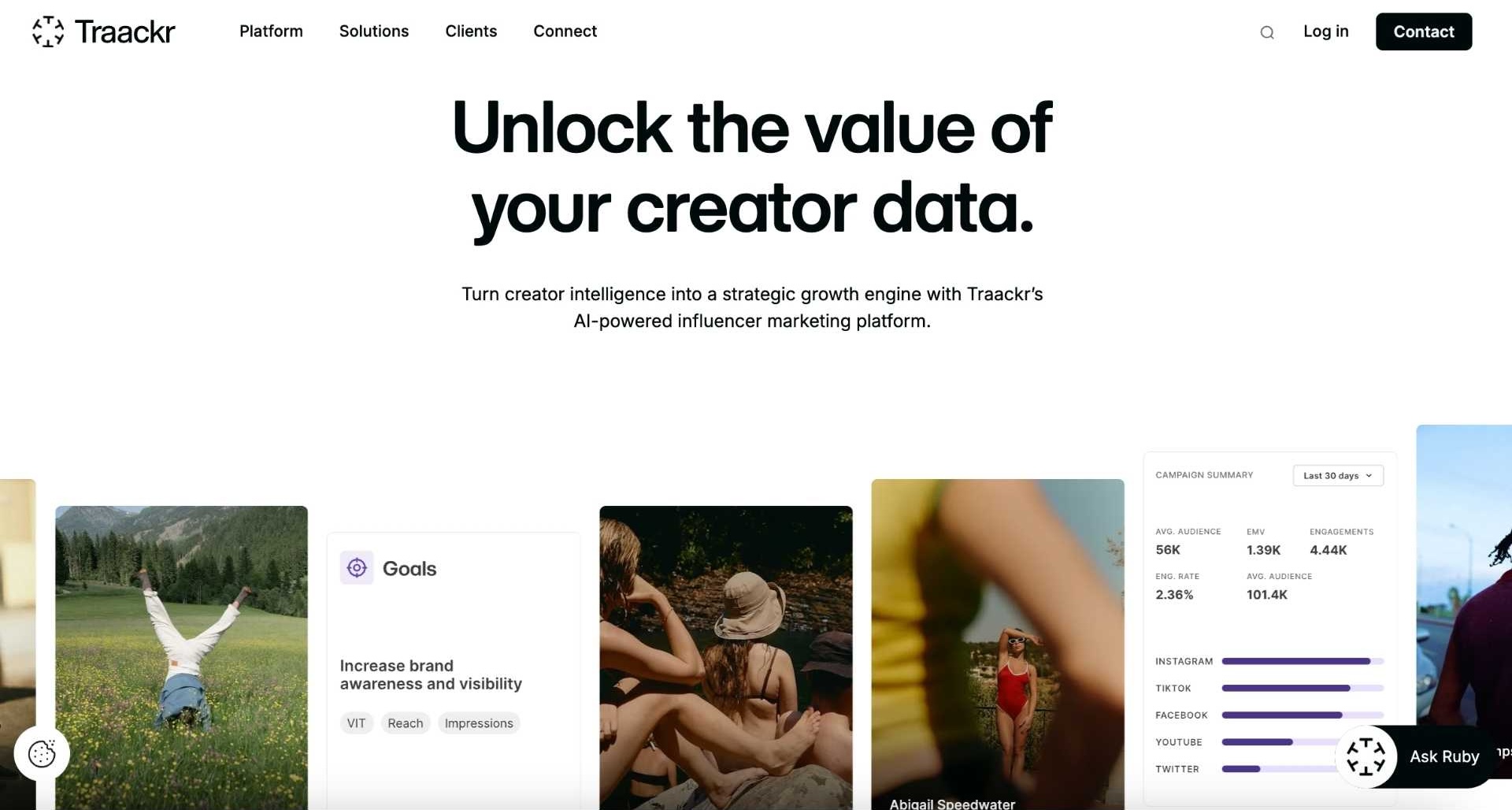
Traackr est une plateforme de marketing d'influenceurs d'entreprise fortement concentrée sur l'intelligence des créateurs, l'analyse comparative, la visibilité du budget et la gestion des relations à long terme. Elle est particulièrement adaptée aux marques mondiales qui souhaitent mesurer la performance des influenceurs sur les marchés et justifier les dépenses par un reporting plus rigoureux que celui proposé par la plupart des outils orientés campagne.
Fonctionnalités clés
Découverte et évaluation des créateurs — Traackr propose une découverte alimentée par l'IA ainsi qu'un accès aux données de plateforme propriétaire pour aider les marques à trouver, évaluer et organiser les créateurs en toute confiance.
Brand Vitality Score (BVS) — sa métrique signature aide les marques à évaluer la visibilité, l'influence et l'impact de la marque par rapport aux concurrents, ce qui est l'un des plus clairs différenciateurs de Traackr.
Optimisation du budget et des dépenses — Traackr met l'accent sur l'efficacité des dépenses, les métriques par coût et la planification des investissements plutôt que simplement sur la prospection de créateurs.
Suivi des affiliés et versements — la plateforme prend en charge le suivi des campagnes d'affiliation et les versements aux créateurs dans le même écosystème.
Ensemencement activé par Shopify — l'intégration Shopify de Traackr rationalise l'ensemencement des produits en permettant aux créateurs de choisir des produits et aux marques de suivre le statut des commandes dans Traackr.
Intégrations d'entreprise et gouvernance — Traackr met en avant les intégrations sur les plateformes sociales, l'e-mail, l'e-commerce, les paiements, l'authentification unique et les outils d'entrepôt de données pour les grandes organisations.
Tarification
Tarification officielle : personnalisée / demander un devis.
Repère public : la tarification commence à environ 32 500 $/an pour un plan standard, avec des modules supplémentaires disponibles sur demande.
Type de contrat : généralement des contrats d'entreprise annuels.
Avis
4,3 / 5,0 (G2)
Avantages
Orientation d'analyse comparative de première classe — BVS, analyse concurrentielle et reporting d'efficacité des coûts rendent Traackr inhabituellement puissant pour les marques qui ont besoin de justifier les dépenses et de comparer la performance entre les régions.
Stack d'intégration d'entreprise solide — Traackr est clairement conçu pour les organisations qui souhaitent que les flux de travail sociaux, d'e-commerce, de paiements, d'authentification unique et de données soient connectés aux programmes de créateurs.
Excellent pour les équipes mondiales — le modèle de produit et de support sont construits pour les programmes multi-marchés plutôt que pour les campagnes légères ponctuelles.
Inconvénients
Processus d'achat coûteux et de style entreprise — la tarification est annuelle et basée sur devis, ce qui rend plus difficile l'adoption rapide par les petites équipes DTC.
Peut sembler lourd en données pour les équipes allégées — les retours publics décrivent systématiquement Traackr comme puissant mais davantage orienté reporting et moins léger que les plateformes plus simples.
Certains utilisateurs signalent toujours des retards de suivi et des problèmes d'estimation des données — notamment autour de la vitesse de synchronisation du contenu et des données démographiques estimées dans certains cas d'usage.
Intégrations
Shopify — alimente les flux de travail d'ensemencement de produits et permet aux marques de suivre les produits sélectionnés par les créateurs et le statut des commandes dans Traackr.
API des plateformes sociales — les intégrations directes fournissent un accès conforme aux données de créateurs propriétaires et à la performance des campagnes.
E-mail — Traackr énumère les intégrations e-mail dans le cadre de son écosystème partenaire pour les flux de travail de communication avec les créateurs.
Paiements — prend en charge les flux de travail de versement aux créateurs via sa couche d'intégration des paiements.
SSO / Entrepôt de données — prend en charge l'authentification d'entreprise et l'infrastructure de données en aval pour les grandes organisations.
Humanz vs Traackr
Humanz est plus axée sur l'exécution pour les marques qui souhaitent la découverte de créateurs, les workflows de campagne et le suivi des conversions dans un package plus ciblé, tandis que Traackr est plus forte en tant que couche de mesure et d'analyse comparative au niveau entreprise. Traackr gagne en intelligence budgétaire, analyse comparative concurrentielle et rapports multi-marchés, tandis que Humanz est l'option la plus accessible pour les équipes qui privilégient les données de créateurs vérifiées et l'activation de campagne au quotidien par rapport à la profondeur analytique entreprise.
Influencity
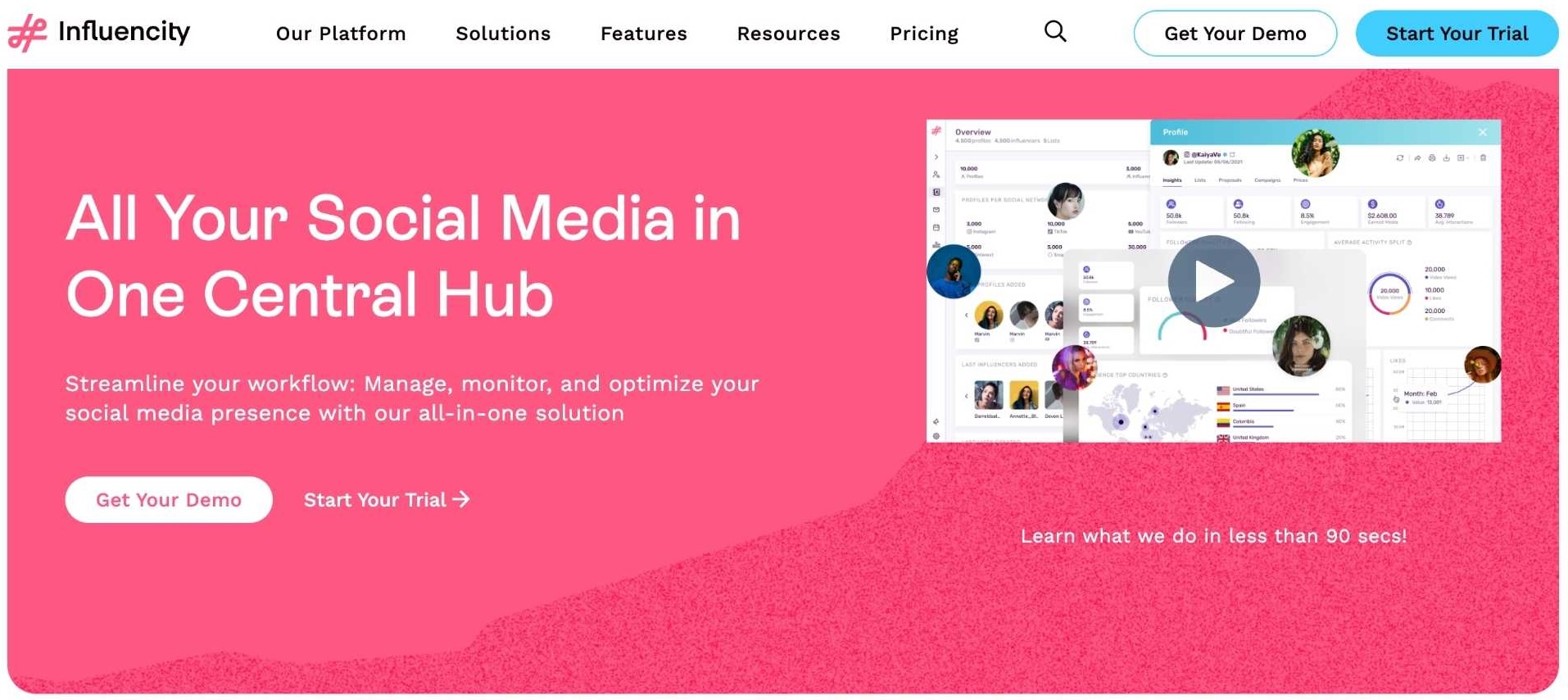
Influencity est une plateforme de marketing d'influenceurs de bout en bout qui combine la découverte, la prospection, la gestion de campagne, l'analytics, l'envoi de produits, les paiements et l'écoute des réseaux sociaux dans un seul système. Son positionnement est particulièrement large : plutôt que de n'agir que comme une base de données de créateurs, elle vise à servir les marques et les agences qui souhaitent une plateforme modulaire avec une tarification transparente et la capacité de payer uniquement pour les fonctionnalités dont elles ont besoin.
Fonctionnalités principales
Grande base de données de créateurs — Influencity affirme fournir des analytics pour plus de 350 millions de profils dans le monde, prenant en charge la recherche, le filtrage et l'examen des créateurs à grande échelle.
Gestion des relations avec les influenceurs — la plateforme couvre le recrutement, l'intégration, les négociations, les workflows de campagne et les approbations dans le même système.
Prévisions et rapports de campagne — Influencity met l'accent sur les rapports, les résultats exportés et les prévisions avant le lancement afin que les équipes puissent mieux planifier les résultats attendus.
Prospection par courrier électronique et séquences — les marques peuvent connecter les boîtes de réception, exécuter des séquences de courrier électronique et gérer la communication avec les créateurs depuis la plateforme.
Envoi de produits Shopify et suivi du commerce électronique — la plateforme supporte les programmes d'envoi basés sur Shopify et lie l'activité des créateurs aux conversions et à l'attribution des ventes.
Paiements mondiaux des créateurs — Influencity supporte les paiements automatisés des créateurs dans une facture consolidée et promeut les paiements mondiaux dans n'importe quelle devise.
Tarification
Influencity propose trois niveaux de tarification principaux, ainsi que des modules complémentaires :
Philosophie de tarification transparente et modulaire — Influencity promeut explicitement une tarification à la carte, transparente et un accès à l'essai gratuit, ce qui est inhabituel dans une catégorie dominée par les ventes sur devis.
Ensemble de fonctionnalités très large tout-en-un — peu de plateformes du marché intermédiaire combinent la découverte, la GRI, les paiements, l'envoi de produits Shopify, les rapports de campagne, le hub social et la surveillance dans une famille de produits.
Bon choix pour les agences et les équipes multi-campagne — le plan Entreprise et la structure de workflow plus large sont clairement conçus pour les équipes gérant plusieurs campagnes, régions ou clients.
Inconvénients
Les références de tarification varient d'une source publique à l'autre — cela rend la budgétisation moins transparente à moins que vous confirmiez le mix de modules exact avec les ventes.
N'est pas un produit fondé sur la marketplace — les marques doivent encore gérer le côté opérationnel de l'embauche et de la création de relations plutôt que de compter sur une marketplace de créateurs hautement sélectionnée.
Peut être plus orienté système que simple — parce qu'il combine le marketing d'influenceurs, les réseaux sociaux et les outils d'écoute, il peut sembler plus lourd que les plateformes de découverte pures.
Intégrations
Shopify — permet les programmes d'envoi de produits, la synchronisation des produits et l'attribution des ventes au niveau des créateurs.
WooCommerce — supporte le suivi lié au commerce électronique et la mesure du ROI pour les campagnes de créateurs.
Gmail — peut être connecté comme boîte de réception pour la prospection de créateurs et les workflows de suivi.
Outlook / Office 365 — supportés dans le cadre du flux d'intégration des services de messagerie d'Influencity pour la gestion de la prospection.
Couche de paiements mondiaux — supporte les paiements consolidés des créateurs dans n'importe quelle devise.
Humanz vs Influencity
Humanz est davantage optimisé autour de la découverte de créateurs, de données vérifiées et du suivi des performances, tandis que Influencity est plus large et modulaire, combinant le marketing d'influenceurs avec la gestion et l'écoute des réseaux sociaux. Influencity offre également un accès aux essais gratuits et un langage tarifaire plus transparents que Humanz, tandis que Humanz a un positionnement plus fort autour des métriques de créateurs vérifiées et de sa propre infrastructure d'attribution.
Heepsy
Heepsy est une plateforme de découverte de créateurs et de gestion de campagnes conçue pour les marques et les agences qui souhaitent trouver des influenceurs rapidement, vérifier la qualité de l'audience, gérer la prospection et suivre l'activité de la campagne sans s'engager dans une suite d'entreprise lourde. Elle est particulièrement attrayante pour les petites et moyennes équipes car elle met l'accent sur la convivialité, une tarification d'entrée plus basse et des flux de travail pratiques plutôt que sur la complexité d'entreprise.
Fonctionnalités clés
Découverte d'influenceurs sur Instagram, TikTok et YouTube — Heepsy se concentre sur la recherche et le filtrage pour que les marques puissent affiner les créateurs par audience, géographie, niche et qualité de profil.
Analyse d'authenticité et d'audience — la plateforme met en évidence les analyses de créateurs, les perspectives d'audience et la détection des faux abonnés pour aider les équipes à éviter les partenariats de faible qualité.
Gestion de campagne de style CRM — Heepsy offre des listes, le suivi des flux de travail, la messagerie et l'organisation de campagnes qui fonctionnent comme un CRM d'influenceurs léger.
Marketplace et offres de campagnes — les forfaits payants permettent aux marques de publier des offres, de recevoir des propositions de créateurs et de gérer les collaborations au sein de la plateforme.
Suivi lié à Shopify — Heepsy s'intègre à Shopify pour suivre les ventes et le trafic générés par les influenceurs.
Rapports de campagne automatisés — les forfaits supérieurs incluent les rapports de campagne, le suivi des clics, le suivi du contenu et la mesure des performances liée au commerce électronique.
Tarification
Gratuit — un accès gratuit limité est disponible.
Starter — les références récentes du blog officiel de Heepsy placent Starter à 89 $/mois.
Plus — les références récentes du blog officiel de Heepsy placent Plus à 249 $/mois.
Advanced — les références récentes du blog officiel de Heepsy placent Advanced à 369 $/mois.
Heepsy affirme également que les utilisateurs peuvent choisir une facturation mensuelle ou annuelle, les abonnements annuels étant remisés par rapport aux tarifs mensuels.
Avis
4,5 / 5,0 (G2)
Avantages
Tarification d'entrée accessible pour les équipes PME — Heepsy est l'une des plateformes les plus faciles à justifier si une équipe a principalement besoin de découverte, de prospection et d'une infrastructure de campagne de base plutôt que d'une gouvernance d'entreprise.
Expérience de découverte et CRM facile à utiliser — sa meilleure réputation concerne la rapidité, le filtrage et une courbe d'apprentissage inférieure à celle des suites plus grandes.
Suivi du commerce électronique pratique pour les marques en croissance — le suivi du trafic et des ventes connectés à Shopify rend Heepsy plus axé sur les performances que les outils de découverte purs.
Inconvénients
Moins adapté aux équipes ayant besoin de flux de travail d'entreprise complexes — Heepsy est intentionnellement plus léger que les plateformes conçues pour la gouvernance mondiale et multi-marchés.
Certaines plaintes concernant la taille des créateurs et les frictions de paiement apparaissent dans les avis des utilisateurs — y compris les préoccupations concernant la gestion des créateurs de moins de 5 K et les frais liés aux paiements.
La communication publique des prix n'est pas parfaitement cohérente d'une page à l'autre — les noms des forfaits sont clairs, mais les tarifs exacts des forfaits varient selon les matériels officiels accessibles.
Intégrations
Shopify — synchronisez les catalogues de produits, lancez des offres de créateurs et suivez le trafic et les ventes générés par les influenceurs.
Intégrations de commerce électronique — les forfaits supérieurs prennent en charge plusieurs intégrations de commerce électronique ainsi que le suivi automatisé des ventes et le suivi des codes promotionnels.
Outils de prospection par courrier électronique — les forfaits payants prennent en charge l'envoi de courriers électroniques, les modèles, les suivi automatisés, la prospection en masse et les courriers électroniques exportés.
Paiements aux créateurs— les plans supérieurs incluent les paiements aux créateurs, la facturation et le support des paiements récurrents.
Suivi du contenu / galerie multimédia — les plans supérieurs ajoutent les téléchargements de contenu, le suivi et les rapports de campagne pour centraliser la production des créateurs.
Humanz vs Heepsy
Humanz est l'option la plus avancée pour les équipes qui souhaitent des données de créateurs vérifiées, une attribution plus riche et un environnement de campagne plus complet, tandis que Heepsy est le choix plus simple et plus économique pour une découverte rapide et une gestion quotidienne des campagnes. Si le prix, la facilité d'utilisation et l'approvisionnement rapide en créateurs sont vos priorités, Heepsy est souvent le meilleur choix ; si la vérification des données et la mesure plus complète de l'entonnoir sont plus importantes, Humanz a l'avantage plus fort.
Lefty
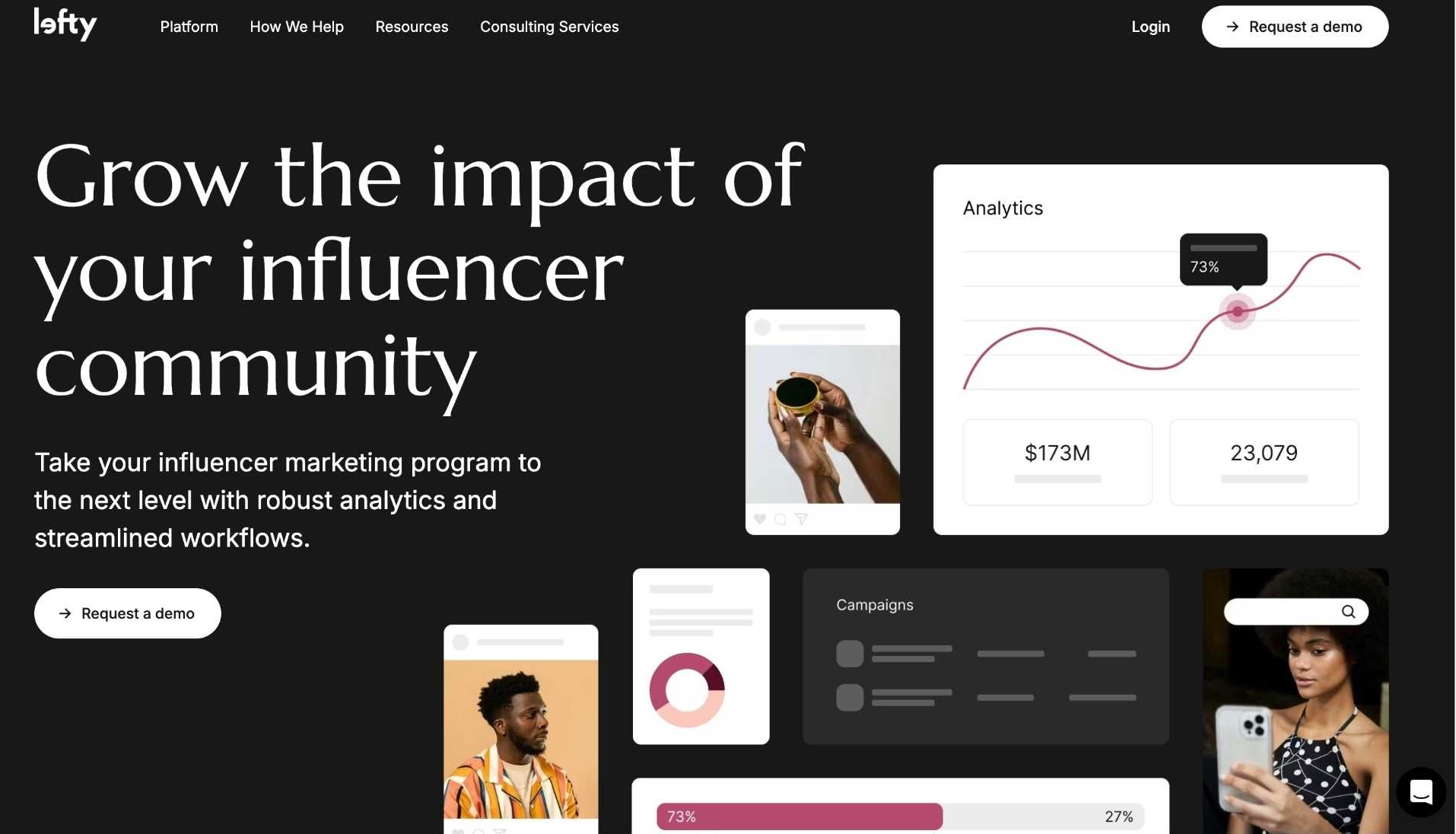
Lefty est une plateforme de marketing d'influenceurs complète conçue principalement pour les marques de style de vie, de beauté, de mode et de luxe qui souhaitent des analyses robustes, des flux de travail de campagne et des outils de commerce social en un seul endroit. Elle met l'accent davantage sur les rapports, l'affiliation, l'envoi de produits et l'efficacité opérationnelle côté marque que de nombreux outils de découverte de créateurs plus simples.
Fonctionnalités clés
Découverte et casting d'influenceurs — Lefty offre la recherche d'influenceurs, la qualification, la découverte de profils similaires et des flux de travail de casting collaboratif pour les parties prenantes internes et externes.
Rapports et analyses de campagne — la plateforme automatise le suivi du contenu des influenceurs, des ventes et des performances d'activation, avec des rapports téléchargeables pour les équipes et les clients.
Affiliation et envoi de produits — les fonctionnalités de commerce social de Lefty permettent aux marques de gérer des programmes d'affiliation, de suivre les conversions et d'envoyer ou de prêter des produits aux créateurs directement depuis la plateforme.
Envoi direct d'e-mails aux influenceurs — Lefty a récemment ajouté l'envoi direct d'e-mails pour remplacer la messagerie in-app plus ancienne, améliorant ainsi les flux de travail de sensibilisation et de communication avec les créateurs.
Analyse des revenus pour le commerce électronique — Lefty relie l'activité des influenceurs aux ventes, aux performances des codes promotionnels et aux rapports de revenus pour les programmes axés sur le commerce électronique.
Paiements intégrés à la plateforme — Lefty prend en charge les flux de travail de paiement des influenceurs et met en avant une intégration Stripe native pour les versements aux créateurs.
Tarification
Prix de départ : ~590 € par mois.
Plan Pro : ~990 €/mois, incluant 2 utilisateurs, 5 campagnes et des rapports illimités.
Plan Premium : ~1 690 €/mois, qui ajoute un gestionnaire dédié.
Plan Premium+ : ~3 490 €/mois pour 10 utilisateurs et 25 campagnes.
Avis
4.7/5.0 (G2)
Avantages
Forte vélocité des fonctionnalités de commerce électronique récemment — les mises à jour 2024–2025 de Lefty ont ajouté une meilleure automatisation du commerce électronique, l'Affiliation 2.0, un prêt de produits plus intelligent et une meilleure analyse, ce qui a considérablement amélioré son cas d'usage commercial.
L'envoi direct d'e-mails est une mise à niveau de flux de travail significative — le lancement en 2025 de l'envoi direct d'e-mails rend la sensibilisation des créateurs plus rapide et plus pratique pour la gestion quotidienne des campagnes.
Bon choix pour les marques de style de vie et de luxe — la clientèle de Lefty, son positionnement et son ensemble de fonctionnalités sont clairement adaptés à la mode, à la beauté et à d'autres verticales sensibles à la marque qui se soucient à la fois de l'image et du retour sur investissement.
Inconvénients
La tarification est encore opaque sur le site officiel — les acheteurs ont besoin d'un processus de vente basé sur la démonstration pour comprendre le coût réel du forfait.
Le volume d'avis publics est limité sur certains annuaires — il y a un sentiment positif, mais un échantillon visible relativement petit dans certaines grandes bases de données de logiciels.
Mieux adapté aux marques souhaitant un flux de travail de commerce social plus complet — les petites équipes qui ont seulement besoin d'une découverte légère peuvent le trouver plus large que nécessaire.
Intégrations
Stripe — Lefty utilise l'intégration Stripe native pour gérer les paiements aux influenceurs de manière plus sécurisée.
Shopify — connecte l'inventaire du magasin à l'envoi de produits, aux demandes de produits, à l'ensemencement et au suivi des revenus.
Salesforce Commerce Cloud — prend en charge l'intégration du commerce électronique en un clic pour l'ensemencement et l'automatisation des flux de produits.
Magento — Lefty peut se connecter aux magasins Magento pour l'envoi de produits conscient de l'inventaire et l'automatisation de la logistique des produits.
Gmail / Outlook— les marques peuvent connecter Gmail ou Outlook pour contacter des influenceurs directement à partir de Lefty à grande échelle.
Humanz vs Lefty
Humanz se concentre davantage sur les données de créateurs vérifiées, la gestion des campagnes d'influenceurs et l'attribution, tandis que Lefty privilégie les flux de travail des marques lifestyle, l'affiliation liée au commerce électronique, le gifting et les rapports opérationnels. Lefty est particulièrement intéressant pour les marques de mode, de beauté et de luxe qui souhaitent un seeding plus robuste et des outils d'affiliation avancés, tandis que Humanz reste la meilleure option pour les équipes qui donnent la priorité aux métriques de créateurs vérifiées et à un positionnement de plateforme d'influenceurs plus direct.
Réflexions finales
Humanz se distingue par ses données de créateurs vérifiées, son suivi des performances et son approche axée sur la conversion, mais le paysage plus large du influencer marketing offre un large éventail d'alternatives adaptées à des besoins différents. Des plateformes comme Influencer Hero, Upfluence et Aspire mettent l'accent sur les intégrations e-commerce et l'automatisation des flux de travail, tandis que des outils d'entreprise comme CreatorIQ et Traackr se concentrent sur les rapports et la gouvernance à grande échelle. Entre-temps, des solutions comme Heepsy et Influencity offrent des options plus accessibles et rentables pour les petites équipes, et des plateformes comme Later et Lefty s'étendent à des écosystèmes complets de réseaux sociaux et de commerce. En fin de compte, la meilleure alternative dépend de la question de savoir si une marque privilégie la précision des données, la scalabilité, la facilité d'utilisation ou une intégration commerce approfondie.
FAQ
Quelles fonctionnalités devriez-vous rechercher dans une alternative à Humanz ?
+
Les fonctionnalités clés à considérer comprennent la découverte d'influenceurs, l'analytics d'audience, la gestion de campagnes, les capacités CRM, le suivi d'affiliés, la gestion de contenu et les intégrations avec des plateformes de commerce électronique comme Shopify.
Quelles sont les plateformes similaires à Humanz en termes de précision des données et d'analytics ?
+
Traackr, CreatorIQ et Aspire sont souvent considérés comme de solides alternatives pour les marques qui privilégient l'analyse, la création de rapports et la sélection d'influenceurs basée sur les données.
Pouvez-vous gérer la prospection d'influenceurs directement au sein de ces plateformes ?
+
La plupart des alternatives à Humanz, telles que Influencer Hero, Upfluence et Aspire, incluent des outils de prospection intégrés comme des modèles d'e-mail, la messagerie en masse et des systèmes CRM pour gérer la communication avec les créateurs de contenu.
Quelle plateforme est la meilleure pour le marketing d'affiliation d'influenceurs ?
+
Upfluence, Influencer Hero, Aspire, et Lefty sont d'excellents choix pour les campagnes axées sur l'affiliation, car ils offrent la génération de codes de réduction, le suivi des liens et la gestion des commissions.
Existe-t-il des alternatives à Humanz dotées de fonctionnalités alimentées par l'IA ?
+
Oui, plusieurs plateformes intègrent désormais l'IA, comme Influencer Hero (automatisation), Aspire (données et flux de travail), Later (EdgeAI) et IZEA (FormAI), pour améliorer la découverte, la prospection et l'optimisation des campagnes.




















.png)


.jpg)