

10 meilleures alternatives à Heepsy pour le marketing d'influenceurs
Les marques D2C s'appuient sur des logiciels de marketing d'influenceurs pour rationaliser la découverte de créateurs, gérer la prospection à grande échelle et suivre les performances liées au chiffre d'affaires réel. Heepsy est devenu un point d'entrée populaire grâce à sa tarification abordable, ses puissants filtres de recherche d'influenceurs et son interface facile à utiliser, en particulier pour les petites équipes qui commencent. Cependant, les limitations courantes—telles que le suivi des ventes restreint sur les plans inférieurs, l'automatisation limitée et les flux de travail de campagne moins avancés—poussent souvent les marques en croissance à explorer de meilleures alternatives à Heepsy. À mesure que les programmes d'influenceurs deviennent plus axés sur la performance, de nombreuses équipes recherchent des plateformes offrant des intégrations plus profondes, une analytics et une scalabilité.
Dans cet article, nous comparons les 10 meilleures alternatives à Heepsy—notamment GRIN, Upfluence, CreatorIQ, Influencer Hero, NeoReach, Lefty, Insense, Kolsquare, Skeepers et Creator.co—pour vous aider à trouver la plateforme idéale pour vos besoins.
Critères clés pour évaluer les plateformes de marketing d'influenceurs
Fonctionnalités principales
Évaluation des capacités essentielles du marketing d'influenceurs, y compris la découverte d'influenceurs, la prospection, la CRM, la gestion de campagnes, les rapports et les flux de travail de contenu.
Tarification et flexibilité
Comparaison des modèles de tarification, des plans d'abonnement et des conditions contractuelles pour correspondre à différents budgets et étapes de croissance.
Avis des clients et satisfaction
Analyse des commentaires des utilisateurs provenant de plateformes d'examen fiables, en mettant l'accent sur la facilité d'utilisation, la fiabilité, le support client et les performances globales.
Avantages et inconvénients
Examen des forces et limitations de chaque plateforme pour mettre en évidence où elle performe bien et où elle peut faire défaut en fonction de différents cas d'usage.
Intégrations
Examen des intégrations les plus importantes (par exemple, Shopify et autres outils technologiques), en mettant en évidence ce que chaque intégration permet en une phrase.
Aperçu de Heepsy

Heepsy est une plateforme de marketing d'influenceurs conçue pour aider les marques à découvrir, analyser et collaborer avec des créateurs à grande échelle. Avec une base de données de millions d'influenceurs sur Instagram, TikTok et YouTube, la plateforme se concentre sur la simplification de la découverte de créateurs, de la prospection et de la gestion de campagnes en un seul endroit.
Elle est particulièrement bien adaptée aux petites et moyennes marques à la recherche d'un moyen rentable de mener des campagnes d'influenceurs sans la complexité ou la tarification des plateformes de niveau entreprise. Bien que Heepsy offre une fonctionnalité complète—de la recherche à la création de rapports—sa plus grande valeur réside dans son accessibilité et sa facilité d'utilisation.
Fonctionnalités clés
- Découverte avancée d'influenceurs
Parcourez une vaste base de données mondiale d'influenceurs en utilisant des filtres tels que la niche, la localisation, le nombre d'abonnés, le taux d'engagement et la démographie du public pour trouver des créateurs hautement pertinents. - Qualité du public et détection de faux abonnés
Analysez l'authenticité du public avec des outils intégrés qui estiment les faux abonnés et aident les marques à éviter les partenariats de faible qualité. - Profils détaillés de créateurs
Accédez aux métriques clés telles que le taux d'engagement, la répartition du public (âge, sexe, localisation), les collaborations récentes avec des marques et la performance du contenu. - Prospection en masse et campagnes par e-mail
Envoyez des e-mails de prospection personnalisés à grande échelle en utilisant des modèles et des suivis automatisés, aidant les équipes à gérer efficacement la communication à haut volume avec les créateurs. - Marketplace d'influenceurs et pages de candidatures
Créez des offres de campagnes et laissez les influenceurs postuler directement, réduisant le besoin de prospection purement sortante. - Gestion de la CRM et du pipeline de campagnes
Organisez les influenceurs en listes et suivez les étapes de la campagne à travers un pipeline visuel (par exemple, contacté, négocié, envoyé, publié). - Suivi du contenu et galerie de médias
Surveillez le contenu des influenceurs, suivez les métriques d'engagement (likes, commentaires, vues) et stockez les actifs de campagne en un seul endroit. - Rapports de campagne et analytics
Mesurez la performance de la campagne avec les métriques d'engagement, et sur les plans supérieurs, suivez les clics, les conversions et le ROI. - Suivi du e-commerce et de l'affiliation
``````html Intégrez-vous avec Shopify (et WooCommerce sur les plans supérieurs) pour générer des codes de réduction, suivre les ventes et attribuer les revenus aux campagnes d'influenceurs.
Tarification
Heepsy propose une tarification flexible avec des options de facturation mensuelle, semestrielle et annuelle (des réductions s'appliquent généralement aux engagements plus longs) :
- Plan Gratuit — 0 $/mois
Recherches limitées et accès à la plateforme de base pour les tests. - Plan Starter — ~69 $/mois (facturé annuellement)
Inclut les filtres de recherche de base, les outils de prospection, les fonctionnalités CRM et l'accès à la marketplace. - Plan Plus — ~199 $/mois (facturé annuellement)
Ajoute les filtres avancés, la prospection en masse, les coordonnées des créateurs, les rapports et la gestion de contenu. - Plan Advanced — ~299 $/mois (facturé annuellement)
Inclut tout ce qui est dans Plus + intégrations Shopify/WooCommerce, suivi des ventes, outils d'affiliation et limites de prospection plus élevées. - Plan Enterprise — Tarification personnalisée
Conçu pour les grandes équipes ayant des exigences d'utilisation plus élevées.
Avis
4,5 / 5,0 (G2)
Intégrations
- Shopify — Synchronisez les produits, générez des codes de réduction et suivez directement les ventes et conversions générées par les influenceurs.
- WooCommerce — Activez le suivi des affiliés et l'attribution des revenus pour les campagnes d'influenceurs (plan Advanced).
- Instagram — Découvrez les créateurs, analysez l'engagement et gérez les campagnes basées sur le contenu Instagram.
- TikTok — Identifiez et collaborez avec les créateurs TikTok à l'aide d'informations sur l'audience et l'engagement.
- YouTube — Recherchez et évaluez les influenceurs YouTube et suivez les performances des campagnes sur le contenu vidéo.
Avantages
- Point d'entrée abordable par rapport aux outils d'entreprise
Heepsy offre un ensemble de fonctionnalités solide (découverte, prospection, CRM) à un coût considérablement inférieur à celui de la plupart des concurrents. - Capacités de découverte et de filtrage solides
Sa recherche multi-filtrée et ses informations sur l'audience facilitent la recherche de créateurs de niche dans différentes régions et segments d'audience. - Flux de travail de prospection et de campagne intégré
Contrairement aux outils de découverte de base, Heepsy permet aux marques de gérer la prospection, les négociations et les étapes de campagne en une seule plateforme.
Inconvénients courants de Heepsy
Suivi des ventes limité sur les plans de niveau inférieur
Les marques ont besoin du plan Advanced pour accéder à l'intégration Shopify et au suivi complet du ROI, ce qui peut augmenter le coût total.
Pas de prospection assistée par IA ou d'automatisation
Comparé aux plateformes plus récentes, Heepsy n'a pas de messagerie générée par IA ou de fonctionnalités d'automatisation intelligente pour le passage à l'échelle des campagnes.
La précision des données n'est pas toujours parfaite
Les mesures telles que la détection des faux abonnés et les informations sur l'audience sont des estimations et peuvent ne pas toujours refléter précisément les performances réelles.
Peut ne pas bien s'adapter aux équipes d'entreprise
Les plus grandes marques ayant des flux de travail complexes, des campagnes multi-canaux ou des intégrations approfondies peuvent trouver la plateforme limitante.
Meilleures alternatives à Heepsy
| OUTIL | AVIS | MEILLEUR POUR | INFO ESSAI | TARIFICATION | ||
|---|---|---|---|---|---|---|
1 |

|
⭐ | Gestion des créateurs DTC | Réserver une démo | Tarification | Site web |
2 |

|
⭐ | Découverte d'influenceurs | Réserver une démo | Tarification | Site web |
3 |
``````html

|
⭐ | Marketing influenceur d'entreprise | Réserver une démo | Tarification | Site Web |
4 |

|
⭐ | CRM influenceur & automation | Réserver une démo | Tarification | Site Web |
5 |

|
⭐ | Campagnes influenceurs & analytics de données | Réserver une démo | Tarification | Site Web |
6 |

|
⭐ | Analytics influenceur & découverte | Réserver une démo | Tarification | Site Web |
7 |

|
⭐ | Créateurs UGC & publicités sociales rémunérées | Réserver une démo | Tarification | Site Web |
8 |

|
⭐ | Découverte influenceur basée sur les données & analytics de campagne | Réserver une démo | Tarification | Site Web |
9 |

|
⭐ | Gifting influenceur & campagnes UGC avec micro-influenceurs | Réserver une démo | Tarification | Site Web |
10 |
``````html

|
⭐ | Campagnes d'influenceurs et marketplace de créateurs | Réserver une démo | Tarification | Site web |
1. GRIN
GRIN est une plateforme de gestion de créateurs axée sur le commerce électronique, conçue pour les marques qui souhaitent exécuter la découverte d'influenceurs, la prospection, l'envoi de produits, la collecte de contenu, le suivi des affiliés et les paiements dans un seul système. Elle s'est récemment orientée davantage vers l'accès en libre-service et l'IA, ce qui la rend plus attrayante pour les marques qui souhaitent un système d'exploitation complet plutôt qu'un outil de découverte léger.
Fonctionnalités clés
- CRM des créateurs et gestion des relations — GRIN est construite autour du suivi des relations à long terme avec les créateurs, avec des flux de campagne, des briefings, des approbations et une communication liés à chaque enregistrement de créateur.
- Découverte d'influenceurs et support IA avec Gia — GRIN positionne maintenant Gia comme un agent marketing de créateurs IA qui aide à trouver des créateurs, à rédiger de la prospection, à gérer l'envoi de produits et à suivre les performances.
- Flux de semis de produits et d'envoi de produits — Les marques peuvent gérer les demandes de produits, l'accomplissement et l'envoi de produits à partir de systèmes de commerce électronique connectés au lieu d'exécuter ces étapes manuellement.
- Suivi et attribution des affiliés — GRIN inclut la gestion des affiliés, les liens profonds et l'attribution avancée sur les niveaux supérieurs, ce qui est utile pour les marques DTC qui se soucient des revenus mesurables.
- Bibliothèque de contenu et organisation UGC — La plateforme stocke, balise et réutilise le contenu des créateurs afin que les équipes puissent réutiliser les ressources dans le contenu payant, les e-mails et les contenus du site.
- Paiements automatisés des créateurs — GRIN prend en charge les versements aux créateurs et les flux de conformité fiscale, y compris le traitement des 1099 et les paiements basés sur PayPal.
- Écoute sociale et surveillance de marque — GRIN inclut l'écoute sociale pour surveiller les mentions, le sentiment et les tendances générées par les créateurs.
Tarification
- Modèle de tarification officiel : La page de tarification actuelle de GRIN promeut un essai gratuit de 30 jours et un emballage plus flexible qu'avant, y compris l'accès en libre-service.
- Conditions de contrat : GRIN met désormais l'accent sur la facturation mensuelle, l'absence de verrouillage à long terme et la possibilité de mettre en pause ou de mettre à l'échelle selon les besoins.
- Référence de prix public de départ : Les répertoires de logiciels récents listent GRIN à partir de 999 $/mois, bien que la tarification d'entreprise semble toujours être à l'échelle de manière significative en fonction des fonctionnalités et de la taille du programme.
- Tarification de référence d'entreprise : Les points de référence de ventes récents et les aperçus de produits placent toujours GRIN, commençant généralement à 25 000 $/an (environ 2 050 $/mois), sans remises pour le paiement d'avance. Les contrats nécessitent un engagement d'un an avec facturation mensuelle.
Avis
4,5/5,0 (G2)
Avantages
-
```
Gia AI est un différenciateur significatif
— GRIN a dépassé l'aide simple à la copie IA et commercialise maintenant Gia comme un assistant agentique qui peut soutenir la prospection de créateurs, la prospection, l'envoi de produits et l'optimisation. - Profondeur de flux de travail commercial forte — l'ensemencement de produits, la gestion des affiliés, les paiements, la gestion fiscale et la réutilisation du contenu sont plus profondément connectés que dans les outils axés sur la découverte.
- L'accès en libre-service réduit les barrières à l'entrée — le lancement récent d'un accès instantané en libre-service rend GRIN plus flexible que les anciens flux d'approvisionnement de style entreprise.
Inconvénients
- Toujours plus lourd opérationnellement que les outils légers — GRIN est puissant, mais les équipes qui ont besoin uniquement de découverte et de prospection peuvent le trouver plus large que nécessaire.
- Les coûts augmentent rapidement à mesure que vous montez en gamme — le passage de Lite à Complete est important une fois que vous avez besoin d'une attribution plus profonde, d'un accès API et d'une capacité plus élevée.
- Les commentaires des utilisateurs pointent toujours vers des frictions de flux de travail et d'assistance dans certains cas — les avis restent globalement forts, mais les plaintes concernant la convivialité, les frictions de configuration et les délais d'assistance apparaissent toujours dans les commentaires publics.
Intégrations
- Shopify — synchronisez les produits, gérez l'envoi de produits et connectez l'activité des créateurs aux flux de travail commerciaux.
- PayPal — payez directement les créateurs et maintenez les flux de travail de versement au sein de la plateforme.
- Klaviyo — utilisez les données de courrier électronique connectées et les modèles personnalisés pour soutenir la communication des créateurs et les programmes de fidélisation.
- Slack — partagez les mises à jour de flux de travail et coordonnez les programmes de créateurs dans les équipes internes.
- Google Drive — centralisez les fichiers et les ressources créatives aux côtés des opérations de créateurs.
Heepsy vs GRIN
Heepsy est l'option plus simple et beaucoup moins chère pour les marques qui ont principalement besoin de découverte de créateurs, de prospection et de léger CRM. GRIN est mieux adapté aux marques qui ont besoin d'ensemencement de produits, d'attribution d'affiliés, de paiements de créateurs, de gestion UGC et d'une infrastructure opérationnelle plus profonde. Heepsy est plus accessible pour les petites équipes, tandis que GRIN est construit pour les marques exécutant des programmes de créateurs répétables liés aux revenus. GRIN offre également maintenant un positionnement IA plus fort grâce à Gia et des flux de travail de paiement et fiscaux plus avancés, tandis que Heepsy reste plus axé sur la découverte. Pour les marques DTC exécutant des campagnes de gifting et d'affiliation à grande échelle, GRIN est le système d'exploitation plus complet ; pour les équipes allégées privilégiant l'abordabilité, Heepsy est généralement le point de départ plus facile.
2. Upfluence
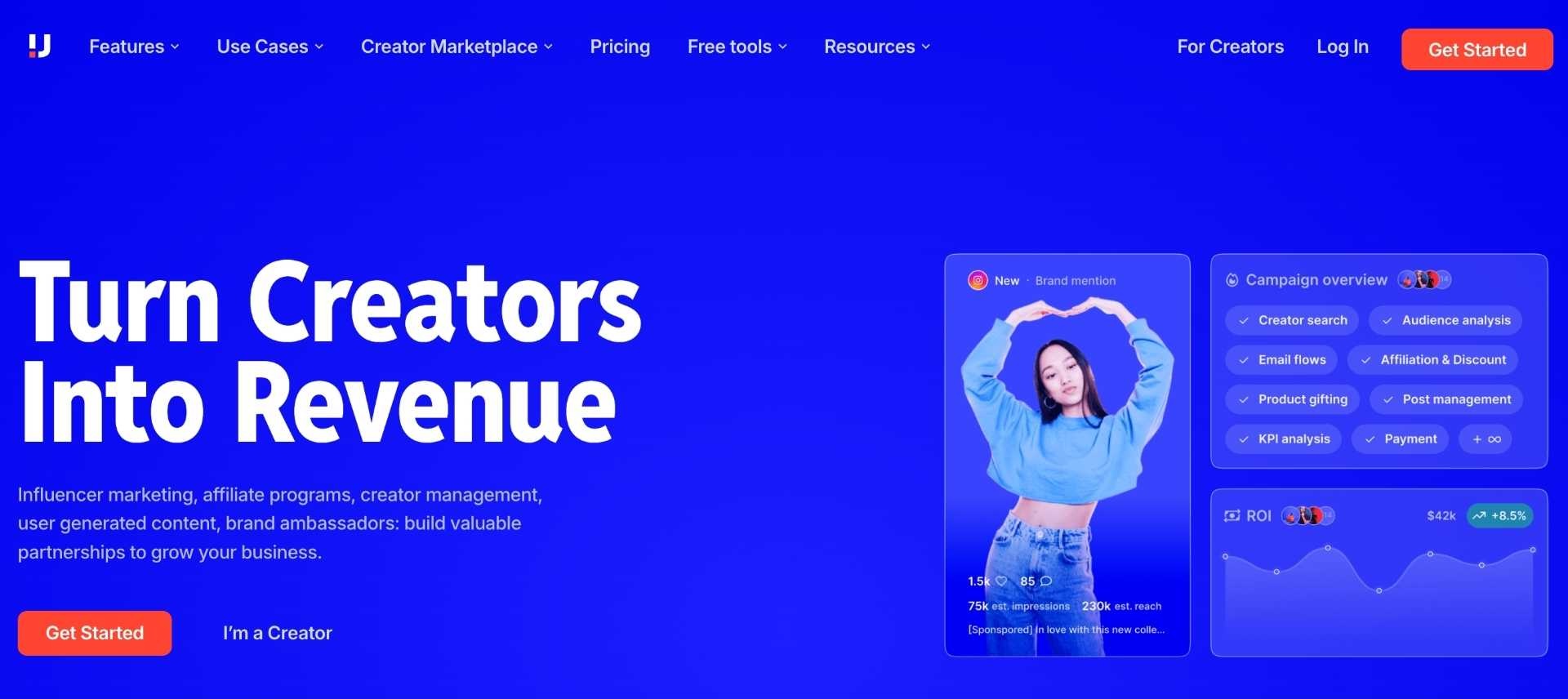
Upfluence est une plateforme de marketing d'influenceur et d'affiliation construite autour de la découverte de créateurs, de la prospection, de la gestion d'affiliation et des intégrations de e-commerce. Son atout le plus évident est de lier les programmes d'influenceur aux données de magasin et de client, en particulier pour les marques qui souhaitent identifier les clients existants qui peuvent devenir des créateurs ou des affiliés.
Fonctionnalités clés
- Recherche d'influenceur avec support IA — Upfluence combine la recherche de créateurs à grande échelle avec des filtres d'audience, de niche et d'engagement, et positionne maintenant Jaice AI comme un assistant pour la recherche de créateurs et la planification de campagne.
- Identification client-à-créateur — l'un des différenciateurs les plus connus d'Upfluence est d'identifier les influenceurs déjà à l'intérieur de votre base de clients ou de vos listes de courrier électronique.
- Gestion des affiliés et des codes promo — les marques peuvent créer en masse des codes personnalisés et des liens d'affiliation liés aux ventes en magasin et aux performances des créateurs.
- Suivi du CRM et des campagnes — Upfluence suit l'embauche de créateurs, les brouillons, les ventes et les paiements dans un flux de travail.
- Paiements des influenceurs — Upfluence prend en charge les flux de travail de paiement et peut connecter les versements via la fonctionnalité alimentée par Stripe.
- Support d'intégration multi-magasin — il prend en charge les principaux systèmes de commerce tels que Shopify, WooCommerce, Magento, BigCommerce et Amazon.
Tarification
- Modèle de tarification : Upfluence utilise une tarification personnalisée plutôt qu'un tableau de plans fixes publics.
- Tous les plans sont personnalisés. Il y a un engagement minimum d'une année complète de service avec des paiements mensuels. En moyenne, les plans commencent autour de 2 000 $/mois (24 000 $ par an)
```html Avis
4.3/5.0 (Capterra)
Avantages
- Intégration e-commerce très approfondie — Upfluence se distingue en connectant les programmes d'influenceurs à Shopify, Amazon, WooCommerce, Magento et BigCommerce.
- Jaice AI est désormais au cœur de la stratégie produit — Upfluence se repositionne activement autour de Jaice AI pour la planification des campagnes, l'appariement des créateurs et l'automatisation des flux de travail.
- L'appariement des listes de clients reste l'un de ses meilleurs différenciateurs — peu de plateformes d'influenceurs grand public sont aussi étroitement associées à la transformation des clients en créateurs et affiliés.
Inconvénients
- Les tarifs sont moins transparents que de nombreux outils mid-market — les acheteurs doivent généralement avoir une conversation avec l'équipe commerciale pour comprendre la véritable structure du package.
- La plateforme peut sembler dense pour les nouvelles équipes — les avis publics décrivent souvent une complexité d'intégration et de flux de travail avant que les équipes ne se sentent vraiment à l'aise avec le produit. (G2)
- Mieux adapté aux cas d'usage axés sur le commerce — les marques qui n'ont pas besoin d'attribution liée au magasin ou d'infrastructure d'affiliation pourraient ne pas en tirer la pleine valeur.
Intégrations
- Shopify — trouvez des clients influents, envoyez des produits et suivez les ventes générées par les créateurs.
- Amazon — gérez des campagnes d'influenceurs et d'affiliés Amazon avec attribution et intégration des paiements.
- WooCommerce — générez et suivez des codes personnalisés et les ventes liées aux créateurs depuis vos boutiques WooCommerce.
- Magento — connectez les campagnes d'influenceurs aux flux de commerce basés sur Magento et au suivi des codes promotionnels.
- Klaviyo — identifiez les abonnés influents et utilisez les données d'e-mail pour soutenir le recrutement de créateurs et le suivi des revenus.
Heepsy vs Upfluence
Heepsy est l'option plus abordable et plus simple pour la découverte de créateurs, la prospection et la gestion légère de campagnes. Upfluence est le meilleur choix lorsque le marketing d'influenceurs est étroitement lié au commerce électronique, au marketing d'affiliation et aux données clients. Heepsy fonctionne bien pour les marques qui souhaitent des outils de recherche et de collaboration simples, tandis qu'Upfluence est mieux adapté aux marques qui souhaitent transformer les clients en créateurs, générer des codes promotionnels à grande échelle et lier directement l'activité des influenceurs aux revenus du magasin. L'étendue d'Upfluence la rend également plus complexe et généralement moins transparente en matière de tarification, tandis que les tarifs publics de Heepsy sont plus clairs et plus faciles à appréhender. En pratique, Heepsy convient mieux aux programmes plus petits ; Upfluence convient mieux aux marques ayant des opérations DTC et d'affiliation plus matures.
3. CreatorIQ

CreatorIQ est une plateforme de marketing de créateurs de niveau entreprise conçue pour les grandes marques qui ont besoin de gouvernance, de rapports, de conformité, de contrôle des flux de travail et d'intégrations multi-fonctionnelles. Le produit a récemment mis l'accent sur son positionnement « AI-native » et son modèle opérationnel basé sur le contenu, renforçant sa place au haut de gamme du marché.
Fonctionnalités clés
- Découverte de créateurs et renseignements de niveau entreprise — CreatorIQ est construit autour de l'intelligence des créateurs à grande échelle, de l'analyse comparative et de la supervision structurée des programmes plutôt que simplement de la prospection légère.
- Modèle opérationnel AI-native — CreatorIQ se décrit maintenant comme un système AI-native et content-first pour les équipes de marketing de créateurs.
- Rapports avancés et gouvernance — la plateforme est conçue pour les rapports exécutifs, les autorisations, la sécurité de la marque et la collaboration multi-équipes.
- API ExchangeIQ et intégrations — CreatorIQ offre un échange de données basé sur l'API pour les outils de BI, les data lakes, les environnements MMM et les systèmes internes.
- Paiements aux créateurs et conformité — CreatorIQ prend en charge les paiements mondiaux, la collecte de taxes, les pistes d'audit et les flux de travail prêts pour la finance.
- Connectivité robuste aux plateformes sociales — CreatorIQ met l'accent sur les intégrations avec les principales plateformes, notamment TikTok, Meta, Snapchat et YouTube.
Tarification
Il existe différents plans :
- Plan de base : À partir de 35 000 $/année. Inclut 1 000 créateurs de contact par mois
- Plan standard : À partir de 50 000 $/année. Inclut 2 500 créateurs de contact par mois ``````html
- Plan Professionnel : À partir de 90 000 $/an. Inclut 5 000 créateurs de contacts par mois
- Plan Entreprise : À partir de 200 000 $/an. Inclut 7 500 créateurs de contacts par mois
Avis
4,4/5,0 (Capterra)
Points forts
- Gouvernance d'entreprise très solide — CreatorIQ est conçu pour les approbations, les autorisations, la sécurité de marque, l'alignement financier et la conformité mondiale d'une manière que la plupart des outils du marché intermédiaire ne sont pas.
- ExchangeIQ et la connectivité API plus large sont des différenciateurs majeurs — il est conçu pour intégrer le marketing de créateurs dans des environnements de rapports et de données plus larges.
- Le produit a été repensé autour d'un modèle centré sur l'IA et le contenu — ce positionnement mis à jour est l'un des changements récents les plus clairs dans l'histoire de la plateforme.
Points faibles
- Barrière d'entrée élevée — CreatorIQ est fermement tarifé au niveau entreprise et nécessite généralement un cycle de vente structuré.
- Courbe d'apprentissage plus raide — sa profondeur est un avantage pour les grandes équipes, mais elle peut sembler lourde pour les programmes plus petits ou plus agiles.
- Moins attrayant pour les besoins légers de découverte uniquement — les marques qui ont principalement besoin d'une recherche et d'une prospection peu coûteuses trouveront généralement que c'est surconçu.
Intégrations
- TikTok — lancez et mesurez les campagnes de créateurs avec la connectivité officielle de la plateforme et le support au niveau partenaire.
- Meta — utilisez les intégrations de plateforme pour la mesure, la gouvernance et l'exécution de campagnes.
- YouTube — intégrez les données des créateurs et les rapports dans le flux de travail central de CreatorIQ.
- Shopify — connectez les données de commerce dans les rapports et les flux de travail de campagne de créateurs.
- ExchangeIQ / API personnalisée — synchronisez les données de marketing de créateurs avec les outils de BI, les systèmes MMM et l'infrastructure de données interne.
Heepsy vs CreatorIQ
Heepsy et CreatorIQ servent des acheteurs très différents. Heepsy est l'option la plus accessible pour les petites et moyennes marques qui ont besoin de découverte, de prospection et de suivi de campagne de base à un point d'entrée public et peu coûteux. CreatorIQ est conçu pour les entreprises qui ont besoin de gouvernance, de rapports avancés, de connectivité API, de contrôles de sécurité de marque et de conformité de paiement de grade financier. Heepsy est plus facile à acheter et plus facile à déployer ; CreatorIQ est plus structuré, plus personnalisable et beaucoup plus cher. Si votre besoin principal est de trouver et d'activer des créateurs rapidement, Heepsy est le meilleur choix allégé ; si le marketing de créateurs doit s'intégrer dans des systèmes d'entreprise plus larges et des rapports exécutifs, CreatorIQ est la plateforme la plus solide.
4. Influencer Hero

Influencer Hero est une plateforme de marketing d'influenceurs tout-en-un destinée aux marques DTC et de commerce électronique qui souhaitent la découverte, la prospection, la CRM, le gifting, le suivi des affiliés et les rapports de campagne dans un seul flux de travail. Son positionnement actuel s'appuie fortement sur l'automatisation, la personnalisation pilotée par l'IA et le large support d'intégration dans les outils de commerce et de marketing.
Fonctionnalités principales
- Découverte d'influenceurs avec filtrage avancé — Influencer Hero supporte la recherche de créateurs à grande échelle avec des filtres démographiques, d'engagement et d'audience.
- Prospection alimentée par l'IA et personnalisation — il propose une personnalisation de première ligne assistée par l'IA, la génération de modèles et les suivis de goutte-à-goutte automatisés.
- CRM centré sur la campagne — les créateurs sont gérés à l'intérieur de tableaux structurés et de pages de transactions qui suivent la communication, les performances, les livrables et l'activité d'affiliation.
- Gifting et ensemencement de produits — la plateforme supporte les envois de produits, le suivi des commandes et les flux de travail de gifting liés au commerce.
- Outils d'affiliation, de vitrine et de paiement — Influencer Hero inclut des liens spécifiques aux créateurs, des codes, des tableaux de bord et le support de paiement.
- Analyses de campagne et suivi du ROI — Surveiller les performances à travers l'engagement, les clics, les conversions et les revenus avec des tableaux de bord de reporting en temps réel
- Bibliothèque UGC — Collecter et organiser automatiquement le contenu des influenceurs pour une réutilisation dans les publicités, les médias sociaux et les pages de produits
- ```Pages d'application et vitrines — Capturez les créateurs entrants via des pages d'application de marque et permettez aux influenceurs de promouvoir les produits via des vitrines personnalisées
Tarification
Influencer Hero propose une tarification flexible basée sur le volume de prospection et vous pouvez avoir un nombre illimité de créateurs dans votre CRM:
- Standard — 649 $/mois (jusqu'à 1 000 messages de prospection par mois)
- Pro — 1 049 $/mois (jusqu'à 5 000 messages de prospection par mois)
- Business — 2 490 $/mois (jusqu'à 10 000 messages de prospection par mois)
- Custom / Agency — Tarification personnalisée
Une tarification personnalisée est disponible pour les agences et les équipes plus grandes
Avis
4,9/5,0 (Capterra)
Avantages
- Couverture d'intégration très large — Influencer Hero dispose de l'une des histoires d'intégration les plus complètes du segment intermédiaire, couvrant l'e-commerce, l'email, l'automatisation et les outils d'assistance.
- Meilleure adéquation créateur-marque grâce aux données — Des fonctionnalités telles que l'identification des followers de marque et la recherche UGC alimentée par l'IA aident les équipes à trouver des créateurs qui s'engagent déjà auprès de la marque ou produisent du contenu pertinent, améliorant l'authenticité et la performance des campagnes.
- Conçu pour une exécution efficace et à haut volume — Les actions en masse, les outils de regroupement et une extension Chrome permettent aux équipes de gérer la prospection, l'approvisionnement en créateurs et les mises à jour de campagnes rapidement, tout en gardant les flux de travail organisés.
Inconvénients
- Tarification plus élevée pour les petites équipes — Peut être moins accessible pour les marques en phase de démarrage ou disposant de budgets limités
- Certains acheteurs pourraient trouver la plateforme riche en fonctionnalités — les équipes cherchant uniquement une recherche simple et une prospection par email pourraient ne pas avoir besoin de sa pile complète.
Intégrations
- Shopify — synchronisez les catalogues de produits, gérez le gifting, créez des codes et des liens, et suivez les revenus par créateur.
- WooCommerce — générez des liens et des codes traçables et synchronisez les clics et les ventes dans le CRM.
- Klaviyo — connectez les données de l'influenceur et de l'email pour mesurer l'impact du créateur sur les abonnés et les revenus.
- Gmail / Outlook — assistez la prospection et la communication via la boîte de réception dans les flux de travail des campagnes.
- Zapier — connectez Influencer Hero aux flux de travail opérationnels plus larges et aux systèmes externes.
Heepsy vs Influencer Hero
Heepsy est l'outil plus simple, moins cher et plus centré sur la découverte. Influencer Hero est la meilleure option pour les marques qui souhaitent un flux de travail DTC plus complet, en particulier autour de la prospection automatisée, du gifting, du suivi d'affiliation, des vitrines d'influenceurs, et des rapports ROI. Heepsy est plus facile à comprendre et à acheter, tandis qu'Influencer Hero est plus lourd en automatisation et plus profondément connecté à l'exécution du commerce et du CRM. Si l'objectif est principalement de trouver des créateurs et de gérer des campagnes plus légères, Heepsy est généralement suffisant. Si l'objectif est de construire un système d'exploitation de créateurs plus évolutif lié aux revenus du magasin et aux flux de travail du cycle de vie, Influencer Hero est la plateforme la plus capable.
5. NeoReach
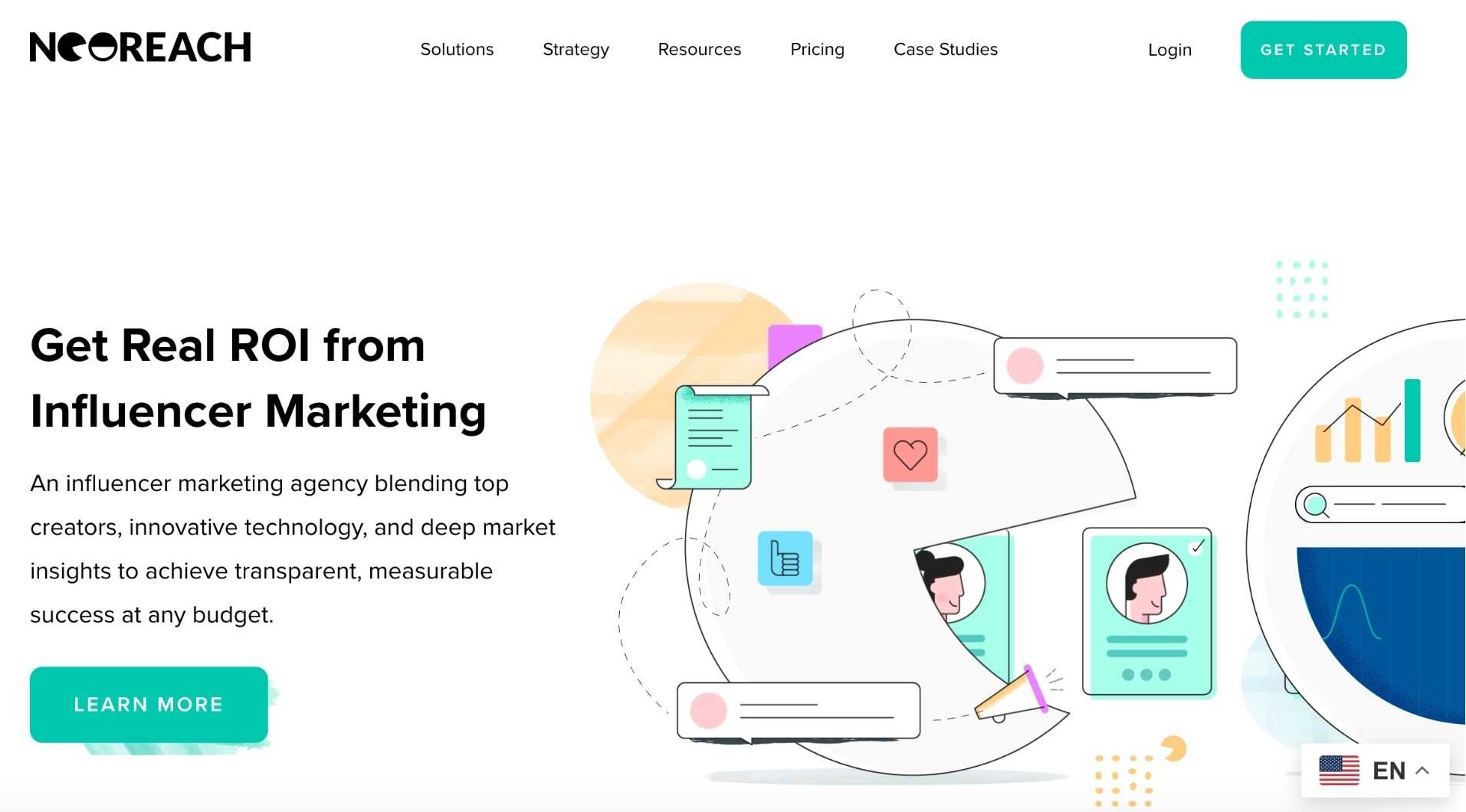
NeoReach est une plateforme d'influencer marketing d'entreprise et un prestataire de services gérés qui combine les logiciels, l'infrastructure API et les services de campagne. Elle est surtout connue pour l'exécution de campagnes à grande échelle, l'accès aux données, la détection de la fraude et la personnalisation d'entreprise plutôt que pour une utilisation libre-service à bas coût.
Fonctionnalités clés
- Gestion de campagne d'entreprise — NeoReach prend en charge la recherche, la gestion de campagne, le suivi des publications et l'exécution à grande échelle pour les marques et les agences.
- Grand ensemble de données d'influenceurs et analyse — NeoReach affirme que son logiciel donne accès à des données et des analyses sur plus de 5 millions d'influenceurs.
- Accès API étendu et aux données — un différenciateur majeur est l'accès à plus de 400 points de terminaison de réseau et des points de terminaison personnalisés pour les applications d'entreprise.
- Détection et signalement de la fraude— La page de tarification et logiciel de NeoReach met explicitement l'accent sur la détection de fraude comme partie de la valeur de la plateforme.
- Paiements mondiaux automatisés des créateurs — NeoReach commercialise les paiements d'influenceurs automatisés mondiaux et la personnalisation des flux de travail d'entreprise.
- Services gérés disponibles — au-delà du logiciel, NeoReach propose également une stratégie, un recrutement, une activation, des performances et un support de publicité payante.
Tarification
- Modèle de tarification : NeoReach utilise une tarification personnalisée et sa page de tarification officielle achemine les prospects vers les ventes pour les campagnes gérées et l'accès à la plateforme/API.
- Offres publiques officielles : NeoReach distingue publiquement les Campagnes d'influenceurs (service géré) et les offres Plateforme & API.
- Prix de départ (liste tiers) : Capterra indique un prix de départ de 399 $/utilisateur/mois, bien que le site de NeoReach lui-même n'affiche pas de tarif public.
Avis
4,5/5,0 (G2)
Avantages
- La profondeur de l'API est un vrai différenciateur — les 400+ points de terminaison de NeoReach et l'accès personnalisé aux données sont plus robustes que ce que la plupart des plateformes de créateurs mid-market offrent.
- Excellente adéquation pour les programmes d'entreprise et de service géré — les marques peuvent associer le logiciel à une stratégie pratique, un recrutement et une amplification payante.
- La détection de fraude et l'analytique restent au cœur de l'offre — le produit met à plusieurs reprises l'accent sur la qualité de l'audience, la détection de fraude et la visibilité des données détaillées.
Inconvénients
- La tarification n'est pas transparente — les acheteurs ont besoin d'un processus de vente pour comprendre la structure commerciale réelle.
- Plus orienté vers l'entreprise que convivial pour les PME — NeoReach est mieux adapté aux grandes campagnes qu'aux équipes agiles à la recherche d'une découverte de créateurs simple et abordable.
- Le volume d'avis public est relativement limité — le score G2 est solide, mais la base d'avis est beaucoup plus petite que pour des outils comme GRIN ou CreatorIQ.
Intégrations
- API REST — intégrez les données sociales de NeoReach et l'intelligence de campagne directement dans les applications et tableaux de bord internes.
- Applications d'entreprise personnalisées — NeoReach est conçu pour pousser 400+ points de données dans les outils et technologies internes.
- Tableaux de bord internes / environnements BI — le package plateforme/API est explicitement positionné pour l'intégration des flux de travail internes et des rapports.
- Flux de travail mondiaux de paiement des créateurs — NeoReach prend en charge l'intégration des paiements et les processus de paiement automatisés des créateurs pour les programmes d'entreprise.
- Flux de travail de mesure compatibles avec Google Analytics — le contenu de méthodologie propre de NeoReach désigne Google Analytics comme faisant partie de la mesure de performance pour les pages de destination des influenceurs et l'analyse du trafic.
Heepsy vs NeoReach
Heepsy est la plateforme bien plus accessible pour les marques qui souhaitent une découverte de créateurs abordable, une prospection et une gestion de campagne plus légère. NeoReach est conçu pour les acheteurs de logiciels d'entreprise et les clients de services gérés qui ont besoin de profondeur d'API, d'accès personnalisé aux données, d'analyse de fraude et d'exécution de campagne à grande échelle. Heepsy l'emporte sur la clarté de la tarification publique et la facilité d'adoption, tandis que NeoReach l'emporte sur l'infrastructure de données d'entreprise et la personnalisation. Heepsy est mieux pour les petites équipes de marques qui font du marketing d'influenceurs en interne ; NeoReach est mieux pour les programmes à gros budget qui ont besoin du logiciel plus un support de service. Dans la plupart des cas, la décision dépend de la simplicité et de l'efficacité des coûts par rapport à la flexibilité et à l'échelle de l'entreprise.


6. Lefty
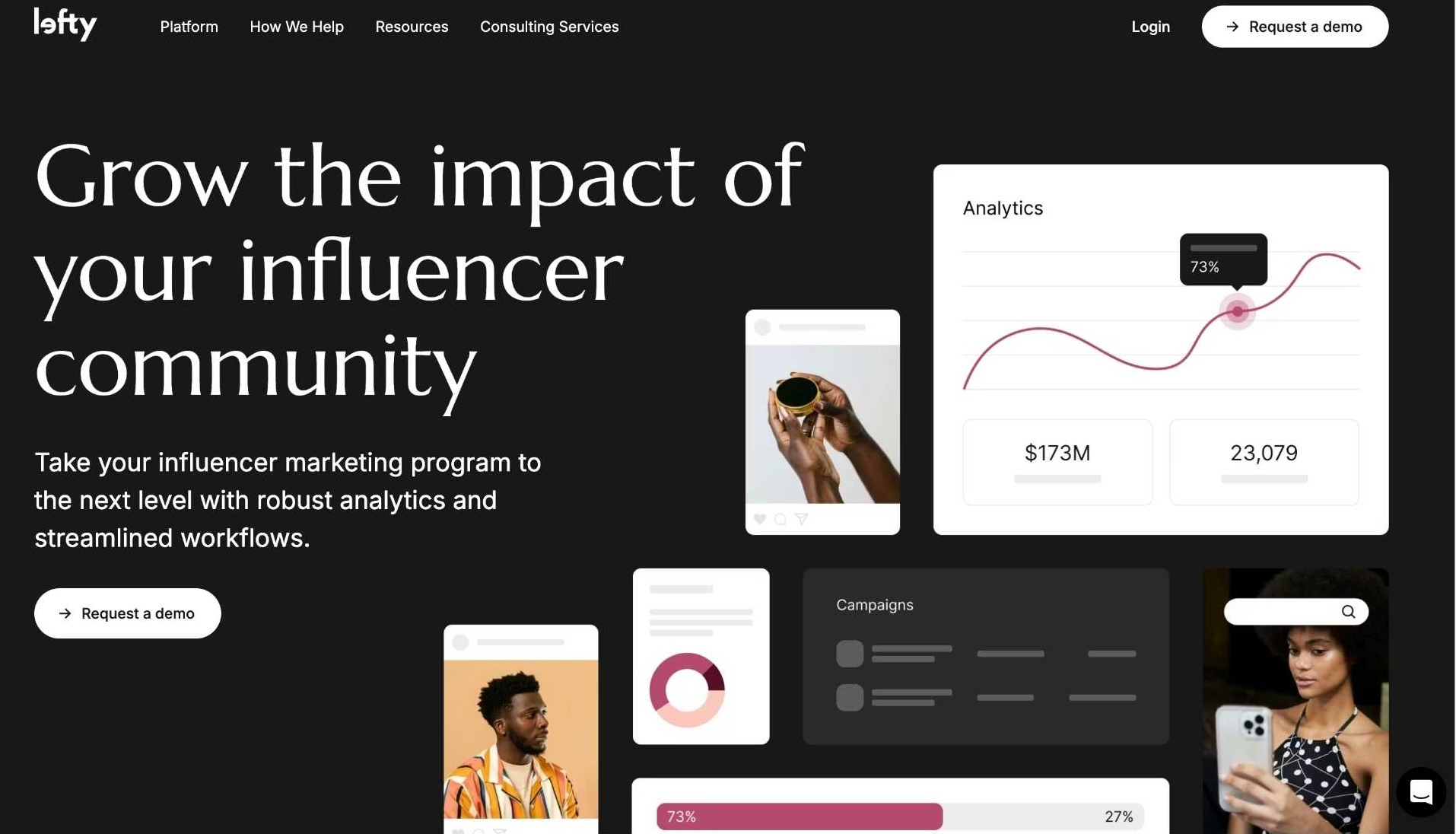
Lefty est une plateforme de marketing d'influenceurs alimentée par l'IA, axée sur la découverte de créateurs basée sur les données, la gestion de campagnes et l'analyse des performances. Elle est particulièrement populaire parmi les marques de milieu de marché et d'entreprise qui souhaitent un équilibre entre une forte analyse et une facilité d'utilisation, sans la complexité des suites d'entreprise complètes comme CreatorIQ.
Fonctionnalités principales
- Découverte d'influenceurs alimentée par l'IA
Lefty utilise l'apprentissage automatique pour identifier les créateurs pertinents en fonction de la démographie du public, des modèles d'engagement et des thèmes de contenu. - Informations sur le public et analyse d'affinité de marque
Fournit des ventilations détaillées du public et identifie les marques avec lesquelles les influenceurs ont travaillé, aidant les équipes à évaluer l'alignement et la saturation. - Tableau de bord de gestion de campagne
Gérez les collaborations avec les influenceurs de bout en bout, y compris la prospection, les approbations, les livrables et le suivi dans un espace de travail centralisé. - Suivi des performances de contenu
Suivez les performances du contenu de la campagne sur les plateformes, y compris l'engagement, les impressions et la portée. - Benchmarking concurrentiel
Analysez les campagnes concurrentes et les partenariats avec les influenceurs pour identifier les lacunes et les opportunités. - Outils de détection de fraude
Identifie les modèles d'engagement suspects et les faux abonnés pour améliorer la sélection des influenceurs.
Tarification
- Prix de départ : ~590 € par mois.
- Plan Pro : ~990 €/mois, comprenant 2 utilisateurs, 5 campagnes et des rapports illimités.
- Plan Premium : ~1 690 €/mois, qui ajoute un responsable dédié.
- Plan Premium+ : ~3 490 €/mois pour 10 utilisateurs et 25 campagnes.
Avis
4,7/5,0 (G2)
Avantages
- Découverte solide basée sur l'IA et informations sur l'affinité de marque — aide à identifier non seulement les influenceurs, mais les bons influenceurs en fonction des collaborations historiques de marque.
- Interface utilisateur propre et intuitive par rapport aux outils d'entreprise — intégration plus facile que les plateformes comme CreatorIQ.
- Fonctionnalités de renseignement concurrentiel — capacité remarquable à analyser les stratégies d'influenceurs concurrentes.
Inconvénients
- Transparence limitée sur les tarifs — nécessite des conversations avec l'équipe commerciale pour comprendre les coûts.
- Focus moins important sur les flux d'affiliation et d'e-commerce — moins puissant pour les marques DTC ayant besoin d'une attribution de ventes approfondie.
- Écosystème d'intégration plus petit par rapport aux principaux concurrents — moins d'intégrations natives.
Intégrations
- Instagram — découvrez et suivez les performances des influenceurs sur les campagnes Instagram.
- TikTok — analysez les créateurs TikTok et l'engagement des campagnes.
- YouTube — évaluez les créateurs vidéo et suivez les métriques de campagne.
- Google Analytics — connectez les données de trafic et de performance de la campagne à l'analyse du site Web.
- Outils CSV/Export — exportez les données d'influenceurs pour l'établissement de rapports et l'analyse externes.
Heepsy vs Lefty
Heepsy est plus abordable et mieux adapté aux marques axées sur la découverte d'influenceurs et la prospection avec une gestion de campagne basique. Lefty, en revanche, est plus axée sur l'analyse, offrant des informations plus approfondies sur le public, l'analyse comparative des concurrents et des recommandations alimentées par l'IA. Bien que Heepsy soit idéal pour les petites équipes ou celles qui commencent le marketing d'influenceurs, Lefty est un meilleur choix pour les marques qui privilégient la qualité des données et les informations stratégiques plutôt que le coût. Cependant, Heepsy offre une meilleure accessibilité et des intégrations d'e-commerce, tandis que Lefty est plus axée sur l'analyse et l'intelligence de marque.
7. Insense
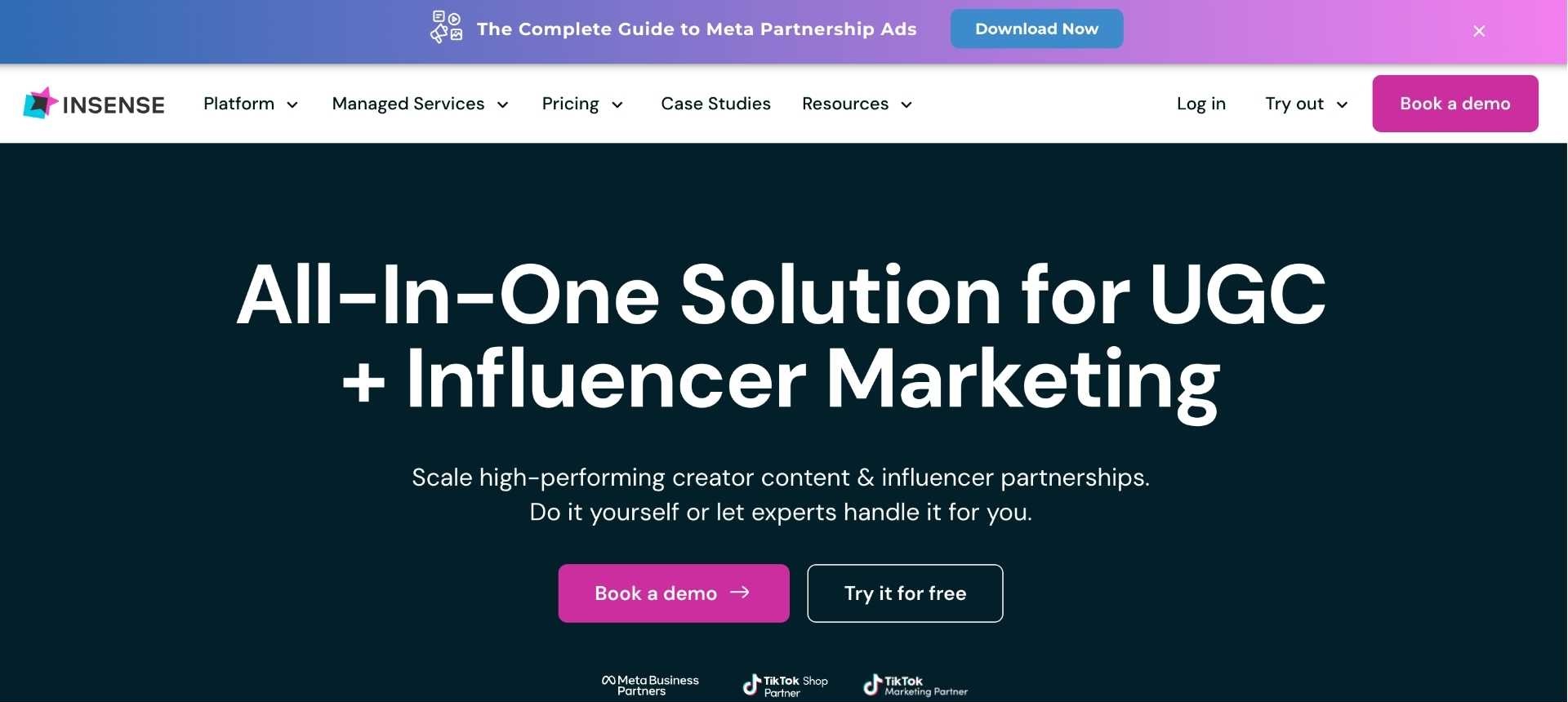
```Insense est une place de marché de créateurs et une plateforme de marketing d'influenceurs axée sur la production d'UGC et l'amplification des publicités sociales payantes. Elle est largement utilisée par les marques DTC et les agences pour sourcer des créateurs, produire du contenu et gérer des campagnes axées sur la performance sur des plateformes comme TikTok et Meta.
Fonctionnalités principales
- Place de marché de créateurs UGC
Accédez à un réseau curé de créateurs qui postulent aux campagnes, réduisant le besoin de prospection sortante. - Flux de travail de production de contenu
Gérez les briefs, les approbations, les révisions et la livraison finale du contenu directement au sein de la plateforme. - Intégration des publicités payantes
Exécutez le contenu généré par les créateurs sous forme de publicités payantes sur Meta et TikTok, bridgeant le marketing d'influenceurs et le marketing de performance. - Whitelisting et boosting
Permettez aux marques d'exécuter des publicités directement à partir des comptes de créateurs pour améliorer la performance et l'authenticité. - Suivi de la performance des campagnes
Mesurez l'engagement, la portée et la performance des publicités du contenu généré par les influenceurs. - Outils de collaboration des créateurs
Les messageries intégrées, les contrats et les flux de travail de paiement rationalisent les partenariats avec les créateurs.
Tarification
- Essai : à partir de 650 $/mois, avec la possibilité de passer à un plan trimestriel.
- Plan pour marques : à partir de 500 $/mois facturé trimestriellement ou 400 $/mois facturé annuellement.
- Plan agence : à partir de 800 $/mois facturé trimestriellement ou 640 $/mois facturé annuellement.
- Les plans en libre-service se renouvellent automatiquement tous les 3 mois sur la facturation trimestrielle, et les paiements aux créateurs sont budgétisés séparément selon un modèle de frais de place de marché.
Avis
4,5/5,0 (G2)
Avantages
- Accent fort sur l'UGC + les publicités sociales payantes — l'une des meilleures plateformes pour transformer le contenu des influenceurs en publicités.
- Demandes d'application des créateurs entrants — réduit le temps consacré à la prospection manuelle.
- Flux de travail de production de contenu transparents — idéal pour les marques produisant de gros volumes de créatifs.
Inconvénients
- Moins robuste pour la découverte d'influenceurs en dehors de la place de marché — limité en comparaison des outils basés sur les bases de données.
- Principalement axé sur les plateformes de contenu court — couverture moins étendue au-delà de TikTok et Meta.
- Les coûts peuvent augmenter avec le volume de campagnes — particulièrement pour les marques à haut rendement.
Intégrations
- Meta Ads Manager — exécutez et optimisez les publicités générées par les influenceurs directement.
- TikTok Ads — lancez et suivez les campagnes payantes en utilisant le contenu des créateurs.
- Shopify — connectez les campagnes aux catalogues de produits et au suivi de la performance.
- Google Analytics — mesurez le trafic et les conversions des campagnes.
- Slack — gérez les mises à jour des campagnes et la collaboration d'équipe.
Heepsy vs Insense
Heepsy est principalement un outil de découverte et de prospection, tandis qu'Insense est conçu pour la production d'UGC et l'exécution des publicités sociales payantes. Heepsy fonctionne mieux pour les marques cherchant à trouver des influenceurs et à gérer des campagnes, tandis qu'Insense excelle dans le sourcing de créateurs qui produisent des créatifs publicitaires à hautes performances. Si votre objectif est les relations avec les influenceurs et les campagnes organiques, Heepsy est le meilleur choix. Si votre but est de dimensionner la production de contenu et d'exécuter des publicités axées sur la performance, Insense offre une solution plus spécialisée.
8. Kolsquare

Kolsquare est une plateforme de marketing d'influenceurs basée en Europe qui se concentre sur la découverte d'influenceurs basée sur les données, la gestion des campagnes et l'analyse des performances. Elle est particulièrement populaire parmi les marques d'entreprise et les agences opérant sur plusieurs marchés internationaux.
Fonctionnalités principales
- Découverte avancée d'influenceurs avec couverture mondiale
Accédez à une large base de données d'influenceurs sur Instagram, TikTok, YouTube et plus encore avec des options de filtrage avancées. - Analyse de l'audience et de la crédibilité
Fournit des métriques détaillées sur les démographies d'audience, la qualité de l'engagement et la crédibilité des influenceurs. - Outils de gestion des campagnes
Gérer les collaborations avec les influenceurs, suivre les livrables et surveiller la progression des campagnes. - Suivi des performances et mesure du ROI
Analysez l'impact des campagnes avec des mesures telles que l'engagement, la portée et la valeur des médias gagnés (EMV). - Outils de sécurité des marques et de conformité
Aide à s'assurer que le contenu des influenceurs s'aligne avec les directives de la marque et évite les risques réputationnels. - Support des campagnes multi-marchés
Conçu pour les marques menant des campagnes dans différents pays et régions.
Tarification
- Discovery : à partir de 500 €/mois.
- Listening : tarification personnalisée.
- Enterprise : tarification personnalisée.
- La tarification de Kolsquare est décrite comme flexible et sur mesure, avec des tarifs spéciaux pour certains organismes à but non lucratif, B Corps et entreprises en phase de démarrage.
Avis
4,5/5,0 (G2)
Avantages
- Couverture internationale solide — idéale pour les marques menant des campagnes mondiales.
- Notation détaillée de l'audience et de la crédibilité — aide à améliorer la précision de la sélection des influenceurs.
- Analytics et reporting robustes — accent fort sur la mesure des performances.
Inconvénients
- Coût élevé pour les petites équipes — mieux adapté aux marques de taille moyenne et entreprises.
- Intégrations e-commerce limitées — pas aussi axé sur le D2C que certains concurrents.
- Onboarding complexe pour les nouveaux utilisateurs — en raison de la profondeur des fonctionnalités.
Intégrations
- Instagram — analysez et suivez les campagnes des influenceurs sur Instagram.
- TikTok — découvrez et gérez les influenceurs TikTok.
- YouTube — suivez la performance des campagnes vidéo.
- Google Analytics — mesurez le trafic et les conversions des campagnes.
- Exports CRM — intégrez les données des influenceurs dans vos systèmes internes.
Heepsy vs Kolsquare
Heepsy est plus accessible et abordable, ce qui le rend idéal pour les petites marques ou celles qui débutent avec le marketing d'influenceurs. Kolsquare, en revanche, est plus avancé et axé sur les entreprises, offrant des analytics plus profonds, une couverture internationale et des outils de conformité. Bien que Heepsy soit meilleur pour la découverte et la prospection rapides, Kolsquare est conçu pour les marques menant des campagnes à grande échelle et multi-marchés avec un accent plus fort sur les données et le reporting.
9. Skeepers
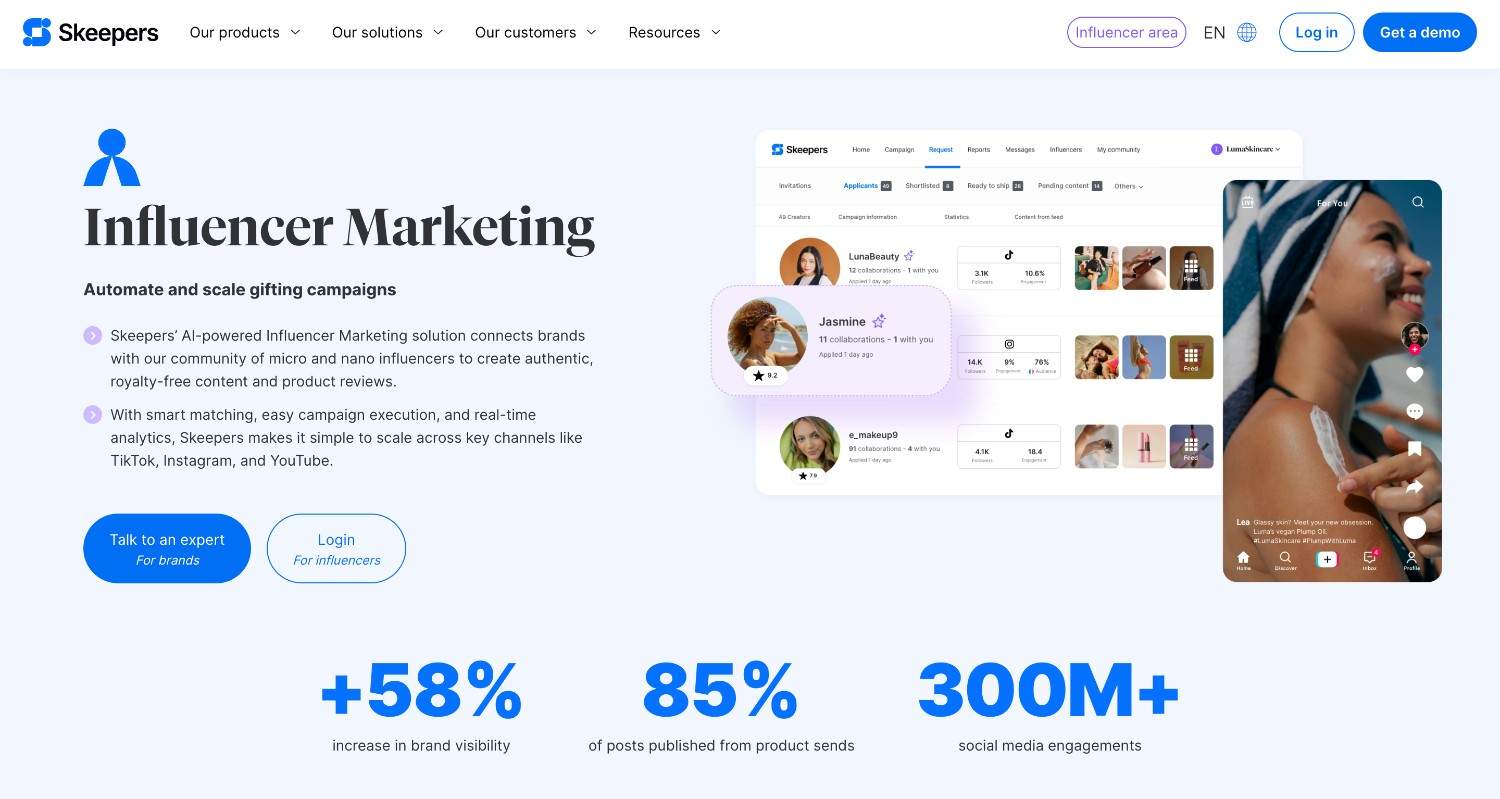
Skeepers est une plateforme unifiée qui combine le marketing d'influenceurs avec le contenu généré par les utilisateurs (UGC), les avis et les outils d'engagement client. Elle aide les marques à créer des preuves sociales et à stimuler les conversions par le contenu créateur et l'advocacy client.
Fonctionnalités clés
- Gestion des influenceurs et de l'UGC
Gérez les collaborations avec les influenceurs aux côtés du contenu généré par les clients et des avis. - Campagnes d'envoi de produits
Envoyez des produits aux créateurs et aux clients pour générer du contenu authentique et des avis. - Intégration des évaluations et avis
Combinez le contenu des influenceurs avec les avis clients vérifiés pour renforcer la crédibilité. - Syndication de contenu
Distribuez l'UGC sur les sites web, les publicités et les canaux de marketing. - Suivi des performances des campagnes
Mesurez l'engagement, les conversions et le ROI des campagnes d'influenceurs et d'UGC. - Programmes communautaires et ambassadeurs
Construisez des relations à long terme avec les créateurs et les défenseurs de la marque.
Tarification
- Skeepers ne liste pas publiquement une table de tarification détaillée pour le Marketing d'Influenceurs sur son site principal.
- Capterra liste un prix de départ de 1 250 €/mois et indique qu'aucun essai gratuit n'est disponible.
Avis
4,3/5,0 (Capterra)
Avantages
- Plateforme tout-en-un UGC + influenceurs + avis — combinaison unique par rapport aux outils purs influenceurs.
- Focus fort sur la preuve sociale et la conversion — intègre le contenu directement dans le parcours d'achat.
- Capacités d'envoi de produits — utile pour augmenter la génération de contenu.
Inconvénients
- Pas un outil pur de découverte d'influenceurs
- Base de données plus faible comparée aux concurrents — base de données moins complète.
- Plateforme complexe en raison de multiples modules — peut nécessiter du temps d'intégration.
- Tarification non transparente — nécessite une interaction avec l'équipe commerciale.
Intégrations
- Shopify — intégrez les avis et l'UGC directement dans les pages produits.
- Magento — connectez les avis clients et le contenu des influenceurs à vos boutiques e-commerce.
- Salesforce — intégrez les données clients et les campagnes.
- Google Analytics — suivez la performance des campagnes et les conversions.
- Plateformes CMS — distribuez l'UGC sur vos sites web et pages de destination.
Heepsy vs Skeepers
Heepsy est principalement axée sur la découverte d'influenceurs et la gestion de campagnes, tandis que Skeepers est une plateforme plus large qui combine le influencer marketing avec l'UGC et les avis clients. Heepsy convient mieux aux marques cherchant à trouver et gérer des influenceurs, tandis que Skeepers est idéale pour les marques souhaitant construire une preuve sociale et exploiter le contenu généré par les clients. Si votre objectif est la prospection d'influenceurs, Heepsy est le meilleur choix ; si votre objectif est d'intégrer le contenu des influenceurs dans le parcours client complet, Skeepers offre plus de valeur.
10. Creator.co
Creator.co est une plateforme de influencer marketing qui combine la découverte de créateurs, les campagnes de marketplace et les outils d'affiliation. Elle est particulièrement populaire auprès des marques DTC pour mener des campagnes de micro-influenceurs à grande échelle et des programmes d'envoi de produits.
Fonctionnalités clés
- Marketplace de créateurs
Les marques peuvent publier des campagnes et recevoir des candidatures de créateurs, réduisant ainsi les efforts de prospection. - Outils de découverte d'influenceurs
Recherchez et filtrez les créateurs en fonction de leur niche, audience et métriques d'engagement. - Flux de gestion de campagnes
Gérez les collaborations, suivez les livrables et contrôlez la progression des campagnes. - Affiliation et envoi de produits
Générez des codes de réduction, suivez les ventes et gérez les campagnes de gifting. - Création de contenu et collecte d'UGC
Collectez et réutilisez le contenu généré par les créateurs à des fins de marketing. - Suivi de la performance et reporting
Suivez l'engagement, les clics et les conversions des campagnes d'influenceurs.
Tarification
- Self-Serve : 299 $/mois, avec un engagement minimum de 3 mois.
- Managed : 2 199 $/mois, avec un engagement minimum de 3 mois.
- Enterprise : Tarification personnalisée, avec un engagement annuel.
- La page de tarification note également qu'après la période initiale, les abonnements mensuels passent à une facturation mois par mois, tandis que les plans annuels se renouvellent chaque année à un tarif réduit.
- Creator.co propose un essai gratuit pour Self-Serve.
Avis
4,6 / 5,0 (G2)
Avantages
- Modèle de marketplace robuste pour la mise à l'échelle des campagnes — excellent pour trouver rapidement plusieurs créateurs.
- Bon équilibre entre la découverte et les candidatures entrantes — approche de sourcing flexible.
- Bien adapté pour les campagnes de micro-influenceurs — particulièrement pour les marques DTC.
Inconvénients
- Analyses avancées limitées par rapport aux outils d'entreprise — moins de profondeur en matière de reporting.
- L'interface et le flux de travail peuvent sembler basiques pour les grandes équipes — non idéal pour les opérations complexes.
- La qualité des créateurs peut varier dans les campagnes de marketplace — nécessite une vérification.
Intégrations
- Shopify — gérez l'envoi de produits et suivez les ventes générées par les influenceurs.
- Stripe — gérez les paiements et les versements aux influenceurs.
- Google Analytics — mesurez le trafic et la performance des campagnes.
- Instagram — découvrez et gérez les campagnes d'influenceurs.
- TikTok — menez des campagnes d'influenceurs et suivez l'engagement.
Heepsy vs Creator.co
Heepsy est davantage axé sur la découverte et la prospection, tandis que Creator.co combine l'approvisionnement en marketplace avec la gestion des affiliés et des campagnes. Heepsy est meilleur pour les marques qui souhaitent trouver et évaluer de manière proactive les influenceurs, tandis que Creator.co est plus efficace pour mettre à l'échelle les campagnes par le biais de candidatures entrantes et de distribution de produits. Pour les campagnes plus petites et le ciblage précis, Heepsy est souvent plus efficace. Pour les campagnes de micro-influencer à grand volume, Creator.co offre une approche plus évolutive.
Réflexions finales
Heepsy reste une plateforme d'entrée de gamme solide pour la découverte d'influenceurs et la prospection, mais ses limitations en matière d'analyses avancées, d'automatisation et de scalabilité d'entreprise rendent les alternatives intéressantes à considérer. Les plateformes comme GRIN, Upfluence et Influencer Hero se distinguent par leurs intégrations profondes du commerce électronique et des affiliés, tandis que CreatorIQ et NeoReach répondent aux besoins des équipes d'entreprise nécessitant une gouvernance et une infrastructure de données. Pendant ce temps, des outils comme Insense, Creator.co et Skeepers se concentrent davantage sur l'UGC, l'approvisionnement en marketplace et la croissance axée sur le contenu. En fin de compte, le bon choix dépend de la question de savoir si une marque privilégie l'accessibilité et la simplicité, ou si elle a besoin d'une solution plus robuste et scalable avec des intégrations plus profondes et un suivi des performances.

.png)


.jpg)